0 IntroductionWith the continuous emergence of new services, users’ pursuit of service experience continues to improve, with higher clarity, more screens, and more viewing methods driving the development of emerging video technologies and the continuous growth of traffic. Operators expect to lead with video services, meeting basic communication needs for households through high traffic, high speed, and fully shared models. The network and technology for carrying Ultra HD (UHD) video, such as 4K, should not only meet current demands for high quality and easy maintenance but also support future service quality improvements, such as VR, which is also a critical requirement for supporting the digital transformation of telecom operators and future network reconstruction. The G.HN protocol, organized by the International Telecommunication Union (ITU), provides a high-speed wired carrier communication solution for access networks, with transmission media including various metal wires such as power lines, coaxial cables, and telephone lines. This article suggests requirements for the functional performance of G.HN and looks forward to its subsequent technological development.1 Video Services and Application Scenarios in Home NetworksWith the gradual popularization of 4K and the rise of 8K, various parties have strengthened their research on UHD video services. The parameter indicators, compression technologies, and bandwidth requirements for various typical resolution videos are shown in Table 1, and the scenarios for operational-grade UHD video services are shown in Table 2.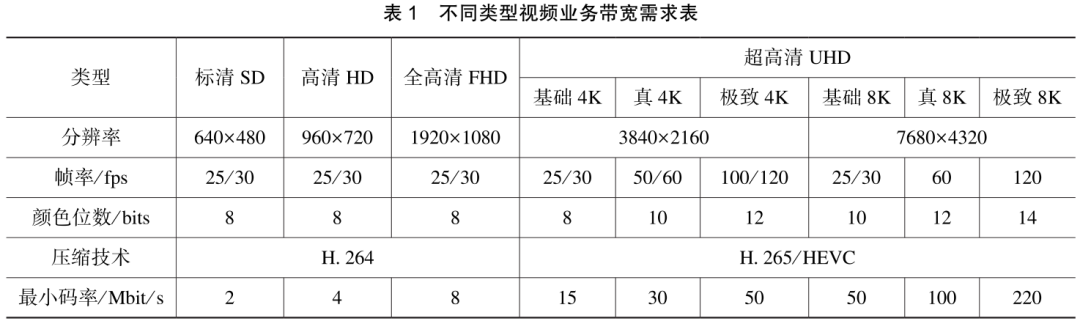
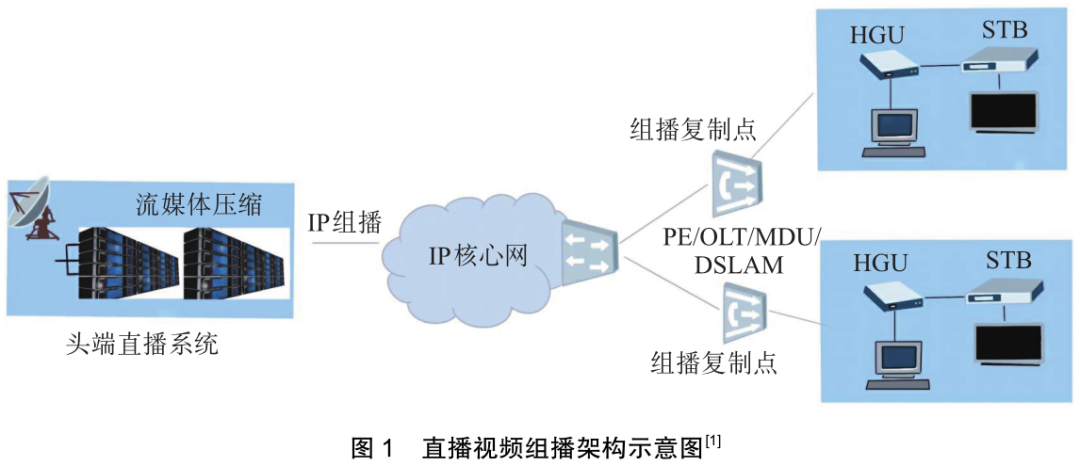
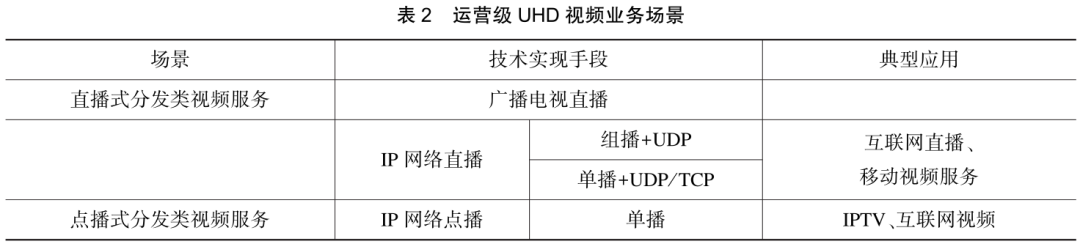 1.1 Live StreamingLive video is an important branch of the rapid development of internet video, where users watch related videos such as interviews, online training, and product sales online through the internet. During the live broadcast, if the user does not actively change the channel, they can only watch the pushed content within the selected channel and cannot switch freely.When using multicast to carry IP network live broadcasts, the network architecture is shown in Figure 1. The transmission network establishes a multicast tree through multicast routing protocols, and the head-end system uses the multicast tree to distribute the encoded and encapsulated streaming media to multicast replication points at the network edge; when a user device sends a request to watch a certain channel, it sends a multicast join message to the multicast replication point. Once the request is accepted, the multicast replication point will replicate the streaming media data to the user device.
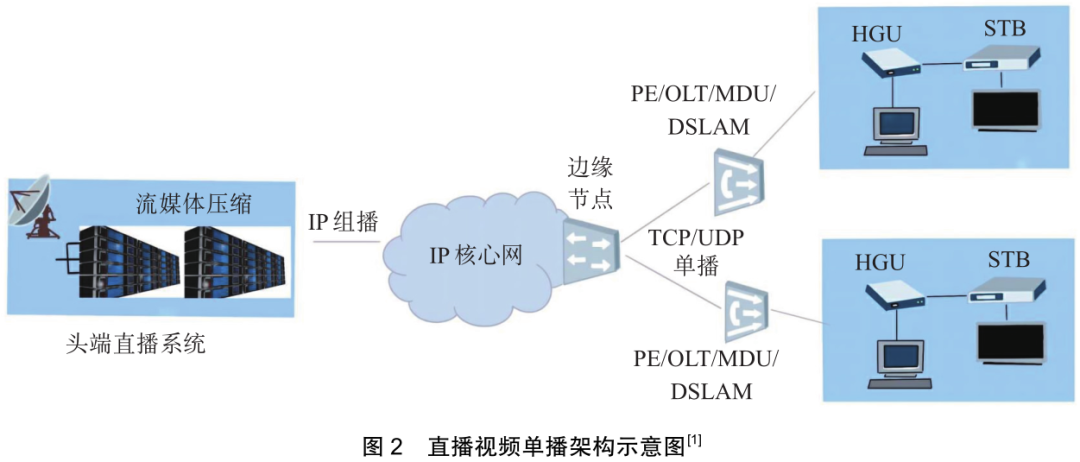
 Currently, most of the IP live broadcast networks built by operators use multicast + User Datagram Protocol (UDP) for transmission. Using multicast to transmit from the head-end system to the network edge nodes can save bandwidth resources in the metropolitan area network, while multicast or unicast can be used from the network edge nodes to user devices. The entire transmission network lacks interaction control at the service layer, so if errors or packet loss occur during transmission, retransmission will not be triggered, making it difficult to ensure user viewing experience during network congestion.As shown in Figure 2, unicast mode mainly exists in data transmission from the operator’s central node to regional or edge nodes, as well as from edge nodes to user devices, while the live data stream from content providers to the operator’s central node mostly still uses multicast.
 Currently popular internet live streaming is an application of IP network live streaming, where users initiate live video viewing requests to the public internet through internet TV integrated machines, set-top boxes + TVs, or mobile terminals, and the public internet provides video transmission services to users.The data stream transmission of internet video mainly has two methods: HTTP Progressive Download (HPD) and HTTP Adaptive Streaming (HAS). When users play videos using terminals based on HPD technology, the playback terminal first downloads and buffers the initial data of the media file, and then can play while downloading. HPD technology has many limitations, such as long initial playback waiting time; playback stuttering when network bandwidth is unstable; and if users abandon watching midway, the continuous downloading of files during playback occupies bandwidth resources, leading to waste of already downloaded files. HAS technology overcomes some limitations of HPD to a certain extent by using video segmentation and Adaptive Bit Rate (ABR) technology. When the screen size of the playback terminal varies, HAS can provide video files that adapt to different screen resolutions and can play videos smoothly under different network transmission qualities.1.2 Video on DemandFor ordinary household users’ entertainment video services, commonly referred to as audiovisual on-demand services, these are provided by content providers and service providers to multiple ordinary users for watching video programs or browsing text, graphics, images, and audio. Users can choose to watch or view from the provided programs or content. On-demand is an asymmetric interactive multimedia communication between users and machines (audiovisual resources), providing audiovisual information to users at any time through telecommunications networks. Users can find the required information with the assistance of a navigation subsystem. After users select and confirm the service mode, the audiovisual on-demand service platform sends content information with certain QoS guarantee levels. Users can use functions similar to VCR to view the received information.As shown in Figure 3, the location of users initiating on-demand services can be fixed, such as at home or in the office, or mobile, such as on a train. The playback terminals used include PCs, set-top boxes + TVs, mobile phones, PDAs, or other devices. Users can choose the corresponding video to watch based on their needs, rather than passively receiving a specific broadcast video, where the on-demand videos include IPTV content provided by operators or video content provided by content providers.
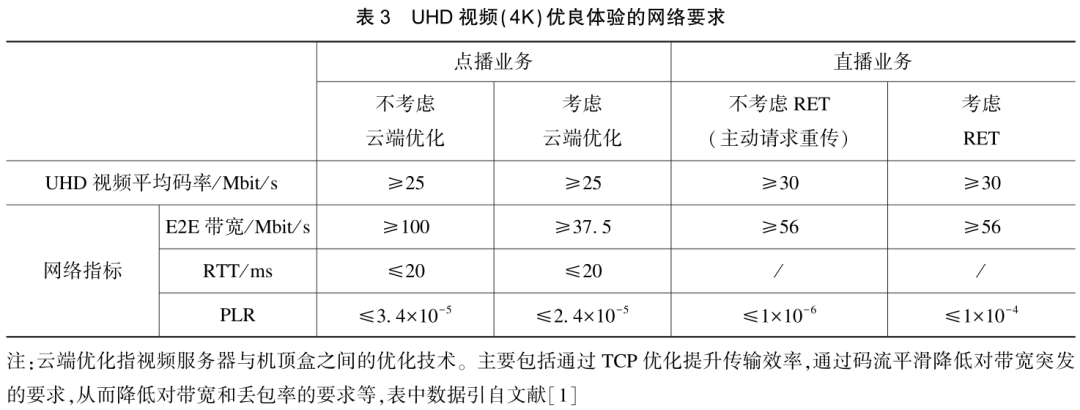
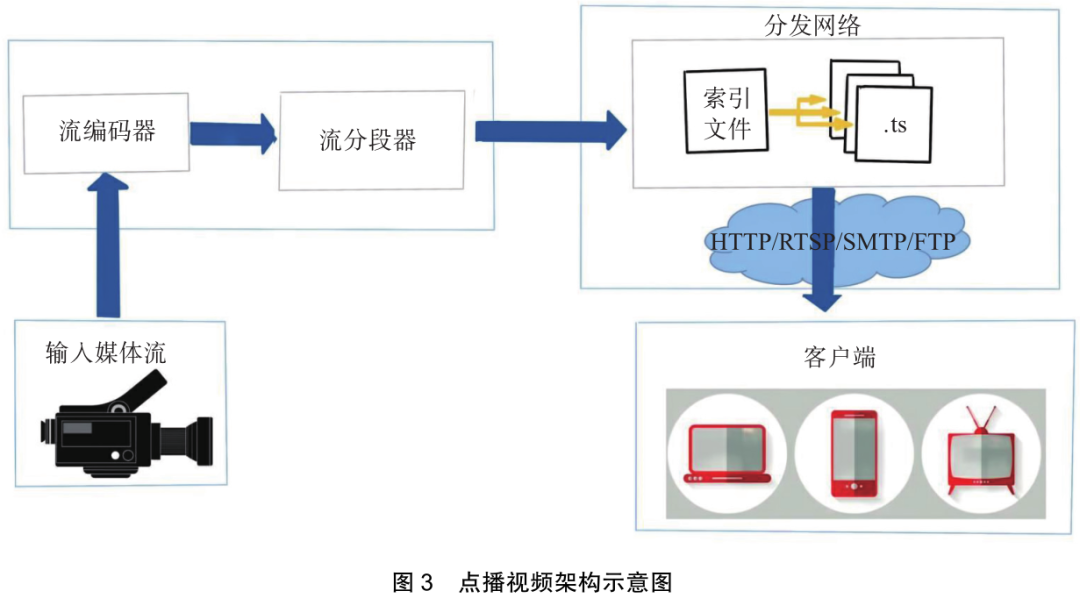 The on-demand system generally adopts unicast mode, and its network structure includes video front-end processing systems, servers, storage subsystems, distribution networks, and playback clients. The detailed implementation process of on-demand is as follows: the user initiates an on-demand request using the playback client, and after the request reaches the server and is verified, the server retrieves the program information from the source library in the storage subsystem. Users select the corresponding program based on their preferences, and the program business stream is transmitted to the playback terminal in the form of video and audio stream files through the distribution network for playback.2 Network Capability Requirements Supporting VideoUHD video services impose high bandwidth, low latency, low error rate, and low packet loss requirements on the carrying network. As the proportion of video service traffic increases, traditional carrying networks face more challenges.(1) Challenges to network architecture. The traditional telecom network model has multi-layer and high convergence characteristics, and it is necessary to simplify the telecom network model and consider how to match the low convergence characteristics of video traffic in home networks. (2) Challenges to bandwidth. Operators promise access bandwidth to fixed broadband users, and home networks need to clarify whether the access bandwidth of various physical media can meet the bandwidth requirements of UHD video.(3) Challenges to latency. This latency refers to the round-trip latency between the client and the server where the video segment files are located, which applies to both fixed broadband internet users and mobile internet users. From the end-to-end (E2E) link perspective, congestion often occurs at the metropolitan backbone and control layers, leading to increased latency and jitter. In home networks, it is necessary to clarify the latency requirements for network physical media.(4) Challenges to packet loss rate. This packet loss rate refers to the round-trip packet loss rate of the link between the client and the server where the video segment files are located, which applies to both fixed broadband internet users and mobile internet users. From the E2E link perspective, there is also a risk of burst packet loss at the metropolitan core and aggregation nodes, and the packet loss rate for home WLAN access needs to be studied. Devices such as gateways and set-top boxes have small caches, which may easily lead to burst packet loss. Additionally, attention must be paid to operational and cost challenges. If traditional expansion methods are used to adapt to the exponential increase in video service traffic, the costs will be high. Video service experience is sensitive and requires real-time performance, so the carrying network must be able to quickly sense user experience and rapidly address faults.Refer to Table 3 for suggested KPI values for the carrying network.
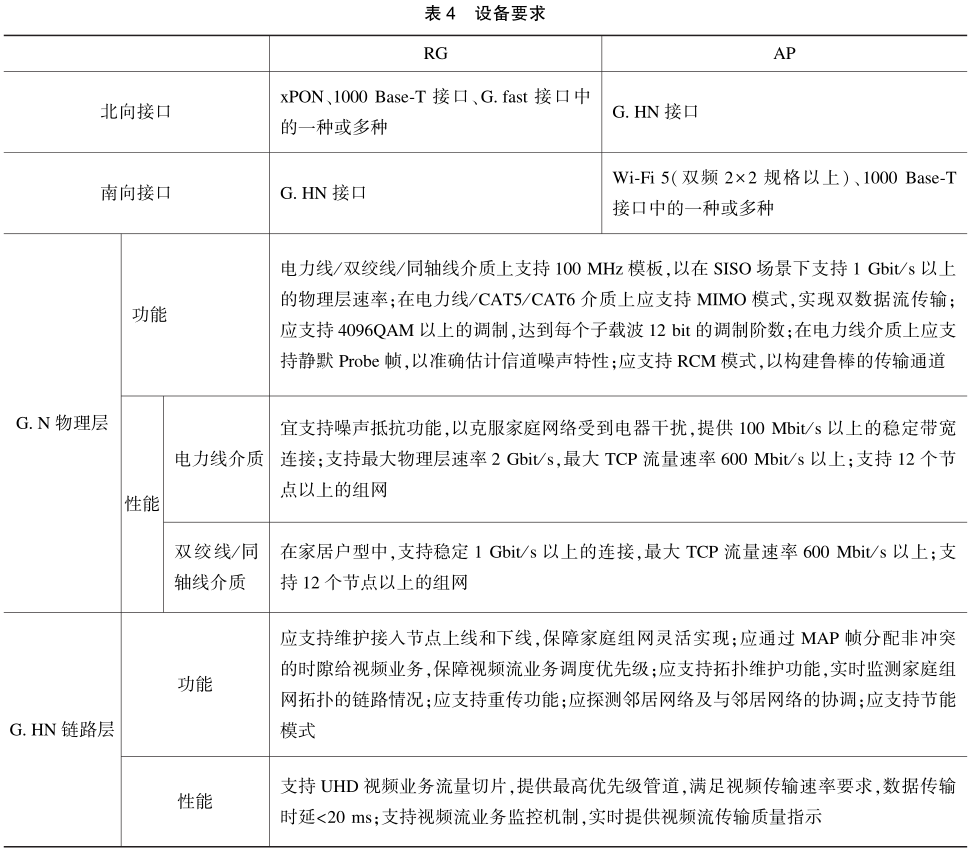
 Operators expect home networks to ensure effective coverage of high-speed networks to support UHD video services through a combination of wired (coaxial, telephone lines, power lines, etc.) and wireless methods. Additionally, the following requirements must be met: first, support seamless sharing of UHD video live and on-demand service content among different terminals in the home network, such as TVs and mobile phones; second, ensure secure transmission of UHD video content within the home network; third, the home networking must have QoS self-check, self-analysis, and transmission adaptability capabilities, able to automatically and timely detect high-speed transmission issues in the home network and possess certain adaptive capabilities. These requirements pose various research demands for home networks.3 Deployment and Business Requirements for High-Definition Video in Home NetworksBased on wired home network transceivers, they can operate on indoor wiring including telephone lines, coaxial cables, and power lines. With the decreasing costs of Ethernet cables and optical fibers, deployment is becoming increasingly common. The transmission technologies based on these media are also continuously developing, and the technologies related to UHD services are also evolving, requiring analysis of whether various home network media meet the requirements for carrying UHD, as well as analysis of E2E carrying network architecture, bandwidth, packet loss rate, and latency, with expandable research on reliability and operational requirements.Traditional broadband networks mainly serve broadband internet access services (HSI), characterized by large bandwidth, low concurrency, and low perception, with low latency requirements. Therefore, traditional packet telecom networks carrying HSI services have high convergence ratios, multi-level aggregation, and best-effort characteristics. Video traffic has high concurrency and low convergence characteristics, and only networks with high throughput, flat architecture, and easy maintenance can provide the best user experience. High throughput requires large bandwidth, low latency, and zero packet loss. Flat architecture means simplifying network layers; easy maintenance means visual experience, quick boundary definition, and precise location. Experience-driven UHD video requires high-quality network support, which imposes clear requirements on physical bandwidth, end-to-end latency, and packet loss rate.The bit rate for 4K video in UHD ranges from 15 to 100 Mbit/s, depending on quality. This has a significant impact on home network technology and imposes additional requirements on the RG itself. A key consideration is how many synchronized streams will be needed and where these streams will terminate in the home. For a single stream on a fixed device in the same room as the RG, there may be no problem, as a short Ethernet cable can connect the STB/TV, provided the RG can offer (backup) gigabit Ethernet ports. However, when multiple UHD-supporting devices need to be supported, and/or the RG and terminal devices are not in the same room, issues may arise.So far, wireless is the most common home network technology and the default network connection for all terminal devices. The wireless coverage and performance in a given home depend mainly on the location of endpoints (e.g., RG). The quality and design of the RG and terminals also affect the actual performance of WLAN. One or more additional access points can be used to extend coverage, but each access point requires some type of wired or wireless backbone connection to the main AP in the RG. Higher-speed WLAN will require one AP per room and a very high-capacity wired backbone, such as G.HN. However, G.HN faces some challenges, such as interference between power line systems and high-speed access technologies (especially G.fast and VDSL2) because they use some of the same frequencies. The highest quality HD television requires not only the capacity needed for other non-TV applications (20 Mbit/s+) but also the ability to provide over 100 Mbit/s (in the worst case) for home distribution. Initially, there may only be one high-quality HD television, but other lower-quality streams will raise this to 200 Mbit/s +.4 Device, Function, and Performance Requirements Recommendations for G.HN Supporting High-Definition VideoIn traditional access network architecture, the RG connects to the access network in the north, returning data through pipelines based on PON, DSL, and other protocols, while providing necessary networking interfaces in the south. If a home networking backbone is formed using interfaces that support the G.HN protocol, carrying home network data, AP devices generally connect terminal devices through southbound interfaces such as WLAN. To support the business needs of UHD protocols, considering the deployment scenarios of high-definition video in actual homes, the following functional requirements must be met in home network networking: RG devices must have central control functions for home network networking, responsible for maintaining the home network topology, device registration, and other basic functions; RG devices should support at least one AP device, with a recommendation to support two or more; home networking should support G.HN’s MESH networking function. Additionally, necessary device requirements for home networking devices should be proposed, as detailed in Table 4.
 5 ConclusionThis article explores the technical requirements for G.HN to carry high-definition video services from the perspective of application scenarios and high-definition video services. More technical details require further research. Among them, in enriching other business applications (such as gaming, VR, IoT) and deployment scenarios in different regions (such as China and overseas), it is necessary to consider supporting home broadband business type identification mechanisms (based on video server addresses, network slicing, additional fields, etc.), configuring different forwarding strategies based on services within the home network, and enabling the home network to adapt to service slicing from topology/link/multi-media perspectives. Relevant interfaces and standards still need to be discussed; in low-latency or latency-sensitive business areas, further exploration from standards is needed to improve adaptation mechanisms and feasibility analysis. For example, opening dedicated channels for time-sensitive services, binding services to dedicated channels through flow control, and ensuring the stability of dedicated channel services and minimizing latency jitter. It may also be considered to use full-duplex mechanisms instead of half-duplex mechanisms to reduce waiting latency in multi-level relay systems; in home network scenarios, with the coexistence of multiple media such as wireless/Cable/power line/fiber, in-depth research and integration of protocol layers for topology discovery/Mesh networking within the home network are needed to provide a better service experience; in home network scenarios, suppressing and avoiding electromagnetic interference generated by home devices, such as avoiding electromagnetic interference through time division, frequency division, or space division scheduling on MAC, and noise cancellation on PHY to provide a better service experience.G.HN has unique advantages in existing network applications, as this technology integrates resources and data transmission over existing twisted pairs, coaxial cables, and power lines (power line), significantly reducing installation and operational costs by utilizing existing common cables without the need for new transmission lines. This fundamentally overcomes the greatest obstacle to large-scale commercial applications, promoting the continuous evolution of G.HN technology in access network scenarios.References[1] Jia Wu, Shao Yan, Li Jie, et al. User Experience Evaluation Technology for Distribution Video Services[J]. Postal and Telecommunications Design Technology, 2017(7):65-69.[2] Zhang Lujing. Research and Design of MAC Mechanism for 10G Coaxial Broadband Access System[D]. Xi’an: Xi’an University of Electronic Science and Technology, 2019.[3] ITU-T. Unified high-speed wireline-based home networking transceivers-system architecture and physical layer specification:G.9960[R], 2018.[4] ITU-T. Unified high-speed wireline-based home networking transceivers-data link layer specification:G.9961[R], 2018.[5] ITU-T. Unified high-speed wireline-based home networking transceivers-multiple input/multiple output specification:G.9963[R], 2018.
Author Information
Gou Shuzhi
Engineer at the Institute of Technology and Standards, China Academy of Information and Communications Technology, mainly engaged in research and testing related to access networks.
Shi Hang
Engineer at the Institute of Technology and Standards, China Academy of Information and Communications Technology, mainly engaged in research and testing related to access networks.
Cao Xiaobo
Engineer at the Institute of Technology and Standards, China Academy of Information and Communications Technology, mainly engaged in research and testing related to access networks.
Zhuo Ansheng
Engineer at the Institute of Technology and Standards, China Academy of Information and Communications Technology, mainly engaged in research and testing related to access networks.
Citation Format:
Gou Shuzhi, Shi Hang, Cao Xiaobo, et al. Research on G.HN-Based Home Networking Technology Supporting Ultra High Definition Services[J]. Information Communication Technology and Policy, 2022,48(4):85-91.
This article was published in “Information Communication Technology and Policy”2022, Issue 4
Organized by: China Academy of Information and Communications Technology
“Information Communication Technology and Policy” is a professional academic journal supervised by the Ministry of Industry and Information Technology and organized by the China Academy of Information and Communications Technology. This journal is positioned as a “barometer of the forefront of information communication technology, a think tank for exploring information society policies“, focusing on technological trends, public policies, national/industry/enterprise strategies in the information communication field, publishing cutting-edge research results, analysis of focal issues, interpretation of hot policies, etc., promoting innovation and development in technologies and industries such as 5G, industrial internet, digital economy, artificial intelligence, blockchain, big data, cloud computing, guiding national technology strategy choices and industrial policy formulation, and building a high-end academic exchange platform for industry, academia, research, and application.


 “Information Communication Technology and Policy” Submission Guidelines!To further improve the level of journal information construction and provide better services for scholars, our journal’s official website has officially launched, and submissions are welcome!


Proofread by | Chen Li, Shan Shan
Edited by | Ling Xiao