Renesas MCU Testing RISC-V DemandThe R9A02G021 belongs to a self-made general-purpose CPU design.The RISC-V CPU architecture has garnered significant attention, but the shipment volume as a primary CPU remains unclear. Renesas Electronics is testing the demand for RISC-V-based embedded microcontrollers (MCUs) through the R9A02G021 (G021), opening a new product line alongside its own models based on Arm architecture and proprietary architecture.The G021 is a simple general-purpose 32-bit processor designed internally by Renesas Electronics, featuring a single-core CPU. It has a clock frequency of only 48MHz and is built using a 110nm process, aimed at reducing costs. Application examples include sensors, remote controls, and trackers. The company states that other models are in the pipeline, but they will observe the response to the first model before following up with more models.Renesas Electronics already has two main MCU series: MCUs based on its proprietary CPU architecture and the latest products using Arm CPUs. If successful, RISC-V will form a third product family. It will not replace the older product lines, as the company has customers using established code on both products and does not want to force them to port to the new architecture.The company is also integrating RISC-V cores into microprocessors and dedicated chips, but these CPUs are sourced from Andes Technology. The new MCU is the first to adopt a self-developed RISC-V design. The G021 is now available, priced above $2.00 per unit, with prices dropping by about half in mass production.Customers expect RISC-V to be inexpensive.It is well known that RISC-V is an open-source architecture, contrasting sharply with the ubiquitous Arm architecture. According to Renesas Electronics, some customers expect RISC-V-based processors to be cheaper because they believe CPUs are essentially free.Considering these expectations, the company believes customers will not accept RISC-V pricing equivalent to Arm, which puts downward pricing pressure on RISC-V MCUs. Offering MCUs with RISC-V CPUs licensed from suppliers like Andes will create profit pressure, as Renesas must pay royalties from the prices it receives. Renesas’s MPUs and two specific application standard products (one for motor control and one for voice control) currently use Andes CPUs and are under this pressure.The mismatch between customer expectations and the economic reality of MCUs has prompted Renesas Electronics to develop its private design. This is not free, but the work may be spread across several new product lines, which can be offered without requiring the company to pay royalties.When customers resist new technologies like RISC-V, it does not always mean that eliminating the main objections will lead to purchases. The outcome is often that, after the first objection, more objections await. RISC-V may be such a case, which is why, despite Renesas Electronics addressing pricing and profit issues through its design, adoption by users cannot be guaranteed. For this reason, the company is currently cautiously entering this market with a single simple model.Simple 32-bit MCUThe G021 integrates a RISC-V core that implements the 32-bit integer (32I) configuration profile, adding multiplication, atomic, compressed code, and bit manipulation extensions (extensions M, A, C, and B), as well as control status and instruction fence extensions (Ziscr, Zifencei). It is a single-issue in-order CPU with a two-stage pipeline and dynamic branch prediction. The core’s local interrupt controller (CLIC) provides 32 interrupts and 16 priorities, supporting non-maskable interrupts. Renesas plans to offer more features in subsequent designs, including register file saving and restoring for fast context switching, Zce extension group (Zca, Zcb, Zcmp, and Zcmt), and a tracing module for tracking program flow.The MCU integrates 128KB of code flash and 4KB of data flash. A total of 16KB of SRAM is available; 12KB has parity, while the remaining 4KB has ECC, as shown in Figure 1.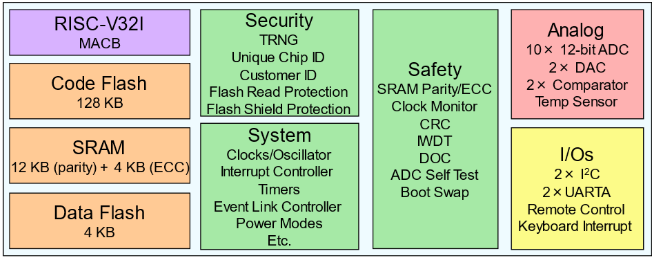 Figure 1 Renesas Electronics’ R9A02G021 Architecture(ECC = Error Correction Code; TRNG = True Random Number Generator; CRC = Cyclic Redundancy Check; IWDT = Independent Watchdog Timer; DOC = Data Operation Circuit; ADC = Analog-to-Digital Converter; DAC = Digital-to-Analog Converter. The processor includes nominal security and safety features, as well as a small amount of analog functionality and I/O.)For security, the processor includes a true random number generator, although it lacks an encryption engine or key management hardware. It features a unique chip identifier and space for customers to place their own ID. The flash memory benefits from two protection schemes: read protection and mask protection. Flash read protection allocates a read-only area of flash memory, typically used to store code, and this strategy prevents overwriting that code. Flash mask protection establishes valid erase and rewrite areas of flash through self-programming. Attempts to rewrite flash outside of the mask window will fail. However, this feature does not affect external programming through the programming interface.Few 48MHz 32-bit MCUsThe G021 will face competition from multiple directions, but limiting candidates to products with a maximum clock speed of 48MHz can eliminate much of the competition. One of its more prominent competitors will come from Renesas Electronics’ own Arm-based CPUs: the RA4M1 series (see MPR report November 2019, “Renesas Electronics’ RA MCU Strengthens Security”). Silicon Labs also produces an older Tiny Gecko model that runs at that speed, as shown in Table 1. There are currently no mainstream MCUs based on RISC-V with similar configurations available.Table 1 Competition for Renesas R9A02G021(Renesas competes with its own Arm-exclusive MCUs, such as the RA4M1 series. Silicon Labs manufactures an MCU with similar resources that consumes less than half of what G021 does. (Source: Suppliers, except where noted from Mouser))
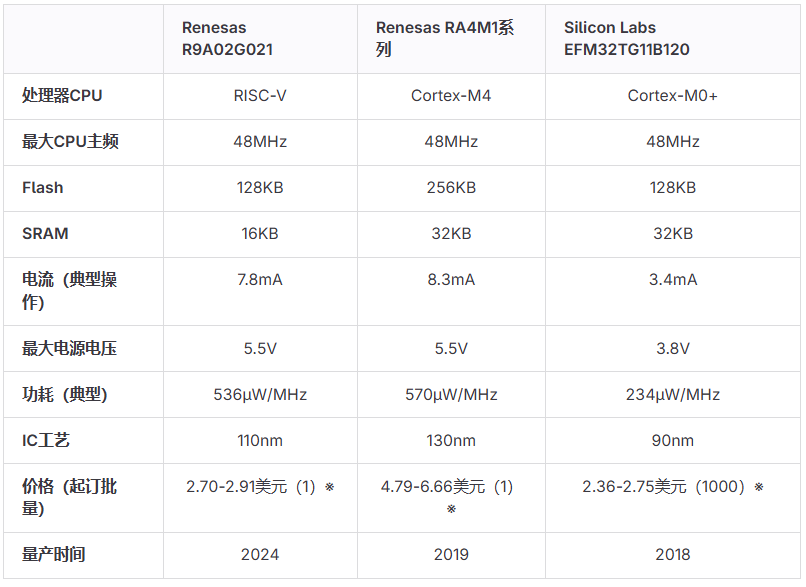 The G021 has the least resources among the three compared but is also the lowest priced. The storage is half that of the company’s Arm-based counterparts, and the SRAM size is half that of the Tiny Gecko chip. The G021’s power consumption is lower than its RA4M1 counterpart, but its power consumption is more than twice that of Silicon Labs’ Tiny Gecko devices.Testing RISC-V DemandDespite all the hype around RISC-V, signs of fragility are appearing, such as layoffs at RISC-V CPU IP supplier SiFive. There are various reasons for this: Arm’s dominance in software and ecosystems, legacy code issues, distrust of IP startups, and/or pricing. Renesas Electronics is testing this, theorizing that price should be the primary consideration for chips containing “free” CPUs. But testing the market involves a classic decision: make or buy?Renesas Electronics has found that buying (i.e., licensing processor cores from IP providers like Andes or SiFive) has financial implications that are not attractive. Therefore, the company decided to produce MCUs based on its self-designed RISC-V core starting with the R9A02G021.Designing a CPU from scratch is a daunting task, and it is surprising that a company would invest so much money to test the market. One possible explanation is that the company’s current MCUs are under price pressure, with customers threatening to switch to cheaper RISC-V versions for a better deal. In this case, Renesas may respond not only to open up business opportunities but also to provide price support for its older product lines. If a company complains too much about the pricing of RA models, Renesas now has an answer to offer customers a lower price point without undermining RA pricing.It is important to clarify that this MCU product is not inferior to any other products produced by the company; the outcome is just less certain. If Renesas Electronics sees the first RISC-V MCU succeed, it is prepared to invest in more RISC-V MCUs. The first model is a small, low-cost unit with fewer resources than competitors. However, if there is sufficient design demand for the resources it possesses, then the pricing will be very attractive.Renesas Electronics is one of the few companies capable of making such bets. If it loses the bet, it still has two popular lines to rely on (prices may be more stable). If it wins, it will be in a favorable position to push more RISC-V processors to market.Pricing and Availability (or More Information):The Renesas R9A02G021 MCU is now available, priced between $2.70 and $2.92 per unit (depending on package type), with prices dropping by about half for larger quantities. For more information, visit the company’s website at https://www.renesas.com/us/en/products/microcontrollers-microprocessors/risc-v/r9a02g021-ultra-low-power-48mhz-mcu-renesas-risc-v-cpu-core.