
1
1
1
Recently, Renesas Electronics launched its latest RA product, the RA4L1. What features does it have, and what application scenarios is it suitable for? This article provides a detailed introduction.
Basic information is as follows:
-
Core: Arm® Cortex®-M33, clock frequency 80MHz.
-
Code Flash: 256KB/512KB optional, minimum erase unit is 2KB, minimum write unit is 8Bytes.
-
Data Flash: 8KB, minimum erase unit is 256Bytes, minimum write unit is 1Byte.
-
Rich digital communication interfaces such as UART, SPI, IIC/I3C, Smart Card, Simple LIN, USB Full-Speed, CANFD, SSIE (Serial Sound Interface Enhanced), and segment LCD controller (supports 8-bit 48 segments).
-
Rich analog resources: 12-bit ADC, 12-bit DAC, two low-power analog comparators, and temperature sensor.
-
Rich PWM timers.
-
Low power characteristics.
-
Security and encryption-related features.
It is particularly worth mentioning that the low power characteristics of RA4L1 include the following aspects:
-
Supports wide voltage operation (1.6V~3.6V).
-
Short wake-up time, as fast as 3.5 µs (when MOCO is used as the system clock source).
-
Supports low power serial port UARTA (Low Power UART), which differs from the general SCI interface (clock source is PCLKA). The clock source for UARTA can be selected from UARTAMCLK (main clock input), UARTALCLK (low-speed on-chip oscillator), UARTASCLK (sub-clock input), UARTAHCLK (high-speed on-chip oscillator), and UARTAMOCLK (medium-speed on-chip oscillator).
-
After waking up from low power, the system does not need to return to the reset vector, avoiding the impact of inrush current on the system.
In addition, RA4L1 is equipped with Renesas security IP (RSIP-E11A), which supports rich encryption and decryption functions through hardware, such as symmetric algorithms like AES (supports both 128-bit and 256-bit key lengths) and asymmetric algorithms like ECC (supports a maximum key length of 256 bits, supporting NIST P-256, Brainpool P256r1, and secp256k1 curves). Additionally, combined with a unique key management mechanism, RA4L1 can protect customers’ key IP and algorithms.
1
2
1
The support for development tools can be summarized in the following image:
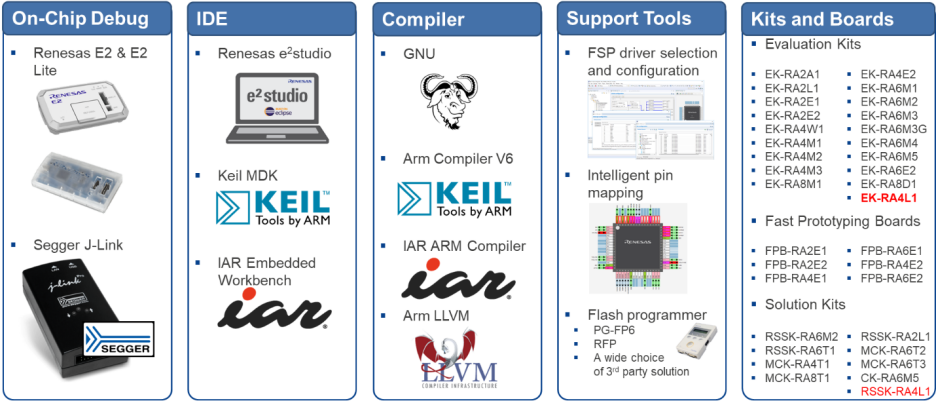
Figure: RA4L1 Development Tools and Development Board
Like other RA products, the RA4L1 supports debuggers including Renesas Electronics’ E2/E2 Lite/EZ-CUBE3, Segger’s J-Link, IAR’s I-jet, Arm’s ULINK, and open-source CMSIS-DAP.
Software development relies on FSP (Flexible Software Package), which not only provides HAL Driver level drivers but also includes rich middleware such as file systems, USB protocol stacks, and network protocols. Additionally, the configuration of FreeRTOS and Azure RTOS can be completed through the FSP UI interface. FSP has supported RA4L1 since version 5.8.0, and all content is hosted on GitHub for self-download. (You can copy the link below into your browser or scan the QR code to view)
FSP
https://github.com/renesas/fsp/releases/

The compiler supports commercial Arm Compiler V6 and IAR Arm Compiler, as well as free versions of GNU and Arm LLVM. For version requirements of the compiler, please refer to the details in the Tools list on the link below. (You can copy the link below into your browser or scan the QR code to view)
Compiler Version Requirements
https://github.com/renesas/fsp/releases/
FSP can be embedded into Renesas Electronics’ IDE e2 studio based on the eclipse platform. For third-party IDEs like Keil MDK and IAR Embedded Workbench for Arm, FSP needs to run as a standalone plugin with RASC (RA Smart Configurator). More details can be found in the RASC documentation (You can copy the link below into your browser or scan the QR code to view). Support for debugging RA devices in VS Code is continuously improving, so stay tuned.
RASC MDK IAR User Guide
https://renesas.github.io/fsp/_s_t_a_r_t__d_e_v.html#RASC-MDK-IAR-user-guide

Download links for each tool can be found in the table below:
| _ |
Name |
Version/Download Link |
|
IDE |
e2 studio |
https://www.renesas.cn/zh /software-tool/e-studio#downloads |
|
Keil MDK |
https://www.keil.com/update/rvmdk.asp |
|
|
IAR Embedded Workbench for Arm |
https://www.iar.com/products/architectures /arm/iar-embedded-workbench-for-arm/iar-embedded-workbench-for-arm-free-trial-version/ |
|
|
Toolchain |
LLVM |
https://github.com/ARM-software /LLVM-embedded-toolchain- for-Arm/releases |
|
GCC |
https://developer.arm.com/downloads /-/arm-gnu-toolchain-downloads |
|
|
ICE |
E2 & E2 Lite |
https://www.renesas.com/en/software -tool/e2-emulator-rte0t00020kce00000r https://www.renesas.com/en/software -tool/e2-emulator-lite-rte0t0002lkce00000r |
|
J-Link |
https://www.segger.com/products /debug-probes/j-link/ |
|
|
I-jet |
https://www.iar.com/products/ architectures/arm/i-jet |
|
|
Code Generator |
RASC (RA Smart Configurator) |
Documentation: https://renesas.github.io/fsp /_s_t_a_r_t__d_e_v.htm l#RASC-MDK-IAR-user-guide |
|
FSP |
https://github.com/renesas /fsp/releases/ |
For example codes and development boards, please refer to the links in the table below:
|
Name |
Brief Description |
Download Link |
|
RA Product Examples |
Includes most examples of the RA series productsNote |
https://github.com /renesas/ra-fsp-examples |
|
Development Board |
EK board of RA series |
https://www.renesas.com/en /products/microcontrollers-microprocessors/ra-cortex-m-mcus/ra-kits |
Note: Examples for RA4L1 will be updated after the official release of RA4L1
1
3
1
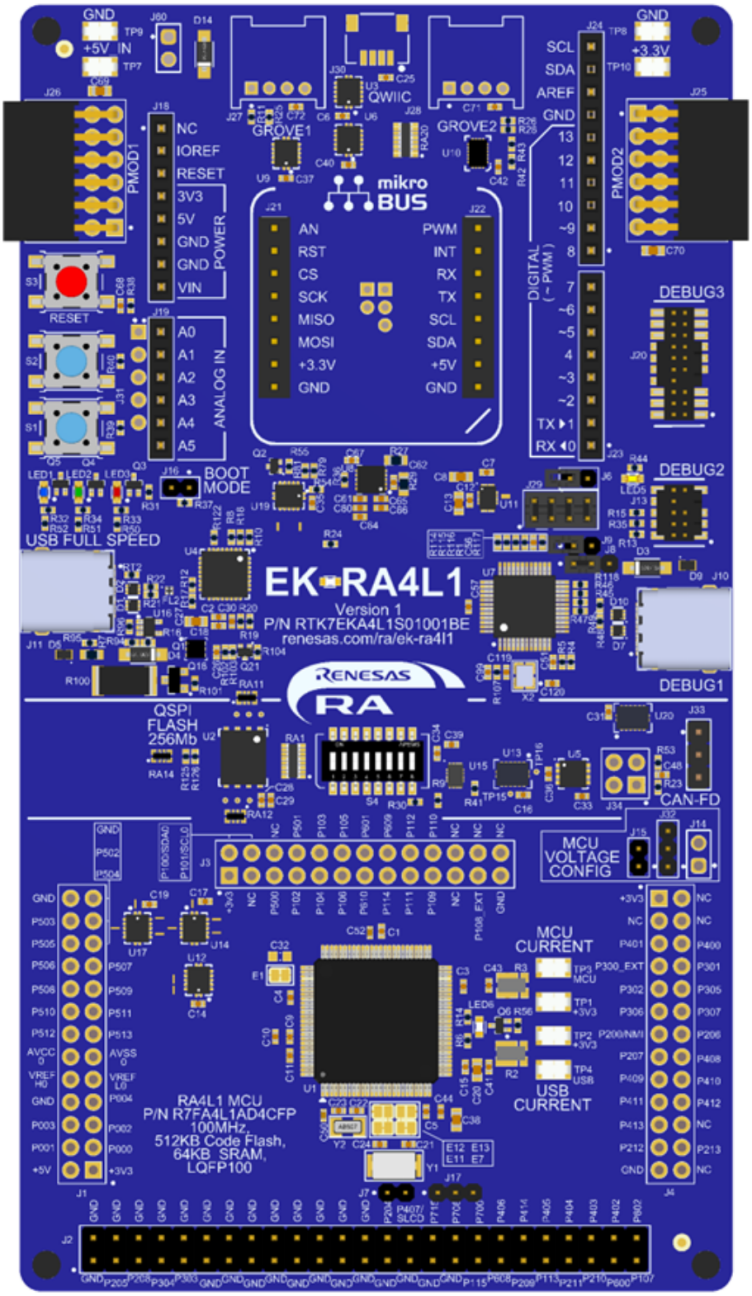
Figure: EK-RA4L1 Top View
EK-RA4L1 continues the consistent style of the RA series EK, arranging the MCU chip body, special functions, and system control in sequence.
Mainly introducing the following parts:
MCU
Centered at the bottom of the board is the MCU RA4L1. The EK-RA4L1 uses a 100-pin R7FA4L1BD3CFP, with a Code Flash size of 512 KB and a Data Flash size of 8KB.
All I/O are connected to three dual-row pin headers (2.54mm pitch), facilitating functional verification.
The bottom J2 is a segment LCD interface, and the included RTKLCDSEG1S00001BE (8 COM 44 SEG) can be directly plugged onto the board. The effect after connection is as follows:
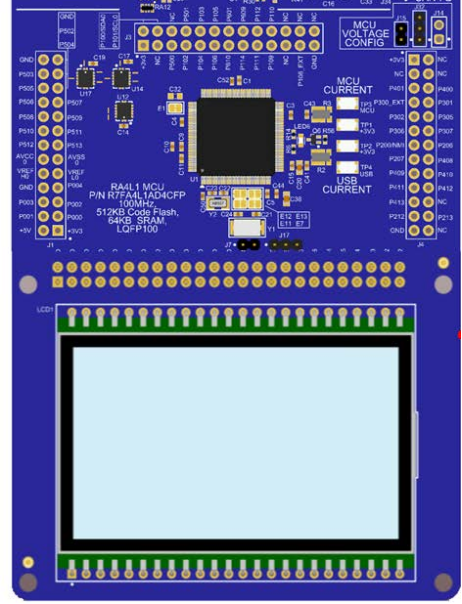
Figure: EK-RA4L1 Connected Segment LCD Effect
J-Link OB Debug Interface
DEBUG1 is a Type C USB socket used to connect the debugger and PC. DEBUG2 and DEBUG3 are debugging interfaces with a 1.27mm pitch, supporting two functions: external debugger connection for debugging RA4L1 (External Debug), and using the onboard J-Link OB (Debug Out) to debug external Arm core products. For specific function selection, please refer to the instructions on the schematic.
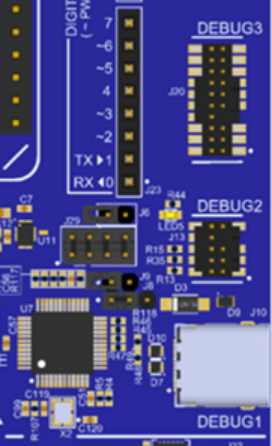
Figure: EK-RA4L1 Debug Interface
USB Full Speed Connector
RA41L supports USB 2.0 full-speed mode, with a total of 10 pipes, which can meet most simple USB application needs.
QSPI
RA4L1 supports external Nor Flash, with an onboard 256 Mb (32 MB) Quad-SPI Flash (MX25L25645GZNI-08G), starting from address 0x60000000, which is the QSPI space. Variables and functions declared with specified keywords can be directly placed in the QSPI Flash area, expanding the usable storage space range, and combined with file systems, can manage and operate large amounts of data. More details can be found in the FSP manual.
PMODs
EK-RA4L1 supports two Digilent PmodTM ports, following standard PMOD specifications, supporting SPI, UART, and IIC interfaces, and can connect compatible sensor modules and other external devices.
microBUS
EK-RA4L1 supports MikroElektronikaTM microBUS connectors, compatible with standard version 2.00 specifications.
Power Consumption Test Points TP1 TP2 TP3 TP4
On the MCU power pathway, there are two high-precision 5 mΩ resistors. By measuring the voltage drop across these resistors, the current consumption of MCU VCC and VCC_USB can be calculated.
It is important to note that due to the rich pin function multiplexing of RA4L1, the board has added an eight-position toggle switch S4 to connect the MCU’s pins to different circuit interfaces. When using, please check that the state of S4 is consistent with the current configuration.
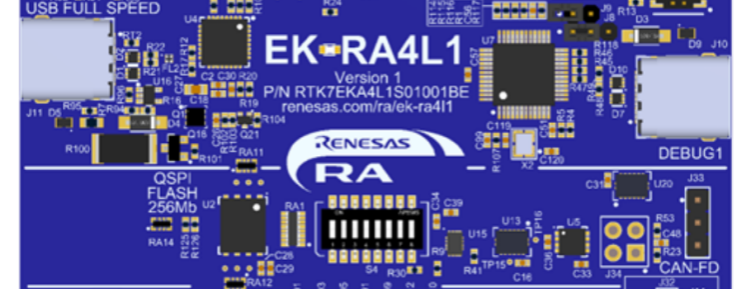
Figure: EK-RA4L1 S4 Toggle Switch
For more details about EK-RA4L1, please refer to
(You can copy the link below into your browser or scan the QR code to view)
More details about EK-RA4L1
https://www.renesas.com/en/products/microcontrollers-microprocessors/ra-cortex-m-mcus
In addition to the example codes hosted on GitHub, we will also continuously upload some example codes to Gitee. Below is an example code that uses RA4L1 to implement ECDH (Elliptic-curve Diffie–Hellman). RA4L1 and RA4M2 obtain a consistent shared secret through ECDH for subsequent communication encryption. (You can copy the link below into your browser or scan the QR code to view)
Example Code
https://gitee.com/recn-mcu-ae/ecdhra4l1ara4m2b


Need Product and Solution Support
Please scan to register

Need Technical Support?
If you have any questions while using Renesas MCU/MPU products, you can identify the QR code below or copy the URL into your browser to access the Renesas Technical Forum to find answers or obtain online technical support.

https://community-ja.renesas.com/zh/forums-groups/mcu-mpu/
1
END
1
Recommended Reading

USB, CANFD, segment LCD, suitable for low-power battery applications – Renesas RA family low-power MCU series new member RA4L1 officially launched

Making an electronic clock based on RASC (Renesas RA) – configuring Keil and using serial port for printing

Introduction to Renesas RA2E1 Product (1) Overview
For more exciting content, please stay tuned


Need Product and Solution Support
Please scan to register