🌟 According to Yu Shi
In this article, Anthropic reveals how the multi-agent system behind Claude has evolved from prototype to production. The article focuses on sharing their key experiences and lessons learned in system architecture, tool design, and prompt engineering. While this article may seem to conflict with the previous article on reliable multi-agent architecture design in 2025 (hereinafter referred to as “Part One”), it is not the case:
【Architecture Pattern Analysis】 The paradigm of multi-agent systems discussed in this article is the “tool paradigm” (also known as unified paradigm or routing paradigm), characterized by: The main control agent decomposes complex tasks and assigns them to multiple parallel sub-agents for execution, with the “context” centralized within the main control agent, ensuring the unity and unambiguity of memory, and maintaining the consistency of information throughout the process, thus avoiding decision conflicts among multiple agents due to information discrepancies.
【Engineering Practice Highlights】 More commendably, Anthropic has demonstrated excellent engineering practices in pushing the system to production during the “last mile.” They not only built a comprehensive observability system for agents to tackle debugging challenges but also introduced an effectiveness evaluation mechanism early in the project, ensuring the reliability of the system through meticulous refinement.
Even more commendable is that Anthropic candidly points out the drawbacks of multi-agent systems: their powerful performance comes at the cost of extremely high token consumption. This is akin to a modern special forces unit executing complex tasks: through the collaboration of a commander (main control agent) and various domain experts, such as demolitions, communications, and medics (sub-agents), they can achieve strategic objectives far beyond the capabilities of individual soldiers, reflecting the tremendous advantages of “collective intelligence.” However, behind this is a vast intelligence network, logistical support, and high-tech equipment, corresponding to the system’s extremely high “resource consumption.”
In this article, Anthropic will unveil how the multi-agent system behind Claude’s research capabilities has transitioned from prototype to production, sharing key experiences learned about system architecture, tool design, and prompt engineering during this process.
A multi-agent system consists of multiple LLM agents that can autonomously and iteratively use tools to collaborate. This system also includes a dominant agent and several parallel sub-agents, which can collectively accomplish complex query tasks.
🌟 Core Advantages of Multi-Agent Systems
Research work often involves open-ended questions, making it difficult to plan all steps in advance. The research process is dynamic and path-dependent, requiring researchers to continuously adjust their methods based on new discoveries. This unpredictability makes AI agents particularly well-suited for executing research tasks.
1. Enhanced Performance and Capability
Once the intelligence of the model reaches a certain threshold, multi-agent systems become a key avenue for performance scaling. Just as human society achieves exponential growth through collective wisdom and collaboration, the tasks that a group of agents can accomplish far exceed those of individual agents.
- • Especially adept at breadth-first queries: Internal evaluations at Anthropic show that multi-agent systems excel in handling “breadth-first” queries that require simultaneous exploration of multiple independent directions.
- • Performance significantly surpasses: In an internal research evaluation, a multi-agent system with Claude Opus 4 as the main agent and Claude Sonnet 4 as sub-agents outperformed the single-agent Claude Opus 4 by 90.2%.
- • Real-world case: For instance, when tasked with identifying the board members of all companies in the S&P 500 information technology sector, the multi-agent system successfully found the answers through task decomposition, while the single-agent system failed due to slow serial searches.
2. Effective Scaling of Token Usage
One core reason for the effectiveness of multi-agent systems is their ability to spend sufficient tokens to solve problems.
- • Anthropic’s analysis found that in an evaluation testing the browsing capabilities of agents, token usage itself explained 80% of the performance variance.
- • The multi-agent architecture achieves parallel reasoning capability scaling by distributing work among multiple agents with independent context windows.
- • Drawback: This architecture consumes tokens at a very fast rate. In Anthropic’s data, the token usage of multi-agent systems is approximately 15 times that of regular chat.
- • Economic considerations: Therefore, multi-agent systems are more suitable for tasks with sufficiently high value that can cover their performance costs.
3. Applicable Scenarios
Anthropic has found that multi-agent systems excel in the following tasks:
- • Tasks involving a large number of parallel operations.
- • Tasks requiring information beyond the capacity of a single context window.
- • Tasks that need to interact with numerous complex tools.
At the same time, for fields requiring all agents to share the same context or where there are strong dependencies between agents (such as most coding tasks), current multi-agent systems are not yet the best choice.
⚙️ System Architecture Overview: Orchestrator-Worker Model
Anthropic’s research system adopts a multi-agent architecture based on the orchestrator-worker model. A dominant agent is responsible for coordinating the entire process and delegating tasks to parallel specialized sub-agents.
When a user submits a query, the dominant agent analyzes the problem, formulates a strategy, and generates multiple sub-agents to simultaneously explore different aspects of the problem. These sub-agents act like intelligent filters, iteratively using search tools to gather information and then returning the results to the dominant agent for final answer integration.
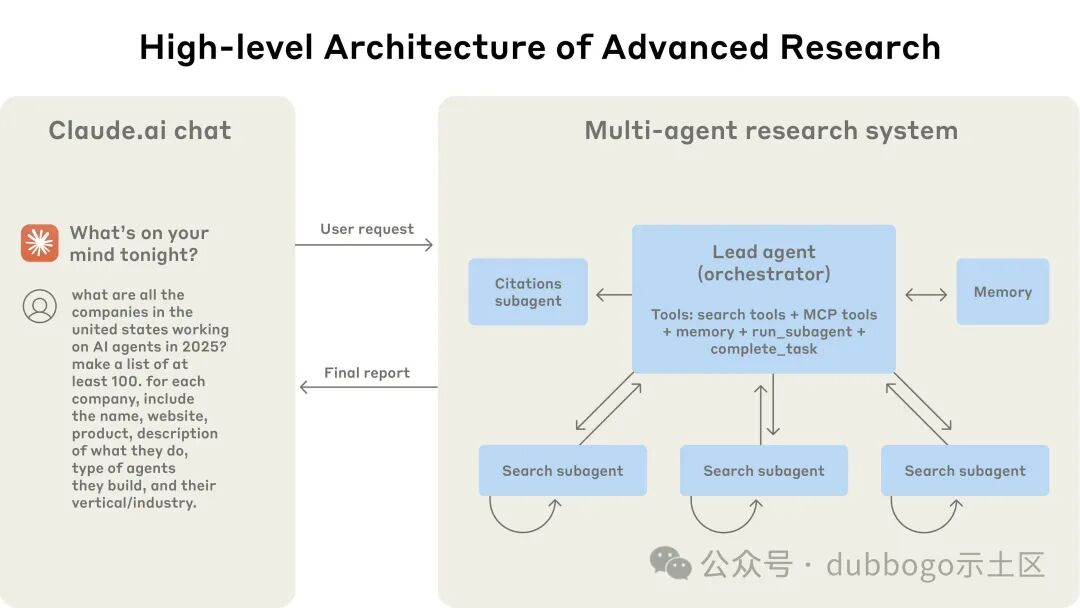
[High-level architecture diagram of the advanced research system]Image description: This high-level architecture diagram illustrates how user requests are processed through a dominant agent, which creates specialized sub-agents to parallel search different aspects of information.
Detailed System Workflow
Unlike traditional RAG methods that use static retrieval, Anthropic’s architecture employs multi-step dynamic searches that can actively discover relevant information, adapt to new findings, and analyze results to form high-quality answers.
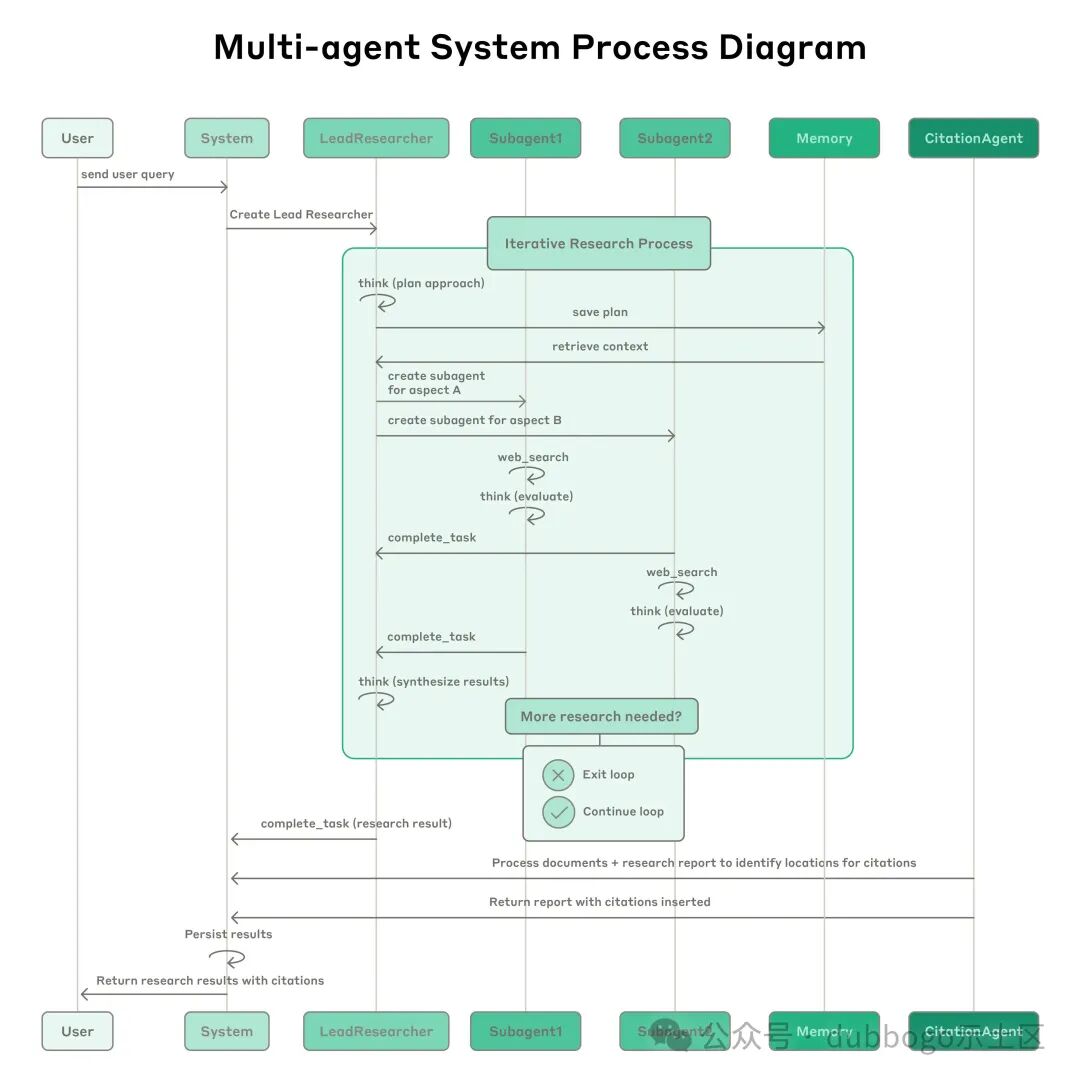 [Multi-agent system flowchart]Image description: This flowchart comprehensively displays the workflow of Anthropic’s research system.
- 1. Initiation and Planning: After the user submits a query, the system creates a
<span>LeadResearcher</span>(main researcher) agent. It first thinks and plans the research method, saving the plan to memory (Memory) to prevent loss due to context window limits (200k tokens). - 2. Task Assignment:
<span>LeadResearcher</span>creates multiple specialized<span>Subagent</span>(sub-agent) agents and assigns specific tasks. - 3. Parallel Research: Each
<span>Subagent</span>independently conducts web searches, evaluates results returned by tools, and feeds discoveries back to<span>LeadResearcher</span>. - 4. Integration and Iteration:
<span>LeadResearcher</span>integrates all results and determines if further research is needed. If so, it can continue to create new sub-agents or adjust strategies. - 5. Citation and Generation: Once sufficient information is collected, the system hands all materials to a
<span>CitationAgent</span>(citation agent), which is responsible for processing documents and finding and inserting accurate citation sources for all assertions in the report. - 6. Return Results: Finally, a research report with complete citations will be returned to the user.
🧠 Core Principles of Prompt Engineering
Since each agent is driven by prompts, prompt engineering is the primary means by which Anthropic improves system behavior. Here are several key principles summarized by Anthropic:
- 1. Think like an agent: To optimize prompts, you must understand their effects. Anthropic simulates the agent’s workflow in the console, observing its behavior step by step, which can immediately expose failure modes, such as not stopping when sufficient results are available or using overly verbose search queries.
- 2. Teach the “orchestrator” how to delegate: The dominant agent needs to provide detailed task descriptions to sub-agents, including goals, output formats, tool usage guidelines, and clear task boundaries. Simple instructions (like “research semiconductor shortages”) can lead to misunderstandings or redundant work by sub-agents.
- 3. Adjust input based on query complexity: Anthropic embeds scaling rules in prompts to help agents determine the effort required for different tasks. Simple fact-finding may only require one agent to make a few tool calls, while complex research may need more than ten clearly defined sub-agents.
- 4. Carefully design and select tools: The interface between agents and tools is crucial. Anthropic provides agents with clear heuristic rules, such as prioritizing all available tools and favoring specialized tools over general ones. Additionally, tool descriptions must be clear and precise, as poor descriptions can completely mislead agents.
- 5. Enable agents to self-improve: Anthropic has found that the Claude 4 model itself is an excellent prompt engineer. When given a prompt and a failure case, it can diagnose the reasons for failure and suggest improvements. Anthropic even created a “tool testing agent” that can iteratively test a flawed tool, ultimately rewriting its description to reduce the task completion time for future agents by 40%.
- 6. Broad-to-narrow search strategy: Anthropic guides agents to mimic the research methods of human experts: first conducting brief, broad queries to understand the overall situation, then gradually narrowing the focus.
- 7. Guide the thinking process: Anthropic utilizes an “expanded thinking mode” to have agents output their thought processes, acting like a controllable draft paper. The dominant agent uses it for planning, while sub-agents use it to evaluate search results and adjust next steps. Testing has shown that this significantly improves instruction adherence, reasoning, and efficiency.
- 8. Parallel tool calls: To address the slow speed of serial searches, Anthropic introduces two forms of parallelization: (1) the dominant agent simultaneously launches 3-5 sub-agents; (2) sub-agents concurrently use more than three tools. These changes have reduced the research time for complex queries by up to 90%.
✅ How to Effectively Evaluate Agents
Evaluation is the cornerstone of building reliable AI applications, but evaluating multi-agent systems faces unique challenges because they do not always follow the same path.
- 1. Start evaluating from small samples immediately: Early in development, a small prompt adjustment can lead to significant performance improvements (e.g., success rates jumping from 30% to 80%). This large effect size can be observed with a small number of test cases (Anthropic starts with about 20 queries). Do not wait until you can build a large-scale evaluation set; testing with small samples immediately is more valuable.
- 2. Scale the use of “LLM as judges”: For free-form research outputs, LLMs are ideal scoring tools. Anthropic uses an LLM judge to score outputs based on a multi-dimensional scoring standard (such as factual accuracy, citation accuracy, completeness, etc.). This approach allows Anthropic to scale evaluations of hundreds of output results.
- 3. Human evaluations capture automation blind spots: Human testing always uncovers edge cases missed in evaluations. For example, Anthropic’s testers found that early agents tended to choose SEO-optimized content farms instead of authoritative academic papers or personal blogs. By adding heuristic rules regarding source quality in prompts, Anthropic addressed this issue. Thus, even in the era of automated evaluation, human testing remains crucial.
🔧 Reliability and Engineering Challenges in Production Environments
Transforming a locally well-functioning agent system into a reliable production system requires overcoming significant engineering challenges.
- • State and Error Accumulation: Agents are long-running and stateful. Minor system failures can lead to catastrophic consequences. Anthropic cannot simply restart from scratch, so they built a system that can recover from the point of failure.
- • Debugging New Methods: The dynamic and non-deterministic behavior of agents makes traditional debugging difficult. Anthropic diagnoses root causes of failures by introducing comprehensive production link tracing.
- • Cautious Deployment Coordination: Agent systems are highly stateful. Anthropic cannot interrupt running agents when deploying updates, so they adopt a “rainbow deployment” strategy, allowing new and old versions to run simultaneously while gradually migrating traffic.
- • Bottlenecks in Synchronous Execution: Currently, Anthropic’s system operates synchronously, meaning the dominant agent must wait for all sub-agents to complete before proceeding. This simplifies coordination but also creates bottlenecks. In the future, asynchronous execution will bring higher parallelism, although it will increase the complexity of state consistency and error propagation.
🚀 Conclusion
When building AI agents, the “last mile” often occupies a significant portion of the entire journey. The gap between prototype and production systems is much wider than one might imagine.
Despite numerous challenges, multi-agent systems have already proven their immense value in open-ended research tasks. User feedback indicates that Claude has helped them discover previously unconsidered business opportunities, solve complex technical problems, and save days of work.
Anthropic believes that through careful engineering design, comprehensive testing, meticulous prompt and tool design, and strong team collaboration, multi-agent research systems can operate reliably at scale and are changing the way people solve complex problems.
📚 Appendix: Other Practical Tips
- 1. Long-range Dialogue Management: For dialogues spanning hundreds of turns, Anthropic manages context by having agents phase-summarize work and store it in external memory. When approaching context limits, agents can generate a new sub-agent with a clean context and maintain continuity through “handoffs.”
- 2. Output through File Systems: To avoid information distortion during transmission (the “telephone game”), Anthropic allows sub-agents to save their work products (especially structured outputs like code and reports) directly to external systems, then only pass a lightweight reference to the coordinator. This reduces token overhead and ensures information fidelity.
We welcome you to join the dubbogo community DingTalk group: 23331795, and feel free to scan the code to join the dubbogo community group: