Quantum mechanics combined with information science leads to quantum informatics, which includes three fundamental directions. Besides quantum computing, there are also quantum communication and quantum precision measurement. In quantum communication, the most researched and applied area is quantum cryptography. The door to quantum cryptography was opened by three scientists who first proposed several innovative ideas related to quantum information, which later developed into the BB84 protocol in “quantum key distribution,” a famous example in quantum cryptography.
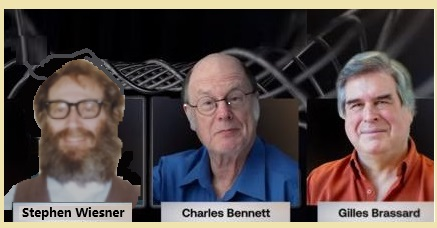
▲Figure 1: Scientists Who Opened the Door to Quantum Cryptography
One of the differences between quantum particles and classical objects is that they cannot be copied or measured! So someone wondered: Can we imprint light quanta onto banknotes to avoid counterfeiting? His friend replied: That seems difficult; photons move too fast! They then said: Let it run; maybe it can help us transmit secrets in communication! Thus, quantum key distribution emerged…
Quantum key distribution, as its literal meaning suggests, is about sending a “private key” using quantum methods. Specifically, it is embodied in the BB84 protocol proposed by the two scientists on the right side of Figure 1, where “BB” stands for the initials of their surnames, combined with the year of the proposal, 84, which refers to 1984. So, what is this private key? Why do we need to send it? What does the BB84 protocol say? To explore these questions, we first briefly introduce classical communication and also understand a few specialized terms in encrypted communication.
01
Two Classical Encryption Methods
The concepts of confidentiality and espionage have existed since ancient times, with an ongoing intellectual war between the two, as the saying goes, “The higher the road, the higher the devil.” The purpose of modern secure communication technology, besides protecting personal privacy, also relates to the struggles between national governments and political parties, the outcomes of wars, and the survival of nations, etc.
For example, Alice and Bob live in two distant cities and have busy schedules that make it hard to meet. However, Alice often sends valuable gifts to Bob. She usually locks the gifts in a sturdy box with a certain lock and sends it to Bob, while also using some method to pass the key to Bob. This way, when Bob receives the box, he uses the key to unlock it and gets the gift.
Suppose the key is the only way to steal the gift, then the security of the sent item entirely depends on the security of the key.
Some say this is simple; the two can pre-customize two identical keys for the lock, so that others cannot steal the gift without a key. However, this method can only be used 1 or 2 times. If over time, they keep using the same lock and key, it is clearly unsafe, as a thief can find a way to copy the key!
Others suggest: they can change the lock and key each time and hire a reliable person to specifically deliver the key. This means using a third party as a messenger. However, this is not a good solution either, as if the messenger can deliver the key, it would be better to bring the gift directly. Moreover, the messenger may not be that reliable; history shows that traitors and spies are everywhere.
So, we still return to the problem of how to pass the “ever-changing” key.
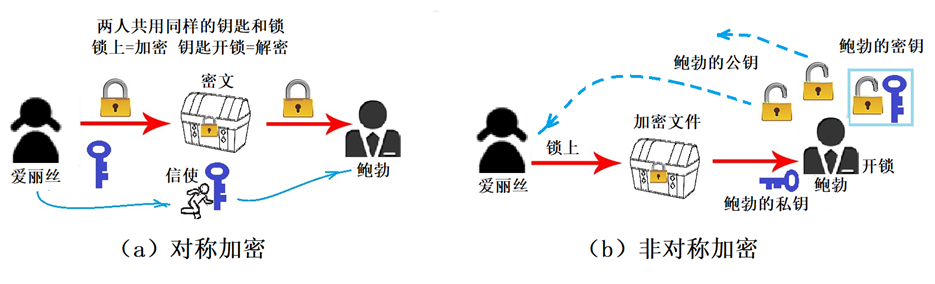
The methods described above, where Alice and Bob use the same lock and key, are symmetric, called symmetric encryption, as shown in Figure 2(a). The method of changing the key and lock each time is called “one-time pad (OTP).”
Smart Bob thought of a second method: he crafted a set of locks and keys himself. He only sent Alice an unlocked lock and kept the matching key. Alice has no key but can easily lock the box with this lock and send it to Bob. Finally, Bob uses his own key to open the box and get the gift. This method is called asymmetric encryption because Bob has the key while Alice does not, making it asymmetric, as shown in Figure 2(b).
▲Figure 2: Two Common Encryption Methods
The two methods used by Alice and Bob above are commonly used in modern communication. The difference is that in modern communication, the encrypted and decrypted items are files, and computer and network technologies are used to perform these operations. In cryptography, the text that needs to be kept confidential is called ‘plaintext,’ and the text transformed by some method is called ‘ciphertext’ or ‘code.’ Thus, the process of turning plaintext into ciphertext is called ‘encryption,’ while the reverse process is called ‘decryption.’ In modern communication, the method used for encryption and decryption refers to a certain computer ‘algorithm,’ and the set of parameters completing specific calculations in these algorithms is called ‘key.’
In symmetric encryption technology, the sender (Alice) and receiver (Bob) share the same key, and the decryption algorithm is the inverse of the encryption algorithm. This method is simple and technically mature, but due to the “shared key,” it is difficult to ensure the secure transmission of the key.
Asymmetric encryption technology, as shown in Figure 2(b), has each person (as the receiver) generate their own pair of keys (public key and private key). For example, in the figure, the unlocked lock represents the public key, and the key represents the private key. The public key is used for encryption, and the private key is used for decryption. The encryption algorithm (public key) is publicly transmitted, while the decryption algorithm is kept secret. Asymmetric encryption is also algorithmically asymmetric: it is easy to derive the public key from the private key, but extremely difficult to derive the private key from the public key. In other words, an algorithm that is easy to operate in a forward direction and extremely difficult to reverse is needed. The commonly used RSA cryptosystem is designed to achieve this purpose.
The RSA algorithm was invented by Ron Rivest, Adi Shamir, and Leonard Adleman 【2】, named after the first letters of their surnames. It is based on a simple number theory fact: multiplying two prime numbers is very easy, but the reverse, factoring their product to find the primes is very difficult. For example, calculating 17×37=629 is easy, but if you are given 629 and asked to find its factors, it becomes more challenging. Moreover, the difference in difficulty between forward and reverse calculations increases sharply with the size of the numbers: the time complexity of multiplying two numbers is at most quadratic, while the complexity of reverse operations grows exponentially. For classical computers, breaking a high-digit RSA password is nearly impossible. For instance, a machine that can perform 1012 operations per second would take 150,000 years to crack a 300-digit RSA password!
02
The Pioneer of Quantum Information
RSA passwords are difficult for classical computers to crack, which seems quite secure. However, technology is constantly advancing, and if quantum computers emerge, the situation will change dramatically. Quantum computers can use Shor’s algorithm, which could potentially crack that 300-digit password in seconds, a task that would take a modern computer 150,000 years. This sounds terrifying! If, in a war, the opposing side has quantum computers, it would be easy to crack the RSA communication passwords of the other side. Although universal quantum computers have not yet been developed, it is necessary to take precautions, which is why various countries and major companies have begun researching quantum information and quantum communication technologies.
Since quantum theory can be used to build quantum computers, could it also be used for secure communication? The first person to raise this question and conceive the original idea of quantum information was a legendary scientist, Stephen Wiesner (1942–2021) 【3】. This was not in 1984, but 14 years earlier in 1970. That year, Wiesner from Columbia University wrote a paper titled “Conjugate Coding” (Figure 3), pointing out that by combining quantum mechanics, two tasks that classical cryptography could not achieve could be accomplished. One is quantum checks, and the other is sending two classical messages as one quantum message, where the receiver can only choose to accept one of them. Both ideas contain the concept of quantum cryptography. However, at the time, they sounded too far-fetched, so the paper was not accepted by professional journals.
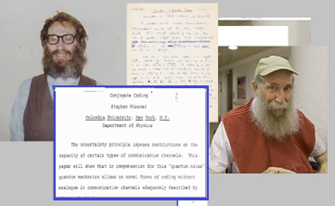
▲Figure 3: Wiesner and His 1970 Paper
Wiesner was born into a Jewish immigrant family in the United States. His father was a Ph.D. in electrical engineering, a professor at MIT, and worked on microwave radar development at the school’s radiation laboratory after World War II. He briefly worked at Los Alamos National Laboratory after the war, then returned to MIT’s Electronic Research Laboratory from 1946 to 1961. He served as a scientific advisor to President Kennedy and later became the Dean of the School of Science and the 13th President of MIT.
Growing up in such an environment, Wiesner developed a keen interest in quantum mechanics and electronic communication.
In 1960, Wiesner entered Caltech and happened to take a physics lab course with Clauser, who first experimentally proved Bell’s theorem in 1972 (a 2022 Nobel Prize winner), and they became friends, frequently discussing quantum mechanics issues. However, Wiesner later transferred to Brandeis University in Massachusetts, where he became roommates and good friends with Charles Bennett, a junior in the chemistry department at the time (1943-). This friendship later facilitated Bennett’s research on quantum key distribution and the proposal of the BB84 protocol. In 1964, Bell visited Brandeis University as a visiting scholar, and that year completed a paper on Bell’s inequality. These experiences helped inspire Wiesner’s ideas about quantum information.
After graduating in 1966, Wiesner went to Columbia University for graduate studies. Two years later, he wrote the paper titled “Conjugate Coding,” proposing how to use the polarization of photons to create unforgeable “quantum money”.
In 1969, Wiesner submitted a paper to the IEEE Transactions on Information Theory. At that time, no one believed that quantum theory was related to information theory, and the manuscript was rejected. He did not attempt to resubmit it anywhere else, and the feedback he received from most people around him (including his Ph.D. advisor) was that these ideas were not “serious science.” Although Wiesner’s work remained unpublished for over a decade, fortunately, he sent copies to some colleagues, including Charles Bennett, spreading it in manuscript form, thus opening the door to quantum informatics.
Wiesner’s consideration of “quantum money” was initially aimed at solving the problem of counterfeiting. Criminals can always produce counterfeit money that is difficult for banks to distinguish. Thus, Wiesner devised a method using the “quantum no-cloning theorem” and the uncertainty principle, implying that if you create a quantum state and keep it secret from the outside world, no one can clone an identical quantum state. Quantum money, in addition to having a serial number like regular banknotes, embeds polarized photons corresponding to the serial number. Banks can check for counterfeits through polarizers.
Wiesner later obtained his Ph.D. in 1972 for a paper on weak interactions. The “Conjugate Coding” paper was finally published in 1983 in the ACM SIGACT journal. Wiesner was introverted and shy, uninterested in honors, and was not concerned about publishing papers. In 1993, he chose to leave the United States and immigrated to Israel, becoming a construction worker in Jerusalem. In his later years, Wiesner avoided secular crowds and lived a very simple life. The pioneer of quantum information passed away in Jerusalem in 2021 at the age of 79.
03
Bennett and Brassard
Bennett was born in New York City in 1943 and spent his childhood around the Hudson River, where he had the opportunity to encounter early versions of computers. However, during his undergraduate studies at Brandeis University, his first interest was biochemistry, which later shifted to chemical physics when he became a graduate student at Harvard. In American universities, Ph.D. students typically serve as teaching assistants for certain courses. Bennett happened to be a teaching assistant for James Watson’s course. This famous scientist in the field of DNA naturally often talked about genetic codes, which suddenly led Bennett to think about linking genetic code mechanisms with Turing machines.
After graduation, Bennett became a postdoc at Argonne Laboratory in Chicago, where his interest in data analysis in computing grew. There, he heard Randall from IBM discuss the inevitable energy costs of computation, which Randall attributed to logically irreversible steps. Encouraged by Randall, Bennett used the idea of chemical Turing machines to explore this thermodynamic problem, ultimately leading to fruitful research, and Bennett transitioned to a postdoc position at IBM.
At the same time, Bennett began discussing ideas with his undergraduate friend Wiesner, who was considering concepts like “conjugate coding” and “quantum banknotes”. Wiesner had some thoughts on things that could be done with quantum particles that could not be done with ordinary information, and Bennett summarized these ideas with the term “quantum information,” which did not exist at the time. He was particularly interested in how to use quantum channels to combine two messages for transmission.
Years later, Bennett encountered Gilles Brassard (1955-) at an international conference on informatics, who was a Ph.D. student in computer science at the University of Montreal and presented a report on “relative cryptography.” Bennett thought he might be interested in quantum information, so he discussed these ideas with him.
The two young scientists hit it off, and after a vigorous exchange of ideas, they found that the idea of “quantum banknotes” might not be practical because photons are fleeting and difficult to “print” on banknotes to fit in people’s pockets. However, light is originally used to transmit information, so why not leverage its strengths to convey some “unforgeable” and “non-copyable” important information? This aspect, as a new idea for cryptographic communication, is worth researching.
Thus, they collaborated to introduce a new theory to the world called “quantum cryptography.” They developed a specific scheme for quantum key distribution, later known as the BB84 protocol, and their paper was published at an IEEE conference in 1984.
Bennett and Brassard were awarded the Wolf Prize in Physics in 2018 【4】.
04
Quantum Key Distribution
Now let’s return to classical cryptography and see what quantum theory can do for it. We introduced two common cryptographic communication systems: symmetric and asymmetric. The former is simple in concept, but the problem is that security depends on the transmission of the “key”; the latter is cleverly designed, with the RSA algorithm being a typical example that classical computers find difficult to crack in a timely manner, thus being widely used for its temporary security.
Scientists have applied quantum concepts to communication technology from two different directions. One is developing quantum computers to attack and break the RSA algorithm in asymmetric systems. The second direction is the quantum key distribution invented by Bennett and Brassard, which utilizes the special physical laws of quantum mechanics and combines them with the “one-time pad” encryption technique to achieve secure “key” transmission in symmetric systems.
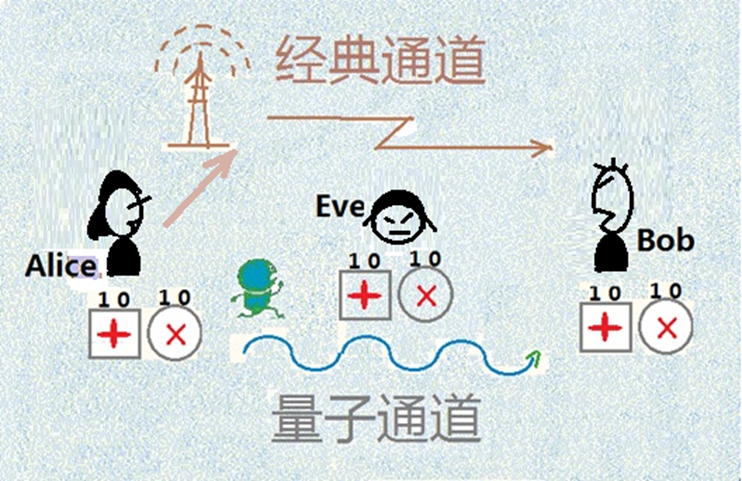
▲Figure 4: Two Channels of the BB84 Protocol
Figure 4 is a schematic diagram of the BB84 scheme, briefly explaining the communication process envisioned by Bennett and Brassard 【5】.
1) There are two signal channels: a classical channel, where transmission methods are the same as before, realized through public channels like radio or the internet; and a special quantum channel. In this channel, the sender uses the polarization state of photons to transmit information, and the photons can travel through optical fibers or other media from the emitter. The purpose of the quantum channel is solely to generate and transmit the “key,” equivalent to the role of the messenger in Figure 2(a). Generally, it is assumed that Eve has the ability to eavesdrop on the information from both channels.
2) The transmission process is divided into two steps:
The first step is to transmit and produce a reliable “shared key,” primarily using the quantum channel and secondarily the classical channel.
The second step is to transmit the files encrypted with the “shared key,” using only the classical channel, just like in classical cases.
3) The key point is to prevent eavesdropping. In classical communication, Alice and Bob cannot detect if Eve is eavesdropping. However, in quantum key distribution, Alice and Bob can detect Eve’s eavesdropping behavior because any attempt to gain information will alter the quantum system, and due to the no-cloning theorem, Eve cannot directly copy the information. Once the parties transmitting information detect the presence of a third-party eavesdropper, they can immediately stop communication and reset the key.
4) The BB84 protocol is unrelated to quantum entanglement. The transmission of classical information is necessary for the completion of communication, and its speed determines the transmission process, without any questions about whether there is “superluminal communication.”
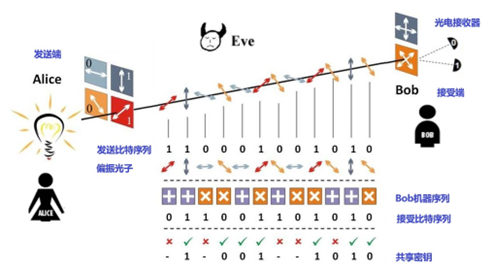
▲Figure 5: BB84 Protocol – “Key Distribution” Schematic
As shown in Figure 5, Alice can prepare polarized photons (or quantum bits) in two ways: linear basis “+” and diagonal basis “×”. In the linear basis, horizontal polarization (0°) and vertical polarization (90°) represent 0 and 1, respectively. In the diagonal basis, 45° polarization and 135° polarization represent 0 and 1, respectively.
This is like having two machines that produce and test quantum bits 0 and 1, one machine called “+” (linear machine) and the other called “×” (diagonal machine). Alice randomly chooses which machine to use for generating each quantum bit and records the order of the machines used while only sending the generated sequence of 0s and 1s through the quantum channel. Correspondingly, the receiver Bob and the eavesdropper Eve also have machines to test these two types of quantum bits: the linear machine “+” and the diagonal machine “×”.
The BB84 protocol utilizes the no-cloning property of the transmitted polarized light quanta and the indistinguishability of the light quanta generated by the two machines. Due to the no-cloning property, once a light quantum is measured, its state changes and is no longer the measured value. Due to the indistinguishability of light quanta, the transmitted quantum does not have a label indicating which machine produced it, so during measurement, it can only be randomly placed into one of the two machines. If it happens to be placed correctly, the measurement result will be 100% accurate; if placed incorrectly, there is a 50% chance of being correct. Since it is randomly placed, the accuracy of the measured result should be 50% for the correct placement, plus half of the incorrect placement still has a 50% chance of being correct (25%), resulting in 75% overall.
After Bob receives the sequence of information sent by Alice, he randomly places each light quantum into one of the two measuring machines and records the measurement results and the order of the machines (right side of Figure 5), sending the machine order and part of the bit sequence back to Alice through the classical channel. If this sequence has not been intercepted, based on the previous analysis, its accuracy should be 75%. At this point, Alice can compare the machine order and part of the bits received by Bob with her own data sent and calculate the accuracy of Bob’s measurement results. If this value is about 75%, it indicates that the information has not been eavesdropped, and Alice will select the quantum bits that Bob measured correctly from the original data as the communication key, sending the key’s machine order position to Bob.
However, if the quantum bit was intercepted by Eve during transmission, because this quantum bit has already been measured by Eve, it is no longer the original value. Therefore, the presence of the eavesdropper introduces an additional 50% error into Bob’s final result. To explain in more detail, the quantum bits that have been eavesdropped by Eve have a 50% chance of remaining unchanged (Alice’s original) and a 50% chance of changing. If Bob measures this quantum bit that has been eavesdropped but unchanged, the accuracy equals 75%*50%=37.5%; if Bob measures this quantum bit that has been eavesdropped and changed, the accuracy equals 50%*50%=25%. Thus, the total accuracy equals 37.5%+25%=62.5%, which is less than the original 75%. In this way, after Alice compares her data with Bob’s, she can determine that the correct rate is around 62.5%, indicating the presence of an eavesdropper, and she can discard this transmission data and take other corresponding measures, such as immediately switching to another quantum channel.
BB84 is the first quantum key distribution protocol, and there have been other improved and perfected distribution methods since.
References:
【1】 “The Code Book” by Simon Singh, translated by Liu Yanfen, published by Taiwan Business Press
【2】 Stephen Wiesner – Wikipedia
https://zh.wikipedia.org/wiki/%E5%8F%B2%E8%92%82%E8%8A%AC%C2%B7%E5%A8%81%E6%96%AF%E7%B4%8D
【3】 Adi Shamir Ronald Rivest and Len Adleman. A method for obtaining digital signatures and public-key cryptosystems. Comm. ACM, 21:120–126, 1978.
【4】 Wikipedia – Wolf Prize in Physics (2018)
https://zh.wikipedia.org/wiki/%E6%B2%83%E7%88%BE%E5%A4%AB%E7%89%A9%E7%90%86%E5%AD%B8%E7%8D%8E
【5】 Wikipedia – BB84
https://zh.wikipedia.org/wiki/%E9%87%8F%E5%AD%90%E5%AF%86%E9%91%B0%E5%88%86%E7%99%BA
This article is reproduced from the “Mozi Salon” WeChat public account//“Physics” Selected Articles from 50 Years
What is a neutron bomb? | Selected Articles from 50 Years of “Physics”
A historical review of crystal defect research | Selected Articles from 50 Years of “Physics”
Phase transitions and critical phenomena (I) | Selected Articles from 50 Years of “Physics”
Phase transitions and critical phenomena (II) | Selected Articles from 50 Years of “Physics”
Phase transitions and critical phenomena (III) | Selected Articles from 50 Years of “Physics”
A review and outlook of condensed matter physics | Selected Articles from 50 Years of “Physics”
Acoustics and Ocean Development | Selected Articles from 50 Years of “Physics”
The role of models in the development of physics | Selected Articles from 50 Years of “Physics”
My memories of Wu Youxun, Ye Qisun, and Sa Bendong | Selected Articles from 50 Years of “Physics”
The National Southwest Associated University Physics Department – A Unique Phenomenon in China’s Physics Community During the War of Resistance Against Japan (I) | Selected Articles from 50 Years of “Physics”
The National Southwest Associated University Physics Department – A Unique Phenomenon in China’s Physics Community During the War of Resistance Against Japan (II) | Selected Articles from 50 Years of “Physics”
The discovery of nuclear fission: history and lessons – Commemorating the 60th anniversary of the discovery of nuclear fission | Selected Articles from 50 Years of “Physics”
Review and outlook – Commemorating the 100th anniversary of the birth of quantum theory | Selected Articles from 50 Years of “Physics”
My research career – Huang Kun | Selected Articles from 50 Years of “Physics”
A model of the integration of theoretical physicists and biologists – A historical contribution of Tang Peisong and Wang Zhuxi to the study of water relations in plant cells (Part I) | Selected Articles from 50 Years of “Physics”
A model of the integration of theoretical physicists and biologists – A historical contribution of Tang Peisong and Wang Zhuxi to the study of water relations in plant cells (Part II) | Selected Articles from 50 Years of “Physics”
To the memories that are forgotten – Recalling the late Ye Qisun | Selected Articles from 50 Years of “Physics”
From the perspective of molecular biology – Commemorating the 50th anniversary of the publication of the golden spiral paper | Selected Articles from 50 Years of “Physics”
Beauty can be described – Mathematical equations describing floral morphology | Selected Articles from 50 Years of “Physics”
Einstein: A portrait on a stamp | Selected Articles from 50 Years of “Physics”
A discussion of the physics of ball sports | Selected Articles from 50 Years of “Physics”
In the blink of an eye, ninety years | Selected Articles from 50 Years of “Physics”
A classic work that has trained generations of physicists – A review of “Theory of Lattice Dynamics” | Selected Articles from 50 Years of “Physics”
The centenary of Landau| Selected Articles from 50 Years of “Physics”
In the language of heaven, explaining the way of physics | Selected Articles from 50 Years of “Physics”
Soft matter physics – A new discipline in physics | Selected Articles from 50 Years of “Physics”
Cosmology over the past 80 years | Selected Articles from 50 Years of “Physics”
The myth of entropy | Selected Articles from 50 Years of “Physics”
Evolutionary phenomena in physics | Selected Articles from 50 Years of “Physics”
Notes from Purdue – Starting from the 2010 Nobel Prize in Chemistry | Selected Articles from 50 Years of “Physics”
My learning and research experience | Selected Articles from 50 Years of “Physics”
Weather forecasting – From experience to physical mathematical theory and supercomputing | Selected Articles from 50 Years of “Physics”
Commemorating the 100th anniversary of Bohr’s “Great Trilogy” and the 100th anniversary of the establishment of the physics major at Peking University | Selected Articles from 50 Years of “Physics”
The history and current status of synchrotron radiation | Selected Articles from 50 Years of “Physics”
The origin of the concepts of Maxwell’s equations and gauge theory | Selected Articles from 50 Years of “Physics”
Space science – The source of exploration and discovery | Selected Articles from 50 Years of “Physics”
The establishment and role of Maxwell’s equations | Selected Articles from 50 Years of “Physics”
Topological phases and topological phase transitions in condensed materials – Interpretation of the 2016 Nobel Prize in Physics | Selected Articles from 50 Years of “Physics”
A few Chinese physics masters I am familiar with | Selected Articles from 50 Years of “Physics”
The interpretation problem of quantum mechanics | Selected Articles from 50 Years of “Physics”
The challenges faced in high-temperature superconducting research | Selected Articles from 50 Years of “Physics”
Unconventional superconductors and their properties | Selected Articles from 50 Years of “Physics”
The vacuum is not empty | Selected Articles from 50 Years of “Physics”
Universal quantum computers and fault-tolerant quantum computing – Concepts, current status, and outlook | Selected Articles from 50 Years of “Physics”
Discussing the writing of “Theoretical Physics Tutorial” | Selected Articles from 50 Years of “Physics”
Struggle, opportunity, physics | Selected Articles from 50 Years of “Physics”
Basic principles of quantum mechanics | Selected Articles from 50 Years of “Physics”
Singularities and black holes in spacetime – Interpretation of the 2020 Nobel Prize in Physics | Selected Articles from 50 Years of “Physics”
A new chapter in condensed matter physics – Topological quantum states beyond the Landau paradigm | Selected Articles from 50 Years of “Physics”
The art of thinking in physics | Selected Articles from 50 Years of “Physics”
Regarding Maxwell’s equations, is the low-speed limit of Lorentz transformation Galilean transformation? | Selected Articles from 50 Years of “Physics”
The research taste and style of Mr. Yang Zhenning and their implications for cultivating outstanding talents | Selected Articles from 50 Years of “Physics”
Poincaré’s theory of special relativity (I): The discovery of the Lorentz group | Selected Articles from 50 Years of “Physics”