If you would like to submit an article, please click Neurosurgery News – We welcome submissions
[Ref: Li G, et al. Sensors (Basel). 2017 Mar 8;17(3). pii: E537. doi: 10.3390/s17030537.]
Traumatic brain injury often leads to brain edema. Continuous monitoring of the progression of brain edema is crucial for the treatment of traumatic brain injury and achieving a good prognosis. Gen Li and colleagues from the College of Biomedical Engineering, Third Military Medical University of China created a rabbit model of brain edema and used a magnetic induction phase shift (MIPS) system to conduct non-invasive, non-contact detection of the occurrence and development of brain edema. The results were published online in March 2017 in Sensors (Basel).
The study involved 16 rabbits, with 10 assigned to the experimental group and 6 to the control group. In the experimental group, brain edema was induced using epidural freezing. Both the experimental and control group animals underwent continuous 24-hour MIPS monitoring while intracranial pressure (ICP) was also monitored. The results showed that within 24 hours of brain edema occurrence, MIPS in the experimental group began to show a downward trend, with a change of -13.1121±2.3953; ICP showed an upward trend within 24 hours, varying between 12–41 mmHg. ICP was negatively correlated with MIPS. In the early stages of brain edema, MIPS changes were more sensitive than ICP. In the control group, MIPS showed no significant change, with a variation of -0.87795±1.5146; ICP fluctuated slightly around 12 mmHg (Figures 1 and 2).
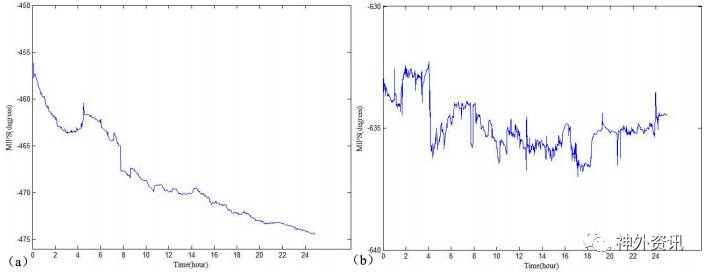
Figure 1. (a) MIPS changes in the experimental group rabbits over 24h; (b) MIPS changes in the control group rabbits over 24h.
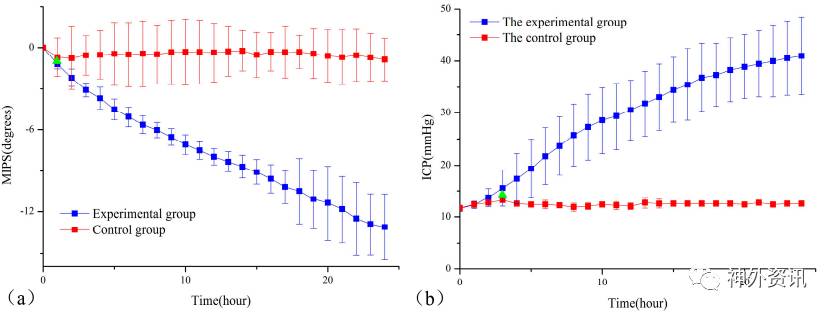
Figure 2. (a) Comparison of MIPS detection results (mean±standard deviation) between the two groups; (b) Comparison of ICP detection results (mean±standard deviation) between the two groups. The green box indicates the time point at which significant differences began to appear between the experimental and control groups.
The study results indicate that the MIPS system can monitor the gradual increase of brain edema volume; to some extent, MIPS can reflect changes in intracranial pressure.
(Compiled by Tim, reviewed by Dr. Zheng Feng from the University of Cologne Medical School, final review by Professor Chen Xiangcheng, Editor-in-Chief of Neurosurgery News and affiliated with Huashan Hospital of Fudan University)
Related Reviews
-
Dexamethasone May Shorten Survival in Glioblastoma Patients
-
Traumatic Brain Injury – Weekly Cases in Neurocritical Care (Issue 7) | A Case of Decompressive Craniectomy + Delayed Intracranial Hematoma and Secondary Hydrocephalus
-
Nivolumab Causes Secondary Malignant Edema in Pediatric Glioma Patients
-
Isolated Brainstem Edema in a 6-Year-Old Boy After Head Injury

Neurosurgery News WeChat public subscription account can be pinned!!! Open your phone WeChat (version 6.3.16 and above), find the Neurosurgery News public account, open it and click the profile picture in the upper right corner, go to the Neurosurgery News details page, and select to pin the public account, this way you can pin the Neurosurgery News and never miss important information!
“Neurosurgery News”, no unauthorized reproduction without permission. If you wish to reproduce, please contact “Neurosurgery Assistant”. We ask all public accounts, websites, and clients to respect the copyright of “Neurosurgery News”. When reproducing articles with permission, please clearly indicate the source as “Neurosurgery News”. “Neurosurgery News” welcomes you to forward to your circle of friends.