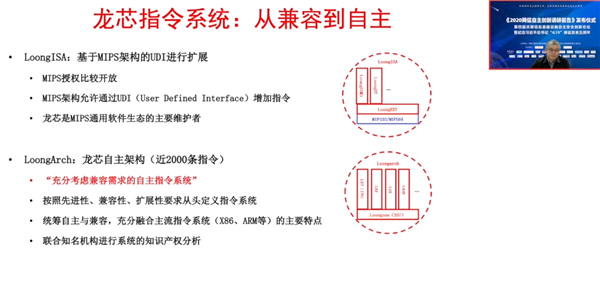
A few days ago, Loongson announced the launch of the LoongArch instruction set, abandoning its previous MIPS licensing, featuring over 2,500 self-developed instructions, and capable of translating MIPS, ARM, and x86 instructions.
For the development of domestic CPUs, there have always been two unresolved issues over the past 20 years: whether to pursue an independent path or a compatible path. Choosing the former means establishing a completely new ecosystem, which is extremely difficult, while choosing the latter allows compatibility with the current ARM or x86 ecosystem, but the core technology cannot be controlled independently.
The LoongArch instruction set launched by Loongson somewhat resolves this dilemma between independence and compatibility, as it aims to achieve both.
After the release of the independent instruction set LoongArch, at the 4th Critical Information Infrastructure Independent Security Innovation Forum, Hu Weiwu, Chairman of Loongson Zhongke, delivered a speech titled ‘Analysis of the LoongArch Instruction System Architecture’, further interpreting the latest release of the Loongson architecture LoongArch, focusing on the construction of an independent information system and the development of the instruction system ecosystem.
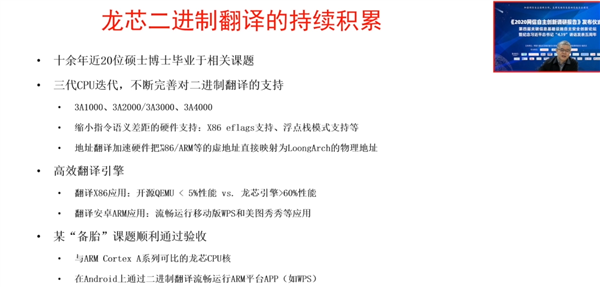
In this speech, Hu Weiwu introduced the development of Loongson, particularly the LoongArch instruction set. The independent aspect does not require further elaboration; it can also achieve compatibility with MIPS, ARM, and x86 processors through binary translation.
Regarding instruction set translation, aside from technical issues, the biggest trouble lies in legal matters. However, this is no longer a major problem as Loongson has engaged domestic and international intellectual property teams to sort this out, ensuring that even binary translations of other instruction set systems do not involve patent disputes.
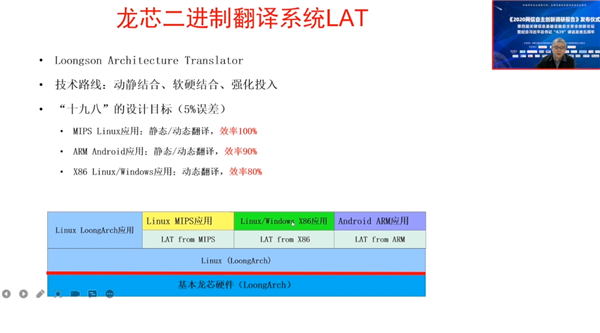
Of course, translating other instructions also faces efficiency issues. Fortunately, the translation efficiency of LoongArch for MIPS instructions is 100%, and for ARM, it can reach 90%.
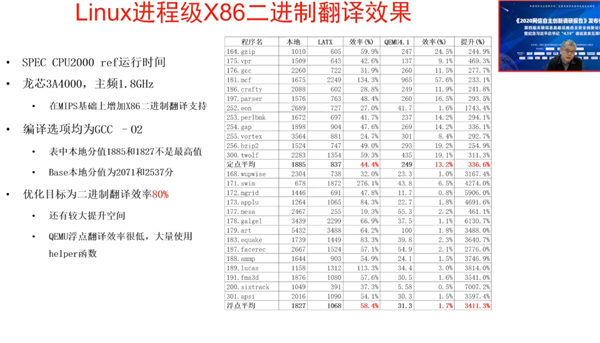
The most challenging is x86, where the translation efficiency under Linux can reach 80%, but under Windows, it drops to 70%. However, further optimizations will be made in the future.
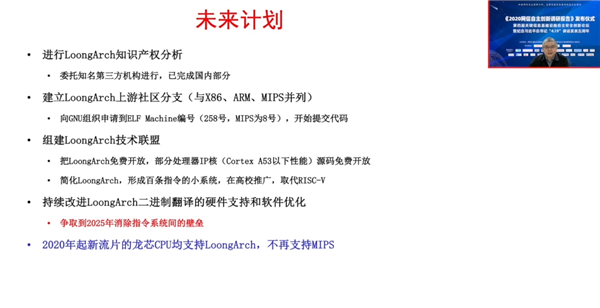
Finally, regarding the future development of the LoongArch instruction set, Loongson will continue to conduct intellectual property analysis and establish upstream community branches for LoongArch, while also forming the LoongArch alliance. On one hand, LoongArch will be freely available, and on the other hand, it will be promoted in universities to replace RISC-V.
Loongson’s goal is to eliminate the barriers between instruction sets by 2025, meaning that within five years, Loongson aims to completely resolve the compatibility issues between different instruction sets, which is of great significance.