Antibody
Antibodies have been analyzed by X-ray crystallography, revealing that Ig consists of four polypeptide chains connected by varying numbers of interchain disulfide bonds. Ig can form a “Y” shaped structure, known as an Ig monomer, which is the basic unit of antibodies.
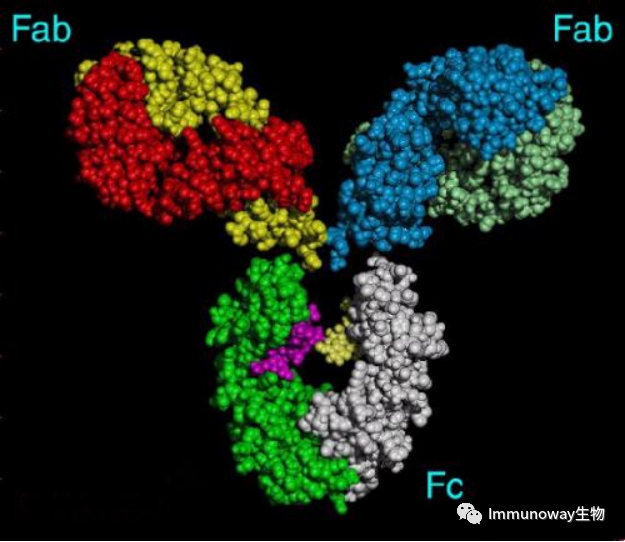
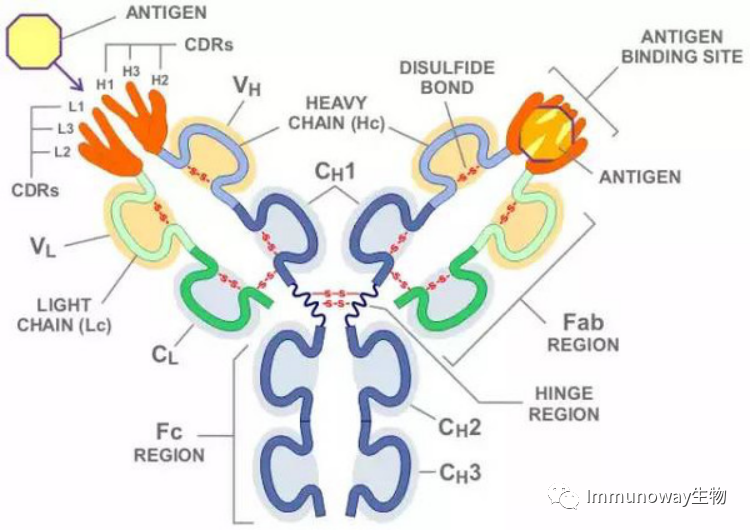
Basic Unit of Antibody
The primary antibody specifically recognizes and binds to the antigen, such as the commonly used primary antibody in protein detection. The secondary antibody binds to the primary antibody, acting as an antibody to the antibody, primarily used to detect the presence of the antibody. In vitro protein detection, the primary antibody targets the antigen, while the secondary antibody targets the primary antibody.

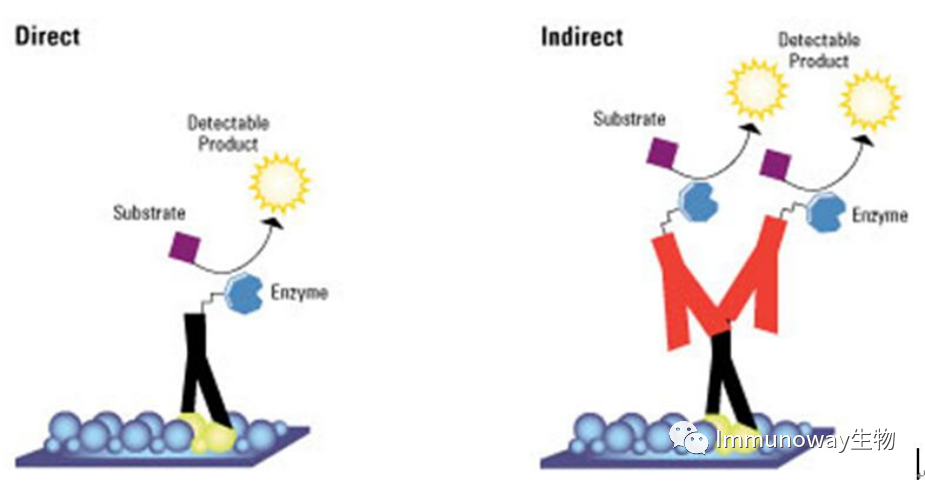
The black “Y” represents the primary antibody, while the red “Y” represents the secondary antibody.
Selection of Secondary Antibodies
The selection of secondary antibodies for IF depends on the species source, type, and subtype of the primary antibody, as well as the detection segment and the labeling of different fluorophores.
 1. Distinguishing the Species Source of Primary Antibodies
The host source of the secondary antibody should differ from that of the primary antibody. The primary antibody can come from various sources, such as rabbits, mice, sheep, monkeys, and chickens… The secondary antibody should be chosen accordingly, e.g., anti-rabbit, anti-mouse, anti-sheep…
Examples of Secondary Antibody Choices:
| Name | Catalog Number | Species | Application |
| Rabbit Anti Sheep IgG (H&L) – Alexa Fluor 488 | RS3230 | Sheep | Elisa, IF/ICC, FCM |
| Rabbit Anti Rat IgG (H&L) – Alexa Fluor 488 | RS3229 | Rat | Elisa, IF/ICC, FCM |
| Goat Anti Rabbit IgG (H&L) – Alexa Fluor 488 | RS3211 | Rabbit | Elisa, IF/ICC, FCM |
| Goat Anti Pig IgG (H&L) – Alexa Fluor 488 | RS3210 | Pig | Elisa, IF/ICC, FCM |
| Goat Anti Mouse IgG (H&L) – Alexa Fluor 488 | RS3208 | Mouse | Elisa, IF/ICC, FCM |
| Rabbit Anti Monkey IgG (H&L) – Alexa Fluor 488 | RS3226 | Monkey | Elisa, IF/ICC, FCM |
| Goat Anti Human IgG (H&L) – Alexa Fluor 488 | RS3202 | Human | Elisa, IF/ICC, FCM |
| Rabbit Anti Horse IgG (H&L) – Alexa Fluor 488 | RS3220 | Horse | Elisa, IF/ICC, FCM |
| Rabbit Anti Guinea Pig IgG (H&L) – Alexa Fluor 488 | RS3219 | Guinea Pig | Elisa, IF/ICC, FCM |
| Rabbit Anti Goat IgG (H&L) – Alexa Fluor 488 | RS3218 | Goat | Elisa, IF/ICC, FCM |
| Mouse Anti Duck IgY (H&L) – Alexa Fluor 488 | RS3233 | Duck | Elisa, IF/ICC, FCM |
| Rabbit Anti Donkey IgG (H&L) – Alexa Fluor 488 | RS3216 | Donkey | Elisa, IF/ICC, FCM |
| Rabbit Anti Dog IgG (H&L) – Alexa Fluor 488 | RS3215 | Dog | Elisa, IF/ICC, FCM |
| Goat Anti Chicken IgY (H&L) – Alexa Fluor 488 | RS3201 | Chicken | Elisa, IF/ICC, FCM |
| Rabbit Anti Cat IgG (H&L) – Alexa Fluor 488 | RS3213 | Cat | Elisa, IF/ICC, FCM |
| Rabbit Anti Bovine IgG (H&L) – Alexa Fluor 488 | RS3212 | Bovine | Elisa, IF/ICC, FCM |
2. Distinguishing the Type, Subtype, and Segment of Primary Antibodies
Primary antibodies can be classified into five types based on the amino acid composition and arrangement of their heavy chain constant regions: IgM, IgD, IgG, IgA, and IgE, corresponding to the μ, δ, γ, α, and ε chains. Different classes of Ig have distinct characteristics, such as the number and position of disulfide bonds both within and between chains, the number of domains, and the length of the hinge region. Even within the same class of Ig, the amino acid composition of the hinge region and the number and position of disulfide bonds in the heavy chain can vary, allowing for further subclassification. For example, human IgG can be divided into four subclasses: IgG1, IgG2, IgG3, and IgG4; human IgA can be divided into IgA1 and IgA2 subclasses.
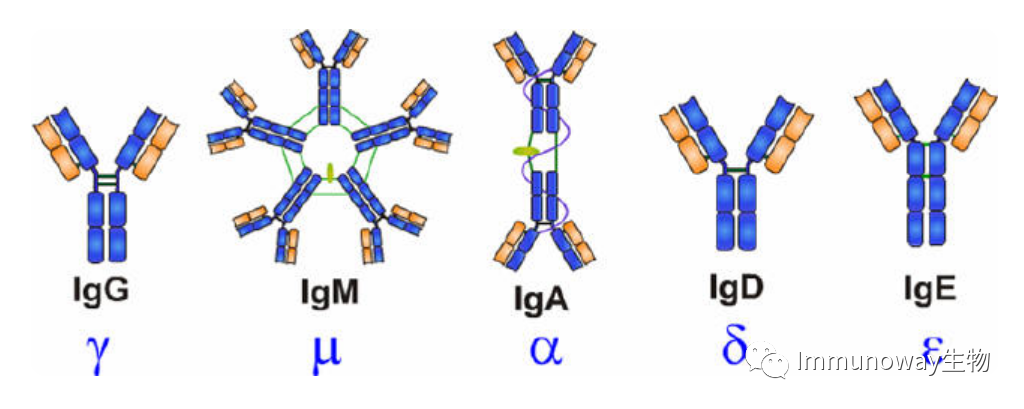
Antibody Classification
Light chains can be classified into two types: kappa (κ) chains and lambda (λ) chains. Based on this, Ig can be divided into two types: κ type and λ type.
Ig hydrolyzed by papain can be cleaved into two identical Fab segments and one Fc segment at the hinge region where the two heavy chains are linked by disulfide bonds near the N-terminus.
If the primary antibody is derived from a mouse, the following secondary antibodies can be chosen:
| Name | Catalog Number | Species | Application |
| FITC*Polyclonal Goat Anti Mouse IgA | RS030611 | Mouse IgA | WB, IHC-p, IF/ICC, ELISA |
| FITC*Polyclonal Rabbit Anti Mouse IgG(h+l) | RS030613 | Mouse IgG(h+l) | WB, IHC-p, IF/ICC, ELISA |
| FITC*Polyclonal Goat Anti Mouse IgG2a | RS030606 | Mouse IgG2a | WB, IHC-p, IF/ICC, ELISA |
| FITC*Polyclonal Goat Anti Mouse IgG3 | RS030609 | Mouse IgG3 | WB, IHC-p, IF/ICC, ELISA |
| FITC*Polyclonal Goat Anti Mouse Kappa | RS030614 | Mouse Kappa | WB, IHC-p, IF/ICC, ELISA |
| FITC*Polyclonal Goat Anti Mouse Lambda | RS030615 | Mouse Lambda | WB, IHC-p, IF/ICC, ELISA |
| FITC*Polyclonal Goat Anti Mouse IgM(u chain) | RS030610 | Mouse IgM(uchain) | WB, IHC-p, IF/ICC, ELISA |
| FITC*Polyclonal Goat Anti Mouse IgG1 | RS030608 | Mouse IgG1 | WB, IHC-p, IF/ICC, ELISA |
| FITC*Polyclonal Goat Anti Mouse IgG2b | RS030607 | Mouse IgG2b | WB, IHC-p, IF/ICC, ELISA |
If detecting human-derived antibodies, the following secondary antibodies can be chosen:
| Name | Catalog Number | Species | Application |
| Goat Anti Human IgG Fab – Alexa Fluor 488 | RS3203 | Human | Elisa, IF/ICC, FCM |
| Goat Anti Human IgG gamma chain – Alexa Fluor 488 | RS3205 | Human | Elisa, IF/ICC, FCM |
| Goat Anti Human IgG+IgM+IgA – Alexa Fluor 488 | RS3206 | Human | Elisa, IF/ICC, FCM |
| Goat Anti Human IgM mu chain – Alexa Fluor 488 | RS3207 | Human | Elisa, IF/ICC, FCM |
| Rabbit Anti Human IgG (H&L) – Alexa Fluor 488 | RS3221 | Human | Elisa, IF/ICC, FCM |
| Rabbit Anti Human IgG Fc – Alexa Fluor 488 | RS3222 | Human | Elisa, IF/ICC, FCM |
| Rabbit Anti Human IgG gamma chain – Alexa Fluor 488 | RS3223 | Human | Elisa, IF/ICC, FCM |
| Rabbit Anti Human IgG+IgM+IgA – Alexa Fluor 488 | RS3224 | Human | Elisa, IF/ICC, FCM |
| Rabbit Anti Human IgM – Alexa Fluor 488 | RS3225 | Human | Elisa, IF/ICC, FCM |
| Mouse Anti Human IgA – Alexa Fluor 488 | RS3234 | Human | Elisa, IF/ICC, FCM |
| Mouse Anti Human IgG Fab – Alexa Fluor 488 | RS3235 | Human | Elisa, IF/ICC, FCM |
| Mouse Anti Human IgG Fc – Alexa Fluor 488 | RS3236 | Human | Elisa, IF/ICC, FCM |
| Mouse Anti Human Ig kappa chain – Alexa Fluor 488 | RS3244 | Human | Elisa, IF/ICC, FCM |
| Mouse Anti Human Ig lambda chain – Alexa Fluor 488 | RS3245 | Human | Elisa, IF/ICC, FCM |
| Goat Anti Human IgG F(ab’)2 – Alexa Fluor 488 | RS3246 | Human | Elisa, IF/ICC, FCM |
| Rabbit Anti Human IgG F(ab’)2 – Alexa Fluor 488 | RS3247 | Human | Elisa, IF/ICC, FCM |
| Mouse Anti Human IgM – Alexa Fluor 488 | RS3238 | Human | Elisa, IF/ICC, FCM |
| Goat Anti Human IgG (H&L) – Alexa Fluor 488 | RS3202 | Human | Elisa, IF/ICC, FCM |
| Goat Anti Human IgG Fc – Alexa Fluor 488 | RS3204 | Human | Elisa, IF/ICC, FCM |
3. Selection of Different Fluorophore Labels
FITC, or fluorescein isothiocyanate, is a widely used fluorophore that emits a bright yellow-green fluorescence. Its advantages include a small molecular weight, allowing several FITC molecules to label each antibody, providing good contrast; however, its disadvantage is relatively rapid quenching, and under weakly acidic conditions, the fluorescence of the FITC group is weaker.
Rhodamine and its derivatives emit yellow-red fluorescence, including TRITC and Texas Red. Rhodamine and its derivatives provide a distinct contrast with the green fluorescence of FITC, making them suitable for dual labeling or comparative staining. Their fluorescence quenching is slow, but their fluorescence intensity is relatively weak.
Cy dyes are a class of fluorophores, including green Cy2, yellow-red Cy3, red Cy5, and near-infrared Cy5.5, each differing slightly in structure and thus in absorption and emission wavelengths. They are highly water-soluble and photostable, with high quantum yield and insensitivity to pH and other environmental factors, making them suitable for multiplex staining.
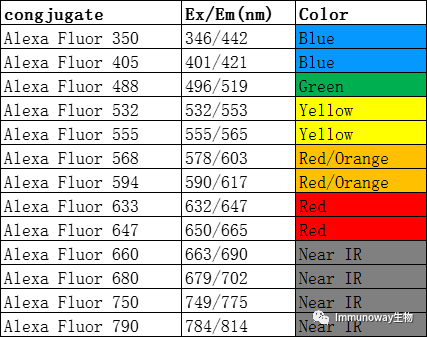
Alexa Fluor is a series of fluorophores developed by Molecular Probes, Inc., which are particularly suitable for laser confocal applications. Their characteristics include excitation peaks that match laser lines, narrow emission peaks that facilitate multiple fluorescent labels. Their fluorescence intensity is superior to other dyes with similar spectral characteristics; they have better photostability, allowing for longer image collection times; they have good pH tolerance, maintaining high fluorescence levels across a wide pH range; and they are well water-soluble, preventing precipitation and aggregation of Alexa Fluor conjugated antibodies, resulting in excellent overall performance.

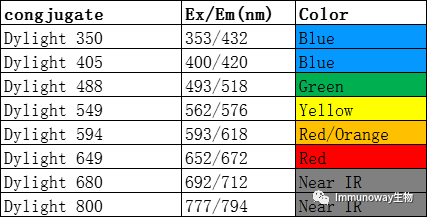
DyLight is a new type of fluorophore that, compared to traditional fluorophores, has a relatively small molecular weight, allowing more DyLight to be labeled on a large molecule. Additionally, individual DyLight fluorophores have stronger fluorescence intensity and better specificity; DyLight is more photostable, meaning it has higher resistance to quenching, and comes in a variety of types, DyLight 350-800, with many fluorescence options, providing excellent overall performance. Furthermore, DyLight also offers near-infrared and far-infrared secondary antibodies compatible with the Odyssey system, namely DyLight 680 and DyLight 800.
Examples of Secondary Antibody Choices:
| Name | Catalog Number | Species | Application |
| Goat Anti Mouse IgG (H&L) – Alexa Fluor 532 | RS3308 | Mouse | Elisa, IF/ICC, FCM |
| Goat Anti Mouse IgG (H&L) – Alexa Fluor 680 | RS4008 | Mouse | IF/ICC, FCM, WB |
| Goat Anti Mouse IgG (H&L) – Alexa Fluor 750 | RS4108 | Mouse | Elisa, IF/ICC, FCM |
| Goat Anti Mouse IgG (H&L) – Alexa Fluor 790 | RS4208 | Mouse | Elisa, IF/ICC, FCM |
| Goat Anti Mouse IgG (H&L) – Alexa Fluor 488 | RS3208 | Mouse | Elisa, IF/ICC, FCM |
| Goat Anti Mouse IgG (H&L) – Alexa Fluor 594 | RS3608 | Mouse | Elisa, IF/ICC, FCM |
| Goat Anti Mouse IgG (H&L) – Alexa Fluor 647 | RS3808 | Mouse | Elisa, IF/ICC, FCM |
| Goat Anti Mouse IgG (H&L) – Alexa Fluor 405 | RS3108 | Mouse | Elisa, IF/ICC, FCM |
| Goat Anti Mouse IgG (H&L) – Alexa Fluor 633 | RS3708 | Mouse | Elisa, IF/ICC, FCM |
| Goat Anti Mouse IgG (H&L) – Alexa Fluor 555 | RS3408 | Mouse | Elisa, IF/ICC, FCM |
| Goat Anti Mouse IgG (H&L) – Alexa Fluor 568 | RS3508 | Mouse | Elisa, IF/ICC, FCM |
| Goat Anti Mouse IgG (H&L) – Alexa Fluor 660 | RS3908 | Mouse | Elisa, IF/ICC, FCM |
| Goat Anti Mouse IgG (H&L) FITC | RS2308 | Mouse | IF/ICC, FCM |
| Goat Anti Mouse IgG (H&L) – Alexa Fluor 350 | RS3008 | Mouse | Elisa, IF/ICC, FCM |
| DyLight 488, Goat Anti Mouse IgG | RS23210 | Mouse | IF/ICC, FCM |
| Dylight 680, Goat Anti Mouse IgG | RS23710 | Mouse | IF/ICC, FCM, WB |
| Dylight 594, Goat Anti Mouse IgG | RS23410 | Mouse | IF/ICC, FCM |
| Dylight 800, Goat Anti Mouse IgG | RS23910 | Mouse | IF/ICC, FCM, WB |
| Dylight 649, Goat Anti Mouse IgG | RS23610 | Mouse | IF/ICC, FCM |
| Dylight 549, Goat Anti Mouse IgG | RS23310 | Mouse | IF/ICC, FCM |
| DyLight 350, Goat Anti Mouse IgG | RS23010 | Mouse | IF/ICC, FCM |
| DyLight 405, Goat Anti Mouse IgG | RS23110 | Mouse | IF/ICC, FCM |
Color Matching for Secondary Antibodies
When performing multicolor detection, avoid cross-reactivity between antibodies, and ensure the primary antibodies are from different species sources. Avoid spectral overlap between fluorophores.
Commonly used dual combinations include Alexa Fluor 488/Alexa Fluor 594, Alexa Fluor 488/Alexa Fluor 555.
Commonly used triple combinations include Alexa Fluor 488/Alexa Fluor 594/Alexa Fluor 647.
Commonly used quadruple combinations include Alexa Fluor 488/Alexa Fluor 555/Alexa Fluor 594/Alexa Fluor 647.
Advantages of Immunoway Secondary Antibodies

1 Over 1000 varieties;
2 Corresponding secondary antibodies can be selected for primary antibodies sourced from rabbits, mice, sheep, monkeys, chickens, pigs, dogs, etc.;
3 Coverage for antibodies from the same species source, including different categories, subtypes, and segments;
4 Multiple options available, including FITC, Alexa Fluor series, DyLight series, etc.;
5 Some items are in stock, reasonably priced, and offer high cost-performance ratio.
If you have any needs, you can click on the “Read Original” link below for inquiries.
Current Promotions at Immunoway:
Gift Benefits│Choose your gift when you reach a certain order amount!
Product Benefits│Label and internal reference gift package!
Other promotions can be found by following the information released by authorized Immunoway distributors.
Previous Related Links:
|
Related to Immunofluorescence |
| IF│Applications, Experimental Procedures, and Process Analysis |
|
Related to Immunohistochemistry |
||
|
Summary of Experimental Methods |
Immunohistochemistry (IHC)│Common Questions and Analysis Collection | |
| The same HRP, different color development systems | Pathological Grade Secondary Antibodies│PK with Top International Brands | Immunohistochemistry-specific antibodies│Exclusive Luxury Experience |
| When detecting proteins, WB OK, IF, IHC, why not OK? |
|
Related to Western Blot |
||
|
Western Blot│Common Questions and Analysis Collection of Experimental Steps |
Western Blot│RIPA is not an all-purpose lysis buffer | Experimental Methods│What to do if you don’t want to do WB anymore? |
| Western Blot│Principles and Precautions for Reference Selection |
Company Profile:
ImmunoWay Biotechnology Company (referred to as Immunoway) was founded in 2002 and registered its brand in Texas, USA, in 2012.
The company began R&D on immunohistochemistry-specific antibodies in 2014, guided by internationally renowned experts in monoclonal antibodies. The immunogens are designed for immunohistochemistry experiments, and the screening of monoclonal cell lines and antibody validation have been conducted using thousands of positive and negative slides to clarify tissue localization and cellular sub-localization. The antibodies are highly specific, sensitive, and produce low background, developed and produced according to the registration requirements for in vitro diagnostic reagents. Clinical immunohistochemistry is applied in the auxiliary diagnosis and differential diagnosis in pathology, providing objective guidance for disease treatment. Currently, the types of antibodies have reached nearly 200 types, covering the majority of detection indicators required for tumor pathology diagnosis, such as breast cancer, cervical cancer, colon cancer, gastric cancer, liver cancer, lymphoma, prostate cancer, thyroid cancer, etc.
Since its establishment, the company has focused on the R&D and production of antibodies, with over 15,000+ types of polyclonal antibodies, over 2,000+ types of monoclonal antibodies, over 700+ types of detection liquid sample Elisa kits, and over 3,000+ types of detection cell sample Cell-Based Elisa Kits, meeting the needs of a wide range of research users.
Immunoway will continue to develop and produce high-quality antibodies and related products, providing better tools for clinical and research scientists, serving the life sciences together.
Welcome to call 400-8787-807
Welcome to visit the website www.immunoway.com
For more exciting content, please long press the QR code ▼