Practical TCP Connection Reuse: Analyzing HTTP Keep-Alive Through Packet Capture
In modern web architecture, keep-alive connections have become a key technology for improving performance and reducing latency. This article uses real Wireshark packet capture data to fully restore a complete local loopback communication process, focusing on the analysis of the TCP connection reuse mechanism, helping developers truly understand the implementation and value of “keep-alive connections” in HTTP/1.1.
🌐 Background: A Typical Scenario of Local Loopback Communication
This packet capture records a complete TCP session occurring within the 192.168.1.100 local machine:
- • Client Port: 56464
- • Server Port: 42100
Although the communication occurs on the local machine, its protocol behavior is identical to that of remote communication—making it an ideal sample for observing and learning the TCP/HTTP interaction mechanism.
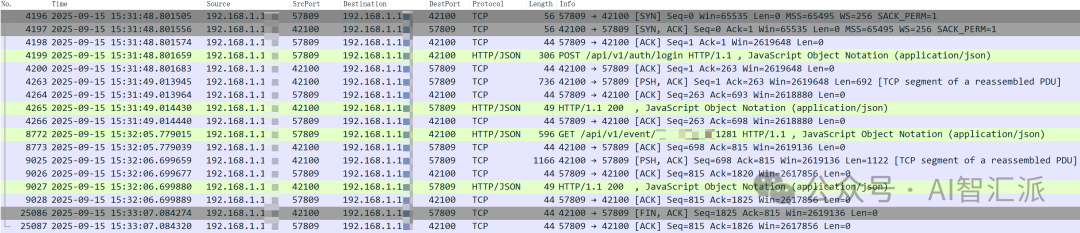
🔄 Breakdown of the Entire Communication Lifecycle
The entire session consists of six key stages, clearly demonstrating the establishment, reuse, and closure of the TCP connection:
- 1. TCP three-way handshake to establish connection
- 2. Client sends login request (POST)
- 3. Server returns login response (HTTP 200, chunked transfer)
- 4. Client initiates business request (GET)
- 5. Server returns business data (HTTP 200, large data chunked)
- 6. Server actively closes the connection (FIN)
🤝 Establishing TCP Connection: Standard Three-Way Handshake Process
Packet 4196: Client → Server [SYN]
- • Flags: SYN
- • Initial Sequence Number: Seq=0
- • Window Size: Win=65535
- • Negotiated Parameters: MSS=65495, WS=256, SACK_PERM
Packet 4197: Server → Client [SYN, ACK]
- • Acknowledges Client SYN: Ack=1
- • Server’s Initial Sequence Number: Seq=0
Packet 4198: Client → Server [ACK]
- • Acknowledges Server SYN: Ack=1
- • Client’s Sequence Number advances to: Seq=1
✅ At this point, the TCP connection is officially established, and application layer data transmission can begin.
🔐 Login Phase: HTTP POST Request and Chunked Response
Packet 4199: Client Sends Login Request
- • Method:
<span>POST /api/v1/auth/login</span> - • Content Type:
<span>application/json</span> - • Data Length: 306 bytes (including TCP header)
- • TCP Sequence Number advances: 1 → 263
Packet 4200: Server Acknowledges Receipt
- • Ack=263, indicating complete receipt of POST data
Packets 4263 + 4264: Server Chunked Response
- • Total Data Volume Approximately 697 bytes (minus TCP header)
- • Uses
<span>[PSH, ACK]</span>flag to prompt the receiver to process immediately - • Wireshark marks as “reassembled PDU”, requiring reassembly to parse the complete HTTP response
Packet 4266: Client Acknowledges Complete Receipt
- • Ack=698, confirming that the server has finished sending data
Key Point: At this point, the connection is not closed—providing a basis for connection reuse for subsequent requests.
📈 Business Phase: Core Reflection of Keep-Alive Connections
Packet 8772: Client Sends GET Request (10 seconds later)
- • Path:
<span>GET /api/v1/event/1281</span> - • Data Length: 596 bytes
- • TCP Sequence Number continues from 263 to 815
📌 This is direct evidence of a “keep-alive connection”: The client did not re-establish the TCP connection but instead reused the existing connection to send a new request. This is a typical manifestation of the Keep-Alive mechanism enabled by default in HTTP/1.1.
Packet 8773: Server Acknowledges Receipt of GET Request
Packets 9025 + 9026: Server Chunked Response of Large Data
- • Total Data Volume Approximately 1171 bytes
- • Sequence Number advances from 698 to 1825
- • Client confirms receipt completion in Packet 9028 (Ack=1825)
🚪 Connection Closure: Server Actively Initiates FIN
Packet 25086: Server Sends [FIN, ACK] (about 60 seconds later)
- • Indicates that the server has decided to close the connection
- • Possible Trigger Condition: Idle Timeout
Packet 25087: Client Acknowledges FIN
- • Ack=1826 (FIN occupies one sequence number)
- • Connection enters half-closed state
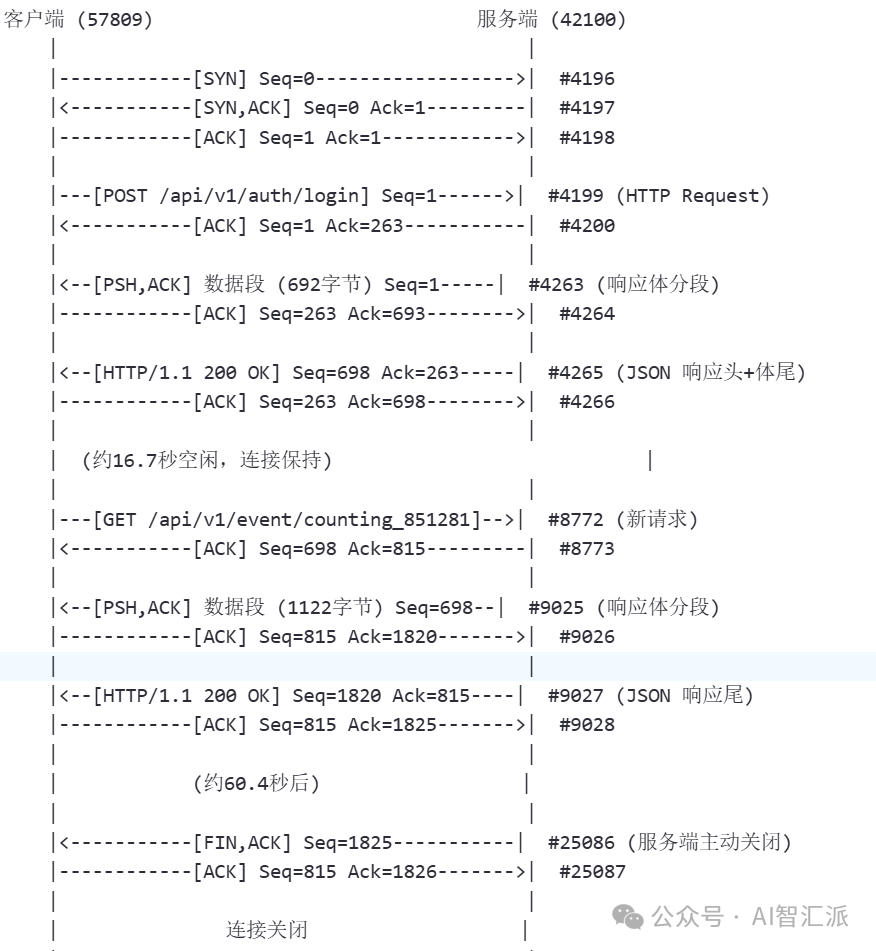
TCP + HTTP Session Timing Diagram
🔍 Technical Analysis: What is a “Keep-Alive Connection”?
In this communication, “keep-alive connections” are reflected in:
- • One TCP handshake, multiple HTTP request reuse The login request and business data request reused the same TCP connection, avoiding the overhead of repeated handshakes.
- • Reduced Latency, Increased Throughput Eliminating three-way handshakes (approximately 1.5 RTT) and slow start processes, especially enhances performance in short, high-frequency request scenarios (such as API calls, microservice communications).
- • Resource Optimization Reduces consumption of system resources such as port usage, connection table entries, and memory buffers.
- • Complies with HTTP/1.1 Default Behavior Unless explicitly specified with
<span>Connection: close</span>, the connection remains open by default.
📊 Performance Comparison Illustration:
Scenario TCP Handshake Count Total RTT (Assumed) Short Connection (new connection for each request) 2 times 3 RTT Long Connection (reuse) 1 time 1 RTT
🌐 Analogous Understanding:
Imagine you are calling customer service:
- • The first time: you say, “I want to log in” → Customer service verifies → Replies “Login successful” ✅ (Packets 4199-4266)
- • Then youdon’t hang up, and 10 seconds later continue with, “Help me check event 1281” 📞 (Packet 8772)
- • Customer service continues to respond to you → Finally hangs up (Packet 25086)
When asking the second question, you do not need to make a second call (i.e., no need for a three-way handshake) because the first call has not ended!
Comparison of Connection Reuse in HTTP/2 and HTTP/3
| Feature | HTTP/1.1 | HTTP/2, HTTP/3 |
| Connection Reuse | ✅ Single connection serial reuse | ✅ Single connection +Multiplexing (parallel) |
| Need for Multiple TCP | ✅ Typically opens 6-8 connections | ❌ Only requires 1 connection |
| Head-of-Line Blocking | ✅ Yes (serial) | ❌ No (streams independent) |
| Performance | Average | Higher (especially for many small files) |
✅ Conclusion
This packet capture fully presents:
- • The entire lifecycle of a TCP connection from establishment to closure
- • The actual operating mechanism of “keep-alive connections” under HTTP/1.1
- • The underlying details of chunked data transmission and reassembly
- • The impact of server idle timeout strategies on connection management
For us, understanding keep-alive connections not only aids in performance tuning but is also essential knowledge for building high-availability, low-latency systems. In today’s world of increasingly popular cloud-native and microservice architectures, mastering connection reuse mechanisms means mastering the key to system efficiency.