|
“The Performance Evaluation Action for Typical Server Application Scenarios” has officially launched!—— To standardize the construction of the ARM full-stack standard system, promote product technology iteration and upgrade, better showcase the advantages of ARM architecture and computing power, and support excellent products and solutions in brand enhancement and market expansion through official authoritative certification, the “Performance Evaluation Action for Typical Server Application Scenarios” (abbreviated as: Evaluation Action) has recently been officially launched by the Green Computing Industry Alliance! This evaluation action includes big data, distributed storage, web applications, high-performance computing, centralized relational database management systems, ARM-native cloud mobile phones, and virtualization as seven typical server application scenarios. |
Today, we bring you a detailed interpretation of “Performance Testing Methods for Server Application Scenarios: Distributed Storage”.
The drafting units of this document include Beijing XSKY Technology Co., Ltd., Weinet Cloud (Shenzhen) Technology Co., Ltd., China Electronics Standardization Institute, Tianjin Feiteng Information Technology Co., Ltd., Huawei Technologies Co., Ltd., Shenzhen Jiechong Technology Co., Ltd., and we thank these units for their strong support.

We welcome you to continue following the series of articles on “Performance Testing Methods for Server Application Scenarios”, and we will bring you the series of exhibitions on products/solutions evaluated through “Performance Testing Methods for Server Application Scenarios: Distributed Storage”!
01
Background of “Performance Testing Methods for Server Application Scenarios: Distributed Storage”
With the gradual implementation of applications and the rapid rise of industries, the importance and scale of data are continuously increasing in the tide of informatization development. As the underlying infrastructure for data, the construction of storage systems has become a particularly important part of informatization construction. How to manage data storage reasonably and simplify it while ensuring data security, improve the read and write performance of storage systems, enhance data processing efficiency, and reduce energy consumption, maximizing the value of storage systems, has become a major consideration standard for storage systems.
The “openness” and “horizontal scalability” of distributed storage ensure that customers’ application systems can connect to the underlying storage facilities in the smoothest way, addressing issues such as load surges and tidal patterns in data center applications that are difficult to predict accurately, achieving interconnection, breaking down data scheduling barriers, breaking through the “data prison”, and enjoying the “data dividend”, thus constructing reasonable storage solutions.
According to IDC reports, distributed storage currently serves as the underlying infrastructure mainly for industries such as government, telecommunications, education, finance, media, manufacturing, healthcare, transportation, and energy, with sales in China growing by 45.5% in 2021 compared to 2020, gradually being recognized by the market.
Moreover, the interface types of distributed storage systems are also diversified, targeting three types of storage interfaces: block, file, and object, each designed for different application scenarios.
The block storage interface is mainly aimed at structured data scenarios, such as databases, cloud platforms, and virtualization, where response latency requirements are high.
The file storage interface is primarily for unstructured data scenarios, such as non-linear editing, video monitoring, images, audio, and other high-bandwidth massive data business scenarios.
The object storage interface is mainly targeted at scenarios such as archiving, data analysis, and internet applications involving massive data and high concurrency.
Due to the characteristics of distributed storage, which integrates the computing, memory, hard disk, and network resources of all servers, the overall capability is mainly dependent on the underlying hardware facilities, while the CPU primarily determines the performance in storage systems.
Depending on the interface type and business scenario, the CPU computing power requirements for distributed storage systems vary. For example, low-latency high IOPS applications mainly consider the CPU’s clock speed performance; the higher the clock speed, the higher the I/O efficiency of the storage system, leading to higher IOPS and response latency. In high-concurrency and high-bandwidth application scenarios, the more CPU cores there are, the faster the supported concurrency and bandwidth. Therefore, the performance of the CPU directly determines whether distributed storage can effectively support the performance requirements of various industries’ business systems.
02
Testing Methods
The overall testing process for distributed storage is conducted using open-source, general-purpose, and industry-recognized testing tools to maximize the simulation of data flows for various business interfaces and scenarios. It involves simulating tests for different interfaces and data granularities of data business I/O, systematically evaluating the overall performance of the storage system under differentiated CPU conditions.
In terms of simulating business-type data, the testing tools simulate various data models such as large files, small files, and databases, and evaluate the performance indicators of the storage system under different CPU conditions based on the performance metrics of various data models. Among them, the performance metric for small files is OPS (the number of files that can be read or written per second), while for large files, it is the read/write bandwidth (the volume of data written and read per second). For database-type applications, the evaluation focuses on the number of database operations per second and the latency generated by each operation, with the overall performance of the storage system evaluated based on OPS, IOPS, bandwidth, and latency.
The selection of test cases corresponds to different data testing granularities based on different interfaces, assessing the overall performance indicators and variables of the storage system under various data I/O granularities.
From the perspective of interface types, file and object storage mainly target unstructured data, while block storage is mainly for structured data. Due to the inherent characteristic of data having variable sizes, the storage testing data I/O granularity adopts a regional specification, namely small data block I/O granularity (4K), general data block I/O granularity (1M), and large data block I/O granularity (16M). Business systems can compare their storage data I/O models with the testing granularity indicators to assess whether the storage system meets the performance requirements of uninitiated businesses.
-
Test Configuration Description
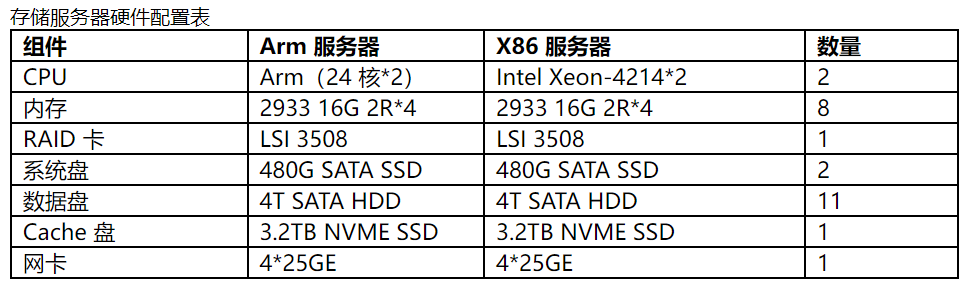
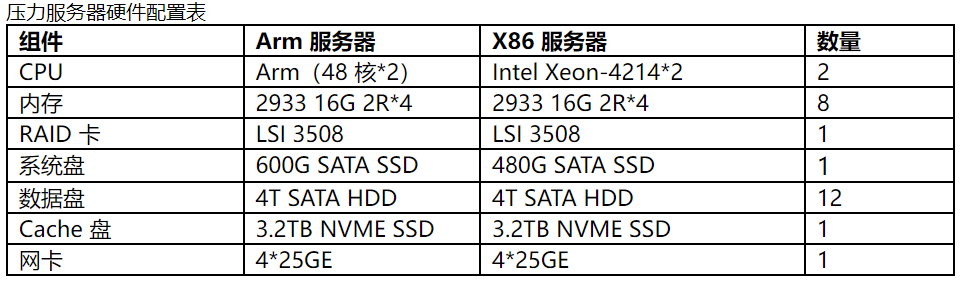
This test utilized four Arm servers and four X86 servers for comparative testing, with four servers used as stress machines. The tested Arm servers used XSKY’s Tianhe Xiangyu, an enterprise-level software-defined storage product aimed at the Xinchuang ecosystem, along with the domestic Galaxy Kirin operating system version 10, while the X86 servers utilized the open-source distributed storage software Ceph and CentOS system. The detailed hardware configuration information for the storage servers and pressure servers is shown in the table below.
|
|


Caption: The Tianhe Xiangyu distributed storage system is an enterprise-level software-defined storage product independently developed and owned by XSKY, tailored for the Xinchuang ecosystem. It has undergone deep adaptation and optimization based on the CPU, operating systems, and applications of the Xinchuang ecosystem, meeting the complex requirements of enterprise-level applications in terms of stability, performance, reliability, and usability, thus providing reliable storage infrastructure support for large-scale Xinchuang cloud environments.
03
Testing Environment and Results
|
Introduction to the Testing Environment—— This evaluation action is undertaken by the China Electronics Standardization Institute, and the alliance collaborates with the institute to create the open laboratory “GCC Open Lab”. Enrolled units can apply for a professional typical application scenario hardware and software compatibility testing environment from the China Electronics Standardization Institute, or they can build their own testing environment, with experts arranged for remote guidance and review to ensure the process and results are authoritative. |
All test data or functional implementation results in this report are sourced from the joint laboratory of the Green Computing Industry Alliance, providing objective and fair testing data while ensuring the testing environments are as similar as possible.
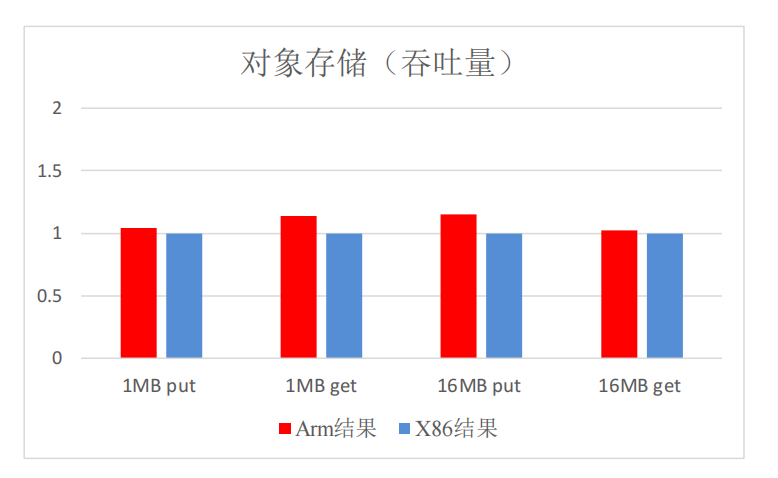
In the object storage testing items, the random small I/O performance results for Arm lead significantly, thanks to the implementation method of object storage in the XSKY SDS Tianhe Xiangyu product being superior to the open-source Ceph, as well as the multi-core concurrency advantages of Arm servers. In the 1MB and 16MB sequential large I/O tests, the Arm results average about 9% ahead of the X86 results.
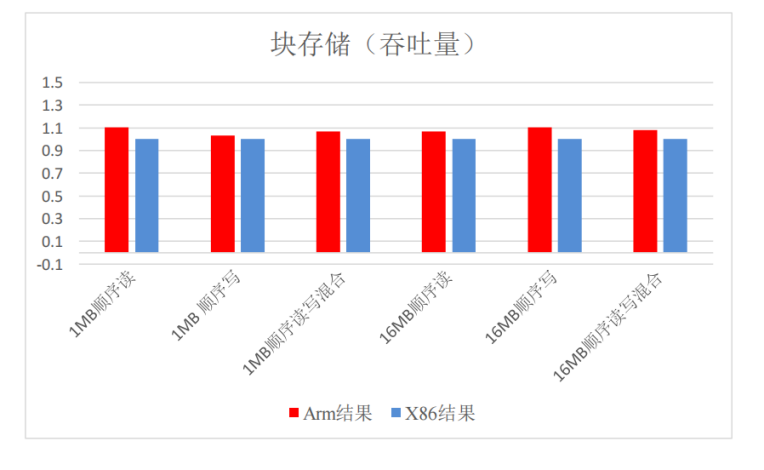
The test results for the block storage scenario show that the random small I/O performance results for Arm lead significantly, with Arm results averaging about 8% ahead of X86 results in the 1MB and 16MB sequential large I/O tests. NVMe SSDs were used as caches for HDDs in the tests, greatly enhancing system performance.
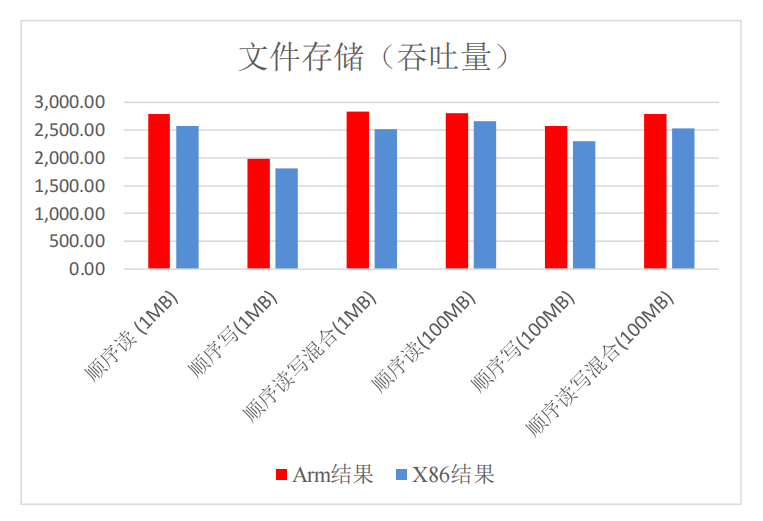
The test results for the file storage scenario show that Arm results average about 10% ahead of X86 results. NVMe SSDs were used as the metadata pool, with HDDs serving as the data pool.
Generally speaking, in balanced/capacity storage scenarios, CPU computing power is not the bottleneck. However, some Arm servers possess hardware compression capabilities, which can ensure higher storage performance and lower CPU utilization, enhancing storage efficiency. In all-flash scenarios (where all data disks are SSDs), high I/O concurrency is required. Traditional platforms face CPU performance bottleneck issues, while Arm servers can fully leverage the performance advantages of multi-core high concurrency.
04
Summary and Outlook
From the testing results of this distributed storage scenario, green computing servers based on the Arm architecture are highly competitive compared to traditional architectures. In terms of overall solutions, green computing servers combined with commercial software solutions demonstrate significant advantages over traditional architecture servers combined with open-source software solutions in this evaluation.
We welcome you to continue following the series of articles on “Performance Testing Methods for Server Application Scenarios”, and we will bring you the series of exhibitions on products/solutions evaluated through “Performance Testing Methods for Server Application Scenarios: Distributed Storage”!
In the future, the Green Computing Industry Alliance will continue to promote performance evaluations of typical computing business scenarios, driving the joint optimization of underlying server hardware and upper-layer application software to reflect the overall competitiveness of Arm full-stack solutions. At the same time, the alliance will collect more industry demands from its members, incorporate more typical server application scenarios (such as edge computing, etc.), and more green computing server configurations, making typical application scenario evaluations the core competitiveness of the Green Computing Industry Alliance.
Additionally, the alliance will conduct evaluations and research on green computing servers from more dimensions, such as artificial intelligence servers, green energy-saving (power management), etc. The alliance will also study the system and mechanism to promote the implementation of alliance standards through evaluation certification, and carry out preliminary research and testing environment updates for the latest green computing technology standards, laying the foundation for subsequent compliance testing and certification services.
The Green Computing Industry Alliance will continue to promote certification activities for green computing technology products, services, and management, enhancing the compliance, compatibility, and quality consistency of products and services, facilitating product interoperability, and building trust throughout the entire industry chain. The alliance is committed to promoting the acceptance of certification results based on alliance standards by end-users and all stakeholders, fully reflecting the value of standards and ensuring their practical application!
*Thanks to XSKY for providing support materials for this article
|
Welcome to Sign Up for the “Evaluation Action”! Boost Brand Enhancement, Customer Recognition, and Commercial Opportunities——
|
|
Don’t Just Think About It…Participate in the “Evaluation Action”! How to Participate? The “Performance Evaluation Action for Typical Server Application Scenarios” has received enthusiastic responses from alliance members since its launch, with the first batch of products and solutions passing the evaluation to be officially released at the “Green Computing Industry Alliance White Paper and Standard Results Release Conference” in July. Additionally, the Green Computing Industry Alliance GCC will provide marketing support for evaluated products through various forms such as “continuous online publicity, publishing evaluation rankings, and showcasing excellent cases”.
|

Click below“Read the Original“ to go to the alliance’s official website to download and view the standard text of “GCC 7002-2020 – Performance Testing Methods for Server Application Scenarios: Distributed Storage”.
——— End of Full Text ———
About the Green Computing Industry Alliance Since its establishment in 2016, the Green Computing Industry Alliance has aimed to collaboratively build a green, open, autonomous, and shared ecological system, dedicated to promoting the development of the green computing industry, building a platform for industrial exchange and cooperation, and enhancing enterprises in fields such as PCs, servers, storage, operating systems, and databases, and promoting win-win cooperation in the computing field. It has now become a global alliance with the most complete Arm infrastructure server chip partners, including Kunpeng, Feiteng, Ampere, and Marvell.