Introduction
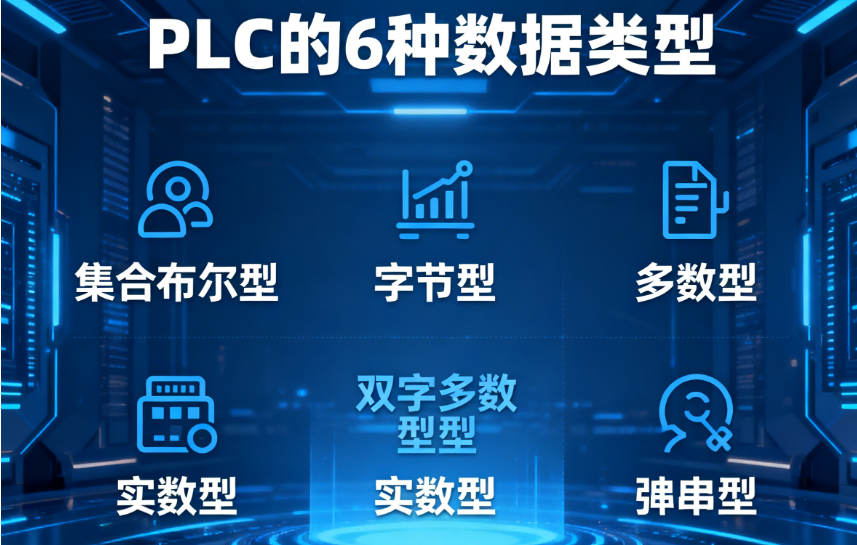
The Six Core Data Types in PLC Programming That Are “Essential for Life”
In the vast field of PLC programming and control, data types serve as the foundation that supports the stable operation and precise control of the entire system. For PLC engineers, mastering and applying various data types is an essential skill for their work.
Among them, the six data types: bool, byte, word, Dword, int, and Real, are considered “reliable partners” in an engineer’s career, playing a crucial role in numerous projects. Let us delve into these six data types and explore their unique charm through practical examples.
 1. bool: The “Little Expert” of Logical Judgments
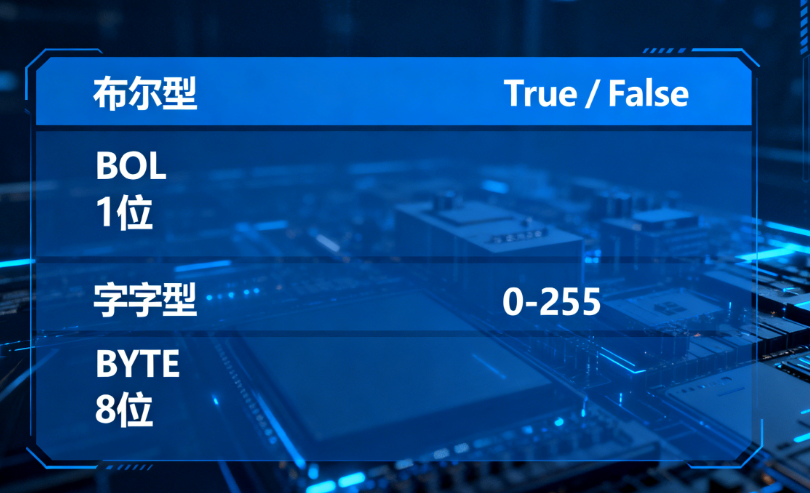
Bool, or Boolean data, has only two values: 0 (representing false) and 1 (representing true). In PLC control systems, the bool type is often used for logical judgments and state representation. For example, in a simple motor start-stop control program, we can use a bool variable “Motor_Start” to represent the motor’s start state.
When “Motor_Start” is 1, the motor starts; when “Motor_Start” is 0, the motor stops. This simple logical judgment allows engineers to easily achieve precise control over the device’s state.
For instance, in the safety detection phase of an automated production line, signals detected by sensors can be converted into bool variables. If a dangerous situation is detected (such as a person entering a hazardous area), the corresponding bool variable changes to 1, and the system immediately triggers a safety protection mechanism to stop the equipment, ensuring personnel safety.
2. byte: The “Compact Sprite” of Data Storage and Transmission
Byte, or byte data, consists of 8 bits and has a value range of 0 – 255. The byte type has wide applications in data storage and transmission.
In some simple data recording scenarios, such as recording the number of times a device has operated, since the count typically does not exceed 255, we can use the byte type to store this data, meeting the needs while saving storage space. In the communication field, bytes also play an important role.
For example, when a PLC communicates with a host computer (such as a PC), data is usually transmitted in bytes. Engineers can package and parse the data to be transmitted by bytes, ensuring accurate data transmission. For instance, a temperature sensor may send the collected temperature value to the PLC in byte form after conversion, which the PLC then processes and analyzes.
 3. word: The “Practical Player” for Medium-Scale Data Processing
Word, or word data, consists of 16 bits and has a value range of 0 – 65535. The word type is suitable for processing medium-scale data.
In some industrial control scenarios, it is necessary to set and monitor the operating parameters of devices, which may exceed the representational capacity of the byte type but do not require a larger data type; this is where the word type comes into play.
For example, in a variable frequency drive control program, we need to set the output frequency of the drive, which typically ranges from 0 – 50Hz. The word type can conveniently represent values within this range. Additionally, in some data acquisition systems, the analog signals collected may be stored and processed using the word type after analog-to-digital conversion.
4. Dword: The “Powerful Backbone” for Large-Scale Data Processing
Dword, or double word data, consists of 32 bits and has a very large value range, from 0 to 4294967295.
The Dword type is suitable for processing large-scale data and performing complex calculations. In some large industrial automation projects, involving substantial data storage and processing, such as production yield statistics and cumulative equipment operating time, using the Dword type ensures data accuracy and integrity.
For instance, in an automotive manufacturing plant, it is necessary to record production information for each vehicle, including production time, batch number, and part numbers. The data volume for this information is large, and using the Dword type can effectively store and manage this data.
Moreover, in control systems requiring high-precision calculations, such as flight control systems in aerospace, the Dword type can provide sufficient precision and range to meet computational needs.
5. int: The “Flexible Player” for Signed Integer Operations
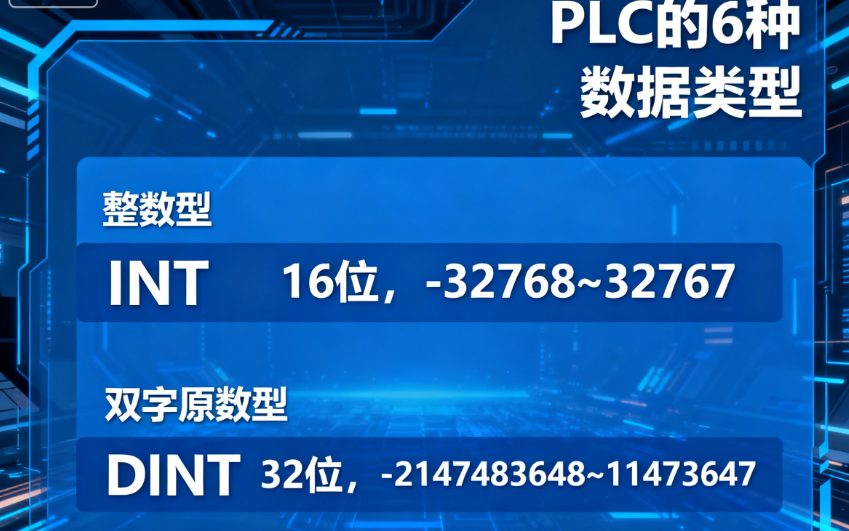
Int, or integer data, also consists of 16 bits, but unlike word, int is a signed number with a value range of -32768 to 32767.
The int type is very practical in scenarios requiring signed integer operations. For example, in a temperature control system, the measured temperature values may be both positive and negative (such as outdoor temperatures in winter being below 0°C). Using the int type can accurately represent these temperature values and perform corresponding control calculations.
Additionally, in an elevator control system, the elevator’s floor position can be represented using the int type, where negative numbers indicate underground floors and positive numbers indicate above-ground floors, facilitating engineers in floor calculations and judgments.
 6. Real: The “Precision Expert” for High-Precision Floating Point Operations
Real, or real data, is the floating-point type that can represent values with decimal parts and has high precision. In scenarios requiring high-precision calculations and representations, the Real type is indispensable.
For example, in a chemical production process, precise control of various chemical concentrations and flow rates is required, and these parameters are usually in decimal form. Using the Real type can ensure the accuracy of calculations and the precision of control.
Additionally, in some robotic control systems, the trajectory planning of robots requires complex floating-point calculations, and the Real type can provide sufficient precision to ensure the accuracy and stability of robot movements.
The six core data types: bool, byte, word, Dword, int, and Real each have unique characteristics and application scenarios.
These data types run through the entire process from simple device control to complex system integration, and mastering their characteristics and application scenarios is fundamental for PLC engineers.
We welcome everyone to leave comments and engage in discussions!