Hello everyone! Today, I bring you two PLC control cases that are very suitable for beginners in electrical automation, helping you quickly grasp basic programming logic. Remember to bookmark and share this with your classmates to progress together! 💡
01Sequential Start and Stop
📌 Application Scenario: In industrial ventilation systems, multiple fans often need to start and stop in sequence. Operators can manually control based on environmental temperature, air quality, and other conditions, achieving energy-efficient operation while ensuring ventilation effectiveness.
✅ Control Requirements:
-
Press start button 1 to start fan 1; then press start button 2 to start fan 2.
-
Press stop button 2 to stop fan 2; then press stop button 1 to stop fan 1.
-
Important interlock: Fan 2 can only start after fan 1 has started; fan 1 can only stop after fan 2 has stopped.
🔧 Implementation Method:
-
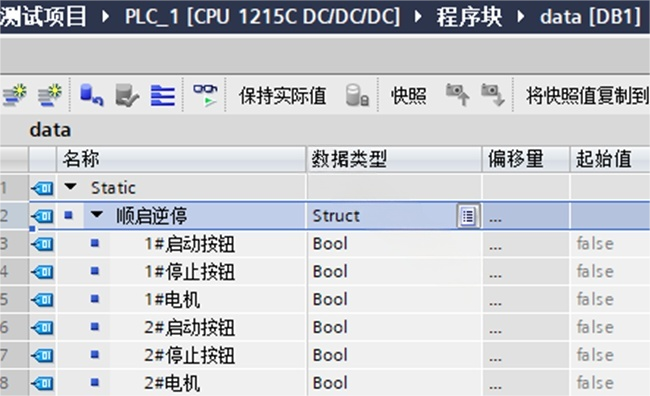
Create a new structure in the global DB block and establish corresponding variables, as shown in the figure below:
👇
-
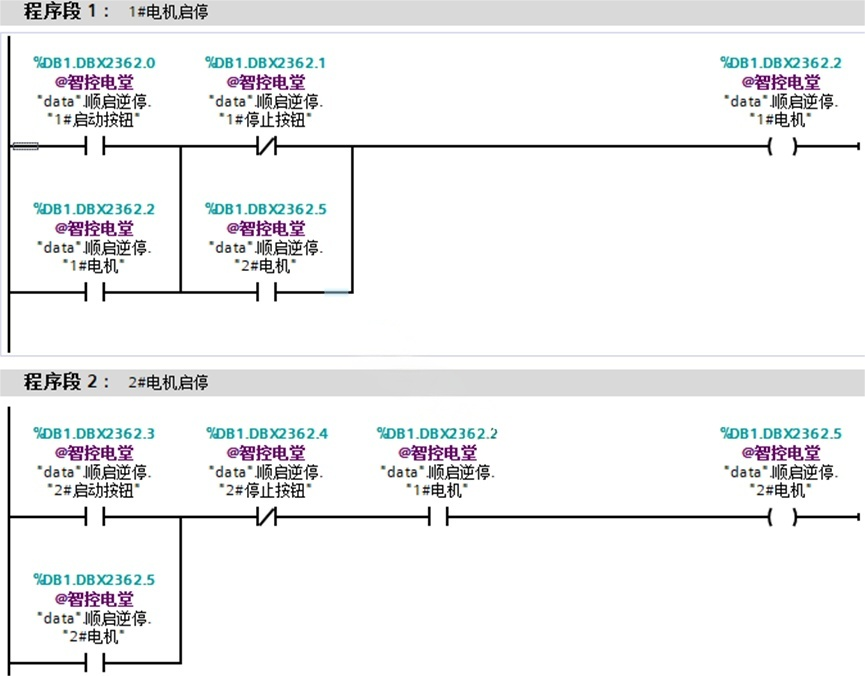
In the stop condition of motor 1, parallel the run signal of motor 2, and in the run condition of motor 2, series the run signal of motor 1.
-
Ensure the start-stop sequence through interlock logic.
02Three-Phase Asynchronous Motor Multi-Speed Efficient Operation
📌 Application Scenario: In the conveyor systems of manufacturing production lines, two-speed control of three-phase asynchronous motors is commonly used to adapt to different production rhythms. For example, the conveyor belt starts smoothly at low speed and operates efficiently at high speed.
✅ Control Requirements:
-
Turn on the main power, press the low-speed button → the motor runs at low speed.
-
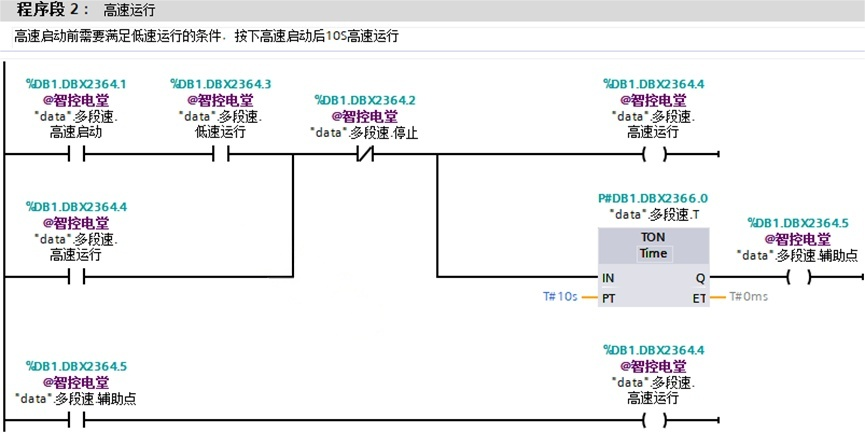
Press the high-speed button → the motor first runs at low speed, then automatically switches to high speed after 10 seconds.
-
Press the stop button → the motor stops immediately.
🔧 Implementation Method:
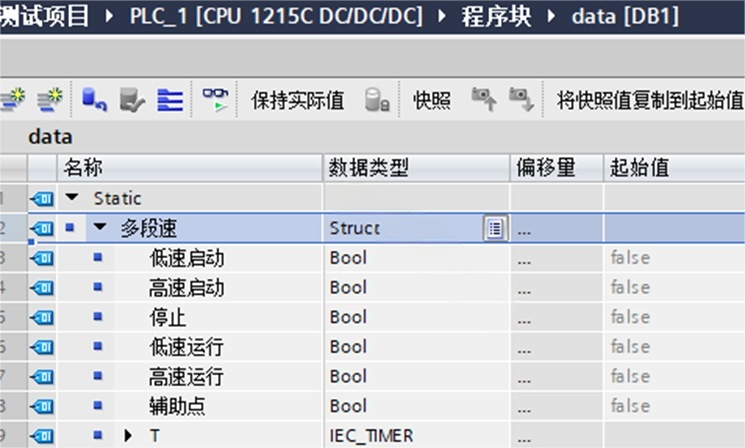
Create a multi-speed structure in the global DB block and establish variables, as illustrated:
👇
-
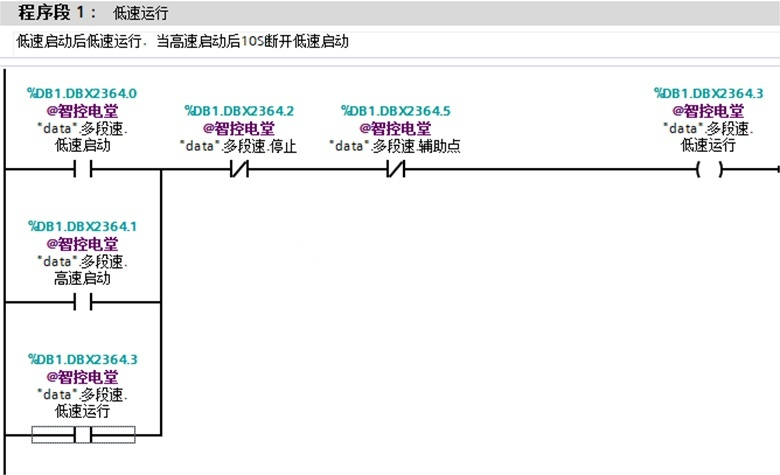
After low-speed start, achieve low-speed operation.
-
The high-speed start signal must be effective under low-speed running conditions, switching to high speed after a delay of 10 seconds.
🌟 Learning Tip: These two cases include important concepts such as basic logic design, interlock protection, and delay control in PLC programming. It is recommended that students practice hands-on in the training room to deepen their understanding.
Everyone is welcome to share learning insights in the comments section,
If you have any questions, feel free to leave a message for discussion! 👇
-END-
Huazhong Advanced Vocational Technical School
 Skills for Success, Skills for the Nation
Study at Huazhong Advanced Vocational Technical School
 If you find this helpful, please give it a thumbs up!