✅ Author Profile: A Matlab simulation developer passionate about scientific research, skilled in data processing, modeling simulation, program design, complete code acquisition, paper reproduction, and scientific simulation.
🍎 Previous reviews, follow the personal homepage:Matlab Research Studio
🍊 Personal motto: Seek knowledge through investigation, complete Matlab code and simulation consultation available via private message.
🔥 Content Introduction
In the field of signal processing and data analysis, efficiently extracting signal features and decomposing complex signals has always been a hot topic and challenge. Multivariate Variational Mode Decomposition (MVMD), as an advanced signal decomposition technique, can decompose complex signals into multiple intrinsic mode functions (IMFs) with different characteristics, but it has certain limitations in parameter selection. The Whale Optimization Algorithm (WOA), with its excellent global optimization capability, provides a new approach for optimizing MVMD. The WOA-MVMD method, which combines WOA and MVMD, is becoming a powerful tool for solving many practical problems.
1. Algorithm Principles: Exploring the Secrets of WOA and MVMD
1.1 Whale Optimization Algorithm (WOA)
WOA is a meta-heuristic optimization algorithm inspired by the hunting behavior of humpback whales. When hunting, humpback whales use a “spiral bubble net” strategy. WOA simulates this process by surrounding the prey, spiraling upward to update positions, and randomly searching for prey in three stages to find the optimal solution. In the prey surrounding stage, the algorithm updates the whale’s position based on the current best solution, gradually approaching the prey; in the spiral upward position update stage, it uses logarithmic spirals to simulate the whale’s movement trajectory during hunting, achieving position updates; the random search for prey stage generates random positions to avoid the algorithm getting trapped in local optima, enhancing global search capability. With its simple principles and minimal parameter settings, WOA has demonstrated strong optimization performance in various fields such as function optimization and engineering design.
1.2 Multivariate Variational Mode Decomposition (MVMD)
MVMD is an adaptive signal decomposition method based on variational models. Compared to traditional signal decomposition methods, such as Empirical Mode Decomposition (EMD), it overcomes issues like mode mixing and can more accurately decompose complex signals into multiple intrinsic mode functions (IMFs) with specific frequency characteristics. MVMD transforms the signal decomposition problem into a variational constraint problem by constructing a variational model, using the Alternating Direction Method of Multipliers (ADMM) for iterative solving, thus obtaining each modal component. In practical applications, MVMD plays an important role in fault diagnosis, vibration signal analysis, etc., but the decomposition effect of this algorithm is sensitive to parameters such as the number of decomposed modes, making appropriate parameter settings key to achieving ideal decomposition results.
2. WOA-MVMD: Implementation Process of Algorithm Fusion
2.1 Determining Optimization Objectives and Parameters
When applying WOA to optimize MVMD, the first step is to clarify the optimization objectives. Typically, the optimization objectives are related evaluation metrics of each modal component after decomposition, such as minimizing reconstruction error to restore the original signal as closely as possible; or maximizing the kurtosis value of modal components to highlight impact features in the signal, facilitating applications like fault diagnosis. At the same time, it is necessary to determine the parameters that need to be optimized in MVMD, commonly including the number of decomposed modes K and the secondary penalty factor α.
2.2 Application of Whale Optimization Algorithm
The parameters of MVMD are encoded as the position vector of the whale, with each whale representing a set of parameter combinations for MVMD. During the iteration process of WOA, the fitness value of each whale is calculated based on the set optimization objectives, continuously updating the whale’s position through the three stages of surrounding prey, spiraling upward to update positions, and randomly searching for prey, i.e., adjusting the parameters of MVMD. After multiple iterations, when the algorithm meets the stopping conditions (such as reaching the maximum number of iterations or convergence of fitness values), the optimal whale position corresponding to the parameter combination is the optimized MVMD parameters.
2.3 Improved MVMD Decomposition
Substituting the optimized parameters into the MVMD algorithm, the original signal is decomposed. At this point, due to the optimization of parameters through WOA, MVMD can more accurately extract signal features, yielding decomposition results that better meet practical needs, enhancing the accuracy and reliability of analysis in applications such as signal denoising, feature extraction, and fault diagnosis.
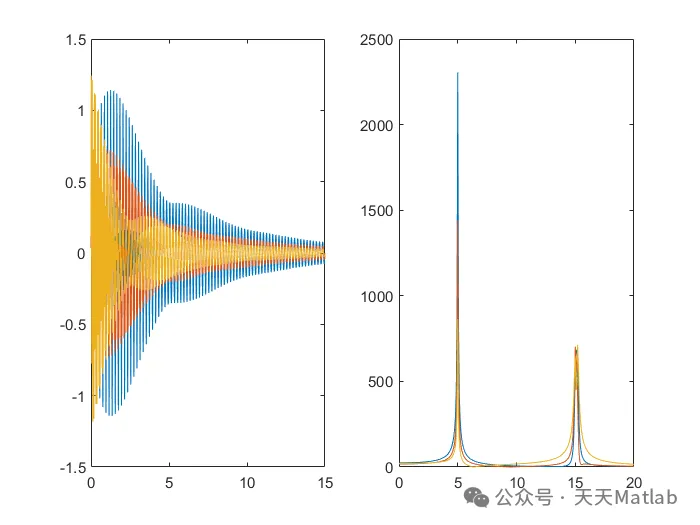
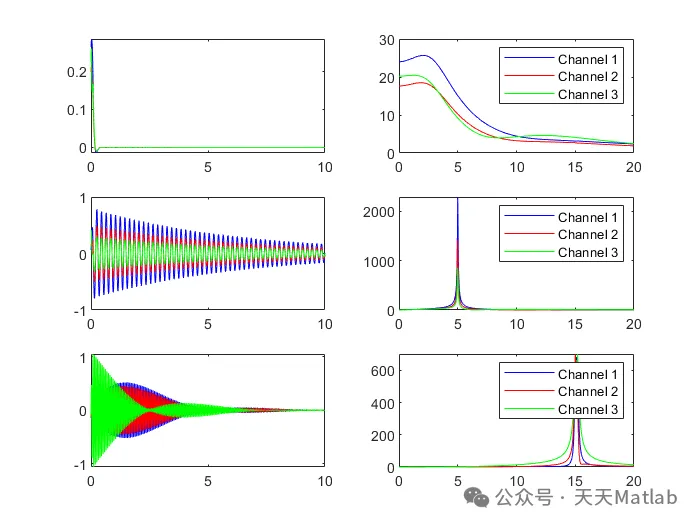
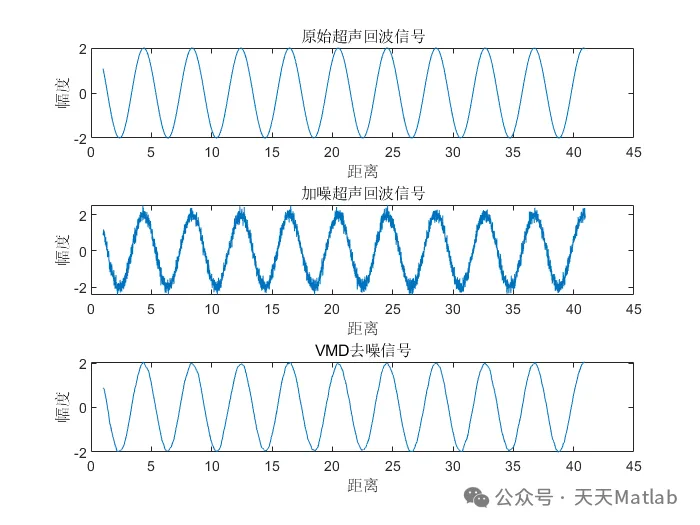
⛳️ Running Results
📣 Sample Code
🔗 References
🎈 Some theoretical references are from online literature; if there is any infringement, please contact the author for removal.
👇 Follow me to receive a wealth of Matlab e-books and mathematical modeling materials
🏆 The team specializes in guiding customized Matlab simulations in various research fields, helping to realize research dreams:
🌈 Various intelligent optimization algorithm improvements and applications
Production scheduling, economic scheduling, assembly line scheduling, charging optimization, workshop scheduling, departure optimization, reservoir scheduling, three-dimensional packing, logistics site selection, cargo position optimization, bus scheduling optimization, charging pile layout optimization, workshop layout optimization, container ship loading optimization, pump combination optimization, medical resource allocation optimization, facility layout optimization, visual domain base station and drone site selection optimization, knapsack problem, wind farm layout, time slot allocation optimization, optimal distributed generation unit allocation, multi-stage pipeline maintenance, factory-center-demand point three-level site selection problem, emergency supply material distribution center site selection, base station site selection, road lamp post arrangement, hub node deployment, transmission line typhoon monitoring devices, container scheduling, unit optimization, investment portfolio optimization, cloud server combination optimization, antenna linear array distribution optimization, CVRP problem, VRPPD problem, multi-center VRP problem, multi-layer network VRP problem, multi-center multi-vehicle VRP problem, dynamic VRP problem, two-layer vehicle routing problem (2E-VRP), electric vehicle routing problem (EVRP), hybrid vehicle routing problem, mixed flow shop problem, order splitting scheduling problem, bus scheduling optimization problem, flight shuttle vehicle scheduling problem, site selection path planning problem, port scheduling, port bridge scheduling, parking space allocation, airport flight scheduling, leak source localization
🌈 Machine learning and deep learning time series, regression, classification, clustering, and dimensionality reduction
2.1 BP time series, regression prediction, and classification
2.2 ENS voice neural network time series, regression prediction, and classification
2.3 SVM/CNN-SVM/LSSVM/RVM support vector machine series time series, regression prediction, and classification
2.4 CNN|TCN|GCN convolutional neural network series time series, regression prediction, and classification
2.5 ELM/KELM/RELM/DELM extreme learning machine series time series, regression prediction, and classification
2.6 GRU/Bi-GRU/CNN-GRU/CNN-BiGRU gated neural network time series, regression prediction, and classification
2.7 Elman recurrent neural network time series, regression prediction, and classification
2.8 LSTM/BiLSTM/CNN-LSTM/CNN-BiLSTM long short-term memory neural network series time series, regression prediction, and classification
2.9 RBF radial basis function neural network time series, regression prediction, and classification
2.10 DBN deep belief network time series, regression prediction, and classification
2.11 FNN fuzzy neural network time series, regression prediction
2.12 RF random forest time series, regression prediction, and classification
2.13 BLS broad learning system time series, regression prediction, and classification
2.14 PNN pulse neural network classification
2.15 Fuzzy wavelet neural network prediction and classification
2.16 Time series, regression prediction, and classification
2.17 Time series, regression prediction, and classification
2.18 XGBOOST ensemble learning time series, regression prediction, and classification
2.19 Transform various combinations of time series, regression prediction, and classification
Covering wind power prediction, photovoltaic prediction, battery life prediction, radiation source identification, traffic flow prediction, load forecasting, stock price prediction, PM2.5 concentration prediction, battery health status prediction, electricity consumption prediction, water body optical parameter inversion, NLOS signal identification, precise prediction of subway stops, transformer fault diagnosis
🌈 In image processing
Image recognition, image segmentation, image detection, image hiding, image registration, image stitching, image fusion, image enhancement, image compressed sensing
🌈 In path planning
Traveling salesman problem (TSP), vehicle routing problem (VRP, MVRP, CVRP, VRPTW, etc.), drone three-dimensional path planning, drone collaboration, drone formation, robot path planning, grid map path planning, multimodal transport problems, electric vehicle routing problem (EVRP), two-layer vehicle routing problem (2E-VRP), hybrid vehicle routing problem, ship trajectory planning, full path planning, warehouse patrol
🌈 In drone applications
Drone path planning, drone control, drone formation, drone collaboration, drone task allocation, online optimization of safe communication trajectories for drones, vehicle collaborative drone path planning
🌈 In communication
Sensor deployment optimization, communication protocol optimization, routing optimization, target localization optimization, Dv-Hop localization optimization, Leach protocol optimization, WSN coverage optimization, multicast optimization, RSSI localization optimization, underwater communication, communication upload and download allocation
🌈 In signal processing
Signal recognition, signal encryption, signal denoising, signal enhancement, radar signal processing, signal watermark embedding and extraction, electromyography signals, electroencephalography signals, signal timing optimization, electrocardiogram signals, DOA estimation, encoding and decoding, variational mode decomposition, pipeline leakage, filters, digital signal processing + transmission + analysis + denoising, digital signal modulation, bit error rate, signal estimation, DTMF, signal detection
🌈 In power systems
Microgrid optimization, reactive power optimization, distribution network reconstruction, energy storage configuration, orderly charging, MPPT optimization, household electricity, electric/cold/heat load forecasting, power equipment fault diagnosis, battery management system (BMS) SOC/SOH estimation (particle filter/Kalman filter), multi-objective optimization in power system dispatch, photovoltaic MPPT control algorithm improvement (perturbation observation method/conductance increment method)
🌈 In cellular automata
Traffic flow, crowd evacuation, virus spread, crystal growth, metal corrosion
🌈 In radar
Kalman filter tracking, trajectory association, trajectory fusion, SOC estimation, array optimization, NLOS identification
🌈 In workshop scheduling
Zero-wait flow shop scheduling problem (NWFSP), permutation flow shop scheduling problem (PFSP), hybrid flow shop scheduling problem (HFSP), zero idle flow shop scheduling problem (NIFSP), distributed permutation flow shop scheduling problem (DPFSP), blocking flow shop scheduling problem (BFSP)
👇