Theme of This Issue
With the rapid development of LLMs and their demonstrated application potential in various fields, research on LLM-based agents has garnered widespread attention from scholars. However, single-agent systems often exhibit drawbacks such as lengthy context and poor interpretability in reasoning processes in complex task scenarios. Meanwhile, research on multi-agent systems has recently gained significant attention. In this issue, we recommend three representative papers on multi-agent systems, exploring the potential of multi-agent frameworks in future artificial intelligence applications.
1. CAMEL: Communicative Agents for “Mind” Exploration of Large Language Model Society
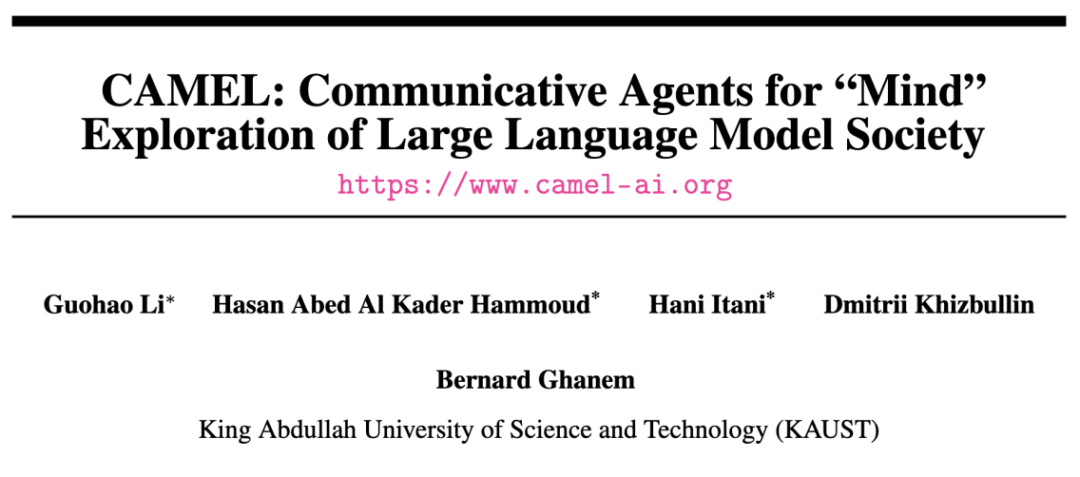
Paper link: https://arxiv.org/pdf/2303.17760
Source code link: https://github.com/camel-ai/camel
This paper presents one of the earlier well-known multi-agent frameworks, primarily designed for the interaction of two agents.
Background: With the rapid advancement of chat-based language models, they have achieved remarkable success in addressing complex tasks. However, these models often rely on human input to correctly guide conversations, leading to time consumption and certain challenges.
Motivation: To reduce the human workload in guiding conversations, this research explores the possibility of multiple agents cooperating autonomously to complete tasks.
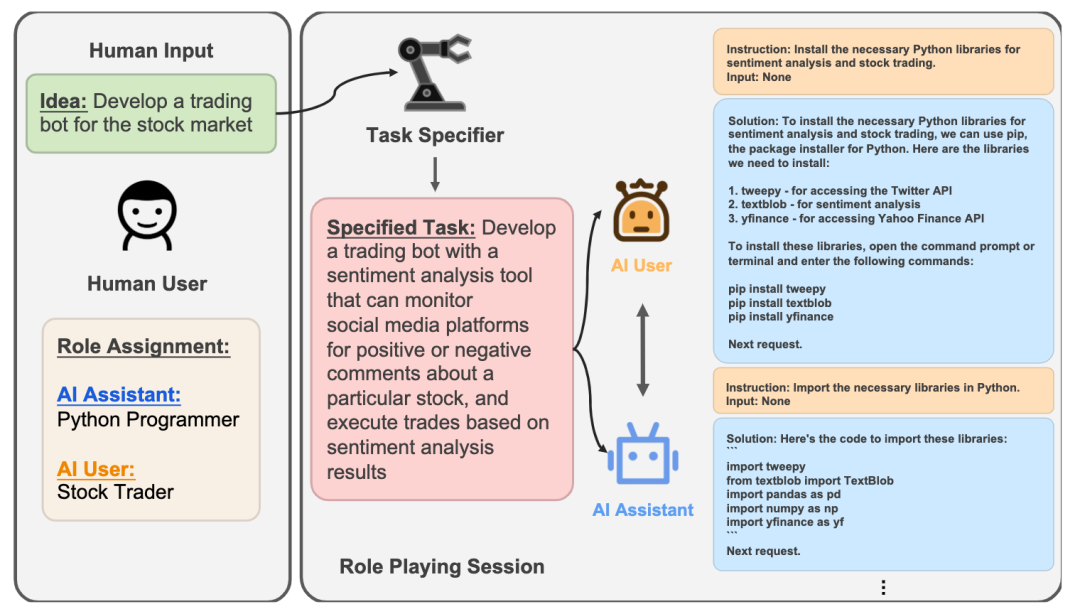
Method: The article proposes a scalable “role-playing” multi-agent framework that guides multiple agents to collaborate autonomously to complete tasks by providing initial tasks and settings.
Features: This framework allows communicative agents to complete tasks through role-playing and dialogue with only initial ideas provided by humans, offering rich conversational data for studying the behavior and capabilities of chat agents. Additionally, a Task Specifier role is set in the pipeline to clarify task descriptions, as the absence of expert agents poses challenges in solving complex tasks, necessitating more detailed and specific task descriptions.
2. AgentVerse: Facilitating Multi-Agent Collaboration and Exploring Emergent Behaviors
Paper link: https://arxiv.org/pdf/2308.10848
Source code link: https://github.com/OpenBMB/AgentVerse/
Background: Although LLM-based agents have made significant progress across various tasks, real-world scenarios often involve many complex tasks that are difficult for a single agent to complete autonomously, usually requiring the cooperation of multiple agents.
Motivation: Inspired by human group dynamics, a cooperative system can perform better than the sum of its parts, potentially improving performance in complex tasks.
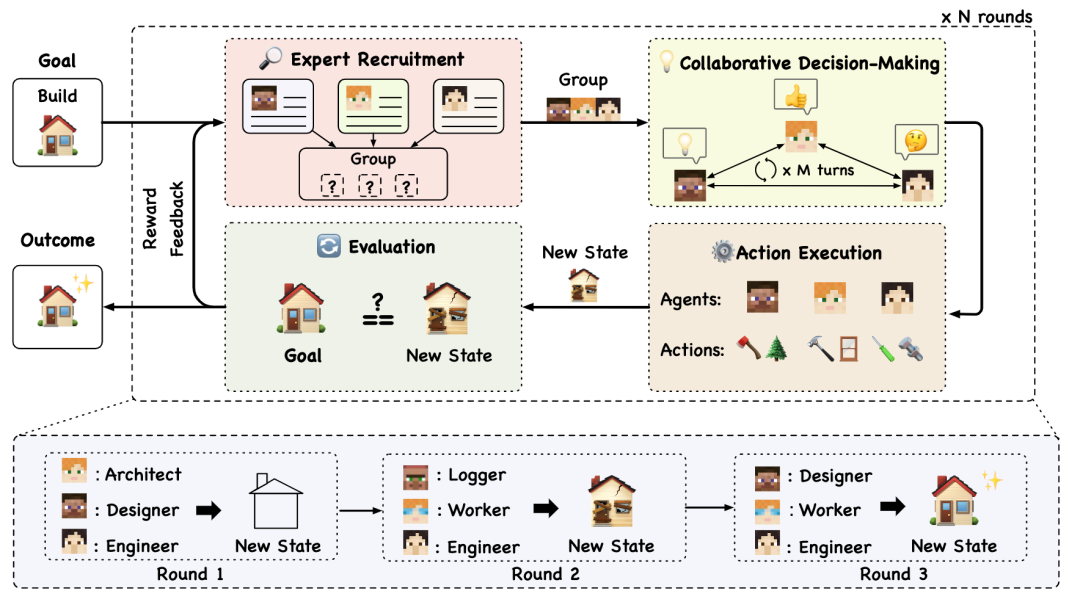
Method: This paper proposes a multi-agent framework called AgentVerse that effectively coordinates multiple expert agents to collaborate on complex tasks.
Features: The task processing includes four main stages: recruiting expert agents, cooperative decision-making, action execution, and evaluation feedback. Additionally, the authors experimentally confirm that the AgentVerse framework effectively enhances agents’ understanding, reasoning, coding, tool usage, and performance and capabilities in embodied intelligence.
3. AutoGen: Enabling Next-Gen LLM Applications via Multi-Agent Conversation
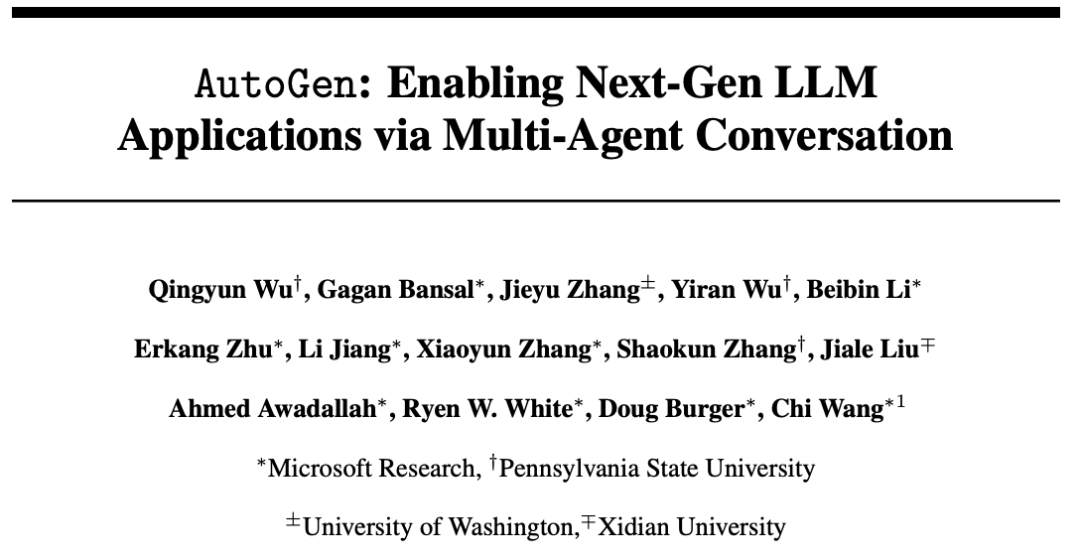
Paper link: https://arxiv.org/pdf/2308.08155
Source code link: https://github.com/microsoft/autogen
Motivation: Previous work has shown that multi-agent systems can promote divergent thinking and enhance reasoning capabilities. The motivation of this paper is to explore how to facilitate cross-domain applications of multi-agent systems and develop complex LLM applications.
Method: The proposed AutoGen framework allows users to build various applications with different complexities and LLM capacities using multiple agents.
Features: This framework supports the construction of customized LLM applications and provides a more flexible design environment for defining agent behaviors for different task scenarios. Additionally, this multi-agent framework features support for user input during the process and the ability to add operational functions. Experiments demonstrate the effectiveness of this framework in applications such as coding, data, and question-answering.
Editors: Sang Jitao, Huang Xiaowen
Material organized by: Jia Haitao
Editor: Yang Yunfan