 Today, I would like to discuss a phenomenon related to the memory of Siemens PLCs. This concept is a fundamental knowledge point that is typically covered when learning about PLCs, often taught by instructors or institutions. However, many people may not pay much attention to it in actual projects.Phenomenon: Last year, during a renovation project at our company, the supplier encountered an issue where the program could not be downloaded. They were quite anxious (the engineer was a novice), as it was a production line, and the downtime for renovations is limited. Upon investigation, we found that the code working memory was full, and the only solution was to replace the PLC, which was a classic case of insufficient preliminary assessment.The memory of a PLC is essentially similar to the memory in a computer, primarily used to store system programs, user programs, and data. Depending on their functions, they can be divided into several memory areas: loading memory area, working memory area, retention memory area, and system memory area. Except for the loading memory area, which typically uses a storage card, the other memory areas are integrated within the CPU, which is closely related to the CPU model.
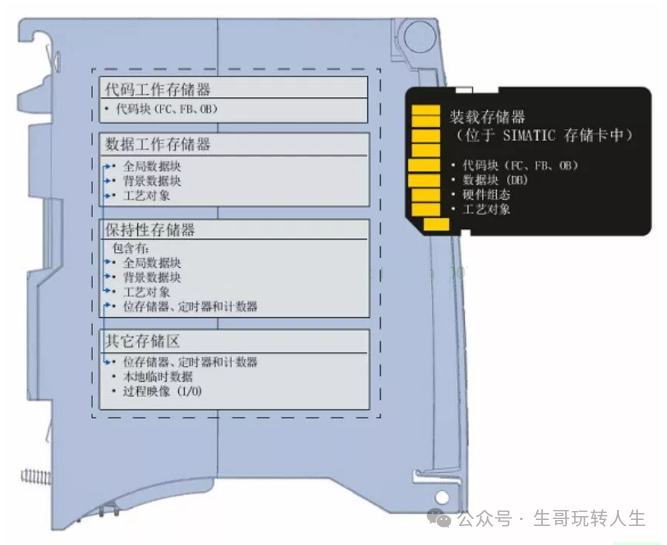 Loading Memoryprimarily stores program blocks, data blocks, process objects, and hardware configurations in the project. In simple terms, it contains all the data generated by the TIA Portal programming and hardware configuration.When downloading a program, it is first stored in the loading memory, and then copied to the working memory, where the program and data run.Working MemoryThe working memory is a RAM memory integrated within the CPU and cannot be expanded. When selecting a new project, it is essential to consider not only the instruction processing speed but also the size of the program. If it cannot run, the only option is to replace the PLC, which increases costs. It can be divided into code working memory and data working memory, used to store program-related code (OB/FC/FB) and data blocks (DB), respectively.System MemorySystem memory, like working memory, is also integrated within the CPU as RAM and cannot be expanded. It mainly includes: input process image area (I area), output process image area (Q area), bit storage area (M area), timer area (T area), counter area (C area), local data area (L area), and IO peripheral memory.Retention MemoryRetention memory is a non-volatile memory integrated within the CPU, which can be configured to retain some data even when power is lost.Below is a schematic view of the memory:Project Tree – Program Information – Resources
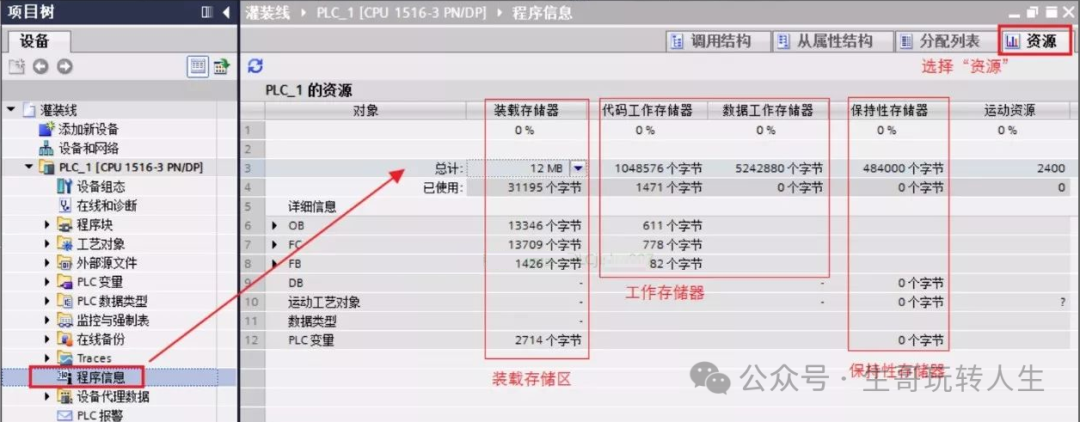 Many clients now have their own frameworks, which include many functions and have high performance requirements for PLCs. In the current market environment, many companies also need to consider cost savings and multi-product co-line production. Therefore, it is crucial to consider these factors during the preliminary selection of new projects and upgrades of old projects; otherwise, it can lead to complications during construction, so it is wise to prepare in advance.
 Thank you to all the brothers for your likes and follows. I have organized some learning materials, and the link is in the comment section for those who need it.
 Mastering Industrial Control: A Treasure Chest for Beginners in Industrial Control – Full of Valuable InformationMastering Industrial Control: Why Run Back and Forth to Press the Interface When Siemens HMI Can Be Remote?Mastering Industrial Control: After Upgrading to Windows 11, TIA Portal Software Is Not Usable, Have You Been Affected?Mastering Computers: Say Goodbye to Annoying Pop-ups from Compression Software