 Keywords:
Lightweight Industrial IoT Open Source Platform (Including Backend and Frontend Source Code)
(1)System Introduction
1.1 System Overview
The lightweight industrial IoT open source platform (including backend and frontend source code)
is developed based on Java 17, Spring Boot 3.x, WebFlux, Netty, Vert.x, Reactor, etc. It is a ready-to-use, enterprise-level IoT foundational platform that can be further developed. The platform implements numerous basic functions related to IoT, helping you quickly establish IoT-related business systems. Overall technical framework diagram: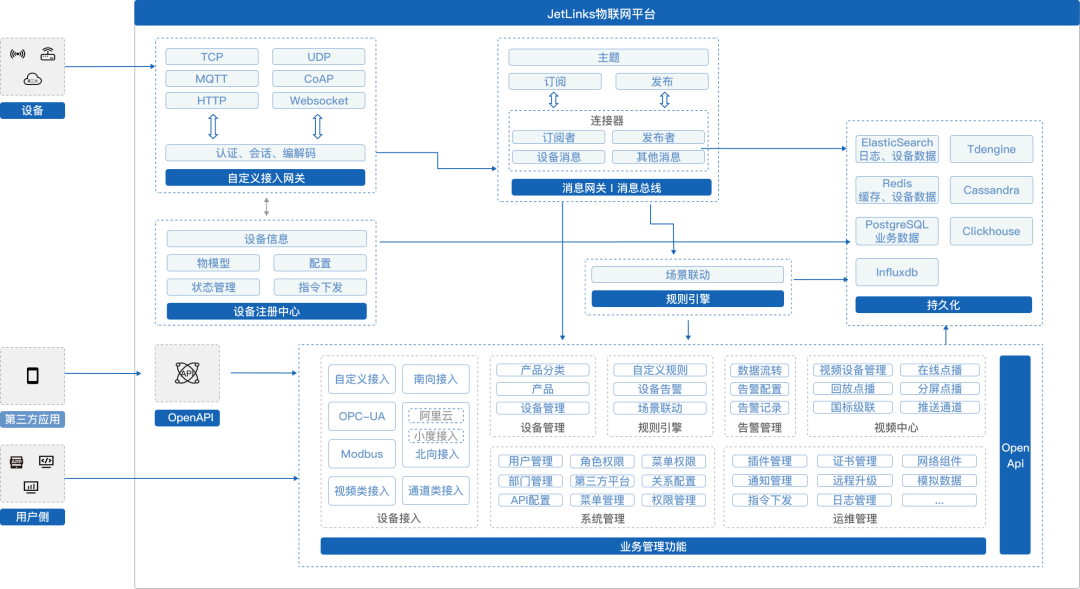
(2)Software Development Environment and Tools
The specific technologies used in system development are as follows:
2.1 Frontend Technology Framework
CSS, JavaScript, jQuery
Frontend framework based on jQuery
BootStrap (frontend framework), dTree plugin, rich text editor, etc.
Vue | Frontend framework
Ant Design Pro | Backend UI framework
Uni-app | Cross-platform framework
2.2 Backend Technology Framework
Spring Boot 3.4.x
Spring WebFlux reactive web support
R2DBC reactive relational database driver
Project Reactor reactive programming framework
Netty, Vert.x high-performance network programming framework
hsweb framework 4 business function foundational framework
ElasticSearch full-text search, logging, time-series data storage (optional)
TDengine device time-series data storage (optional)
Redis cache data
TimescaleDB time-series data storage (optional)
PostgreSQL business function data management
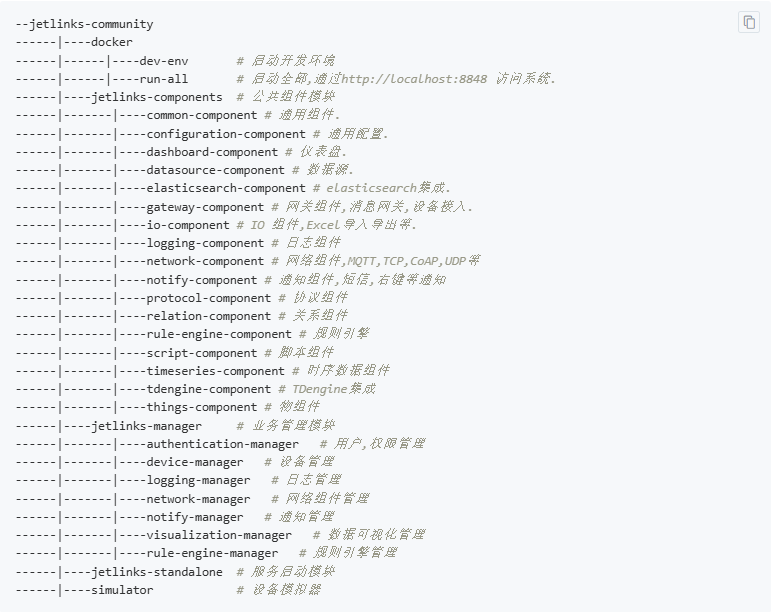
Note: These development environments and tools will be used during the setup process.
It is recommended to learn these tools in advance, as they are all free. You can find and download these tools online.
2.3 Program Deployment and Configuration
Simple deployment: minimal operation requires only Java 17, Redis, and TimescaleDB, without the need to deploy a large number of middleware.
Unified device access, massive device management: TCP/UDP/MQTT/HTTP, TLS/DTLS, different vendors, different devices, different message formats, unified access, unified management.
Rule engine: Flexible rule model configuration, supporting various rule models and custom rule models. Device alarms and scene linkage are managed by a unified rule engine.
Data permission control: Flexible non-intrusive data permission control. It can achieve three-dimensional data permission control for menus, buttons, and data. It can control the operation permissions of individual data.
Core Code Display
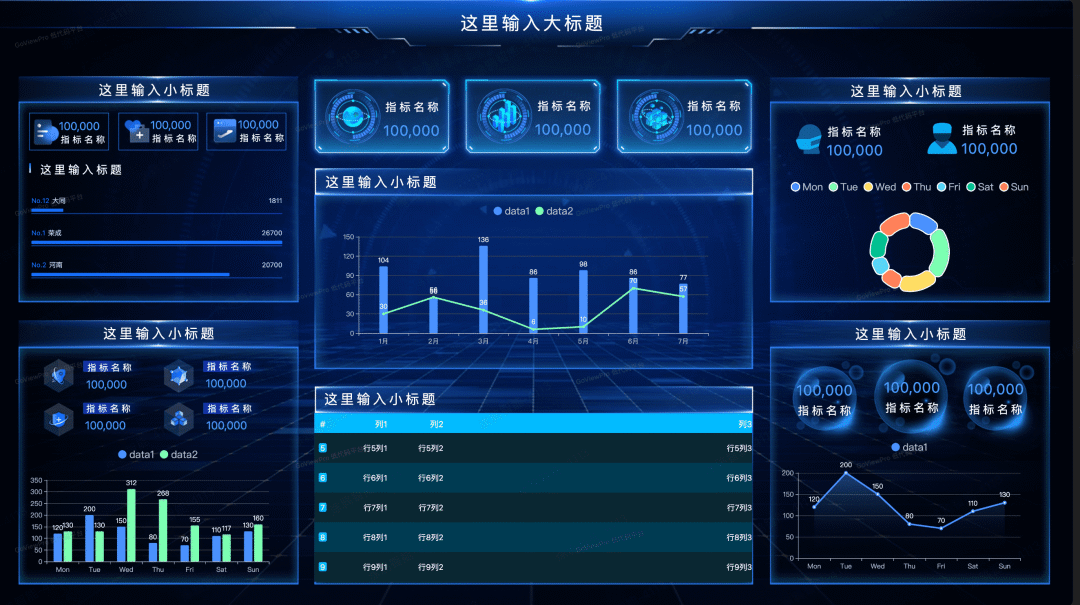
2.3.2 Backend Management System Design
Technical Architecture Management Function Modules
- Device Monitoring Dashboard
- Real-time device status monitoring
- Water consumption statistics and analysis
- Fault warning system
- Membership level system
- Consumption record inquiry
- User behavior analysis
- Income statistics report
- Transaction reconciliation function
- Coupon management
(3) Source Code Download Instructions and Project Description
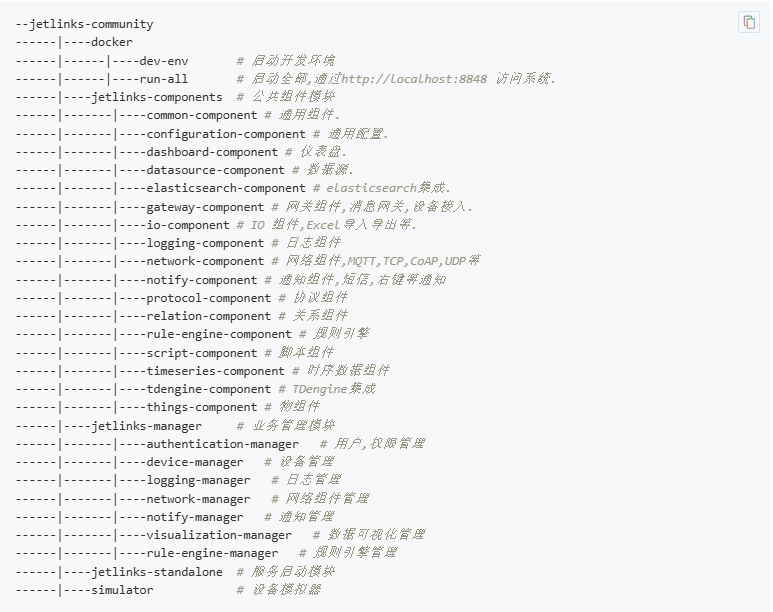
Note: As this is an open-source project, it is recommended to review the relevant source code project’s agreement before use. If you intend to develop, please contact the original author for authorization.
Follow our public account, reply in the messages:Lightweight IoT 999
Please open in the WeChat client