The content is approximately 3,500 words long, with a reading time of 10-15 minutes. Please like, share, and bookmark for reference, thank you!NVIDIA CEO Jensen Huang believes that after AI, robotics technology is another market with growth potential for NVIDIA.
The robotics industry is transitioning from “concept hype” to “mass production implementation,” with the global industry scale expected to reach trillions of yuan in the future.
According to the latest research report from Morgan Stanley, the core driving force behind this wave of robotics isthe intensive dynamics of Tesla’s Optimus and the latest advancements from global tech companies.Is this surge just the beginning? Where is the next explosion point in the robotics sector?For investors, only by understanding the long-term driving forces behind it can they accurately capture the true leaders and opportunities.The Hong Kong stock market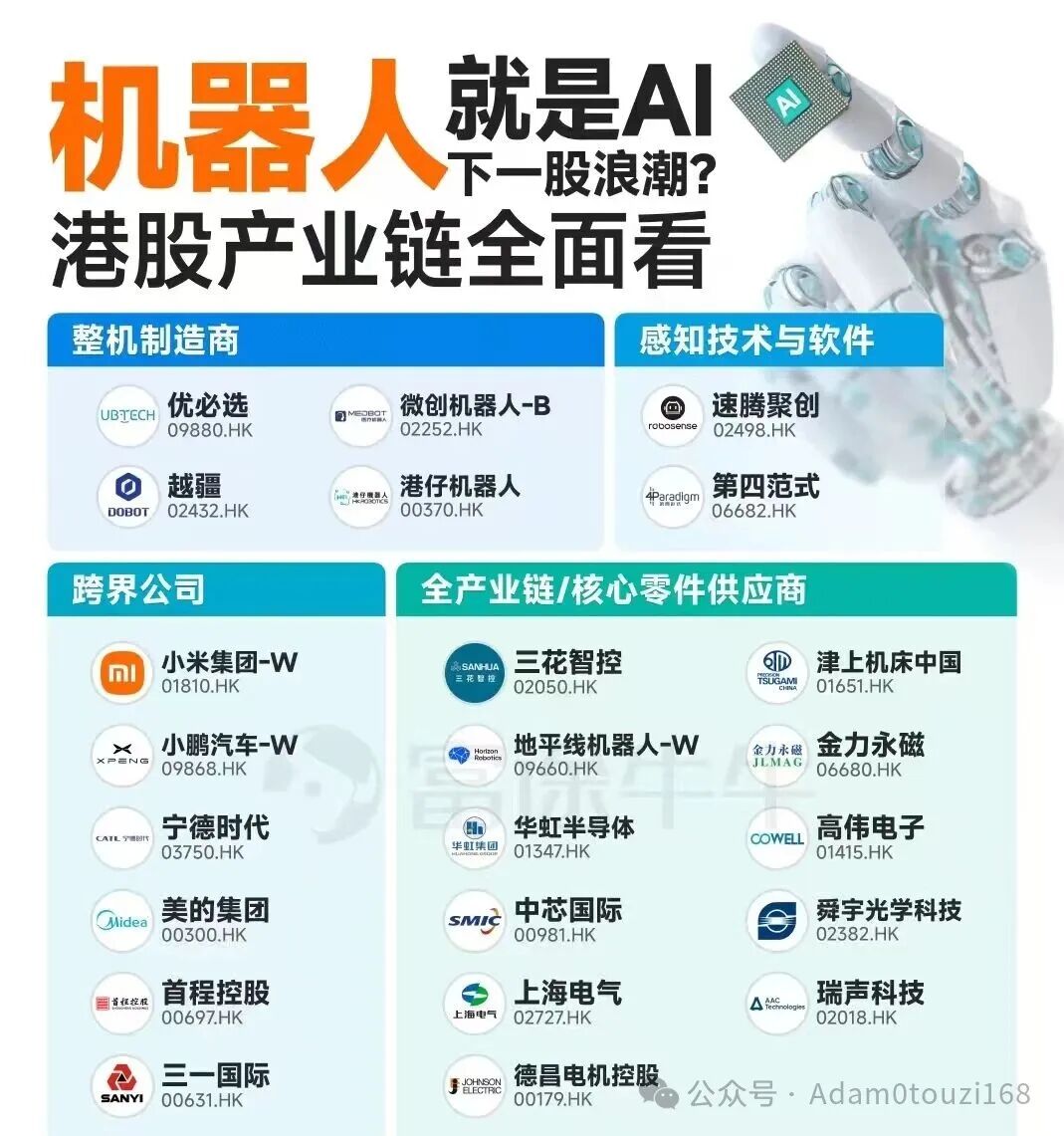 In the Hong Kong stock market, whole machine manufacturers to watch includeUBTECH, Unitree, MicroPort Robotics-B, and Hong Kong Robot.
- UBTECH is the first stock in Hong Kong for humanoid robots, possessing full-stack humanoid robot technology advantages, and recently received a new order for 250 million humanoid robots.
- Unitree Robotics is the first company globally to promote a “robotic arm + humanoid + hexapod” embodied robot platform.
- MicroPort Robotics is currently the only company in the world with business coverage in five major “golden tracks” of surgical robots: endoscopy, orthopedics, vascular, natural orifice, and percutaneous puncture.
Additionally, companies likeXiaomi Group-W, Xpeng Motors-W, CATL, CATL, and First Journey Holdingsare also crossing over to bet on robotics.
- Xiaomi Group released its first full-size humanoid bionic robot, CyberOne (Iron Big), in 2022. This year, Xiaomi is promoting the phased implementation of CyberOne (Iron Big) in its own manufacturing line.
- Xpeng Motors entered the humanoid robot market as early as 2020 and released its first humanoid robot “Iron” in 2023, competing with Tesla’s “Tesla Bot” and officially entering the smart robotics field.
- CATL will increase its investment in the robotics field starting at the end of 2024, and has already formed a team of dozens in Shanghai, independently developing robot bodies, control, and human-machine interaction algorithms. The initial plan is to manufacture industrial robots such as robotic arms and AGVs for application in battery factories.
- Midea Group recently established a humanoid robot innovation center to intensify its research and development efforts in related fields. Midea’s humanoid robot prototype was first revealed in March this year, capable of performing various actions such as shaking hands, serving water, making heart signs, dancing, opening bottles, and screwing.
- First Journey Holdings announced the establishment of Beijing First Journey Robotics Technology Industry Co., Ltd. in Beijing at the beginning of the year, which will focus on creating a complete robotics industry ecosystem. Additionally, First Journey Holdings, through its managed Beijing Robotics Industry Development Investment Fund, completed its first investment in Yushu after its IPO application in 2024, and added further investment in July this year, solidifying its position as a strategic shareholder.
- Sany International’s subsidiary, Sany Robotics Technology Co., Ltd., was established against the backdrop of Sany Group’s comprehensive promotion of intelligent manufacturing and digital transformation. The company focuses on intelligent industrial robots, industrial automation, integrated application equipment for robots, autonomous driving technology, and the development and manufacturing of related software and hardware; manufacturing industrial robots, special robots, etc.
Core component suppliers across the entire industry chain to watch includeSanhua Intelligent Control, Horizon Robotics-W, Hua Hong Semiconductor, SMIC, Shanghai Electric, Delta Electronics, Jinan Machine Tool China, Jinli Permanent Magnet, Gaowei Electronics, Sunny Optical Technology, and AAC Technologies.Perception technology and software: including SUTENG, Fourth Paradigm.The US stock market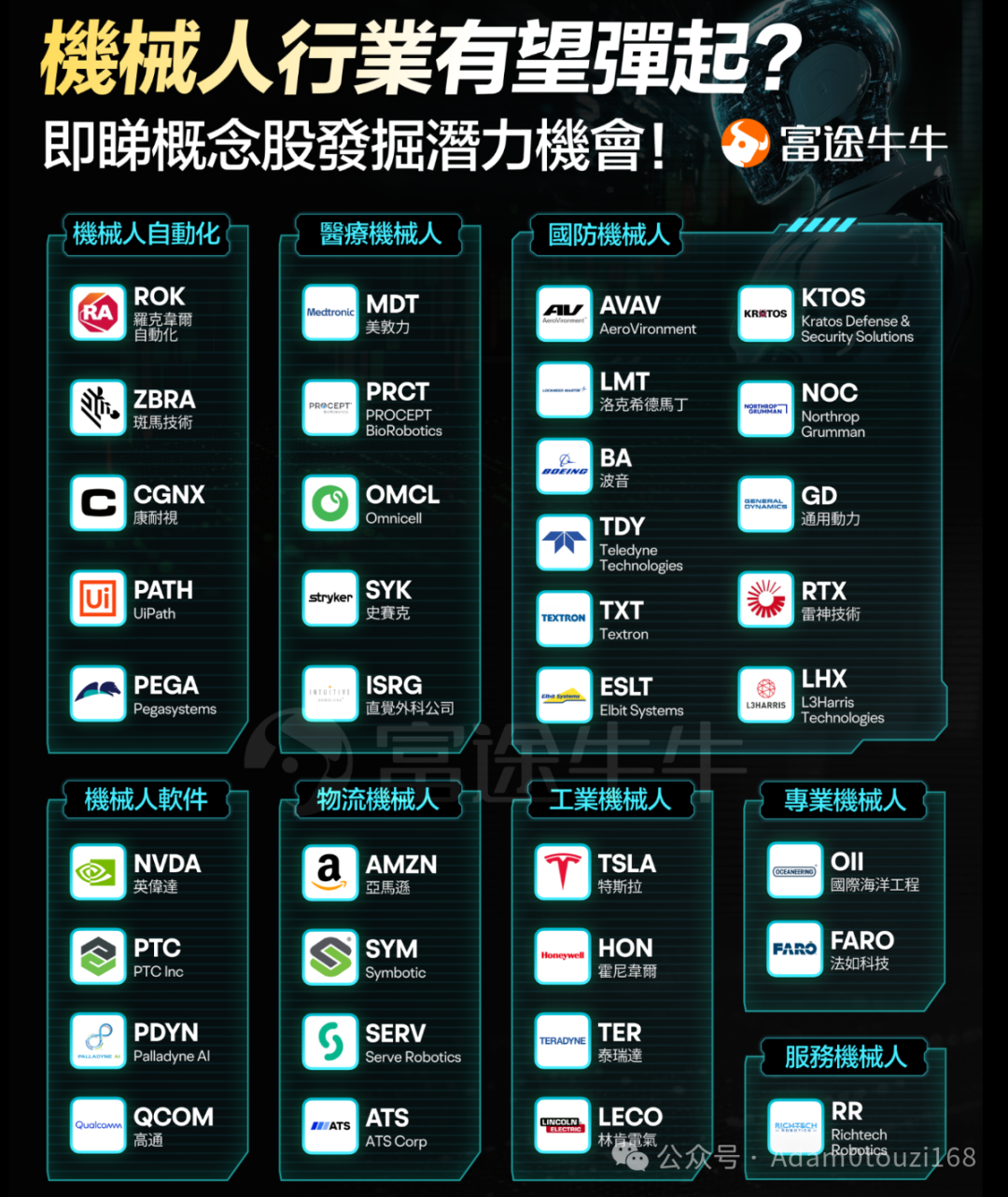 In the US stock market,in the logistics robotics field:Amazon, warehouse robotics leader Symbotic (SYM.US), Serve Robotics (SERV.US) providing “last mile” delivery for Uber Eats, warehouse robot ATS Corp (ATS.US), Guardforce AI (GFAI.US);in the robotics software field:NVIDIA (NVDA.US), PTC Inc (PTC.US), Palladyne AI (PDYN.US), Mobilicom (MOB.US), Qualcomm (QCOM.US); in the industrial robotics field:Tesla (TSLA.US), Honeywell (HON.US), Teradyne (TER.US), Lincoln Electric (LECO.US); in the robotics automation field:Rockwell Automation (ROK.US), Zebra Technologies (ZBRA.US), Cognex (CGNX.US), UiPath (PATH.US), Pegasystems (PEGA.US); in the medical robotics field: Medtronic (MDT.US), Stryker (SYK.US), and the developer of intelligent robotic radiation surgery systems $Precision Radiation (ARAY.US); global surgical robotics leader Intuitive Surgical, surgical robot supplierPROCEPT BioRobotics (PRCT.US)global leader in electrophysiology innovative robotic technologyStereotaxis (STXS.US),rehabilitation robotics leader $Lifeward (LFWD.US)robotic surgery systems led by Bill GatesVicarious Surgical (RBOT.US), pharmacy dispensing robots Omnicell (OMCL.US); defense roboticsAeroVironment (AVAV.US), Kratos Defense & Security Solutions (KTOS.US), Lockheed Martin (LMT.US), Northrop Grumman (NOC.US), $Boeing (BA.US), General Dynamics (GD.US), Teledyne Technologies (TDY.US), Raytheon Technologies (RTX.US), DRS Technologies (TXT.US), L3Harris Technologies (LHX.US), Elbit Systems (ESLT.US), Nauticus Robotics (KITT.US); specialized robotics field:underwater robotics International Ocean Engineering, 3D scanning robots $FARO Technologies (delisted) (FARO.US); consumer robotics field:robot vacuum cleaner iRobot (IRBT.US); service robots:cleaning, delivery, and cooking service robot developer Richtech Robotics (RR.US). AI computing power and embodied intelligent foundation NVIDIA provides a full-stack solution from cloud to edge for robots through the Isaac platform, and its GR00T open-source model has been adopted by Agility Robotics, Boston Dynamics, Xpeng Robotics, etc., supporting motion planning and environmental interaction for humanoid robots. The launch of the Blackwell chip further enhances the inference capability on the robot side, and it is expected that by 2025, the revenue share from the robotics business will reach 15%.Microsoft Azure AI robotics services are deeply integrated with OpenAI, helping enterprises quickly deploy AI-driven logistics robots and customer service robots, with clients including Walmart and FedEx NVIDIA.Leaders in medical and industrial roboticsIntuitive Surgical(ISRG.O)has a global market share of over 80% for its da Vinci surgical robots, with Q2 2025 revenue expected to grow by 12% year-on-year, and the new generation SP system reduces blood loss in urological surgeries by 30%, benefiting long-term from the demand for minimally invasive surgeries driven by global aging. Teradyne is a leader in semiconductor testing equipment, and its robotic testing systems (such as J750) are indispensable in AI chip validation, with Q1 2025 orders expected to grow by 25% year-on-year and a gross margin of 55%. The humanoid robot mass production raceTesla’s Optimus Gen3 plans to achieve mass production by the end of 2025, adopting a pure vision AI training scheme (abandoning motion capture suits) with a cost target reduced to below $20,000, initially focusing on assembly and handling scenarios within factories, and eventually expanding to home services. If mass production is successful, Tesla is expected to reshape the global labor market landscape.Investment advice for AI response robots in the Hong Kong, US, and Japanese stock markets: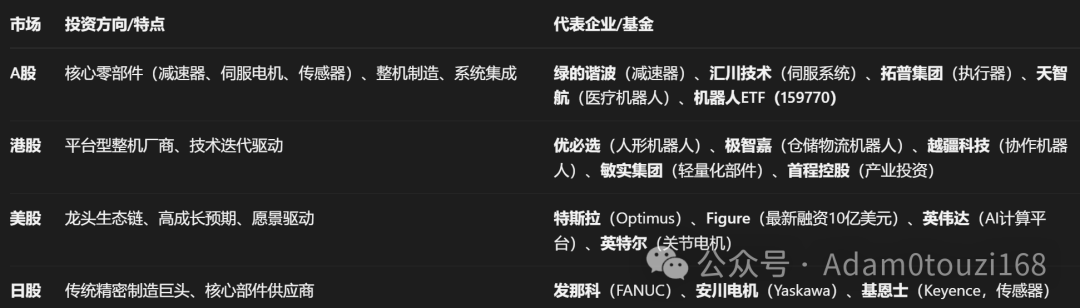
In the A-share market: Focus on domestic substitution and core supply chains
Core components: High technical barriers, accelerated domestic substitution process, are the main components of robot costs.
Reducers: Greel’s Harmonic (with a global market share of over 30% in harmonic reducers, supplying Tesla and UBTECH), Zhongda Lide (dual layout of planetary/harmonic reducers).
Servo systems: Inovance Technology (the number one market share in domestic servo systems), Mingzhi Electric (top three in global market share for hollow cup motors).
Sensors: Keli Sensor (the only mass production enterprise for domestic six-dimensional force sensors), Orbbec (over 70% market share for 3D vision sensors).
Whole machines and system integration: Focus on companies with landing applications and orders in specific scenarios.
Industrial robots: Estun (domestic industrial robot leader), Tuosda (focusing on automation in small and medium-sized manufacturing). Special/service robots: Tianzhihang (leader in orthopedic surgical robots), Ecovacs (leader in robot vacuum cleaners).
Materials and innovation:China Research Co., Ltd. (PEEK materials used for lightweight joints), Guangwei Composite Materials (carbon fiber composite materials).
Investment tools:Robot ETF (159770), one-click layout of the industry chain.
In the Japanese stock market: Precision manufacturing and industrial robot leaders
1. Core tracks and targets
Global leader in industrial robots
FANUC (6954.T) is one of the four major families of global industrial robots, with a Q1 2025 net profit expected to grow by 20% year-on-year, and a market share of over 40% in servo motors, with its collaborative robot CRX series being the number one in the electronics manufacturing field.
Yaskawa Electric(6506.T)has a 35% market share for welding robots in the automotive industry, and will launch the AI vision-equipped MotoMINI model in 2025, reducing costs by 25% compared to previous generations.
Harmonic Drive Systems (Harmonic Drive Systems) is a leading company in the global harmonic reducer field, with core advantages in its harmonic reducer products, which are core components of robots and are crucial for motion accuracy and stability.
Medical and nursing robots
Toyota (7203.T) has deployed its “Human Support Robot” in many nursing homes in Japan, assisting the elderly in getting up and walking, with orders expected to exceed 10,000 units by 2025, and a gross margin of 28%.
Cyberdyne (7777.T) has a market share of over 70% for its HAL exoskeleton robot in the medical rehabilitation field, and in 2025 will collaborate with the US Department of Veterans Affairs to expand into the North American market.
Semi-conductor equipment and materials
Tokyo Electron (8035.T) has wafer inspection robots (such as TEL AIT) that are indispensable in TSMC and Samsung production lines, with Q1 2025 orders expected to grow by 30% year-on-year and a gross margin of 50%.
Shin-Etsu Chemical (4063.T) has a global market share of over 60% for photoresist coating robots, benefiting from the demand for AI chip manufacturing, with net profit expected to grow by 25% in 2025.

Opportunities and Risks
The robotics industry chain can be divided intoupstream core components, midstream whole machine manufacturing, and downstream scenario applicationsthree major links, with technical barriers decreasing from upstream to downstream.Among them, upstream core components (reducers, sensors, controllers) are key to domestic substitution and are also long-term high value-added areas; midstream whole machine manufacturing needs to focus on technological iteration and scalability; downstream scenario applications should focus on the commercialization of high-value scenarios (such as medical and logistics).
The investment opportunities brought by the robotics wave are global, but the characteristics of each market are different:
In the A-share market: The complete industry chain focuses ondomestic substitution and scalable manufacturingadvantages, especially in core components and specific scenario integration.
In the Hong Kong stock market: Pay attention toplatform-type whole machine manufacturers and specialized technology companies, as well as investment platforms benefiting from industry development.
In the US stock market: Focus onleading ecosystems, cutting-edge technologies, andvision-drivenhigh growth expectations.
In the Japanese stock market: Focus on traditional giants with deep foundations inprecision manufacturing and core components.
Risk Control Diversified investment: Avoid excessive concentration on a single market or target, it is recommended to allocate the ratio of Hong Kong stocks, US stocks, A-shares, and Japanese stocks as 3:3:3:1 (varies by individual); Valuation safety margin: Prioritize choosing companies with PEG<1 (such as Jizhi Jia PS about 9.9 times, significantly lower than the industry average); Technological iteration risk: Regularly track technological routes (such as whether Tesla Optimus shifts to LiDAR), and adjust positions in a timely manner.This year, major events in the robotics industry:September: Tesla Optimus production plan meeting; November 6: Tesla annual shareholder meeting; October-December: Yushu Technology applies for IPO.In the next 10 years, the robotics wave will reshape the global manufacturing and service landscape, with core component localization, AI + robotics integration, and high-value scenario implementation being three major certain opportunities.Note: The above investments are for personal sharing only. The stock market has risks, and investment should be cautious.Welcome to join Adam’s Marginal Notes Planet↓↓1. Continuously publish selected high-quality content2. Market prediction sharing3. Focus on derivatives (turbos, options) trading