0 Introduction
The Linux operating system has good security and stability. As an open-source UNIX-like operating system, its security and reliability have attracted the attention of governments worldwide, especially in our country where it has played a positive role in the security and controllability of operating systems[1]. In recent years, the market share of the Linux operating system has been increasing year by year, especially in the desktop operating system and embedded systems. To meet the rapid development needs of Linux operating systems in society, many universities have included Linux operating system courses in the teaching plans of computer science and related majors as a compulsory course for cultivating innovative application-oriented talents.
1 Characteristics of Linux Operating System Courses
The content of Linux operating system courses includes the use of graphical and character interfaces under the Linux operating system, commonly used Linux commands, various practical programs in the Linux environment, C programming in the Linux environment, setting up common Internet network servers, system management, and network management. The applicability and practicality of the Linux operating system course are very strong, with a focus on application; how to apply it is our main research goal. The Linux operating system also holds a significant position in the technical structure of computer network technology, and mastering this course strongly supports students in further studying other computer-related courses and enhancing their practical skills.
2 Problems in Teaching Linux Operating System Courses
In the traditional teaching model of the Linux operating system, most universities separate the theoretical knowledge teaching from the experimental courses, usually with teachers first lecturing theoretical knowledge in the classroom, and then students going to the lab to conduct experiments according to the hours and experimental content set in the syllabus. A prominent feature of this traditional teaching model is that the experimental phase is used to “assist” theoretical teaching; students “verify” what they have learned in class through specific experimental operations. The actual teaching effect generally shows that students’ theoretical knowledge has indeed reached a certain level, but practical operations, especially application skills, are relatively lacking.
Currently, students mostly encounter the Windows operating system and are accustomed to using it. When they first come into contact with the Linux operating system, they often find it difficult to adapt. This is because there are many commands in the Linux operating system, and each command must be used with certain options, which can indeed be difficult to remember and unfamiliar for beginners. This discomfort can hinder beginners from delving deeper into learning the Linux operating system, thus preventing them from experiencing the advantages of using it.
Based on the problems mentioned above and in line with the goal of cultivating innovative application-oriented talents, an “application-driven” teaching method for the Linux operating system can be used to help students overcome difficulties in learning the course, enhance their interest in learning, and improve their ability to analyze and solve practical problems in learning the Linux operating system. This teaching method is significantly different from traditional teaching models.
3 Reform Methods for Application-Driven Course Teaching
Teaching the Linux operating system must align with the current national demand for Linux operating system talents, reforming the traditional teaching model and updating the course content in conjunction with application projects. This is essential in both the teaching of theoretical knowledge and the design of cases. The “application-driven” teaching method focuses on “application-oriented cases” and places students as the “main body,” combining theoretical knowledge from textbooks with specific real-world cases. It fully leverages the strong applicability characteristic of the Linux operating system course[2].
Therefore, a key aspect of the course is the selection of cases. When selecting cases, certain principles should be followed: first, the actual cases included in the teaching plan should comply with the syllabus and be guided by it; second, the selected cases should be exemplary and widely applicable, covering the main content of the Linux operating system course. Only application-oriented case materials with these characteristics are suitable for teaching and experimental cases in this course.
By engaging with these application-oriented cases, students can transform abstract concepts into concrete understanding, gain a perceptual understanding of the Linux operating system, digest theoretical knowledge from the course, and master practical operational skills. Ultimately, applying the theoretical knowledge of the operating system to solve practical problems in the cases allows students to explore multiple solutions to those problems. The teaching process needs to emphasize a practice-oriented approach to mastering application skills, highlighting the student as the main subject and fully utilizing their initiative and creativity, thereby enhancing interest and hands-on ability in learning the Linux operating system and deepening their understanding of operating system theory. Students with strong learning and practical skills can experience a sense of achievement after successfully completing projects, which reflects the essence of the application-driven teaching philosophy.
Teachers play a role in guiding direction and macro-control during the teaching process. In addition to carefully selecting practical cases, they must also organically integrate the theoretical knowledge points of the course with various aspects of the specific real-world cases, conducting corresponding theoretical sorting and experimental design. At the beginning of the course, teachers should help students understand the characteristics of the Linux operating system course, guide them to establish a project-oriented learning mindset, and showcase typical cases of project-oriented learning while ensuring adherence to the course syllabus. Gradually, students should develop a positive cycle of “first theory guiding practice, then practice deepening understanding of theory” during their learning process in this course. The “application-driven” teaching method for the Linux operating system enables students to achieve an ideal level of both theoretical and practical operational abilities, realizing a win-win teaching effect for theory and skills[3].
4 Organic Integration of Projects and Courses
Combining the main teaching tasks of the Linux operating system course, students are trained to manage systems and networks in a Linux environment, proficiently master and use various Linux commands, set up common network servers, and configure networks. In the “application-driven” teaching method, the teaching content is broken down according to the syllabus into corresponding knowledge points, and the various operational parts of the project are organically integrated with the broken-down knowledge points[4], mainly focusing on tasks completed by the Linux operating system.
4.1 Design a Project for Building and Managing a Linux Local Area Network for the Academic Affairs Office
The functions that the project needs to achieve can be summarized as follows: implement DHCP functionality in the local area network, requiring IP binding for a client machine for the main responsible person in the academic affairs office; implement DNS functionality in the local area network, capable of resolving domain names for departments such as the Student Management Section, Examination Center, Teaching Operation Management Center, and Experiment and Internship Section; establish a web site within the academic affairs office that can be accessed via a browser; establish a MAIL server within the academic affairs office capable of sending and receiving emails from various servers; create an FTP for the academic affairs office to create users and groups for each department, setting different FTP access permissions for different users; set up a SAMBA server to achieve resource sharing between Linux and Windows systems; and formulate daily system maintenance and routine task customization.
4.2 Decompose the Project According to the Linux Operating System Syllabus and Integrate Knowledge Points to Design Specific Tasks for Several Stages
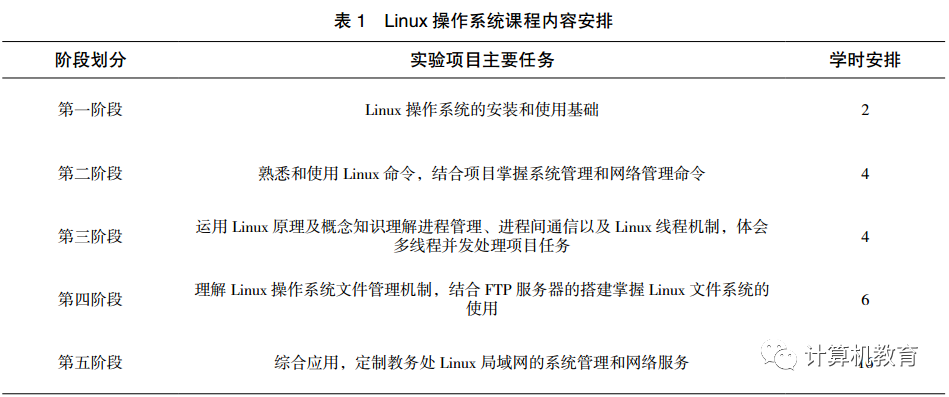
The total class hours for the Linux operating system course is 32 hours. In conjunction with the project, the overall planning of the course is divided into several stages, blurring the fixed sequence of unit chapters set in the traditional teaching model, as shown in Table 1.
4.3 Divide Each Stage into Several Small Tasks and Set Evaluation Mechanisms
Focusing on the Linux local area network setup project, the learning tasks are refined and practically implemented, integrating theoretical knowledge from the course with specific operational tasks at each stage, allowing students to learn and understand theoretical knowledge while also practicing specific applications. This ensures that the entire learning process becomes familiar with the Linux operating system, making theoretical knowledge engaging and not abstract, with practical projects targeting specific applications, truly practicing the principle of learning for use and improvement.
As the course approaches its conclusion, teachers should emphasize evaluating the implementation effects of case teaching. This can be achieved through establishing an appropriate teacher evaluation mechanism linked to the completion of course tasks and a student peer evaluation mechanism, setting specific and detailed evaluation segments for project completion. Finally, successful student projects can be selected, summarized, and presented to classmates, actively guiding students to think about continuous improvement of projects and the potential for future enhancements, striving to convey to students that while this course is coming to an end, their learning of the Linux operating system will not cease and will continue to enhance their application and project development skills.
4.4 Innovate Course Content to Promote Practical Teaching for Skill Enhancement
The “application-driven” teaching method, based on the theoretical guidance of the syllabus, reasonably organizes theoretical teaching content into practical teaching projects, breaking and improving the traditional unit-chapter-based teaching model. Project-driven approaches allow students to understand the horizontal knowledge points related to project tasks while also experiencing the progressive nature of vertical tasks.
Teachers creatively set up new learning resources and build real application scenario learning environments, inspiring students to expand their learning from one case to multiple different application scenarios, and gradually guiding students to apply the theoretical knowledge they have learned and the practical skills they have acquired to their own designed cases and application scenarios, fostering their innovative thinking in network management and operation maintenance in the Linux operating system. Teachers can use these successful student-designed cases in the next round of teaching content, providing valuable references for optimizing teaching content and cases, truly realizing the principle of “mutual growth in teaching”.
5 Effect Analysis of Course Teaching Reform
To verify whether the application-driven teaching reform is reasonable and feasible, we analyzed the final exam scores of students from the computer science major at Beijing Forestry University for the years 2019 and 2020. Figure 1 shows the distribution of final exam scores for students from a certain grade before the implementation of the teaching reform in 2019. As can be seen from Figure 1, the number of students scoring below 60 is relatively high, accounting for 27% of the total number of students taking the exam, while those scoring above 90 are few, only accounting for 7% of the total.
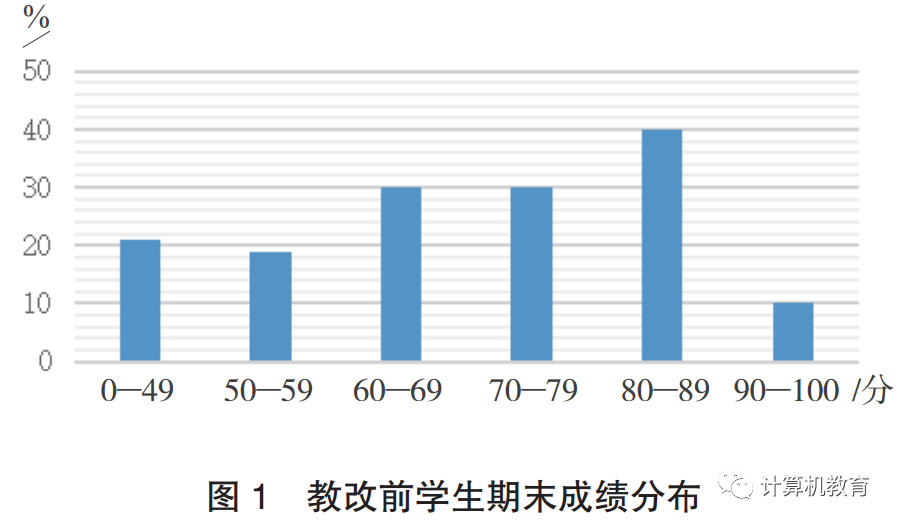
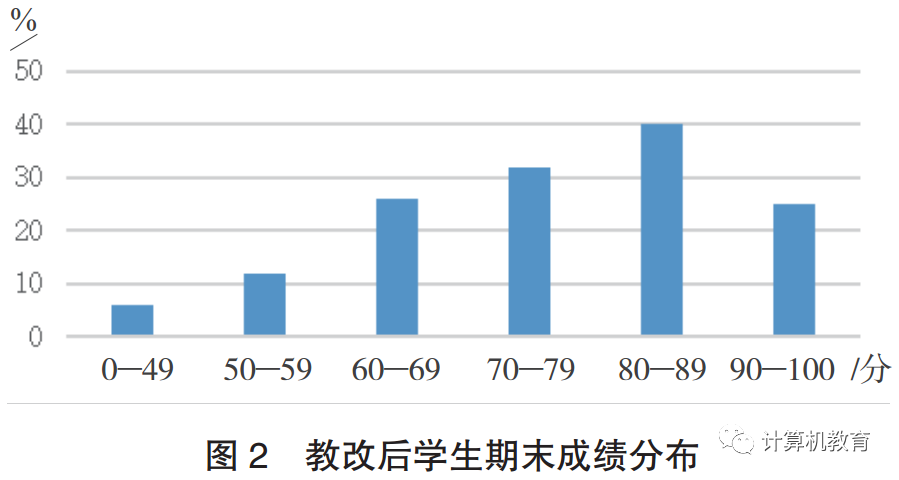
Figure 2 shows the distribution of final exam scores for students from a computer science major at Beijing Forestry University after the implementation of the teaching reform in 2020. From Figure 2, it can be seen that under the premise of similar question volume and difficulty, the number of students scoring below 60 has significantly decreased, and the final exam scores of students are centered around 60-100, presenting a Poisson distribution. The results indicate that compared to the final exam scores of students before the implementation of the teaching reform, the number of students failing has significantly decreased, and the number of students with excellent scores has notably increased, demonstrating a significant improvement in students’ interest in learning the Linux operating system course and a clear enhancement in their overall scores.
6 Conclusion
The “application-driven” teaching method, when implemented in actual teaching processes, may encounter issues such as varying levels of student learning abilities and differences in understanding and completing tasks. Students with a strong foundation are more interested in completing tasks, showing higher learning motivation and gradually improving their innovation capabilities. In contrast, students with weaker foundations may struggle to complete basic tasks, leading to noticeable anxiety and slow learning progress. In the future, this course will consider designing a layered teaching model for the “application-driven” method, where the design of projects and tasks follows the principles of progressing from simple to complex, from small to large, and from coarse to fine, ensuring orderly arrangements for specific tasks and tailoring teaching to different levels of students. For students who show a clear interest in the Linux operating system course, teachers may increase the difficulty of project design, reserve suitable backup projects, and provide targeted and selective continuous learning and improvement opportunities.
Finally, it is suggested that teachers emphasize to students during the teaching process that from the moment they begin learning the Linux operating system, they should try to abandon the working methods and problem-solving approaches associated with the Windows platform. These two operating systems are distinctly different, particularly in aspects such as memory management mechanisms and process management operation mechanisms. Teachers should guide students to distinguish these differences in their understanding of Linux operating system knowledge points and conduct comparative analysis in project practices, deeply appreciating and exploring the unique advantages of the Linux operating system.
References:
[1] Li Li, Sun Hua, Wang Xianhui, et al. Research and Improvement of Teaching Methods for the “Linux Operating System” Course. China Management Informationization, 2014, 17(2): 137-138.
[2] Fan Quanrun, Qin Haifei. Research on Application-Driven Operating System Teaching. Computer Education, 2013(15): 4-8.
[3] Fu Sha. Teaching Reform and Practice of Operating System Principles Course. China Management Informationization, 2010, 13(21): 67-68.
[4] Wu Shuqian. Research and Exploration of “Linux Operating System” Course Teaching in Colleges and Universities. Educational Theory and Practice, 2017, 37(33): 57-58.
Funding Project: Exploration of “Application-Driven” Linux Operating System Teaching Reform (BJFU2019JY079).
First Author Profile: Li Qun, Female, Lecturer at Beijing Forestry University, research direction in operating systems and search engines, [email protected].
Citation Format:Li Qun, Li Juhu, Han Hui. Application-Driven Linux Operating System Teaching Reform[J]. Computer Education, 2021(11):120-123.
(WeChat Editor: Shi Zhiwei)
(End)
More Exciting:
[Directory] Computer Education 2021 Issue 10
[Directory] Computer Education 2021 Issue 9
[Directory] Computer Education 2021 Issue 8
Professor Chen Daoxu from Nanjing University: Teaching students to ask questions and teaching students to answer questions, which is more important?
Professor Xu Xiaofei from Harbin Institute of Technology on the exploration and reflection of new engineering construction and educational model innovation in Chinese universities.
[Directory] Computer Education 2021 Issue 7
[Editor-in-Chief’s Message] Insights from “Online Teaching is Also Possible”
[Directory] Computer Education 2021 Issue 6
5118 Courses! The Ministry of Education officially announces the first batch of national first-class undergraduate courses.
The first batch of national first-class undergraduate courses has been announced, with detailed explanations from the Ministry of Education.
[Yanshi Series]: Trends in Computer Discipline Development and Their Impact on Computer Education.
Professor Li Xiaoming from Peking University: From interesting mathematics to interesting algorithms to interesting programming—one pathway for non-professional learners to experience computational thinking?
[Directory] Computer Education 2021 Issue 5
Several Thoughts on Building a First-Class Computer Discipline
Professor Liu Yunhao from Tsinghua University answers 2000 questions about AI.
[Directory] Computer Education 2021 Issue 4
[Directory] Computer Education 2021 Issue 3
[Directory] Computer Education 2021 Issue 2
[Directory] Computer Education 2021 Issue 1
Professor Zhan Dechen from Harbin Institute of Technology: A new model to ensure the quality of university teaching—synchronous and asynchronous blended teaching.
[Principal Interview] Accelerating the Advancement of Computer Science Education—An Interview with Professor Zhou Aoying, Vice President of East China Normal University, who is a pioneer in data science education.
[Yanshi Series] Analysis and Suggestions on Quality Issues in Undergraduate Computer Courses.
Analysis and Insights on the Setting of Computer Undergraduate Courses at the University of Tokyo.
Teaching Reform and Practice of Artificial Intelligence Courses at Peking University.
Construction of New Engineering and Big Data Majors.
Learning from Others—Compilation of Research Articles on Computer Education at Home and Abroad.