Hello everyone, recently in the large PLC market, well-known products include Siemens S7-400, AB 1756, Schneider Quantum, M580, and others. Schneider’s Modicon series PLCs are highly recognized in the market. In particular, the large PLC Modicon M580 series, along with AB ControlLogix L7 and Siemens S7-400, consistently ranks among the top three in market share for large PLCs.Today, I will briefly analyze Schneider’s related PLCs. This article is of reference significance for PLC sales personnel and some R&D staff.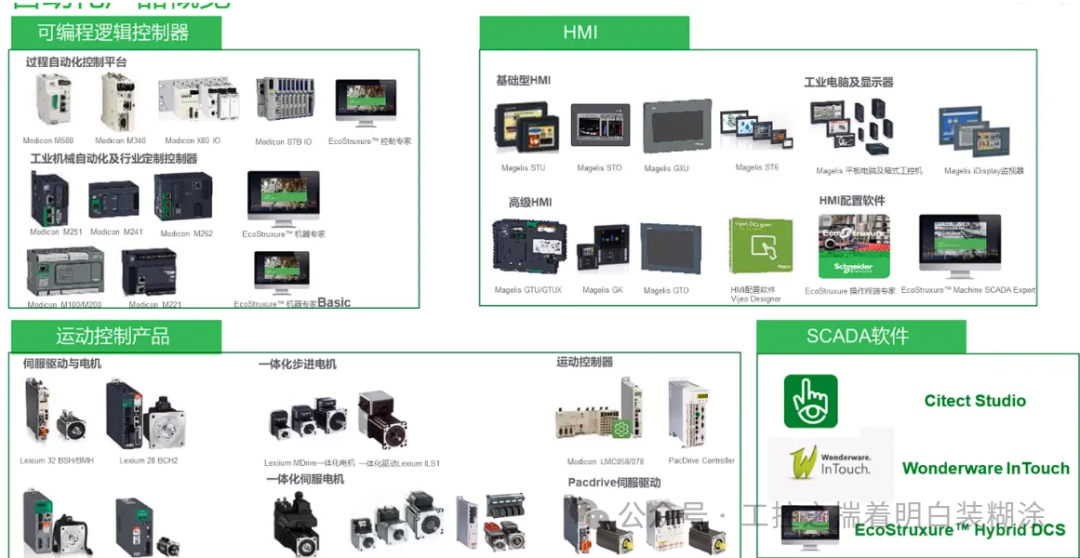
Schneider acquired an American company called Modicon, whose products include the Quantum and Momentum series PLCs and programming software Concept. The background is as follows: Dick Morley invented the Modicon M084 PLC in 1968 and then founded Modicon. The name Modicon comes from Modular Digital Control. Modicon was later acquired by the German company AEG. In 1994, due to a joint venture between Schneider and AEG, Modicon’s shares were transferred to this joint venture. In 1996, Schneider acquired all shares of AEG Schneider, thus fully owning Modicon. Subsequently, Schneider was officially renamed Schneider Electric.
- Large PLC: Quantum, M580
- Medium PLC: Premium, M340
Schneider also acquired an American company called TE, whose Premium Micro series PLC products are also under Schneider.
The programming software related to these PLCs was gradually integrated into Unity Pro software by Schneider.
Tracing back, both Modicon and TE are American companies that developed PLCs, so we see that the Quantum PLC and the M580 PLC’s programming software Unity Pro have an American flavor in their operation interface and user programming style, which is very similar to Rockwell’s Studio5000 and GE’s PLC programming interfaces.
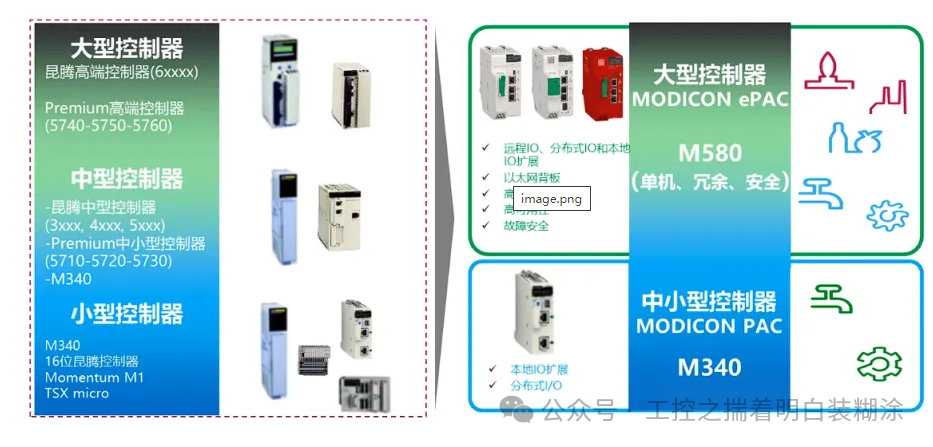
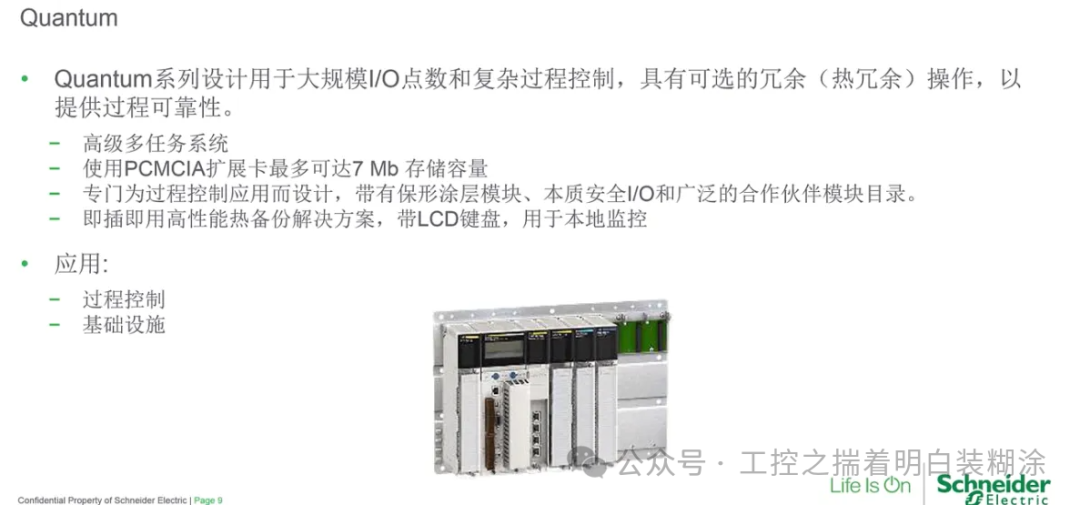
Old PLC: Quantum series, Premium, Momentum + Unity Pro programming software;
New PLC: M580, M340 + Control Expert programming software;
Continuing, after Schneider acquired the aforementioned companies, they integrated them, and the Momentum and Micro PLC products have gradually exited the Chinese market, and it seems Schneider is no longer promoting them.
Additionally, Schneider has a PLC programming software called SoMachine, which is actually a secondary development based on CODESYS and corresponds to Schneider’s PLC product series mainly including M218, M238, M258, LMC058, LMC078, etc., and is mainly used in the OEM market.
Moreover, Schneider has another series of PLCs called the M series, mainly including M221 M100 M200, which is similar to Siemens’ SMART series, targeting the increasingly competitive cost and functionality in the OEM industry, with programming software SoMachine Basic. Although its name also includes SoMachine, it has no relation to CoDeSyS, and its programming style is similar to Japanese PLCs. I have not used this series, but I have heard about it.
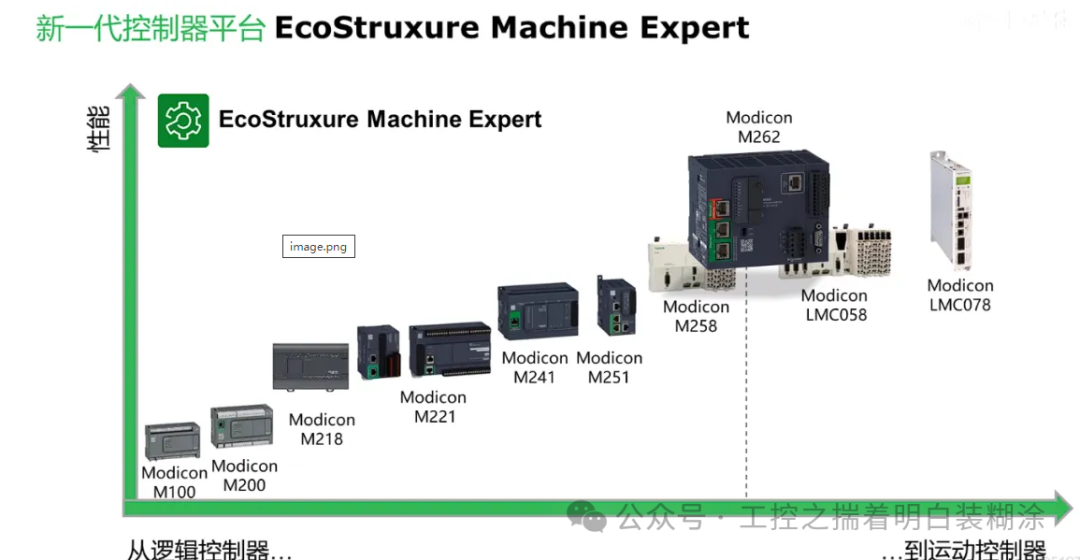
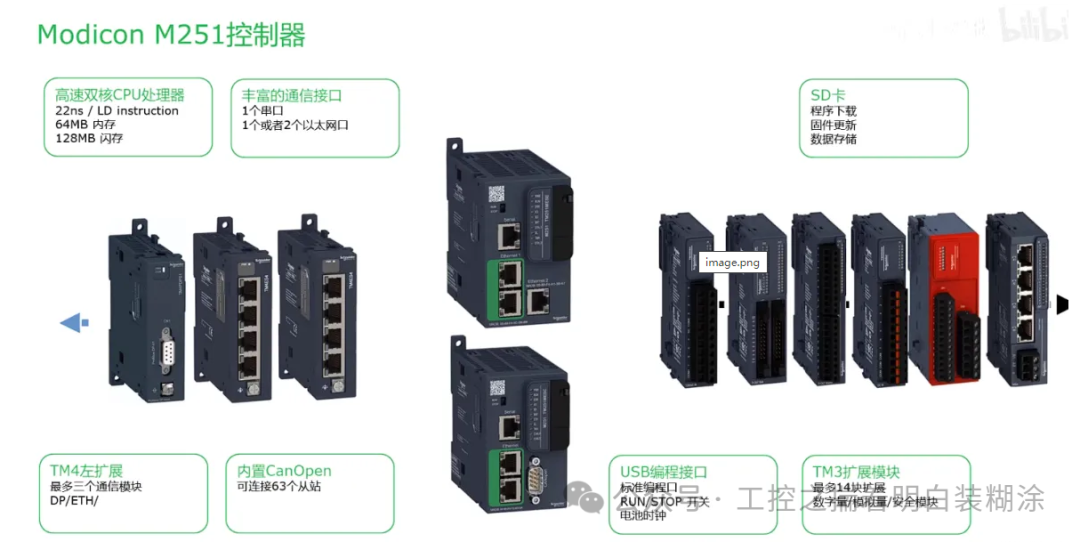
From the above image, it can be seen that the M25* series also adopts a modular design: starting from the CPU module, various communication modules such as CANopen and Ethernet communication modules are expanded on the left, while the right side is for expansion I/O modules, which is quite interesting, clear and elegant; Mitsubishi PLC’s module expansion is also done this way, but I am curious whether the power module connection will affect these expansion modules.
Although I have just mentioned many Schneider PLC programming software, the ones that will be commonly used in the future are still Unity Pro SoMachine SoMachine Basic. I have only studied Unity Pro and SoMachine on these two PLC upper-level machines.
OK, from the above information, everyone has understood the history of Schneider’s PLC and its family of products. Now, let’s focus on Schneider’s M580 series large PLC products.
Modicon M580 ePAC is the first high-end integrated controller designed for EcoStruxure™ factories, featuring an open, flexible, reliable, sustainable, secure, and robust architecture. It has built-in Ethernet redundancy controllers and safety controllers (SIL3 level), as well as network security embedded in its core.
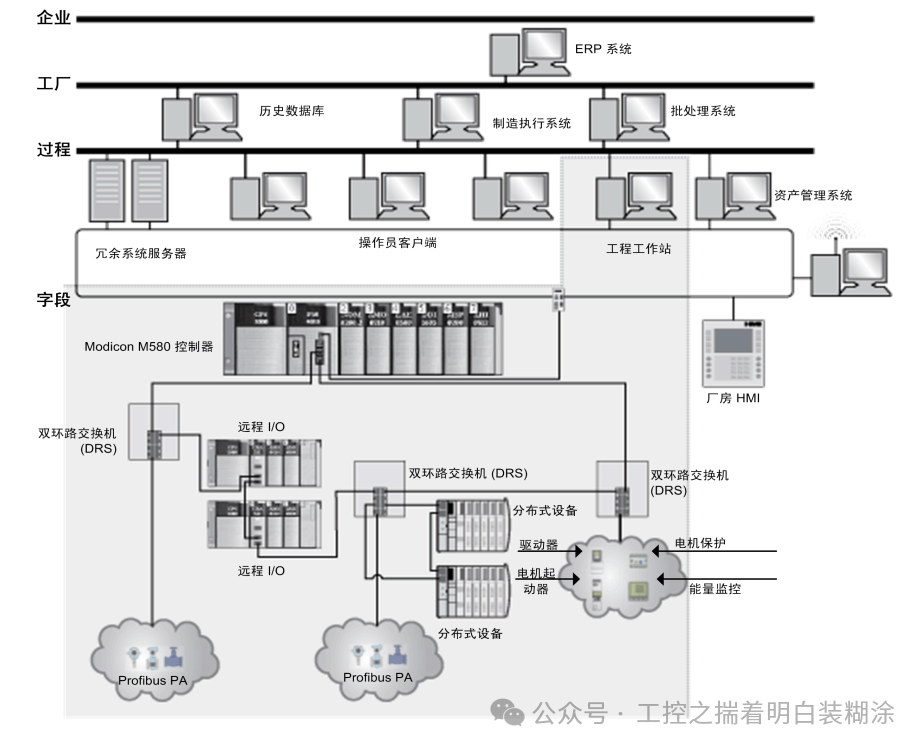
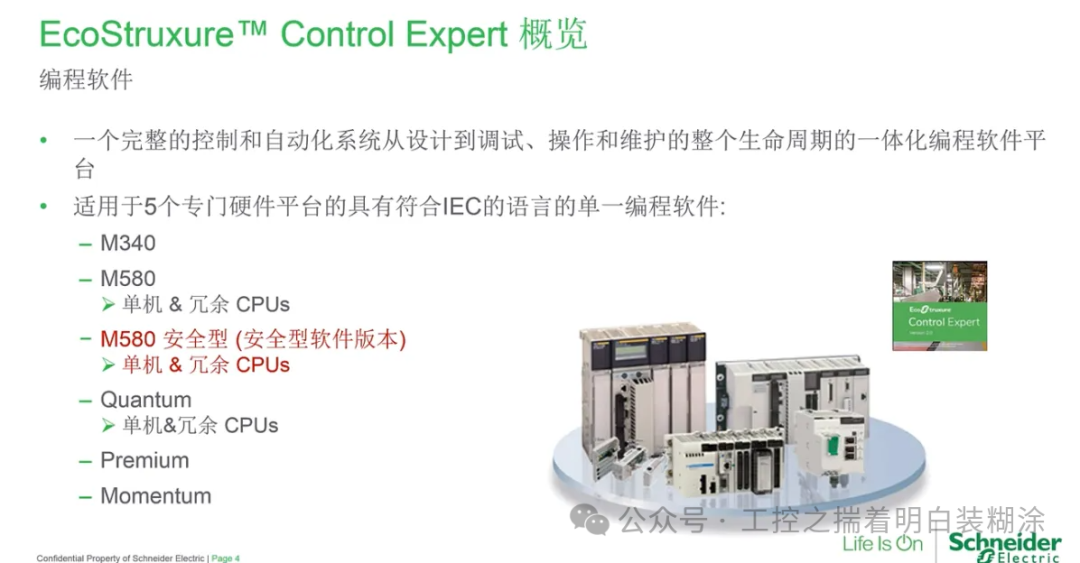
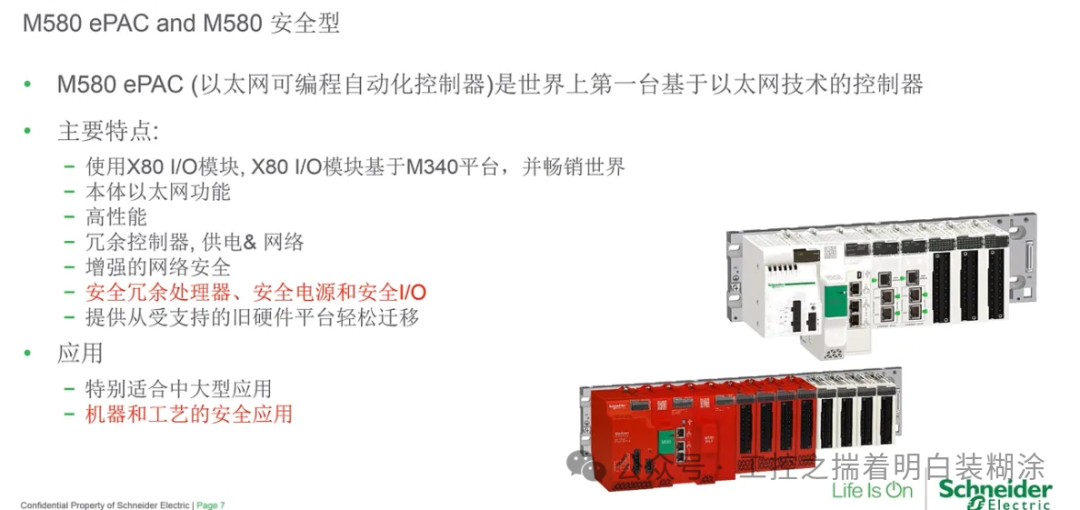 Standard controllers or safety controllers use the same Modicon X80 I/O platform modules and EcoStruxure Control Expert (formerly Unity Pro) software for programming and configuration..
 The CANopen communication of the M580 series CPU does not have a built-in CANopen port like the M340 series CPU; it must use the CANopen X80 master module (BMECXM0100) to achieve CANopen communication on the M580 PAC, with a device part number BMECXM0100 used to declare and configure two types of CANopen X80 master module references, following the protocol standard CANopen CiA 301 V4.2. It supports M580 Ethernet backplane (with substation communicator BMECRA31210 module, minimum firmware version V2.10) for remote substations.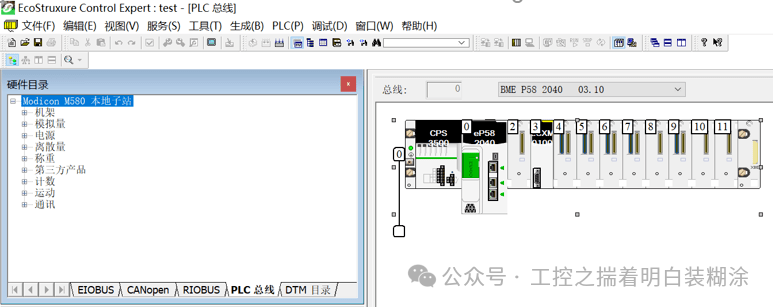
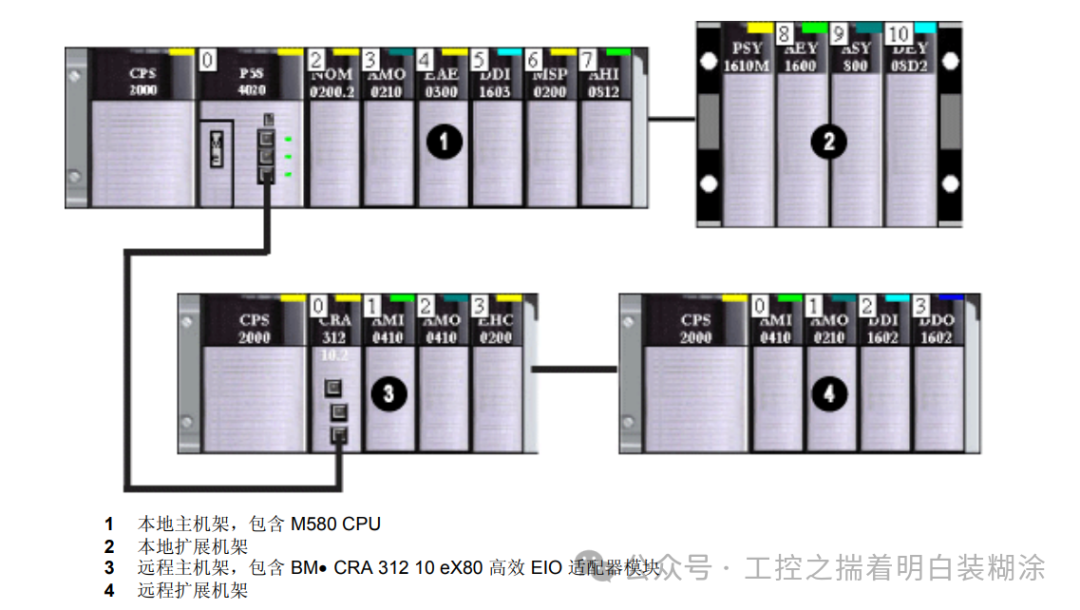
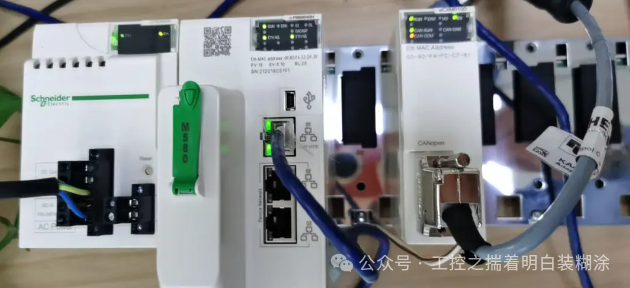 From the manual, it can be seen that in the main loop of the M580 system, the local rack includes the CPU as well as communication and dedicated modules. A local rack contains 1 main rack and up to 7 fully expanded racks (similar to Siemens’ TDC expansion modules), depending on the CPU used. The main rack is required in the M580 architecture; the expansion rack is optional, and when present, it is considered part of the local rack. Up to 7 expansion local racks can be installed, depending on the CPU type.
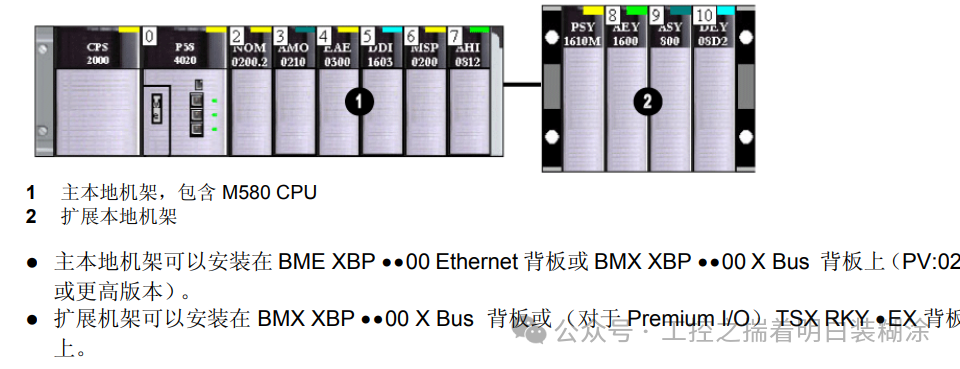 From the above image, it can be seen that the M580 actually has different backplane models, at least three, including Ethernet backplane, I/O bus backplane, and Premium backplane; as for why this design is made and why not unify it into one backplane, I am also curious, it may relate to the product design philosophy.Its backplane compatibility:
- Modicon X80 I/O modules can be installed on BME XBP ••00 Ethernet or BMX XBP 0•00 X bus backplanes.
- Only Modicon eX80 (e.g., PME SWT 0100 and BME AH• 0•12 modules) can be installed on BME XBP ••00 Ethernet backplane.
- Only Premium I/O modules can be installed on TSX RKY •EX Premium backplane.
Schneider’s dual-ring switch DRS:This product, I think, is really impressive, as it meets star topology architecture and supports high-speed communication. The product manager and R&D personnel have definitely put in a lot of effort, and I recommend relevant personnel to take reference.The ConneXium extended managed switch running on the M580 network is called the dual-ring switch (DRS). Predefined configurations provided by Schneider Electric can be used for DRS.
- Supports the use of optical cables between two adjacent remote devices over distances greater than 100 meters (this can also be achieved using the BMX NRP 020• (see page 81) fiber converter module).
- Enables distributed devices to participate in the RIO network, providing RSTP recovery support for devices and cables on the sub-loop.
- Isolates sub-loops from each other and isolates sub-loops from the main loop to improve system performance.
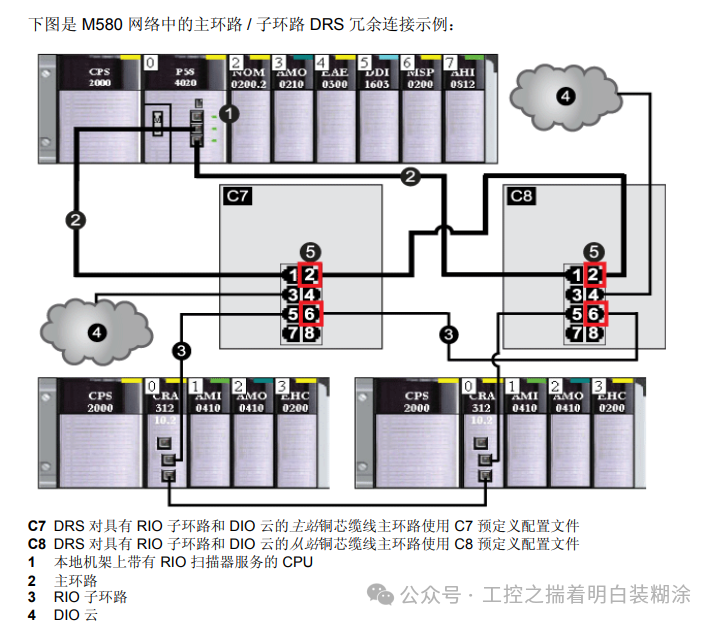 The redundancy PLC architecture diagram of M580:
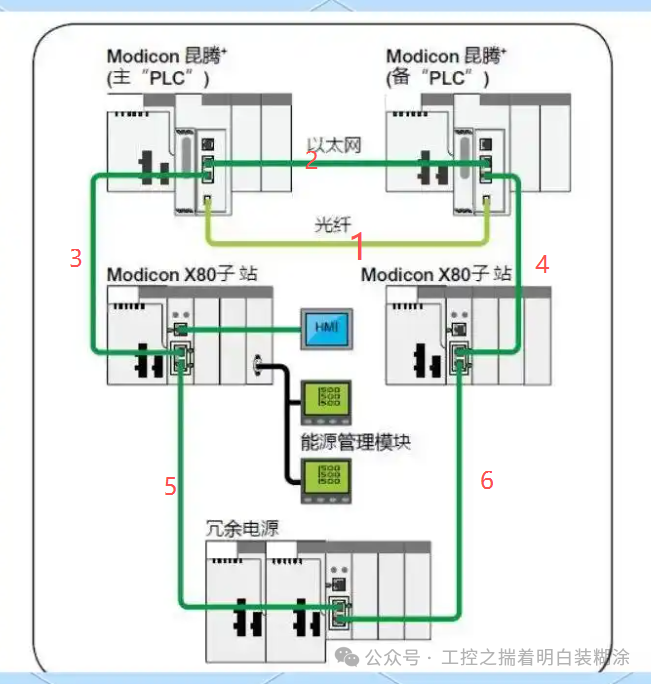 From the above diagram, you can see the topology of the ring redundancy control system. I have labeled the relevant cables with numbers. Based on my own R&D and application experience, I have summarized the following related issues:1. If line 1 is disconnected, who will control the remote I/O modules between the master and backup PLC, will it be preemptive or separated;2. How is the upstream communication with SCADA and other data acquisition and monitoring systems achieved, and is there a redundancy switching issue for downstream data;3. How to ensure the switching mechanism and response time when other lines are disconnected simultaneously, such as line 1 and line 3, or line 1 and line 6, or line 2 and line 5 being disconnected at the same time, this is a very thought-provoking question.4. The role of redundant power modules and the impact response of cable disconnections;In fact, if you look closely at this diagram, there are many details and points to consider, and I suggest readers study it carefully.The redundancy topology diagram of distributed remote I/O modules:
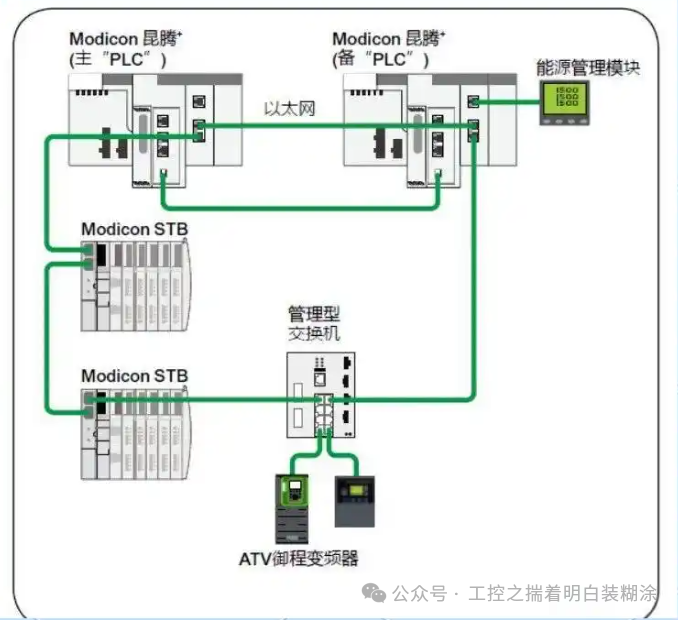 The redundancy topology diagram of hybrid I/O modules and PLC:
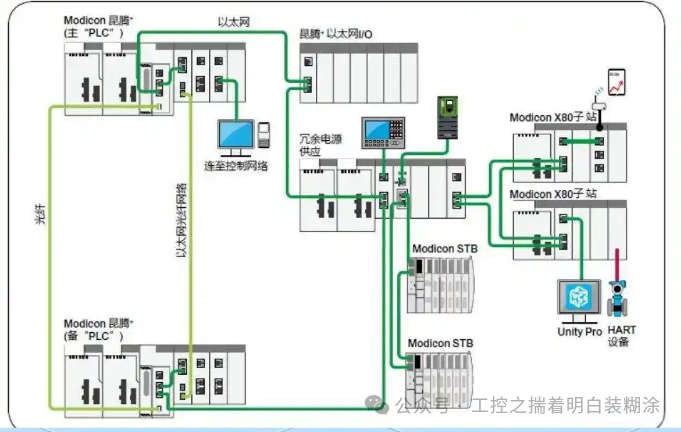 The above diagrams are very characteristic, not only showing redundant PLCs but also the communication between redundant PLCs and Quantum PLCs. So, everyone can think about: how is communication with non-redundant Quantum PLC ensured during the switching of redundant PLCs?From the above redundancy topology diagrams, it can be seen that this flexible and variable architecture design aims to connect a wider range of devices, providing the system with stronger expansion capabilities. The design of the Modicon M580 redundancy PLC not only provides powerful expansion capabilities but also adapts to the needs of complex device configurations, showcasing its diversity and adaptability. The related architecture, design solutions, and implementation methods of M580 have significant reference value for the R&D and application of large PLCs in China.The overall PLC product series summary from Schneider is as follows: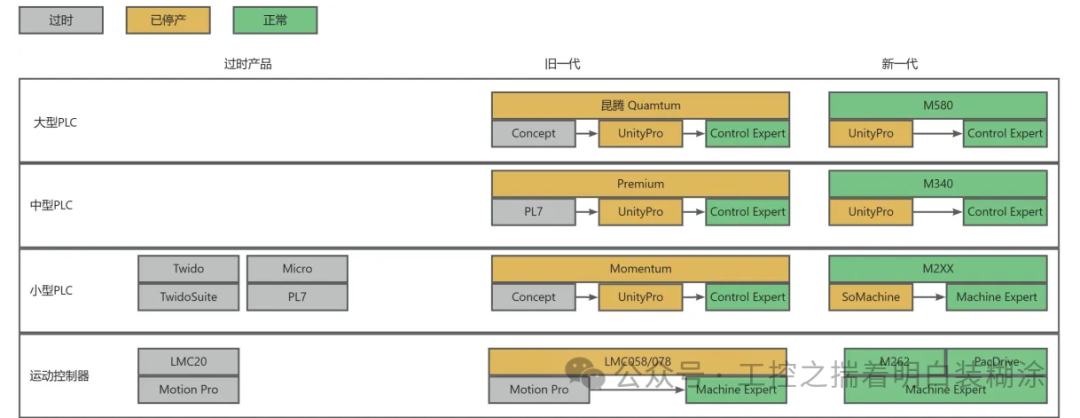
Final summary;
Process controllers (mostly modular design) are hardware and software developed by Schneider, using Unity Pro / Control Expert programming software.
Large PLC: Quantum (Quantum) –> M580
-
Quantum: Old generation large PLC, large capacity, strong performance, with redundancy and safety features, competing with Siemens S7-400.
-
M580: New generation large PLC, enhanced network functionality, with redundancy and safety features, competing with Siemens S7-1500.
Medium PLC: Premium –> M340 mid-to-high-end model.
-
Premium: Old generation medium PLC, supports various modules, can perform motion control, has redundancy, competing with Siemens S7-300.
-
M340: New generation medium-small PLC, supports various modules, competing with Siemens S7-1200 high-end model.
Small PLC: Momentum, Atrium –> M2XX, M340 low-end model.
My insights: By carefully studying Schneider’s products, one can learn a lot of information and details, from structural design, design principles, communication architecture, topology methods, to byte transmission efficiency, I have learned a lot just from the hardware perspective. In the future, I will also combine its software to further explore the details, learn and enrich myself, and I hope all readers will learn together and make progress together. Thank you all.