As AI accelerates from the cloud to the edge, a digital intelligence revolution is quietly unfolding across all scenarios: #AI smartphones turn casual photos into artistic masterpieces in seconds, AI PCs can automatically handle tedious document processing, robots can perceive their environment in real-time and move flexibly, and smart cars can perform real-time traffic analysis and predictions… The complex reasoning, decision-making, and interaction tasks in these scenarios must run smoothly, efficiently, and with low power consumption on edge devices, relying heavily on the powerful support of NPUs (Neural Processing Units) as the “behind-the-scenes accelerators.” So, how does the NPU help edge devices break through computing power bottlenecks and become the key engine to unlock the potential of edge AI computing?
 Computing Power “Iron Triangle”: CPU, GPU, and NPU
In the current landscape where AI large model applications are flourishing, CPU, GPU, and NPU are often regarded as the “iron triangle” of computing power. Although these three processors coexist in the computing power ecosystem, they each showcase their strengths and complement each other due to architectural differences:
CPU (Central Processing Unit) is responsible for core computation and control functions, serving as the foundation for system operation. In various AI terminal devices, the CPU acts more like a “universal manager“, adept at handling complex logical judgments, system resource scheduling, and general computing tasks;
GPU (Graphics Processing Unit) is akin to a “graphics rendering expert“, capable of efficiently completing graphics rendering and quickly processing large-scale data computations due to its massive parallel computing architecture, thus becoming the main force in accelerating cloud-based AI model training;
NPU (Neural Processing Unit) is specifically designed for AI computing and machine learning. Thanks to its large-scale parallel processing units and efficient interconnect structure, it excels in deep learning tasks such as matrix multiplication and convolution operations. As a highly specialized “AI acceleration engine“, the NPU can achieve higher computational efficiency and better energy efficiency ratios when executing edge AI inference tasks.
For example, when running multimodal AIGC applications like text-to-image on AI terminals, leveraging the NPU to handle massive AI computations can significantly reduce the workload on the CPU and GPU, thereby enabling high-performance, low-power real-time AI inference locally.
Edge AI Rising, NPU Accelerates Terminal Computing Power Upgrade
Currently, the advantages of edge inference in terms of response speed, data security, network dependency, and operational costs are becoming increasingly prominent. However, under the practical constraints of limited battery life, heat dissipation space, and model adaptation in terminal devices, how can we achieve efficient and real-time intelligent responses? The NPU is the key to breaking through these challenges.
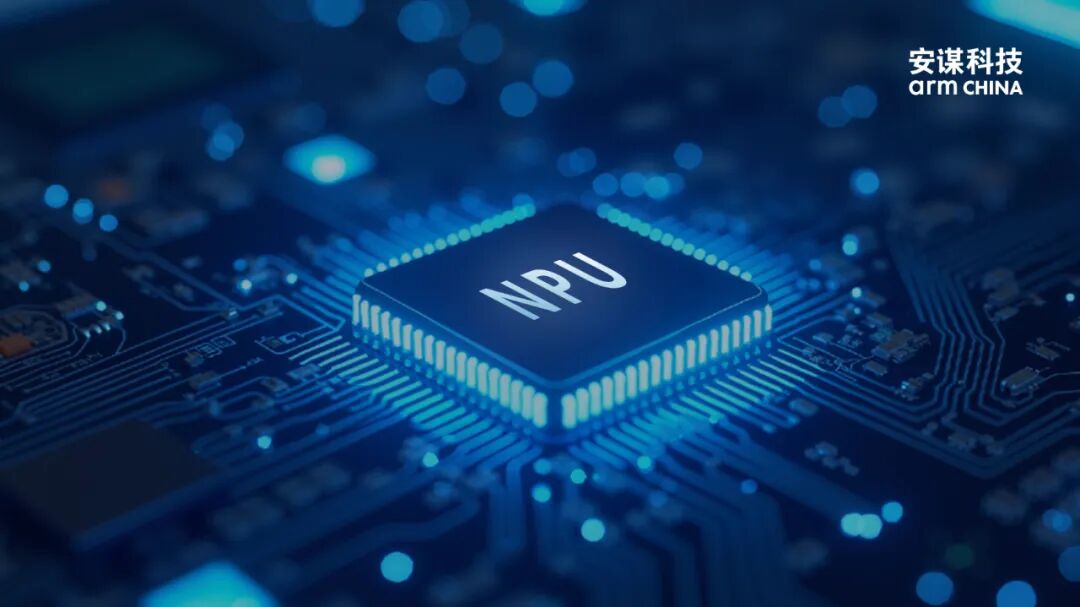
High Energy Efficiency Ratio: The NPU employs a dedicated hardware architecture that concentrates computing resources on core AI tasks and further reduces power consumption through optimized data transport mechanisms. Compared to other computing units, the NPU often achieves a better energy efficiency ratio when performing equivalent AI inference tasks.
Fast Response: Based on large-scale parallel computing units, specially tuned data flow paths, and efficient memory access mechanisms, the NPU can significantly enhance real-time data processing capabilities, effectively reducing AI inference latency. Additionally, local deployment of AI models avoids uncertainties in latency and bandwidth constraints caused by network transmission.
Efficient Adaptation of Large Models: Cloud models have a massive number of parameters and need to be compressed (e.g., quantization, pruning) to meet terminal deployment requirements. Since NPUs typically natively support low-precision quantization computing, combined with hardware-level acceleration and specialized operator optimization, they can ensure that “slimmed down” models maintain computational efficiency on edge devices, achieving an effective balance between inference accuracy and real-time response.
Highly Flexible Customization: Most NPUs adopt highly integrable and scalable IP core forms, allowing them to be flexibly embedded into various SoC chips, collaborating with other processors to achieve high levels of intelligent computing power scheduling and management. Their single-core or multi-core elastic configurations can provide “just-right” AI computing power for diverse terminal scenarios, promoting the large-scale implementation of AI technology across various terminal devices.
Overall, the NPU, with its dedicated architecture and high energy efficiency ratio, is accelerating its integration into multi-scenario edge AI computing solutions, allowing the intelligence of large models to truly “take root”.
The wave of edge AI is reshaping the future of human-computer interaction, driving real-time intelligence with “thousands of faces” deep into various industries. This is not only an important milestone for the inclusive development of AI technology but also a key pathway for industrial upgrading. Meanwhile, edge AI tasks are evolving from early single voice recognition to higher-order scenarios such as environmental perception and multimodal interaction, with the scale and complexity of AI computing workloads increasing day by day. In this process, the NPU possesses unique advantages in edge AI computing, while the collaborative heterogeneous computing of CPU, GPU, and NPU becomes the optimal solution to meet diverse computing power demands.
Arm Technology’s next-generation self-developed “Zhouyi” NPU adopts an architecture design optimized for large model characteristics, significantly releasing breakthrough edge computing power potential through deep collaboration between software and hardware innovations. Its innovative architecture has supported mainstream large models such as DeepSeek-R1, Llama, and Qwen, and through fine-grained task scheduling and priority resource allocation, it has achieved seamless collaboration between traditional voice, visual services, and large model applications, ensuring efficient processing in multi-task scenarios. In the face of the continuously evolving opportunities in edge AI, Arm Technology innovatively integrates Arm® technology with self-developed products, building a full-stack technology ecosystem that includes computing IP, open-source software stacks, toolchains, and algorithm optimization, providing high-quality and diversified heterogeneous computing solutions for local industry partners, deeply empowering cutting-edge fields such as AI PCs, AI smartphones, robots, and smart cars, and accelerating the comprehensive industrialization process of edge AI.
The statement: Arm is a registered trademark of Arm Limited (or its subsidiaries).
END

Previous Highlights