This article is an excerpt. For the full report, please contact customer service or scan the code to obtain more reports.

1 PCB as the “Mother of Electronic Products”, with a Wide Range of Downstream Applications
1.1 PCB as the “Mother of Electronic Products”, High Layer Count Boards and HDI Market Perform Well
PCB has a wide range of applications and is known as the “Mother of Electronic Products”.Printed Circuit Boards (PCBs) are circuit boards formed by creating copper circuit patterns on copper-clad laminates according to predetermined designs. Their main function is to connect various electronic components according to the designated circuit, serving as electrical connections. PCBs are critical interconnect components for assembling electronic parts, providing not only electrical connections for electronic components but also carrying out functions such as digital and analog signal transmission, power supply, and RF microwave signal transmission and reception. They are indispensable components in most electronic devices and products, widely used in communications, consumer electronics, computers, automotive electronics, servers, data centers, national defense, aerospace, industrial control, medical devices, and other fields, thus being referred to as the “Mother of Electronic Products”.
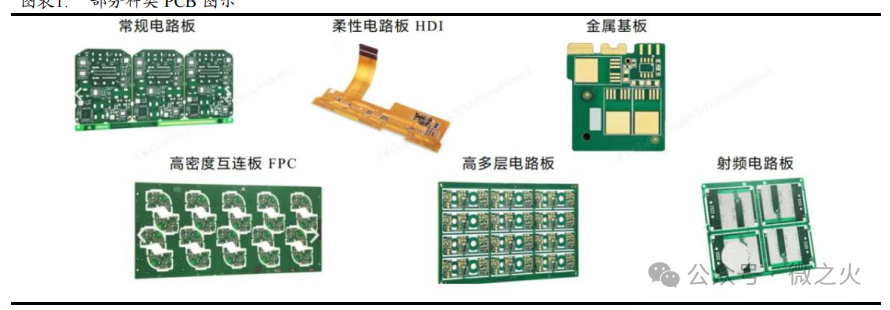
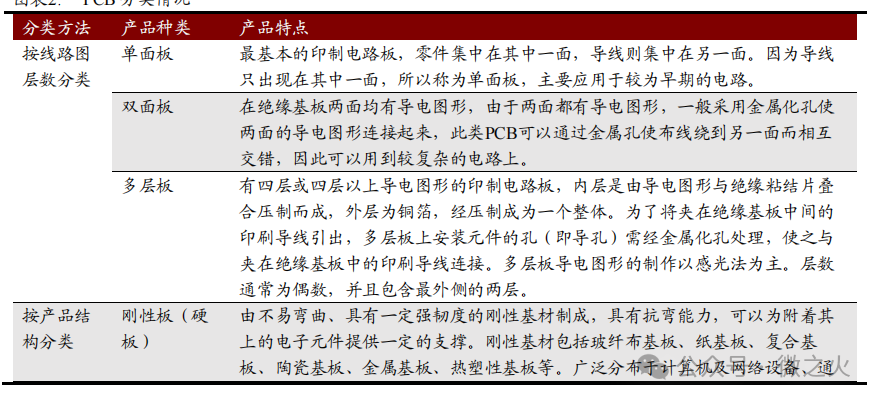
PCB classification can be viewed from three aspects: the number of circuit layers, product structure, and product usage.According to the number of circuit layers, PCBs can be classified into single-sided, double-sided, and multi-layer boards; based on product structure, they can be classified into rigid boards, flexible boards, rigid-flex boards, HDI boards, and packaging substrates; based on product usage, they can be classified into communication equipment boards, network equipment boards, computer/server boards, consumer electronics boards, industrial control equipment boards, medical device boards, automotive electronics boards, and aerospace boards.
1.2 The PCB industry chain is extensive, with copper-clad laminates accounting for a significant portion of PCB material costs
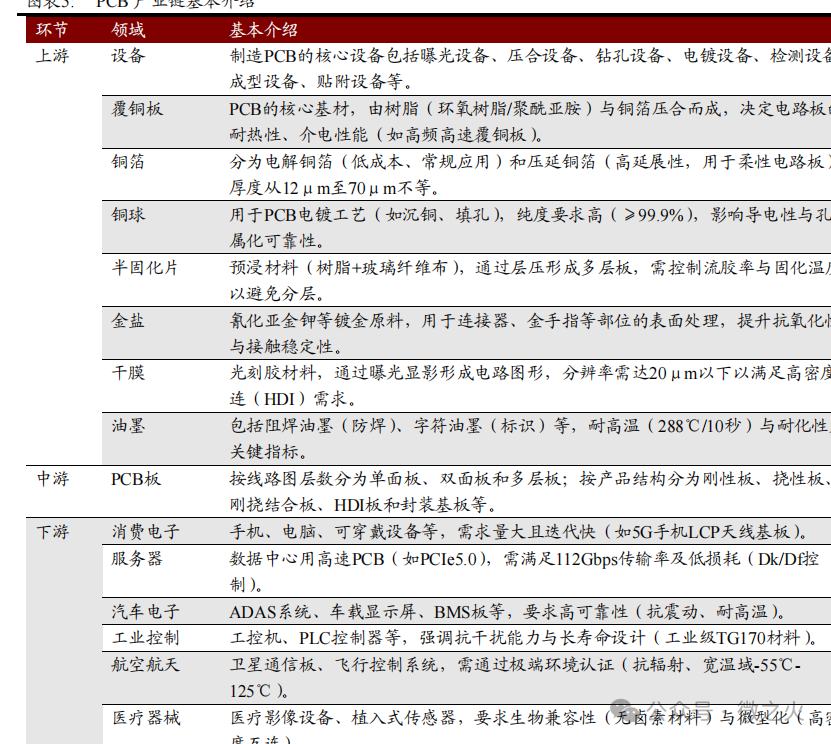
The PCB industry chain is extensive.The upstream of the PCB industry chain mainly includes equipment and materials, where equipment includes exposure equipment, lamination equipment, drilling equipment, plating equipment, testing equipment, forming equipment, and attachment equipment. The materials mainly include copper-clad laminates, copper foil, copper balls, prepregs, gold salts, dry film, and inks. The midstream involves PCB manufacturing, which can be divided into rigid boards, flexible boards, rigid-flex boards, and packaging substrates. The downstream is widely applied in consumer electronics, servers, automotive electronics, industrial control, aerospace, medical devices, and other fields.
2 The PCB market size is steadily growing, with China’s PCB industry output value leading globally
2.1 Benefiting from the demand for AI computing power, the global PCB market size is steadily growing
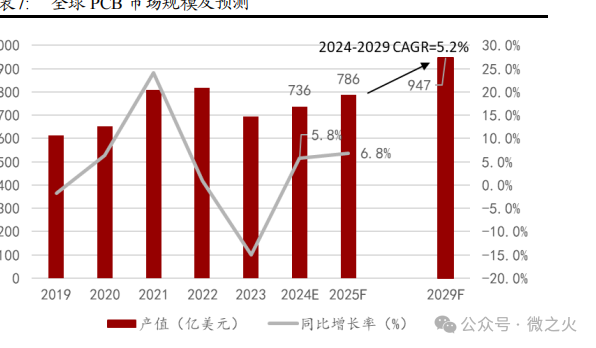
The construction of AI computing power is thriving, driving steady growth in the global PCB industry.AI servers and high-speed network equipment in data centers are the core growth engines for the PCB and packaging substrate market in 2024, continuously driving the demand expansion for high-end PCB products. According to Prismark data, the global PCB output value is expected to reach $73.6 billion in 2024, a year-on-year increase of 5.8%; it is projected to reach $78.6 billion in 2025, a year-on-year increase of 6.8%; and by 2029, the global PCB market size is expected to reach $94.661 billion, with an average annual compound growth rate of 5.2% from 2024 to 2029.
2.2 China’s PCB output value is globally leading, with export scale continuing to grow
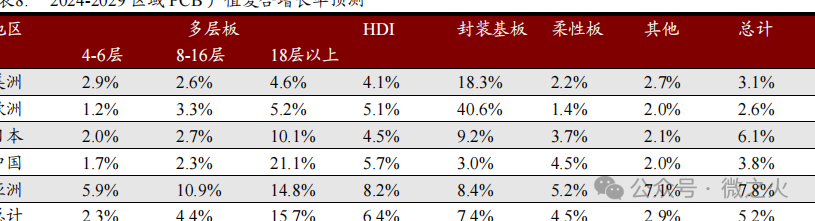
China’s PCB industry output value is globally leading.According to Prismark data, it is expected that in 2025, China’s PCB industry will have a year-on-year growth rate of 8.5%, with particularly strong growth in multi-layer boards with 18 layers and above, expected to grow by 69.4%, likely pushing China’s market share in this segment to over 50%. At the same time, China is also showing good growth in the fields of high-density interconnect (HDI) boards and flexible circuits. Looking ahead, the demand for high-end PCBs such as high-layer boards and HDI, as well as large-size advanced substrates, is expected to rise, becoming the core driving force for the global PCB market development. During this period, China will continue to maintain its position as the largest PCB production region globally, with its output accounting for more than half of the global total. According to Prismark data, the future compound annual growth rate of China’s PCB industry is expected to be 3.8%, which may be significantly lower than the global industry average of 5.2%. From the perspective of global regional growth patterns, the strongest growth is expected to be in Asia (excluding China and Japan), especially in Southeast Asia, where the Asian PCB industry is expected to have a compound annual growth rate of 7.8%, driven mainly by PCB suppliers seeking to invest in alternative production bases outside of China.
3 Emerging fields drive the growth of high-end PCB demand, with domestic manufacturers performing well
3.1 Emerging fields such as AI, robotics, and automotive electronics are expected to drive the growth of high-end PCB demand
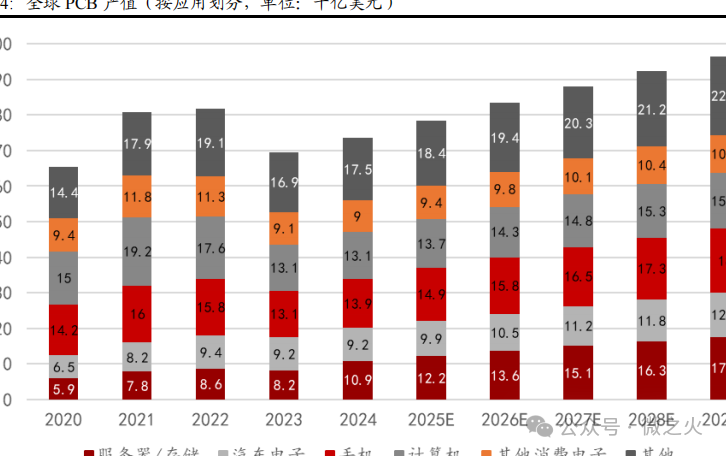
From the perspective of downstream application fields of PCBs, emerging fields such as servers & storage and automotive electronics are growing rapidly.According to data from Prismark and ZhiShi Consulting, in recent years, emerging fields such as servers/storage and automotive electronics have seen rapid growth, with the output value of server/storage PCBs increasing from $5.9 billion in 2020 to $10.9 billion in 2024, accounting for 14.8% of the total output value in 2024, and expected to reach $12.2 billion in 2025, increasing its share to 15.5%. The output value of automotive electronics PCBs is expected to grow from $6.5 billion in 2020 to $9.2 billion in 2024, accounting for 12.5% of the total output value in 2024, and expected to reach $9.9 billion in 2025, increasing its share to 12.6%. Other fields such as mobile phones, computers, and other consumer electronics are also maintaining a steady upward trend in PCB output value.
The switch market size is steadily growing, which is expected to drive PCB demand.Communication equipment refers to the communication infrastructure used for wired or wireless network transmission, covering communication base stations, routers, switches, base station antennas, RF devices, and backbone network transmission equipment. Currently, the demand for PCBs is mainly for multi-layer boards; 5G communication equipment has higher requirements for high-frequency and high-speed PCB processes and materials, requiring low power consumption, high power density power supplies, and high multi-layer products to match the increased data transmission volume. This has led to a significant increase in demand for high-frequency and high-speed boards that facilitate high-speed signal transmission. For example, with the improvement in chip performance and data throughput requirements, 800G switches are accelerating penetration, necessitating the use of multi-layer PCBs to ensure high-speed and stable signal transmission, thereby driving both the volume and price of PCBs in the switch field. Switches are one of the core devices in computer networks, and according to data from the China Business Industry Research Institute, PCBs account for about 7% of their cost structure. In recent years, the scale of China’s switch market has maintained a steady upward trend, reaching 42.36 billion yuan in 2024, a year-on-year increase of 6%, and is expected to grow to 44.48 billion yuan in 2025, a year-on-year increase of 5%. The steady growth of the switch market is expected to drive the demand for switch PCBs.
3.2 PCB manufacturers are performing well, with domestic manufacturers leading in high-end PCB product layout
PCB manufacturers are performing well.We selected the top ten companies in the Shenwan printed circuit board industry by revenue in the first half of 2025 to observe their performance. All top ten PCB manufacturers achieved year-on-year revenue growth in the first half of 2025, with Shenyang Electronics, Shenghong Technology, and Huadian Co., Ltd. showing high growth rates of 91.0%, 86.0%, and 56.6%, respectively. In terms of net profit attributable to the parent company in the first half of 2025, all manufacturers except Jingwang Electronics achieved year-on-year growth, with Shenyang Electronics, Shenghong Technology, and Pengding Holdings showing high growth rates of 452.1%, 366.9%, and 57.2%, respectively. The growth rate of net profit attributable to the parent company exceeded that of revenue, indicating a significant improvement in profitability, with overall performance being quite impressive.
4 PCB manufacturers are accelerating capacity expansion, with upstream copper-clad laminates and equipment expected to benefit
4.1 Domestic mainstream PCB manufacturers are accelerating capacity expansion, actively increasing high-end PCB capacity
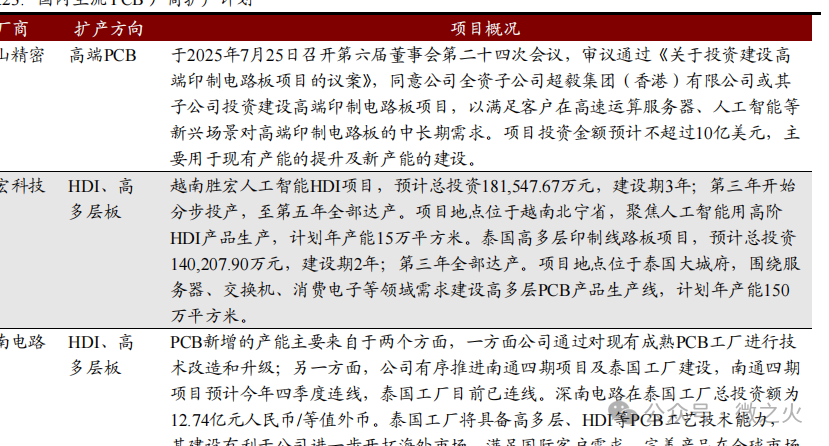
Domestic mainstream PCB manufacturers are accelerating capital expenditures, actively expanding HDI, high-layer board, and other high-end PCB capacities.Leading domestic PCB manufacturers such as Dongshan Precision, Shenghong Technology, Shenzhen Circuit, Huadian Co., Ltd., Shenyang Electronics, and Jingwang Electronics are accelerating capital expenditures to actively expand HDI, high-layer board, and other high-end PCB capacities to meet the long-term demand for high-end printed circuit boards from customers in emerging computing scenarios such as high-speed computing servers and artificial intelligence.
4.2 Copper-clad laminates are expected to benefit from PCB expansion demand, with domestic CCL manufacturers actively laying out
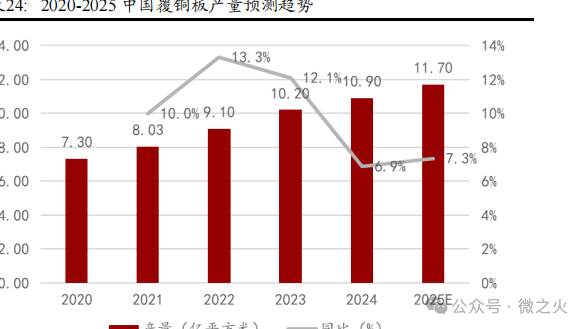
Copper-clad laminates are expected to benefit from PCB expansion demand, with steady growth in production.Copper-clad laminates account for a significant portion of PCB material costs and are expected to benefit fully from PCB expansion demand. According to data from the China Business Industry Research Institute, the production of copper-clad laminates in China is expected to reach approximately 1.09 billion square meters in 2024, a year-on-year increase of 6.9%, and is projected to grow to 1.17 billion square meters in 2025, with a year-on-year increase of 7.3%.
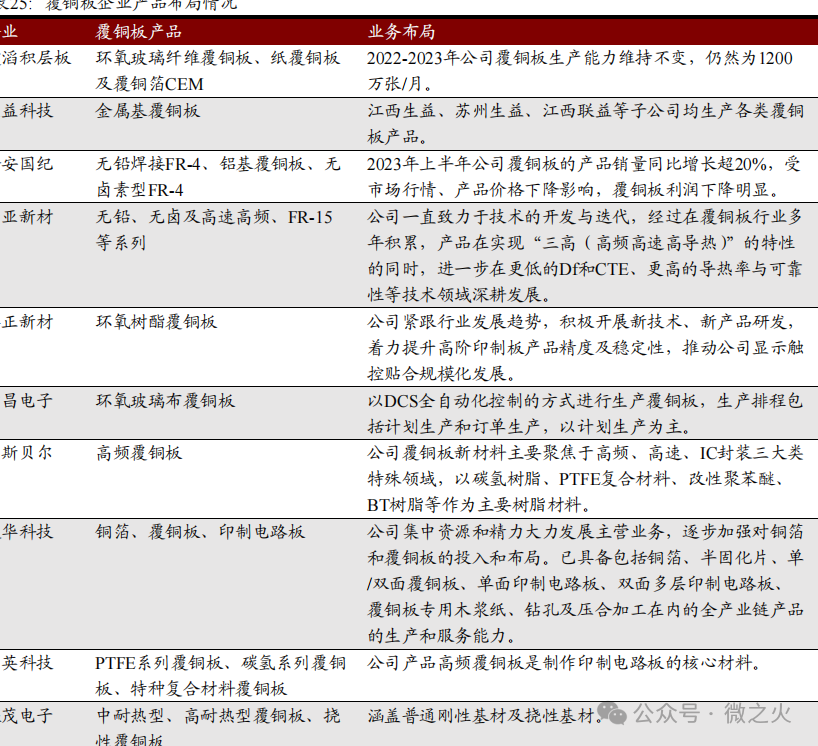
Currently, many companies in China are actively laying out in the copper-clad laminate industry.From the perspective of the business layout of representative companies in the copper-clad laminate industry, most companies primarily produce and sell ordinary rigid copper-clad laminates, with a few companies producing and selling only rigid and flexible copper-clad laminates, and very few focusing on high-frequency copper-clad laminates and epoxy resin-type copper-clad laminates, which are high-tech products. Currently, China’s high-frequency copper-clad laminate industry has formed a well-defined and complete industrial structure, with leading companies such as Shengyi Technology, Zhongying Technology, and Huazheng New Materials continuously leading the industry development direction based on their strong technical accumulation and large-scale manufacturing advantages. Companies like Nanya New Materials, Jin’an Guoji, and Baoding Technology are occupying important market shares in the mid-to-high-end application fields by focusing on niche markets and strengthening product differentiation competitiveness. Meanwhile, emerging companies such as Yaohong Electronics, Longyu New Materials, and Nafur Technology are achieving rapid breakthroughs in specific niche markets through keen market insights and innovative technology research and development capabilities.
4.3 China’s PCB equipment market is large, with drilling and exposure equipment growing relatively fast
PCB-specific production equipment serves the entire process of printed circuit board manufacturing.PCB-specific production equipment covers the complete process chain from substrate material pretreatment to the final shaping of finished circuit boards, relying on precision processing and testing technology systems to accurately meet the technical requirements for high precision, operational stability, and production efficiency of various PCB products in diverse application scenarios. Although there are procedural differences among different PCB products, their core production process steps include exposure, lamination, drilling, plating, forming, and testing.In the aforementioned processes, PCB-specific production equipment serves as the core execution carrier, playing a decisive role in ensuring the dimensional accuracy, electrical performance, and reliability of PCB products; at the same time, the construction and operation of PCB production lines require matching large-scale capital investments.
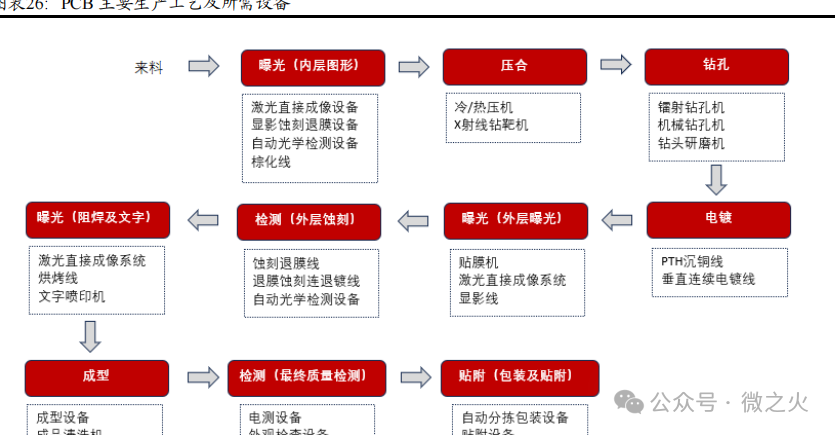
Major PCB production equipment includes exposure equipment, lamination equipment, drilling equipment, plating equipment, testing equipment, forming equipment, and attachment equipment.The value chain of the PCB-specific equipment industry mainly consists of upstream suppliers, midstream manufacturers, and downstream participants. Upstream suppliers provide components and materials (including mechanical components, optical components, control circuits, and advanced materials) for PCB-specific production equipment, as well as core technologies such as automation control, laser technology, and AI data analysis. The midstream consists of manufacturers responsible for the research, production, and sales of PCB-specific production equipment. The downstream mainly includes PCB manufacturers, who are direct customers of midstream manufacturers, and the PCBs they produce are widely used in servers and storage, automotive electronics, mobile phones, computers, consumer electronics, and other fields. Major PCB production equipment includes exposure equipment, lamination equipment, drilling equipment, plating equipment, testing equipment, forming equipment, and attachment equipment.
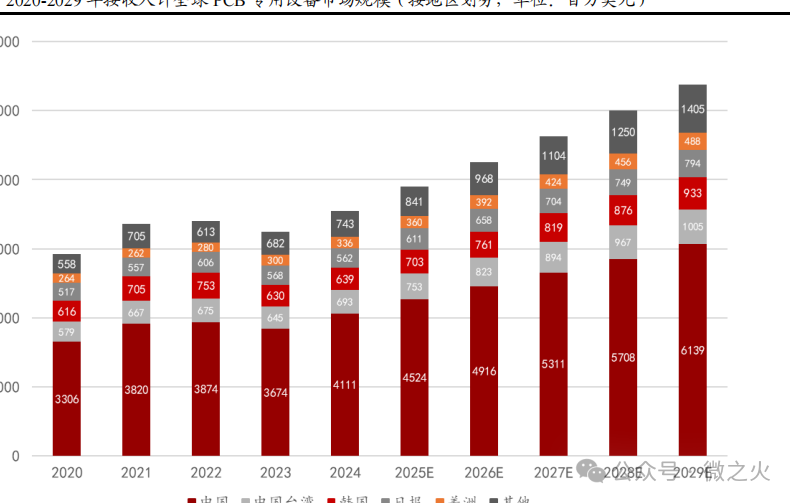
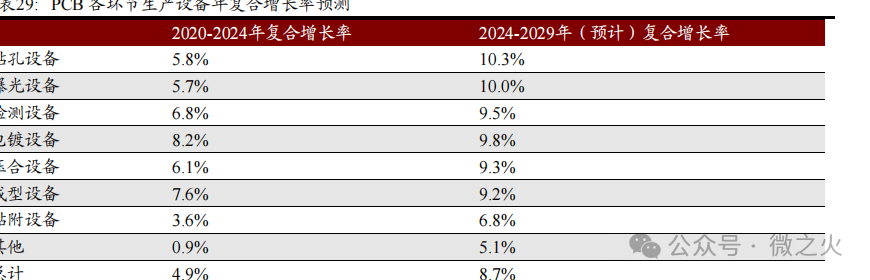
Drilling and exposure equipment have high value, and are expected to grow rapidly in the future.According to data from Prismark and ZhiShi Consulting, drilling and exposure equipment are two categories of PCB-specific equipment that are relatively high in value and play a key role in the entire production process, accounting for approximately 21% and 17% of the overall equipment market size, respectively. The global market size for drilling and exposure equipment is expected to reach $1.47 billion and $1.204 billion in 2024, respectively, and is expected to grow to $1.637 billion and $1.339 billion in 2025, with year-on-year growth rates of 11.4% and 11.2%, respectively. According to Prismark and ZhiShi Consulting forecasts, from 2024 to 2029, drilling and exposure equipment are expected to have relatively high growth rates among all equipment segments, with projected compound annual growth rates of 10.3% and 10.0%, respectively.
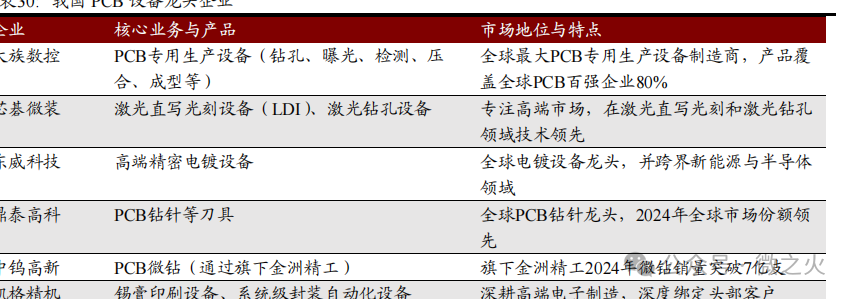
China’s leading PCB equipment companies are basically globally competitive and are expected to benefit from the expansion of the PCB industry.China’s leading PCB equipment companies have formed global competitiveness in the four major areas of drilling, exposure, plating, and consumables, but ultra-precision equipment such as LDI still needs to break through the technical barriers of Japan and Germany. In the future, with the explosive demand for AI computing power and new energy vehicles, the industry will accelerate its iteration towards high precision, intelligence, and green manufacturing, and domestic manufacturers are expected to fully benefit from the global capacity expansion.