AllwinnerT153Chip Deep Dive: Solidifying the Foundation of Industrial Intelligence with Heterogeneous Computing Power and High Expandability
On September 24, 2025, Allwinner Technology made a significant announcement in Shanghai regarding the launch of its next-generation industrial-grade system-on-chip, the T153. As a core product under Allwinner’s “Industrial 2.0” strategy, the T153 is precisely positioned as a “value-for-money industrial chip,” aiming to provide a solid and flexible computing platform for smart industrial applications with its outstanding heterogeneous computing power, extreme interface expandability, and open ecosystem. This article will analyze the performance characteristics of the T153 chip in depth, interpreting how it becomes an ideal choice in the field of industrial automation.
 1. Precise Positioning and Abundant Heterogeneous Computing Power: A Delicate Balance of Performance and Real-Time Control
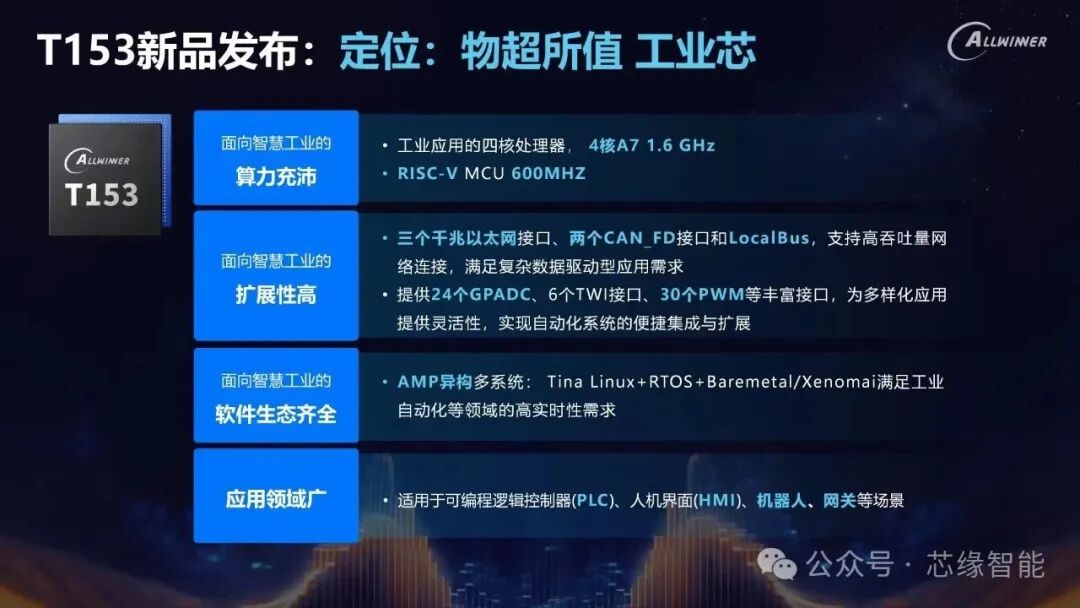
The design philosophy of the T153 directly addresses the core of industrial applications: achieving a unity of high-performance application processing and highly reliable real-time control in complex scenarios. This positioning is perfectly realized through its innovative “Quad-core Cortex-A7 @1.6GHz + RISC-V MCU @600MHz” heterogeneous architecture.
Main Application Processing Unit (Cortex-A7): The quad-core Arm Cortex-A7 CPU cluster provides ample application processing performance for the main control system. Its 1.6GHz clock speed can easily support rich operating systems like Linux, responsible for human-machine interaction (HMI), data protocol conversion, network communication, and upper-level business logic, ensuring system smoothness and multifunctionality.
High Real-Time Control Unit (RISC-V MCU): The independent high-frequency RISC-V microcontroller is key to achieving industrial-grade real-time performance in the T153. Its 600MHz operating frequency is designed for handling real-time tasks such as PLC ladder diagram scanning, motion control instruction processing, and IO signal acquisition, with response delays reaching microsecond levels, fully meeting stringent industrial real-time standards.
Performance Value: This heterogeneous design achieves the best of both worlds, not only reducing system complexity and power consumption but also providing a solid computing foundation for complex industrial automation scenarios from the chip level, covering a wide range of needs from gateways to controllers.
2. Extreme Interface Expandability: The Industrial Bridge for Connectivity and Control
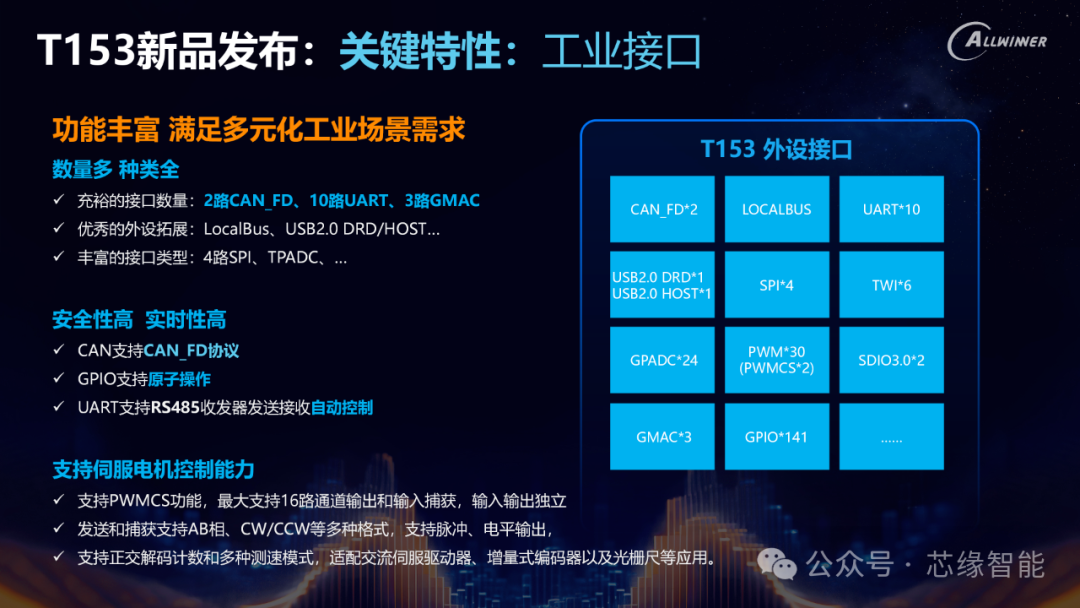
The T153 showcases its powerful capabilities as the industrial “connection core” with its exceptionally rich built-in interfaces, truly achieving “rich functionality, numerous options, and complete variety.”
High-Speed Network Interconnectivity: Integrated with 3 Gigabit Ethernet (GMAC) interfaces, far exceeding the configurations of similar chips. This allows it to natively support dual network redundancy, multi-segment isolation, or simultaneous connections to management, production, and device networks, making it an ideal choice for building high-end industrial gateways and controllers.
Industrial Control and Connection Bus:
2 CAN-FD: Supporting higher communication speeds and data throughput, the CAN bus protocol is standard in modern vehicle and industrial control networks, providing efficient channels for connecting servo drives, remote IO modules, and other devices.
10 UART: Ample serial port resources can connect a large number of Modbus, RS485 devices simultaneously, meeting the multi-node communication needs of industrial sites.
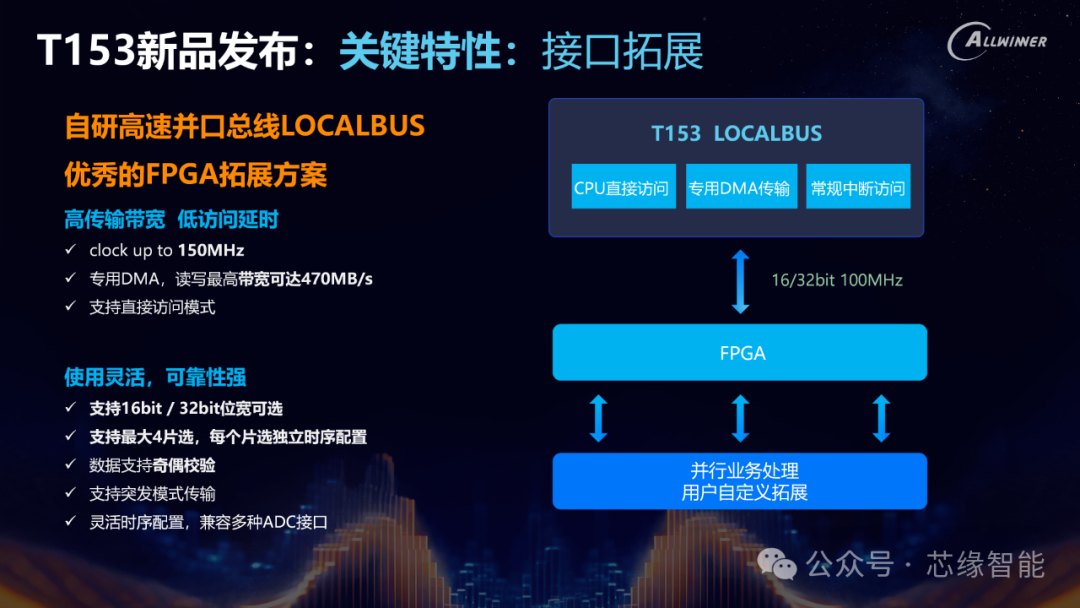
Self-developed High-Speed Parallel LocalBus: This is a major highlight of the T153, supporting clock speeds of up to 150MHz, achieving read and write bandwidths of up to 470MB/s through dedicated DMA. It supports 16/32-bit width options, a maximum of 4 chip selects, data parity checks, and flexible timing configurations, allowing seamless integration with FPGA for parallel business processing or user-defined expansions, greatly enhancing the chip’s flexibility and processing capabilities.
Precise Control and Signal Acquisition: The chip integrates up to 30 PWM channels (of which 2 support PWMCS functionality), 24 GPADC, and 6 TWI. Notably, its PWMCS functionality supports up to 16 channels for output and input capture, supporting various formats such as AB phase, CW/CCW, and more, and supports quadrature decoding counting and various speed measurement modes, directly adapting to high-precision motion control applications such as AC servo drives, incremental encoders, and grating scales, significantly reducing reliance on external expansion chips.
Performance Value: The T153 achieves a “one-to-many” effect through highly integrated interfaces and powerful LocalBus expansion capabilities, allowing customers to develop more complex, highly connected industrial devices with fewer components and simpler PCB designs, significantly reducing BOM costs and design difficulties.
3. Flexible Software Ecosystem and Industrial-Grade Safety Assurance
Powerful hardware requires equally flexible software to drive it.The T153 supports AMP heterogeneous multi-systems (Tina Linux + RTOS + Baremetal/Xenomai), allowing users to allocate real-time tasks to run on the RISC-V core with RTOS and non-real-time tasks to run on the A7 core with Linux, achieving optimal software configuration freedom to meet the high real-time requirements in fields such as industrial automation.
In terms of safety, the T153 is designed with industrial-grade certification in mind. Its GPIO supports atomic operations, and the UART supports automatic control of RS485 transceiver sending and receiving, enhancing reliability from the hardware level. Additionally, the chip supports IEC-60730 Class-B functional safety standards and PSA Certified Level 1 safety certification, with built-in mechanisms including memory protection, fault diagnosis, and secure boot, ensuring that the system can enter a safe state in the event of anomalies in harsh industrial environments, safeguarding both equipment and personnel.
Conclusion: A Performance Benchmark Born for Industry
In summary, the Allwinner T153 chip, with its abundant heterogeneous computing power from the “Quad-core A7 + RISC-V,” luxurious interface integration and expansion capabilities (especially the ability to connect external FPGA via LocalBus), and native support for high-precision servo control, precisely addresses the core pain points of industrial applications.
It is not just a chip; it is a complete, value-for-money solution platform. Its performance configuration makes it highly competitive in fields such as PLCs, industrial gateways, high-end HMIs, and robotic servo control, and it is expected to become a “reliable industrial core” driving the intelligent upgrade of industrial equipment, injecting new momentum into building a solid and intelligent industrial foundation.