In-Depth Analysis of Linux Thread Principles and Implementation Mechanisms
1. Basic Concepts and Evolution of Threads
1.1 Essential Definition of Threads
In the field of operating systems, a thread is the smallest unit of program execution flow, representing an independent control sequence within a process. If a process is a container for resources, then a thread is the entity that actually executes on the CPU. The implementation of threads in Linux has undergone a long and complex evolutionary process:
| Period | Thread Implementation | Main Features | Defects |
|---|---|---|---|
| Early | LinuxThreads | Based on lightweight processes, 1:1 model | Confused PID management, signal handling issues |
| Transition Period | NGPT | N:M model developed by IBM | Poor performance, compatibility issues |
| Modern | NPTL | 1:1 model, improved thread group concept | Has become the current standard |
1.2 Dialectical Relationship Between Processes and Threads
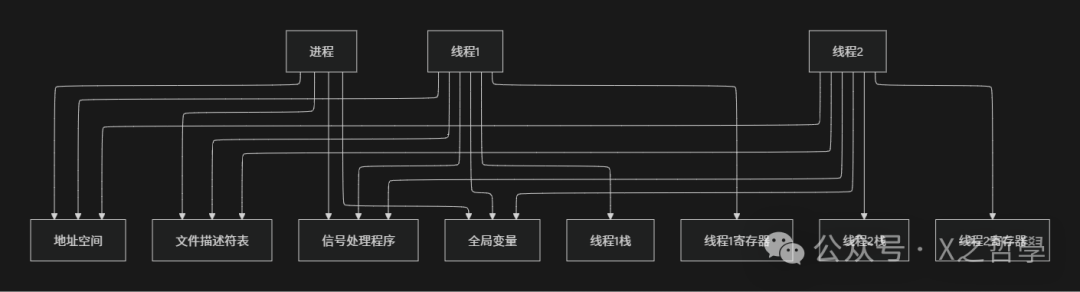
Let me explain with a vivid analogy:A process is like a factory, while threads are the production lines within the factory
- • Factory (Process): Has fixed resources such as land, buildings, and raw material warehouses
- • Production Line (Thread): Shares factory resources and independently completes production tasks
- • Advantages: Establishing a new production line is much cheaper than building a new factory, and collaboration between production lines is more efficient
2. In-Depth Analysis of Linux Thread Implementation Architecture
2.1 Core Architecture of NPTL (Native POSIX Threads Library)
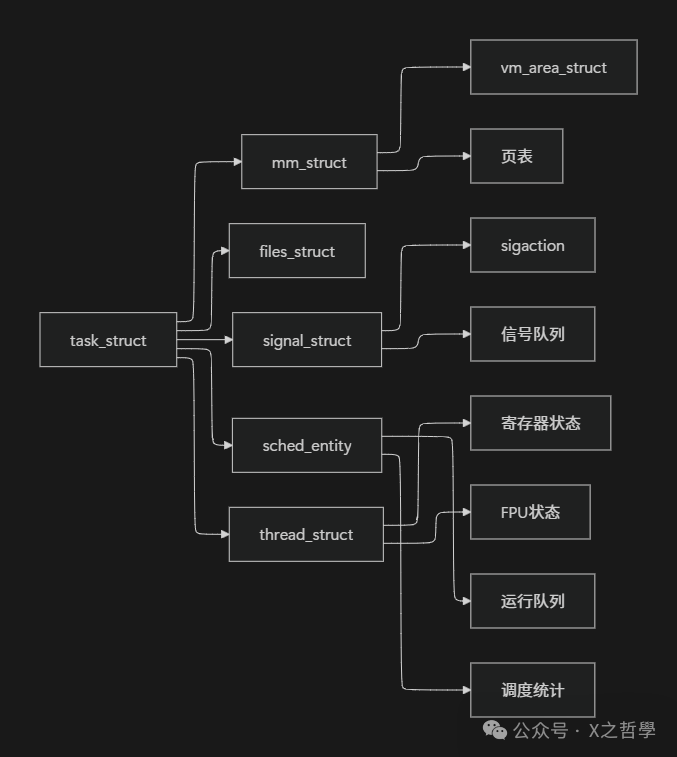
Modern Linux adopts NPTL as the standard for thread implementation, with the core idea being the 1:1 model – each user-space thread corresponds to a kernel scheduling entity (task)
// Core data structure for threads in the Linux kernel task_struct (simplified version)
struct task_struct {
    volatile long state;                    // Thread state
    void *stack;                           // Kernel stack pointer
    unsigned int flags;                    // Thread flags

    // Scheduling related
    int prio;                             // Dynamic priority
    int static_prio;                      // Static priority
    struct sched_entity se;               // Scheduling entity

    // Process/Thread identification
    pid_t pid;                           // Thread ID (from the kernel perspective)
    pid_t tgid;                          // Thread group ID (Process ID)

    // Resource sharing related
    struct mm_struct *mm;                // Memory management structure
    struct files_struct *files;          // Open file table

    // Signal handling
    struct signal_struct *signal;        // Signal handling structure
    sigset_t blocked;                    // Blocked signal set

    // Thread-specific data
    struct thread_struct thread;         // Architecture-specific thread information

    // Linked list structure
    struct list_head tasks;              // Task linked list
    struct task_struct *group_leader;    // Thread group leader
};
2.2 Kernel-Level Analysis of Thread Creation
When calling <span>pthread_create()</span>, the following complex process occurs at the lower level:
// Simplified thread creation call chain
pthread_create()
    → __clone() system call
        → do_fork() kernel function
            → copy_process() copies process descriptor
            → copy_mm() handles memory space (usually shared)
            → copy_files() handles file descriptors (usually shared)
            → copy_sighand() handles signal handlers
            → wake_up_new_task() wakes up the new thread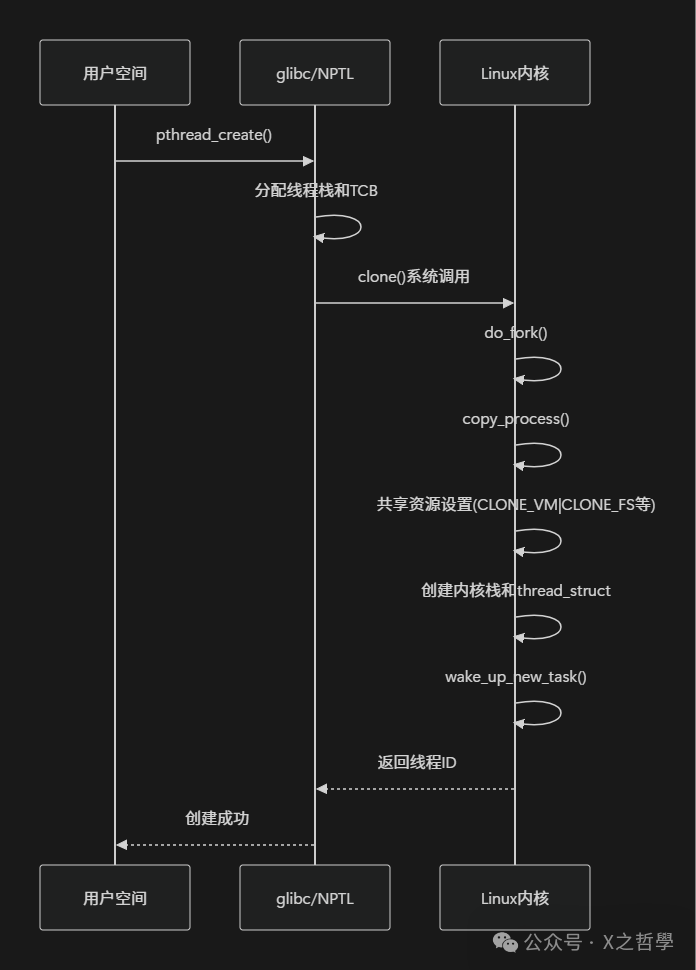
2.3 Key Data Structure Relationship Network
3. Analysis of Thread Synchronization Principles
3.1 Deep Implementation of Mutex
Mutex is the cornerstone of thread synchronization, and its implementation has undergone complex cooperation from user space to kernel space:
// Internal structure of pthread_mutex_t (simplified)
typedef union {
    struct __pthread_mutex_s {
        int __lock;                    // Lock state
        unsigned int __count;          // Recursive count
        int __owner;                   // Current owner thread ID
        unsigned int __nusers;         // User count
        int __kind;                    // Lock type
        int __spins;                   // Spin count (adaptive lock)
    } __data;
    char __size[__SIZEOF_PTHREAD_MUTEX_T];
} pthread_mutex_t;
The process of acquiring the lock reflects the ingenuity of Linux thread design:
- 1. Fast Path: Atomic operation attempts to acquire the lock, succeeds immediately if there is no contention
- 2. Medium Path: Light spinning wait, avoiding immediate entry into the kernel
- 3. Slow Path: Enters the kernel wait queue through the futex system call
// Simplified logic of futex system call
long do_futex(u32 __user *uaddr, int op, u32 val, ktime_t *timeout,
              u32 __user *uaddr2, u32 val2, u32 val3)
{
    // Key operations:
    // FUTEX_WAIT - Add thread to wait queue
    // FUTEX_WAKE - Wake up waiting threads
    // FUTEX_REQUEUE - Requeue waiting threads
}
3.2 Condition Variable Mechanism
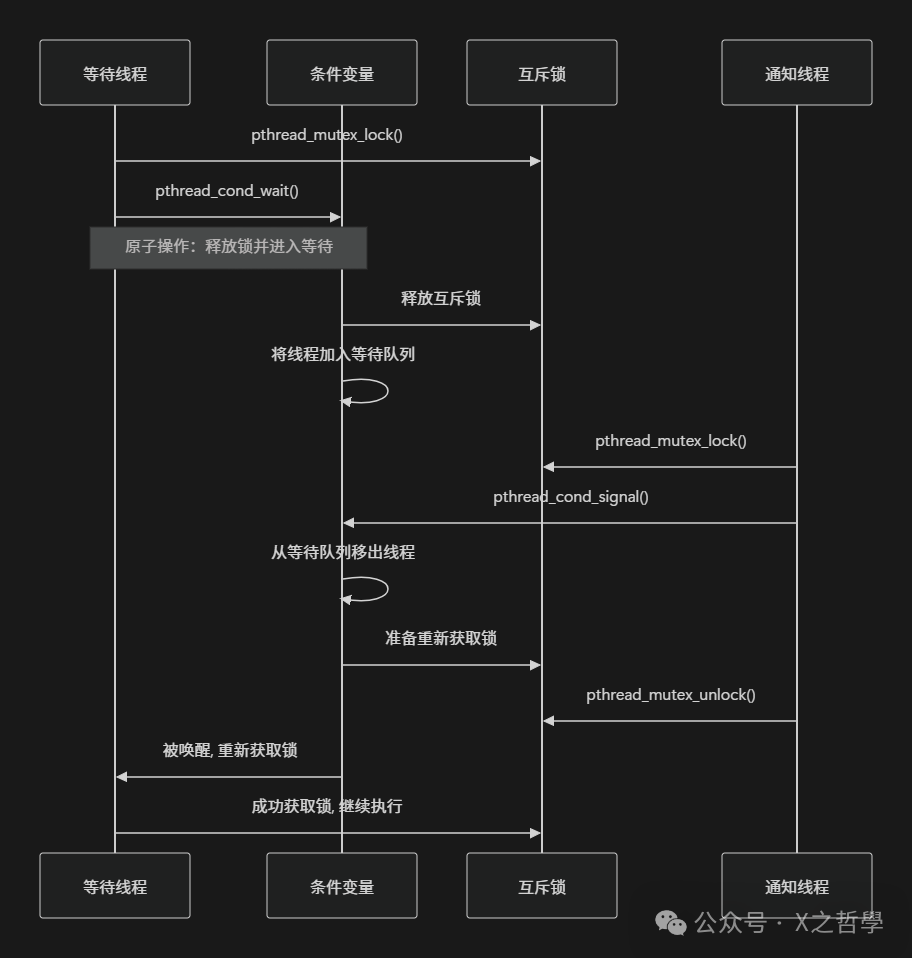
Condition variables solve the cooperation problem of “wait-notify” between threads:
// Internal structure of condition variable
struct pthread_cond {
    union {
        struct {
            int __lock;               // Internal lock
            unsigned int __futex;     // futex variable
            unsigned long long int __total_seq;  // Total sequence number
            unsigned long long int __wakeup_seq; // Wakeup sequence number
            unsigned long long int __woken_seq;  // Already woken sequence number
        } __data;
        char __size[__SIZEOF_PTHREAD_COND_T];
    };
};
Workflow of the wait-notify pattern:
4. Thread Scheduling and CPU Affinity
4.1 Thread Scheduling in CFS (Completely Fair Scheduler)
The CFS scheduler in Linux uses a red-black tree to manage runnable threads:
// CFS scheduling entity
struct sched_entity {
    struct load_weight load;           // Load weight
    struct rb_node run_node;           // Red-black tree node
    struct list_head group_node;       // Group scheduling node
    unsigned int on_rq;                // Whether in the run queue

    u64 exec_start;                    // Start execution time
    u64 sum_exec_runtime;              // Total execution time
    u64 vruntime;                      // Virtual run time
    u64 prev_sum_exec_runtime;         // Previous total execution time
};
Scheduling decision process:
- 1. Each thread maintains
<span>vruntime</span>(virtual run time) - 2. CFS always selects the thread with the smallest
<span>vruntime</span>to run - 3. Priority is reflected through different time slice weights
4.2 Principles of CPU Affinity
// CPU affinity mask
typedef struct {
    unsigned long __bits[__CPU_SETSIZE / (8 * sizeof(unsigned long))];
} cpu_set_t;

// System call to set affinity
long sched_setaffinity(pid_t pid, size_t cpusetsize,
                       const cpu_set_t *mask);
Application scenarios of affinity:
- • Performance Optimization: Reduce CPU cache misses
- • Real-Time Systems: Ensure critical threads run on specified CPUs
- • NUMA Architecture: Optimize memory access locality
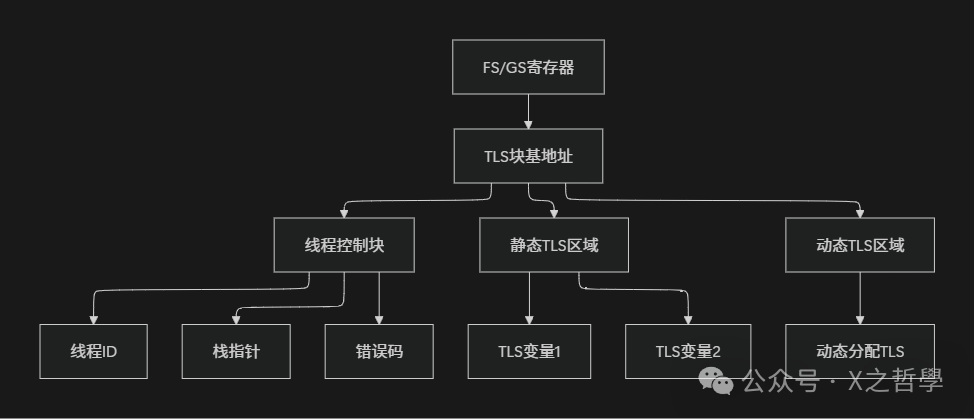
5. Implementation Mechanism of Thread Local Storage (TLS)
TLS allows each thread to have an independent copy of variables, and the implementation principle is quite ingenious:
// TLS access model
// The compiler translates TLS variable access into special instruction sequences
// TLS access under x86_64:
// mov %fs:0x0,%rax       // Get TLS base address
// mov 0x10(%rax),%rax    // Access TLS variable offset

// Internal data structure of TLS
struct pthread {
    // ... other fields
    void *specific_1stblock[PTHREAD_KEY_1STLEVEL_SIZE];
    void **specific[PTHREAD_KEY_2NDLEVEL_SIZE];
};
TLS Memory Layout:
6. Practical Programming Examples and Performance Analysis
6.1 Core Implementation of a Multithreaded Web Server
#include <pthread.h>
#include <stdio.h>
#include <stdlib.h>
#include <unistd.h>
#include <sys/socket.h>
#include <netinet/in.h>

#define THREAD_POOL_SIZE 10
#define MAX_QUEUE_SIZE 100

// Thread pool structure
typedef struct {
    pthread_t *threads;           // Array of threads
    int thread_count;            // Number of threads

    int *queue;                  // Task queue
    int queue_size;              // Queue size
    int queue_head;              // Queue head
    int queue_tail;              // Queue tail
    int queue_count;             // Number of tasks in the queue

    pthread_mutex_t queue_mutex; // Queue mutex
    pthread_cond_t queue_not_empty; // Condition for queue not empty
    pthread_cond_t queue_not_full;  // Condition for queue not full

    int shutdown;                // Shutdown flag
} thread_pool_t;

// Global thread pool instance
thread_pool_t *g_thread_pool = NULL;

// Worker thread function
void *worker_thread(void *arg) {
    thread_pool_t *pool = (thread_pool_t *)arg;

    while (1) {
        pthread_mutex_lock(&pool->queue_mutex);

        // Wait for tasks in the queue or thread pool to close
        while (pool->queue_count == 0 && !pool->shutdown) {
            pthread_cond_wait(&pool->queue_not_empty, &pool->queue_mutex);
        }

        if (pool->shutdown && pool->queue_count == 0) {
            pthread_mutex_unlock(&pool->queue_mutex);
            pthread_exit(NULL);
        }

        // Retrieve task from the queue
        int client_fd = pool->queue[pool->queue_head];
        pool->queue_head = (pool->queue_head + 1) % pool->queue_size;
        pool->queue_count--;

        // Notify producer that there is space in the queue
        pthread_cond_signal(&pool->queue_not_full);
        pthread_mutex_unlock(&pool->queue_mutex);

        // Handle client request (actual business logic)
        handle_client_request(client_fd);
        close(client_fd);
    }

    return NULL;
}

// Initialize thread pool
thread_pool_t *thread_pool_create(int thread_count, int queue_size) {
    thread_pool_t *pool = malloc(sizeof(thread_pool_t));

    // Initialize queue
    pool->queue = malloc(sizeof(int) * queue_size);
    pool->queue_size = queue_size;
    pool->queue_head = pool->queue_tail = pool->queue_count = 0;

    // Initialize threads
    pool->threads = malloc(sizeof(pthread_t) * thread_count);
    pool->thread_count = thread_count;

    // Initialize synchronization primitives
    pthread_mutex_init(&pool->queue_mutex, NULL);
    pthread_cond_init(&pool->queue_not_empty, NULL);
    pthread_cond_init(&pool->queue_not_full, NULL);

    pool->shutdown = 0;

    // Create worker threads
    for (int i = 0; i < thread_count; i++) {
        pthread_create(&pool->threads[i], NULL, worker_thread, pool);
    }

    return pool;
}

// Add task to thread pool
int thread_pool_add_task(thread_pool_t *pool, int client_fd) {
    pthread_mutex_lock(&pool->queue_mutex);

    // Wait for space in the queue
    while (pool->queue_count == pool->queue_size && !pool->shutdown) {
        pthread_cond_wait(&pool->queue_not_full, &pool->queue_mutex);
    }

    if (pool->shutdown) {
        pthread_mutex_unlock(&pool->queue_mutex);
        return -1;
    }

    // Add task to the queue
    pool->queue[pool->queue_tail] = client_fd;
    pool->queue_tail = (pool->queue_tail + 1) % pool->queue_size;
    pool->queue_count++;

    // Notify worker threads
    pthread_cond_signal(&pool->queue_not_empty);
    pthread_mutex_unlock(&pool->queue_mutex);

    return 0;
}
6.2 Performance Optimization Techniques and Trap Avoidance
Common performance traps and solutions:
| Trap Type | Problem Description | Solution |
|---|---|---|
| False Sharing | Frequent writes to the same cache line by different CPU cores | Cache line alignment, padding bytes |
| Lock Contention | Frequent contention for the same lock by multiple threads | Lock decomposition, lock-free data structures |
| Context Switching | Too many threads leading to frequent switching | Thread pools, coroutines |
| Memory Allocation | Frequent malloc/free contention | Thread-local cache, memory pools |
// Example to avoid false sharing
struct aligned_data {
    long value __attribute__((aligned(64))); // Cache line alignment
    char padding[64 - sizeof(long)];         // Fill remaining space
};

// Simple implementation of a lock-free queue
typedef struct {
    volatile uint64_t head;
    volatile uint64_t tail;
    void **buffer;
    uint64_t size;
} lockfree_queue_t;
7. Debugging Tools and Diagnostic Techniques
7.1 Summary of Common Debugging Commands
# View thread information
ps -eLf                          # Display all threads
top -H -p <pid>                  # Real-time view of thread CPU usage
cat /proc/<pid>/task/*/status    # View detailed information of each thread

# Performance analysis
perf record -g -p <pid>          # Performance sampling
perf report                      # Analyze performance data
strace -ff -p <pid>              # Trace system calls

# Deadlock detection
gdb -p <pid>                     # Attach to process
(gdb) thread apply all bt        # All thread stack
(gdb) info threads               # Thread status information

# Memory diagnosis
valgrind --tool=helgrind ./program    # Thread error detection
valgrind --tool=drd ./program         # Data race detection
7.2 Advanced Diagnostic Techniques
Dynamic Tracing Techniques:
# Use SystemTap to analyze thread scheduling
probe scheduler.cpu_on {
    printf("thread %d migrated to cpu %d\n", tid, cpu)
}

# Use BPF tools to analyze lock contention
bpftrace -e 'tracepoint:lock:contention {
    @[comm] = count();
}'
8. Summary and Key Points Review
Through this in-depth analysis, we can draw the following key conclusions:
8.1 Core Features of Linux Thread Implementation
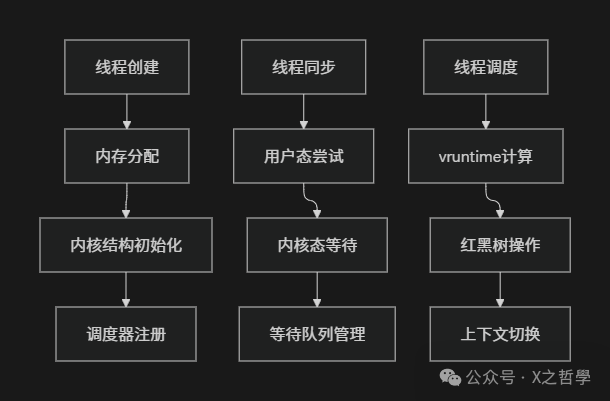
- 1. Advantages of the 1:1 Model: Each user thread corresponds to a kernel scheduling entity, leading to high scheduling efficiency
- 2. System Call Based on clone: Controls the degree of resource sharing through flexible flags
- 3. Futex Synchronization Mechanism: An efficient synchronization primitive that cooperates between user space and kernel space
- 4. Thread Group Concept: A unified process/thread management model
8.2 Key Performance Paths
8.3 Practical Guidelines
- 1. Control the Number of Threads: CPU-bound tasks ≈ number of CPU cores, I/O-bound tasks can be increased appropriately
- 2. Choose Synchronization Primitives: Select appropriate locks based on critical section size and contention level
- 3. Memory Locality: Make full use of TLS and cache-friendly data structures
- 4. Error Handling: Properly handle thread cancellation and resource cleanup