The automotive industry is rapidly evolving, driven by new technologies, particularly the emergence of regional architectures, optimization of ADAS sensors, and the increasing use of high-quality displays in vehicles, making cars smarter than ever before. Manufacturers urgently need solutions that can help them innovate while being flexible for future updates.
— TECHnalysis Research Bob O’Donnell
The market demand for advanced electric and hybrid vehicles remains strong and is expected to continue in the short term. According to data from McKinsey, the global automotive software and electronics market is projected to reach $462 billion by 2030, with infotainment, connectivity, safety, and connected services applications growing in sync with the overall software market, becoming the second-largest software market during the same period.
As these reports indicate, infotainment systems are becoming one of the most important features customers consider when purchasing a new car. Moreover, depending on the vehicle, these systems can take various forms, from a single touchscreen display to multiple high-resolution displays used for central entertainment centers, dashboards, head-up displays, and rear-seat displays, as well as options like curved displays, rearview mirror displays, 3D, and augmented reality.
These systems need to handle increasingly complex information and larger volumes of data, requiring scalable and flexible hardware and software solutions. Advanced electronic components require high-speed interfaces to support the connection and synchronization of multiple displays, while low-power, low-latency data processing also becomes critical. Failure to meet these requirements can significantly impact the safety of drivers and passengers, as well as the user experience.
Sensors, Displays, and Cameras Require Bridging Capabilities
With the development of infotainment and ADAS (Advanced Driver Assistance Systems), the resolution of displays and cameras is also improving. Simultaneously, connecting and processing multiple high-resolution displays, sensors, and cameras presents significant challenges, and many modern vehicles are utilizing “regional architectures” to achieve this. Regional architectures provide better scalability, support simpler software development, and offer optimized functionality and reliability, where sensors, computing, and interconnect components are grouped into different “computing zones,” and the computational results from these zones are sent to the main SoC.
As the number of displays, cameras, and other visual sensors increases, and the new interfaces designed to manage higher data rates exceed the I/O capabilities of the central SoC, efficient bridging is crucial for combining, multiplexing, or separating signals. FPGAs are an excellent choice as they inherently offer flexibility, can execute various functions, and are compact. It is common to find multiple FPGAs in a vehicle, with each FPGA supporting different applications.
Lattice offers a range of automotive-grade solutions for various in-vehicle applications, including ADAS for sensor bridging and processing; low-power, flexible regional bridging; and monitoring for drivers, cabins, and vehicles.
Accelerating Automotive Application Development with Lattice Drive
Our recently launched Lattice Drive solution set helps automotive manufacturers accelerate the development of advanced, flexible automotive system designs and applications, thereby providing the next-generation in-vehicle experience.
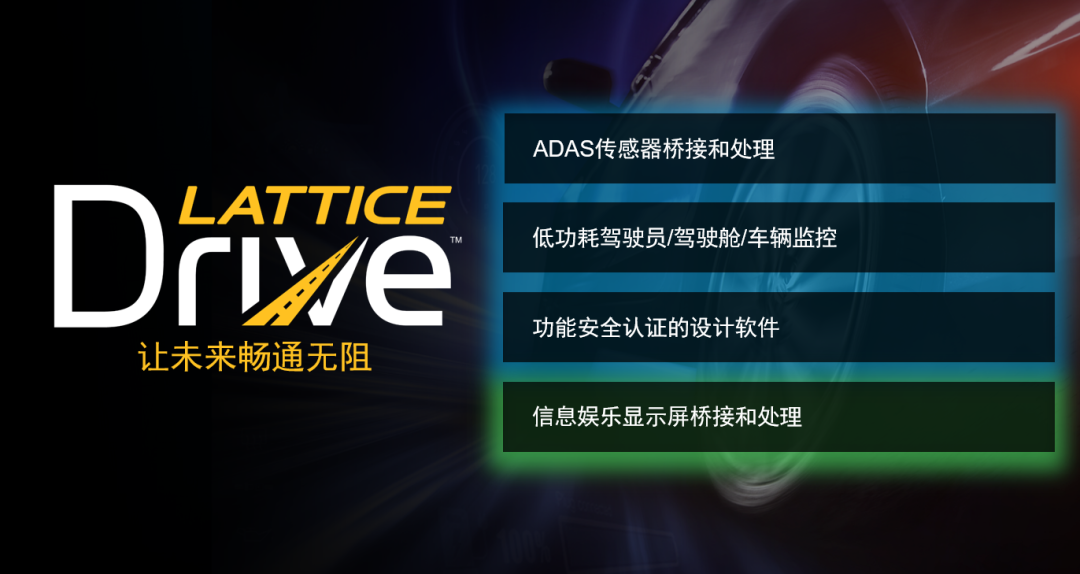
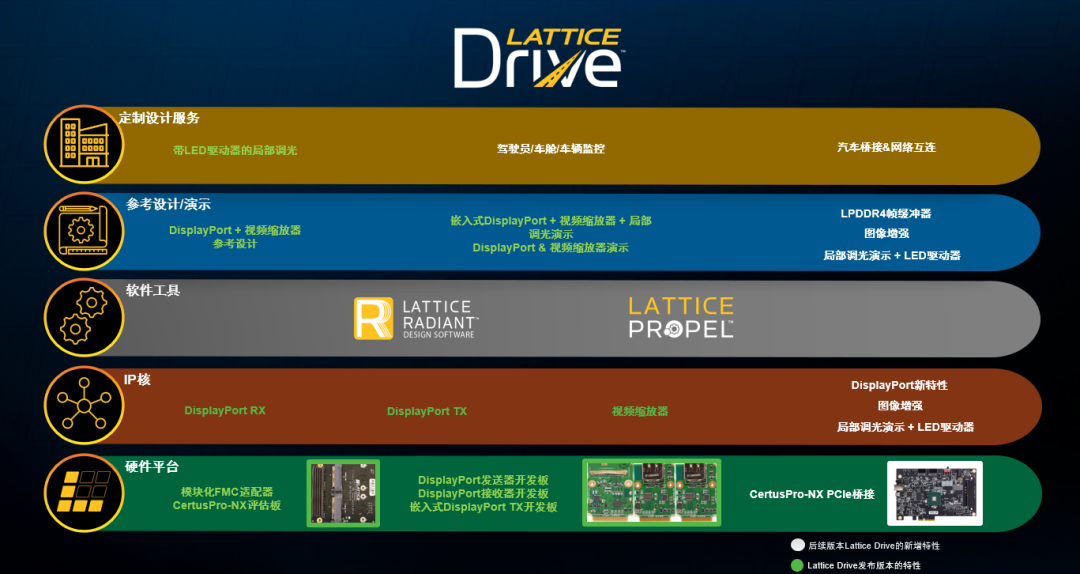
The initial version of Lattice Drive focuses on implementing advanced display bridging and processing capabilities to meet the evolving needs of infotainment systems, including:
-
Advanced Display Interconnection and Processing
● Supports multi-resolution scaling, accommodating display sizes up to 4K
● Supports DisplayPort up to HBR 3, 8.1 Gbps per channel
● Provides image/video enhancement through scalable full-array local dimming solutions
-
Multiple Display Interconnection
● Capable of bridging multiple displays, offering 1.5 times faster DisplayPort interfaces than competing devices
-
Efficient Data Processing
● Able to process or collaborate on data to alleviate CPU load, with power consumption 75% lower than competing devices
With the Lattice Drive solution set, the infotainment systems designed by automotive manufacturers can feature multiple high-resolution displays that can be scaled across vehicle model ranges, sharing CPU processing tasks with faster interface speeds and lower power consumption, thereby achieving seamless processing and connectivity. The inherent flexibility of FPGAs allows for rapid design adjustments to meet various model requirements, making it easier to cope with supply chain fluctuations and ensuring future software updates can be conducted on-site.
Local Dimming Requires Flexibility and Scalability
The Lattice Drive solution set provides comprehensive solutions tailored for specific applications, combining reference platforms and designs, demonstrations, IP building blocks, and FPGA design tools to accelerate customer application development and time to market. This includes adaptive full-array local dimming solutions for automotive LCD panels.
Full-array local dimming technology uses a set of LEDs behind LCD panels, with each LED or LED area capable of being dimmed individually, illuminating only the pixels needed on the display, dynamically adapting to the image content. Local dimming in automotive applications is a computationally intensive function, as the required algorithms are relatively complex. In addition to considering individual partitions, the software must continuously monitor lighting conditions, which change as the vehicle moves, such as day and night, different weather conditions, and passing through tunnels.
The same local dimming technology can be applied to automotive head-up displays (HUDs), which are typically used to project driving information onto the windshield, such as vehicle speed, navigation instructions, or warnings. Local dimming for HUDs not only enhances visibility but also provides a more seamless experience.
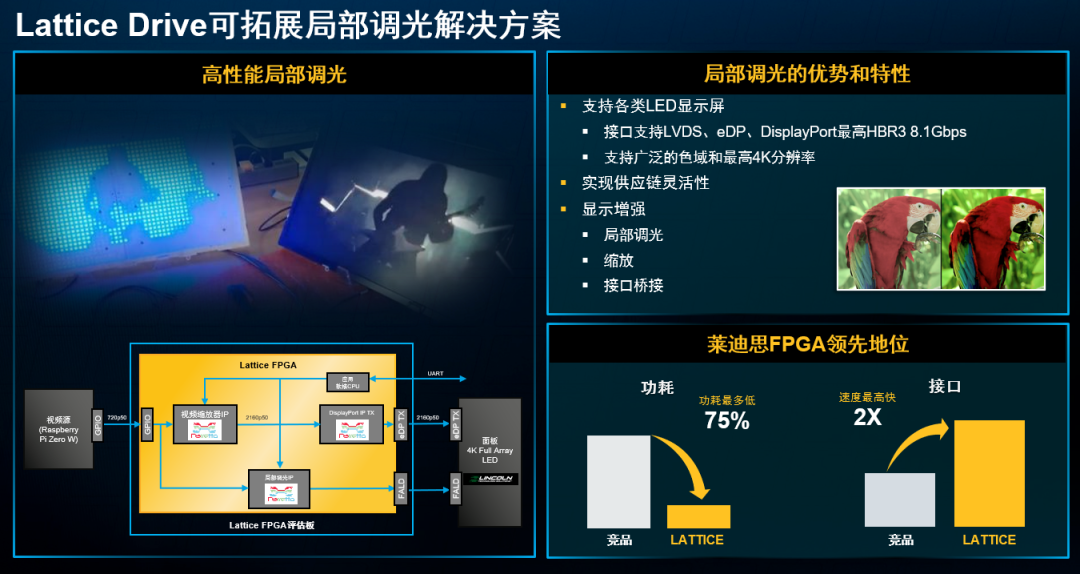
FPGAs are an excellent choice for implementing local dimming in automotive LCD panels because they can provide real-time processing capabilities, customization, flexibility, high-speed interfaces, reliability, and the ability to run AI and ML algorithms. To learn more about how the Lattice Drive solution stack running on low-power Lattice FPGAs achieves full-array local dimming solutions, please download our white paper.
For more information on how the Lattice Drive solution set can help you address key trends in automotive application design and reduce time to market, please contact the Lattice team.