The EBU’s Head of Technology and Innovation envisions the infotainment systems in future connected cars.
The European Broadcasting Union (EBU) focused on potential future broadcasting and audio entertainment models at the Digital Broadcasting Summit held in February 2020.
One of the core topics was the future role of integrated broadcasting and multimedia systems in connected cars.
During the conference, EBU’s Director of Technology and Innovation, Antonio Arcidiacono, delivered a keynote speech. He emphasized the value of both linear and non-linear audio content within the vehicle, which can be appropriately integrated through next-generation systems and user interfaces, effectively blending broadcasting and IP sources.
Truly Immersive
After the conference, Arcidiacono discussed his vision for cars in 20 years. He imagines himself gripping the steering wheel, finding himself in a semi-mobile living room, where the multimedia system welcomes him and understands his current mood.
According to Arcidiacono, the system will know he has been in the office, so it will first provide him with information that interests him the most, then carefully determine the content delivery process based on what he is most interested in.
The driver could then prompt the car by saying, “Well, that’s enough news for now. How long until we get home?” The car would answer that question and then play music again based on the mood of the driver and passengers.
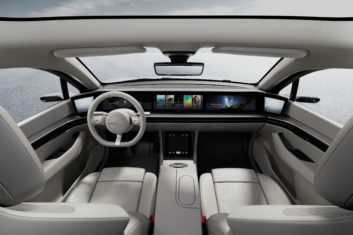
Dashboard of the Sony Vision-S electric concept car showcased at CES 2020.
“Let me explain,” Arcidiacono said, “I have lived in Paris for 30 years, and I believe that the best music to listen to in the car in the French capital is jazz because the city has the spirit of jazz, and people walk to the rhythm of jazz,” he said. “Other places may not be the same, so the system will provide an immersive experience that strikes a subtle balance between mood and environment.”
On the other hand, if the system knows his actual mood is tired, perhaps he would like the system to play some relaxing music, like Debussy’s “Clair de Lune.”
Comfort
In 20 years, cars are likely to be self-driving, so there will be no worries about driver distraction. The system is also likely to provide various types of content, including visual types, but always contextually.
“As the French say, it’s a ‘comfort’ issue,” Arcidiacono added, “an experience that can provide maximum comfort while allowing users to make or receive calls.”
In his vision, the system will be able to automatically detect which calls he will accept, which calls he will not, and manage and categorize them accordingly. In some cases, it could also return calls or messages, as it can learn from him and knows how to respond appropriately to the most common messages and calls.
The idea is that due to the intelligent behavior of the car and entertainment system, the system will allow the driver to continue living in a seamless comfort experience.
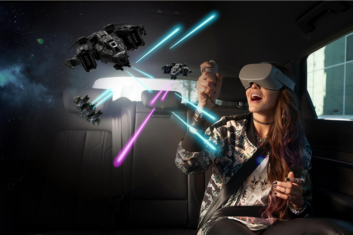 Holoride is an extended reality (XR) system that enhances visual impressions through real-time physical feedback from moving vehicles, providing a more intense immersive VR car experience.
He continued, “Perhaps the system could also understand that I don’t want to go home one evening, and then it would suggest that the car take me to my favorite restaurant.”
The car would also share the same suggestion with his wife, who is driving another car elsewhere. If both couples agree, the two cars would take them to the chosen restaurant, where they would meet at a reserved table.
Integration
If the preferred restaurant has no availability, the system will suggest another suitable option, again matching their preferences and current moods.
“It’s also possible, for example, that after work, I go directly to a cultural event instead of going home,” Arcidiacono continued. The system will learn that this person is going to that particular event, so during the drive, the system will provide him/her with an overview of what they might see and hear at the event, along with expert commentary, so they can make the most of their trip.
Thus, the three pillars of broadcasting—information, entertainment, and education—will continue to merge in the future. Arcidiacono believes they will increasingly integrate with each other.
However, if at any moment, the driver decides they do not want this assistance, they can simply say, “Let me be quiet for a moment because I want to think, I need some silence,” and the car will understand.
Speaking of user interfaces, Arcidiacono believes that most buttons will disappear. “If the driver is feeling tense, perhaps there will be one button left that can turn everything off because having everything under control is also a natural feeling. Pressing a big red button to tell the system ‘Stop it!’ could be useful,” he summarized.
Recommended Reading


Is VR the next trend in conference room technology?

In a special year, Sony remains committed to providing high-quality imaging products.

With the release of “The Eight Hundred,” Wang Zhongjun made 300 million, with 19 companies waiting to profit.