Welcome to follow the WeChat public account belowAbao1990, this account focuses on autonomous driving and smart cockpits, providing you with daily automotive insights. We start with cars, but we are not limited to them.

Abstract: With the continuous development of automotive technology, the functions of in-vehicle entertainment systems are becoming increasingly rich, and the requirements for audio and video transmission are also rising. Audio Video Bridging (AVB) and Automotive Audio Bus (A2B) are two important in-vehicle communication technologies that play a key role in in-vehicle entertainment systems. This article will provide a detailed introduction to the technical characteristics of AVB and A2B, including a high-level overview, advantages and disadvantages, and applicable applications. Through comparative analysis, it will demonstrate their unique value and complementary relationship in in-vehicle entertainment system communication, providing professionals and enthusiasts in the automotive electronics field with a reference for a deeper understanding of these two technologies.
1. Introduction
In modern vehicles, in-vehicle entertainment systems have become an important part of enhancing the driving experience. From high-definition audio playback to video streaming services, from the transmission of images from vehicle monitoring cameras to the realization of Internet of Vehicles functions, all rely on efficient and reliable communication technologies. AVB and A2B have emerged to address the special needs of the in-vehicle environment, providing dedicated solutions for audio and video data transmission.
2. Audio Video Bridging (AVB)
(1) Overview of AVB
AVB is primarily used for transmitting audio and video over Ethernet. It is implemented as a switched Ethernet network, ensuring that audio and video data can be transmitted stably and smoothly in the network by reserving a portion of the available Ethernet bandwidth for audio and video traffic. It adopts a daisy chain connection topology and can be connected with intermediate AVB bridges or point-to-point connections. This topology allows for flexible device layout in the in-vehicle network, adapting to different layout requirements.
The implementation of AVB is based on a series of IEEE standards, which provide a solid foundation for the standardized operation of AVB. For example, traffic is prioritized into three classes (Class A, Class B, Class C) based on maximum latency, ensuring that latency-sensitive audio and video traffic is prioritized during network congestion. When fully transitioning to TSN (Time-Sensitive Networking) and limited to automotive profiles, more standards need to be adopted to further meet the automotive industry’s stringent requirements for reliability and real-time performance. For instance, ADI’s ADSP SC58x/59x series supports AVB and IEEE standards, providing hardware support for AVB applications in in-vehicle systems.
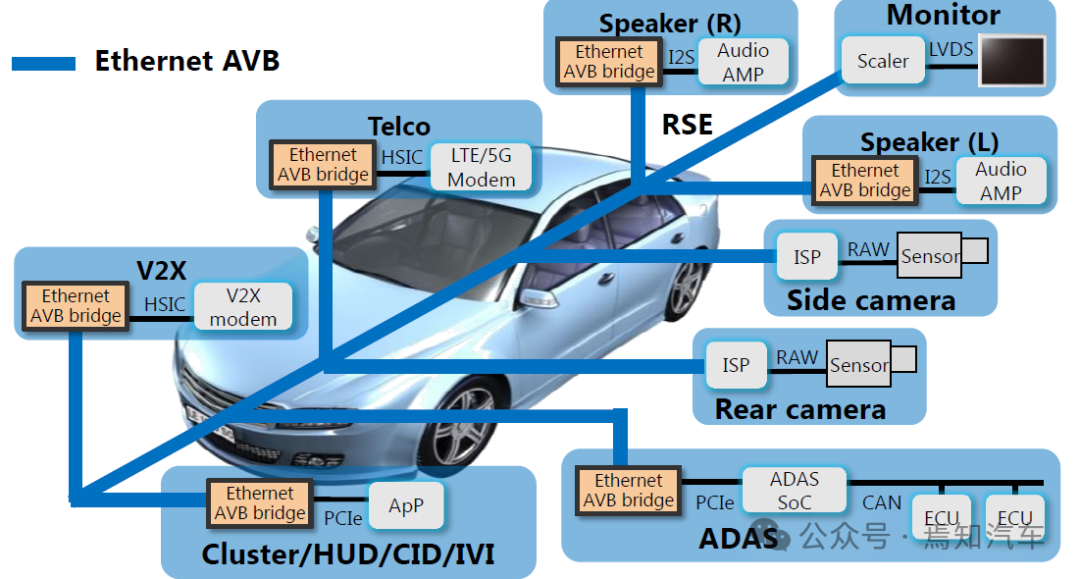
Figure 1: Audio Video Bridging (AVB) System
(2) Advantages and Disadvantages of AVB
-
Advantages
-
Standardization Advantage: The protocol is standardized by IEEE (Table 1), meaning that any vendor can follow the standards to implement the AVB stack. Different chipsets from different vendors come with ready-to-use AVB stacks, greatly promoting the adoption and application of AVB technology in the market, lowering technical barriers and development costs.
-
Multi-Functional Transmission: Supports the transmission of audio, video, and other control data, meeting the diverse data transmission needs of in-vehicle entertainment systems. For example, it can transmit multimedia data such as music and movies, as well as vehicle control commands.
-
Flexible Conversion: Can serve as a gateway and protocol converter, enabling conversion from Ethernet to CAN/LIN and vice versa. This allows AVB to seamlessly interface with other types of buses in the in-vehicle network, integrating different electronic systems within the vehicle.
-
Scalable Bandwidth: Scalable bandwidth from 10Mbps to 1000Mbps can accommodate different resolutions of audio and video as well as bandwidth requirements for various application scenarios. During high-definition video transmission, higher bandwidth can be utilized to ensure smooth video playback, while in scenarios with lower bandwidth requirements for audio transmission, bandwidth usage can be reduced to improve network resource utilization.
Table 1: IEEE Standards
|
IEEE Standard Number |
Standard Name |
Description |
|
IEEE 802.1AS |
Precision Time Protocol (PTP) |
Used for precise clock synchronization between network devices. |
|
IEEE 802.1Q |
Virtual Local Area Network (VLAN) and Quality of Service (QoS) |
Allows network devices to identify and prioritize different types of traffic. |
|
IEEE 802.1Qat |
Stream Reservation Protocol (SRP) |
Used for bandwidth reservation and traffic control. |
|
IEEE 802.1Qav |
Forwarding and Queuing for Time-Sensitive Streams |
Ensures that time-sensitive data streams (such as audio and video) can be prioritized for transmission. |
|
IEEE 1722 |
AVB Transport Protocol Framework and Requirements |
Defines the framework and requirements for the AVB transport protocol, including data formats and flow control. |
|
IEEE 1723 |
AVB Transport Protocol Stream Identification and Processing |
Defines the stream identification and processing methods for the AVB transport protocol. |
|
IEEE 802.1BA |
AVB System Standard |
Defines a series of preset values and settings used in the production of AVB-compatible devices. |
|
IEEE 802.1Qci |
Enhanced Transmission Selection |
Used to improve the transmission efficiency of data streams in the network. |
|
IEEE 802.3 |
Ethernet Standard |
Includes physical and data link layer specifications, on which AVB technology is based. |
|
IEEE 802.3at |
Power over Ethernet (PoE) |
Although not a core standard of AVB, PoE can supply power to devices in the AVB network in practical applications. |
-
Disadvantages
-
Implementation and Integration Challenges: Implementing the AVB stack software and integrating the AVB stack into the platform’s IEEE standards is complex, requiring developers to possess a high level of technical skill and extensive experience, increasing the complexity and difficulty of development.
-
Lack of Tools: There is no centralized GUI tool for complete network configuration/AVB traffic visualization (currently unavailable, but coming soon), which complicates network deployment and debugging, making it difficult for developers to intuitively understand the network’s operational status and traffic distribution.
-
Additional Hardware Requirements: Requires microcontrollers to run the AVB stack and additional clock generators to lock PTP recovery, leading to additional bill of materials (BOM) costs, increasing the overall cost and complexity of the system.
(3) Applicable Applications of AVB
-
Camera Applications: In in-vehicle camera systems, AVB can reliably transmit video data captured by cameras, whether for reversing images, dashcams, or cameras monitoring the vehicle’s surroundings, ensuring real-time video transmission and providing accurate visual information to drivers.
-
Video Streaming: For in-car video streaming services, such as rear-seat passengers watching online videos or local video playback, AVB’s high bandwidth and traffic prioritization can ensure smooth video playback, avoiding stuttering and delays, providing a high-quality video viewing experience.
-
OTA and Gateway (when used as TSN): In the Internet of Vehicles’ OTA (Over-the-Air) update function, AVB can serve as a reliable transmission channel to quickly and accurately transmit update data to various parts of the in-vehicle system. When used as a gateway and applying TSN technology, it can efficiently exchange and integrate data across different networks, ensuring interoperability and collaborative operation of in-vehicle networks.
3. Automotive Audio Bus (A2B)
(1) Overview of A2B
A2B uses simple UTP wiring to transmit audio, adopting a daisy chain topology from the master node to the slave nodes. This topology simplifies wiring, effectively reducing the complexity of in-vehicle wiring. The master node can access all slave nodes and peripherals connected to the slave nodes, facilitating centralized control and management of the audio system.
Slave nodes directly support pulse density modulation (PDM) microphones without requiring a host microcontroller, reducing the cost and complexity of the slave nodes. Slave nodes can synchronize with the master clock, and there is a deterministic time delay from the master node to the slave nodes, which is crucial for the synchronization and stability of audio transmission, ensuring accurate playback of multi-channel audio. Additionally, slave nodes can be bus-powered or locally powered, providing more flexibility in power supply options.
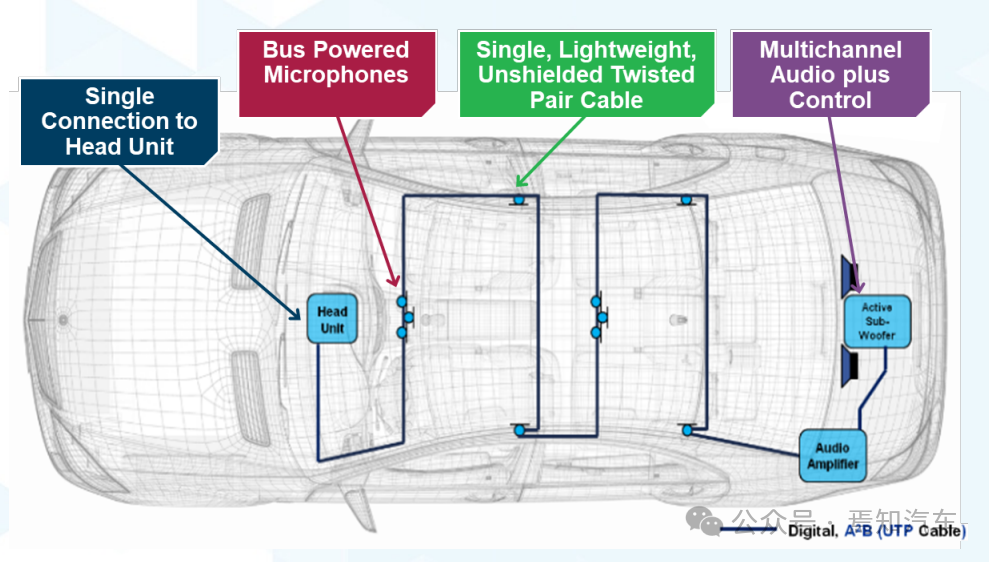
Figure 2: Automotive Audio Bus (A2B)
(2) Advantages and Disadvantages of A2B
-
Advantages
-
Low Overhead: No overhead from IEEE standards, A2B has advantages in protocol complexity and resource usage compared to AVB, allowing for more efficient use of system resources.
-
Easy to Integrate: The A2B stack is easy to integrate into common operating systems such as RTOS, Linux, and QNX, reducing development difficulty and shortening the development cycle, enabling automotive manufacturers to apply A2B technology to in-vehicle audio systems more quickly.
-
Network Diagnostics Support: A2B supports network bus diagnostics, allowing for timely detection of faults and issues in the network, facilitating maintenance and repair, and improving the reliability and maintainability of in-vehicle audio systems.
-
Cost and Weight Advantages: The weight and cost of cables are significantly reduced, which is very important for the automotive industry, as it can lighten vehicle weight, reduce production costs, and minimize the space occupied by wiring in the vehicle.
-
Multi-Functional Communication: A2B also supports asynchronous communication on the synchronous bus, suitable for OTA, diagnostics, and other applications, extending its application range beyond audio transmission to meet other non-audio data transmission needs.
-
Wake-Up Function: Due to bus powering support, A2B can also be used to wake applications from deep sleep states, which is very useful for some low-power application scenarios, enabling quick activation of related devices when needed, improving system responsiveness.
-
Flexible Control: The master node can control the GPIO of slave nodes from a distance, and using the GUI (Sigma Studio) tool allows for flexible design of the A2B network topology, facilitating engineers to customize designs according to different vehicle models and audio system requirements.
-
Disadvantages
Bandwidth Limitation: Fixed bandwidth of up to 50Mbps. If higher bandwidth is required, parallel bus connections (multiple master nodes) may be needed, which somewhat limits A2B’s application in high-bandwidth demand scenarios, such as high-definition video transmission.
(3) Applicable Applications of A2B
-
Radio/Audio: A2B was originally designed for in-vehicle audio transmission, making it very suitable for transmitting radio audio signals and constructing in-vehicle multi-channel audio systems, ensuring high-quality transmission of audio signals and providing clear and smooth music experiences for passengers.
-
Lightweight Application Control, Sensor Data: For lightweight application control data and sensor data transmission, A2B can meet its bandwidth and functional requirements, such as the transmission of simple sensor data collection within the vehicle, like temperature sensors, humidity sensors, etc.
-
Voice Applications: In in-vehicle voice control systems, A2B can reliably transmit voice data, ensuring the accuracy and timeliness of voice recognition, providing reliable communication support for voice interaction functions.
-
Lightweight OTA: For small data volume OTA updates, such as updates to audio system software, A2B can handle these with lower costs and resource consumption, achieving remote upgrades of in-vehicle audio systems.
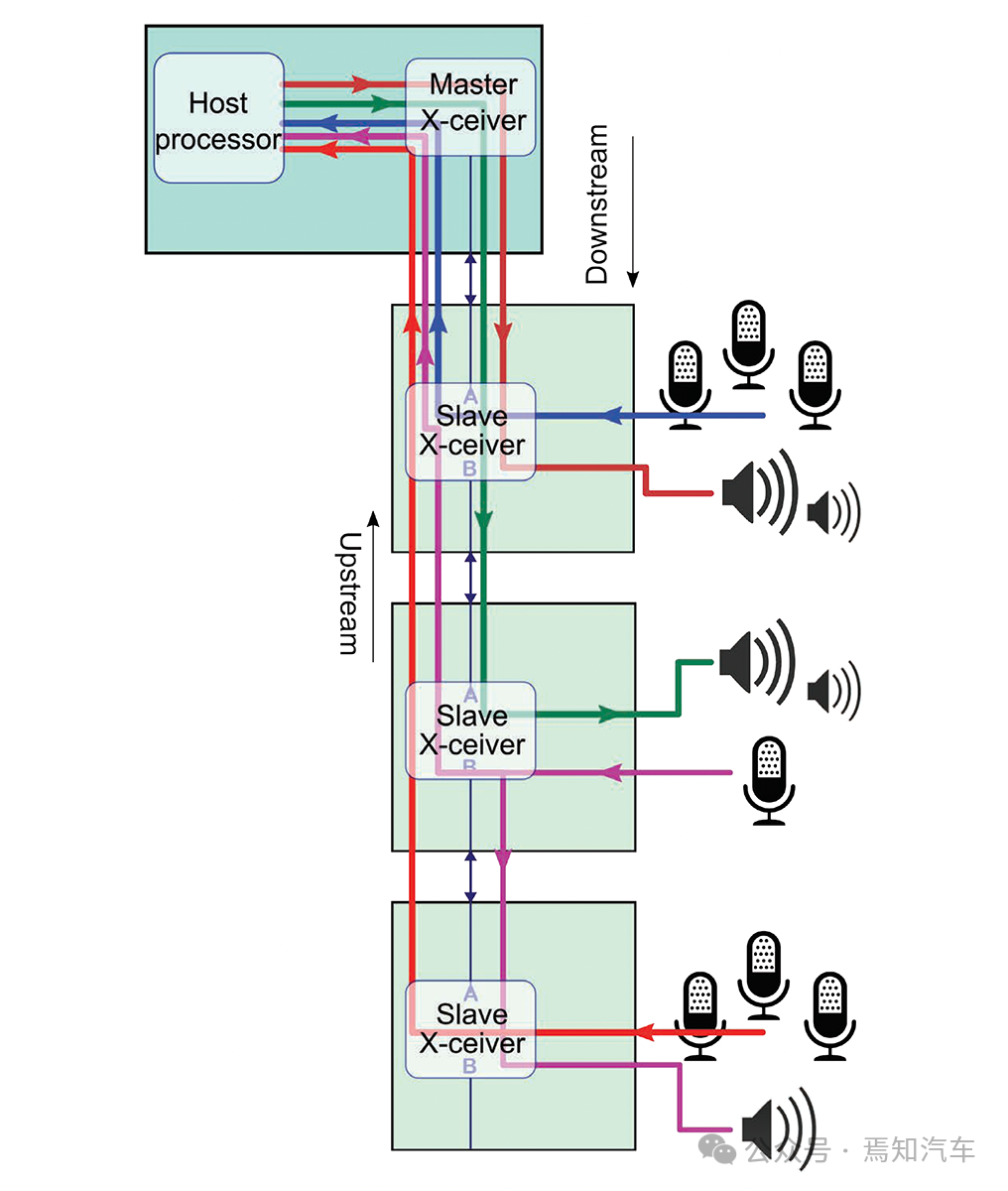
Figure 3: A2B Node Interconnection
4. Comparison and Complementarity of AVB and A2B
(1) Comparison
Standards and Complexity: AVB is based on IEEE standards, which has a high degree of standardization but also brings implementation and integration complexity; A2B has no overhead from IEEE standards and is relatively simple to integrate.
Bandwidth: AVB has scalable bandwidth from 10Mbps to 1000Mbps, suitable for high-bandwidth applications; A2B has a fixed bandwidth of up to 50Mbps, suitable for medium to low bandwidth audio-related applications.
Hardware Requirements: AVB requires microcontrollers and additional clock generators, increasing BOM costs; A2B slave nodes do not require microcontrollers, providing a certain advantage in hardware costs.
Application Focus: AVB focuses on video transmission, camera applications, and applications as a gateway in the Internet of Vehicles; A2B primarily focuses on in-vehicle audio transmission and some lightweight data transmission and control.
(2) Complementarity
In in-vehicle entertainment systems, AVB and A2B are not mutually exclusive but have strong complementarity. For high-definition video streams, complex Internet of Vehicles data exchanges, and applications with high bandwidth requirements, AVB can leverage its advantages; while for audio transmission, lightweight control, sensor data transmission, and scenarios with high cost and simplicity requirements, A2B is a better choice. For example, in a high-end in-vehicle entertainment system, both AVB and A2B can be used simultaneously, with AVB responsible for video playback, camera image transmission, and high-speed data exchange with external networks, while A2B focuses on constructing the audio system and transmitting some simple in-vehicle sensor data. Together, they build an efficient, stable, and feature-rich in-vehicle entertainment communication system.
5. Conclusion
Audio Video Bridging (AVB) and Automotive Audio Bus (A2B) play irreplaceable roles in in-vehicle entertainment system communication. AVB occupies an important position in video-related applications and the Internet of Vehicles due to its standardization, high bandwidth, and multi-functional conversion advantages; A2B excels in audio transmission and lightweight data applications due to its low overhead, easy integration, and cost advantages. By reasonably applying and integrating these two technologies, automotive manufacturers can build more advanced, reliable, and user-demanding in-vehicle entertainment systems, providing passengers with a richer and higher-quality in-car experience. As automotive technology continues to evolve, AVB and A2B technologies will also continue to evolve and improve, playing an important role in the future of in-vehicle communication and driving the in-vehicle entertainment system towards higher performance and more diverse functionalities.
A group of like-minded friends gathers in the Knowledge Circle
Join the “Abao Talks Cars” Knowledge Circle to obtain related learning materials for these modules (currently including research reports, online expert sharing, and offline closed-door meetings), covering 16 major sections, with a detailed list as follows: