Once upon a time, the price of a humanoid robot was enough to buy a house in first-tier cities. Today, you only need to spend the price of a smartphone to bring home a more powerful robot.
At the recent World Internet Conference Wuzhen Summit, various robots showcased their capabilities.
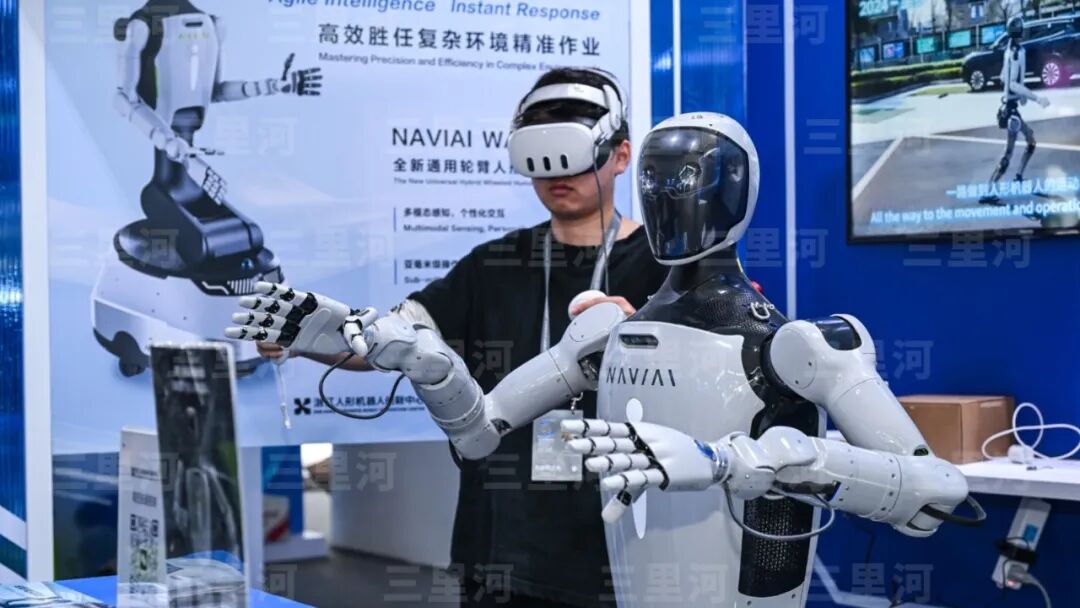
On November 7, 2025, the World Internet Conference Wuzhen Summit opened in Wuzhen, Zhejiang.
At the same time, several Chinese companies have continuously lowered the prices of their new humanoid robots:
Accelerated Evolution launched the entry-level platform Booster K1, with a limited-time price starting at 29,900 yuan;
Unitree Technology’s Unitree R1 AIR is also priced at 29,900 yuan;
Songyan Power’s “Little Bumi” is priced as low as 9,998 yuan.
From “the price of a house” to “the price of a car,” and now to “the price of a smartphone,” this is not just a simple case of low profit and high sales, but a revolution in the “Chinese manufacturing” industry.
While prices are being “driven down,” performance is “rising up.”
Previously, humanoid robots could only run and dance. Now, they possess stronger functional expandability. Chinese companies are pushing humanoid robots to accelerate towards “consumer-grade”.
“Little Bumi” supports graphical programming and course development; Booster K1 is aimed at education, research, competitions, and exhibitions, building a complete development ecosystem.
The rapid decline in humanoid robot prices is fundamentally due to the cost restructuring from technological breakthroughs and the strong high-quality supply chain formed by China’s industrial accumulation.
Jiang Zheyuan, founder of Songyan Power, stated that the reason “Little Bumi” can reduce its price to below 10,000 yuan is due to increasing the proportion of self-developed components, innovating materials and structural design, and leveraging the advantages of the local supply chain.
This confidence comes from the strong high-quality supply chain formed by China’s industrial accumulation.
Core components such as high-precision reducers, servo systems, and intelligent controllers have continuously achieved breakthroughs, and the localization rate continues to rise…
In the first three quarters of 2025, China’s industrial robot production reached 595,000 units, and service robot production exceeded 13.5 million units, both surpassing the total production for the entire year of 2024.
Under the joint action of China’s technological breakthroughs and industrial chain collaboration, humanoid robots are rapidly replaying the story of new energy vehicles.
It is foreseeable that as the industrialization of the industry continues to advance, the efficiency from component production to assembly and debugging will continue to optimize, and the cost of humanoid robots can further decrease.
However, reducing prices is not the goal; building an “ecological moat” is the strategic intent of industrial enterprises.
As Cheng Hao, CEO of Accelerated Evolution, said, the current market lacks humanoid robot platforms suitable for secondary development, “We hope to lower the cost to allow more developers to enter, promoting technological research and development.”
After all, whoever has more developers will define the future application scenarios and establish a solid ecological moat.
More importantly, the process of popularizing humanoid robots is intersecting with breakthroughs in AI technology.
Recently, the Zhiyuan Research Institute released the Emu3.5 multimodal large model. Wang Zhongyuan, director of the Zhiyuan Research Institute, stated that this large model can enable humanoid robots to move from “preset scenarios” to “generalized adaptation,” from “mechanical execution” to “intelligent interaction.”
This means that the “brain” of robots is undergoing a revolution. With the support of new technologies, robots can quickly adapt to numerous scenarios, greatly reducing the training costs of robots.
On the “humanoid” level, bionic robots have already stepped out of the “catwalk” and were even mistaken by netizens as “skin-suit humans.” Staff members, in order to prove this, cut open the covering of the robot’s leg on-site to publicly display the internal mechanical structure.
By achieving cost control through a strong supply chain, entering the market with highly competitive prices, and quickly forming scale and ecology, a wave of robot popularization led by Chinese companies is accelerating.
In the past month alone, over a hundred smart robot products have been launched on JD.com, with the transaction amount for embodied intelligent robots increasing by 757% year-on-year.
When robots become as common as home appliances and cars, they will give rise to a huge industry and application ecosystem.
“Sanlihe” Studio
▎Previous Recommendations
New Deployment from the State Council on “Dual Construction”
U.S. Government Temporarily Revives
Exclusive Interview with Minister of Ecology and Environment Huang Runqiu
Hefei is truly fierce
National Development and Reform Commission’s “Breakfast Meeting”