
When collecting data from websites, we found that many sites encrypt their data, and one common encryption method is MD5.
Regarding MD5 encryption, it is generally implemented according to the RFC 1321 defined MD5 algorithm standard.
Today, we will test the MD5 encryption algorithm of a certain website.
function c(e) {function t(e, t) {return e << t | e >>> 32 - t}The left rotation function t(e, t) shifts the 32 bit integer e to the left by t bits, while filling in the overflow bits from the right.
function n(e, t) {var n, r, o, i, a;return o = 2147483648 & e, i = 2147483648 & t, a = (1073741823 & e) + (1073741823 & t), (n = 1073741824 & e) & (r = 1073741824 & t) ? 2147483648 ^ a ^ o ^ i : n | r ? 1073741824 & a ? 3221225472 ^ a ^ o ^ i : 1073741824 ^ a ^ o ^ i : a ^ o ^ i}The 32 bit unsigned addition function n(e, t), handles overflow situations, where
2147483648 = 2^31 (sign bit)
1073741823 = 2^30 – 1 (30 bit mask)
function r(e, t, n) {return e & t | ~e & n}function o(e, t, n) {return e & n | t & ~n}function i(e, t, n) {return e ^ t ^ n}function a(e, t, n) {return t ^ (e | ~n)}The four basic functions of the MD5 algorithm, used for different rounds:
F: (X & Y) | (~X & Z)
G: (X & Z) | (Y & ~Z)
H: X ^ Y ^ Z
I: Y ^ (X | ~Z)
function s(e, o, i, a, s, u, c) {return e = n(e, n(n(r(o, i, a), s), c)),n(t(e, u), o)}function u(e, r, i, a, s, u, c) {return e = n(e, n(n(o(r, i, a), s), c)),n(t(e, u), r)}function c(e, r, o, a, s, u, c) {return e = n(e, n(n(i(r, o, a), s), c)),n(t(e, u), r)}function l(e, r, o, i, s, u, c) {return e = n(e, n(n(a(r, o, i), s), c)),n(t(e, u), r)}Four round transformation functions, each function executes one round of MD5 transformation, with parameters:
e: current state variable
o,i,a: other state variables
s: message block
u: shift amount
c: constant
function f(e) {for (var t, n = e.length, r = n + 8, o, i = 16 * ((r - r % 64) / 64 + 1), a = new Array(i - 1), s = 0, u = 0; n > u; ) s = u % 4 * 8, a[t = (u - u % 4) / 4] = a[t] | e.charCodeAt(u) << s, u++;return s = u % 4 * 8, a[t = (u - u % 4) / 4] = a[t] | 128 << s, a[i - 2] = n << 3, a[i - 1] = n >>> 29, a}The message padding function f(e), which calculates the padded length and converts the string into a 32 bit word array, adding a 1 bit and 0 padding, and appending the original message length (64 bits).
function d(e) {var t, n, r = "", o = "";for (n = 0; 3 >= n; n++) r += (o = "0" + (t = e >>> 8 * n & 255).toString(16)).substr(o.length - 2, 2);return r}The byte order conversion function d(e), converts32 bit integers to little-endian hexadecimal strings.
function p(e) { e = e.replace(/\r\n/g, "\n");for (var t = "", n = 0; n < e.length; n++) {var r = e.charCodeAt(n);128 > r ? t += String.fromCharCode(r) : r > 127 && 2048 > r ? (t += String.fromCharCode(r >> 6 | 192), t += String.fromCharCode(63 & r | 128)) : (t += String.fromCharCode(r >> 12 | 224), t += String.fromCharCode(r >> 6 & 63 | 128), t += String.fromCharCode(63 & r | 128)) }return t}The encoding function p(e), converts strings to UTF-8 encoding.
var h, m, y, v, g, b, _, w, S, x = [], k = 7, E = 12, L = 17, M = 22, T = 5, O = 9, C = 14, P = 20, j = 4, A = 11, D = 16, I = 23, N = 6, R = 10, Y = 15, F = 21, H;Initialization.
for (x = f(e = p(e)),b = 1732584193,_ = 4023233417,w = 2562383102,S = 271733878,h = 0; h < x.length; h += 16)m = b,y = _,v = w,g = S,b = s(b, _, w, S, x[h + 0], 7, 3614090360),S = s(S, b, _, w, x[h + 1], E, 3905402710),w = s(w, S, b, _, x[h + 2], L, 606105819),_ = s(_, w, S, b, x[h + 3], M, 3250441966),b = s(b, _, w, S, x[h + 4], 7, 4118548399),S = s(S, b, _, w, x[h + 5], E, 1200080426),w = s(w, S, b, _, x[h + 6], L, 2821735955),_ = s(_, w, S, b, x[h + 7], M, 4249261313),b = s(b, _, w, S, x[h + 8], 7, 1770035416),S = s(S, b, _, w, x[h + 9], E, 2336552879),w = s(w, S, b, _, x[h + 10], L, 4294925233),_ = s(_, w, S, b, x[h + 11], M, 2304563134),b = s(b, _, w, S, x[h + 12], 7, 1804603682),S = s(S, b, _, w, x[h + 13], E, 4254626195),w = s(w, S, b, _, x[h + 14], L, 2792965006),b = u(b, _ = s(_, w, S, b, x[h + 15], M, 1236535329), w, S, x[h + 1], 5, 4129170786),S = u(S, b, _, w, x[h + 6], 9, 3225465664),w = u(w, S, b, _, x[h + 11], C, 643717713),_ = u(_, w, S, b, x[h + 0], P, 3921069994),b = u(b, _, w, S, x[h + 5], 5, 3593408605),S = u(S, b, _, w, x[h + 10], 9, 38016083),w = u(w, S, b, _, x[h + 15], C, 3634488961),_ = u(_, w, S, b, x[h + 4], P, 3889429448),b = u(b, _, w, S, x[h + 9], 5, 568446438),S = u(S, b, _, w, x[h + 14], 9, 3275163606),w = u(w, S, b, _, x[h + 3], C, 4107603335),_ = u(_, w, S, b, x[h + 8], P, 1163531501),b = u(b, _, w, S, x[h + 13], 5, 2850285829),S = u(S, b, _, w, x[h + 2], 9, 4243563512),w = u(w, S, b, _, x[h + 7], C, 1735328473),b = c(b, _ = u(_, w, S, b, x[h + 12], P, 2368359562), w, S, x[h + 5], 4, 4294588738),S = c(S, b, _, w, x[h + 8], A, 2272392833),w = c(w, S, b, _, x[h + 11], D, 1839030562),_ = c(_, w, S, b, x[h + 14], I, 4259657740),b = c(b, _, w, S, x[h + 1], 4, 2763975236),S = c(S, b, _, w, x[h + 4], A, 1272893353),w = c(w, S, b, _, x[h + 7], D, 4139469664),_ = c(_, w, S, b, x[h + 10], I, 3200236656),b = c(b, _, w, S, x[h + 13], 4, 681279174),S = c(S, b, _, w, x[h + 0], A, 3936430074),w = c(w, S, b, _, x[h + 3], D, 3572445317),_ = c(_, w, S, b, x[h + 6], I, 76029189),b = c(b, _, w, S, x[h + 9], 4, 3654602809),S = c(S, b, _, w, x[h + 12], A, 3873151461),w = c(w, S, b, _, x[h + 15], D, 530742520),b = l(b, _ = c(_, w, S, b, x[h + 2], I, 3299628645), w, S, x[h + 0], 6, 4096336452),S = l(S, b, _, w, x[h + 7], R, 1126891415),w = l(w, S, b, _, x[h + 14], Y, 2878612391),_ = l(_, w, S, b, x[h + 5], F, 4237533241),b = l(b, _, w, S, x[h + 12], 6, 1700485571),S = l(S, b, _, w, x[h + 3], R, 2399980690),w = l(w, S, b, _, x[h + 10], Y, 4293915773),_ = l(_, w, S, b, x[h + 1], F, 2240044497),b = l(b, _, w, S, x[h + 8], 6, 1873313359),S = l(S, b, _, w, x[h + 15], R, 4264355552),w = l(w, S, b, _, x[h + 6], Y, 2734768916),_ = l(_, w, S, b, x[h + 13], F, 1309151649),b = l(b, _, w, S, x[h + 4], 6, 4149444226),S = l(S, b, _, w, x[h + 11], R, 3174756917),w = l(w, S, b, _, x[h + 2], Y, 718787259),_ = l(_, w, S, b, x[h + 9], F, 3951481745),b = n(b, m),_ = n(_, y),w = n(w, v),S = n(S, g);Initial state, and performing64 rounds of transformation (4 rounds, each round has 16 steps)
return (d(b) + d(_) + d(w) + d(S)).toLowerCase()};Returning the result, converting the four 32 bit state variables to a hexadecimal string and concatenating them, finally converting to lowercase.
console.log(c('123456'))Console test.
Let’s take a look at the test results:
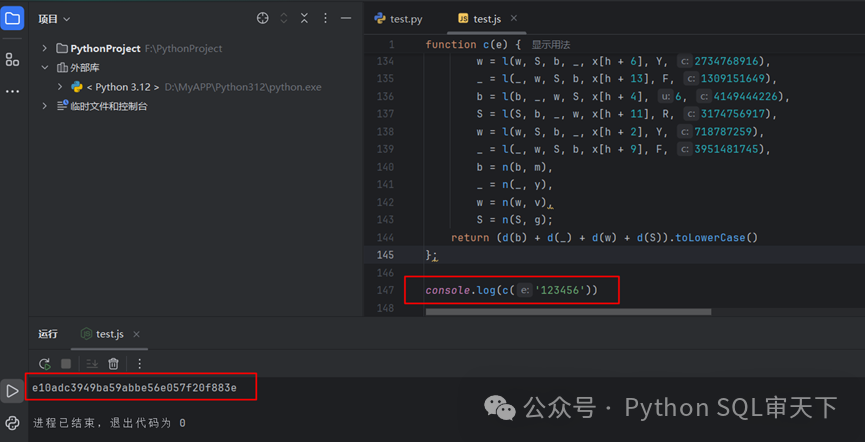
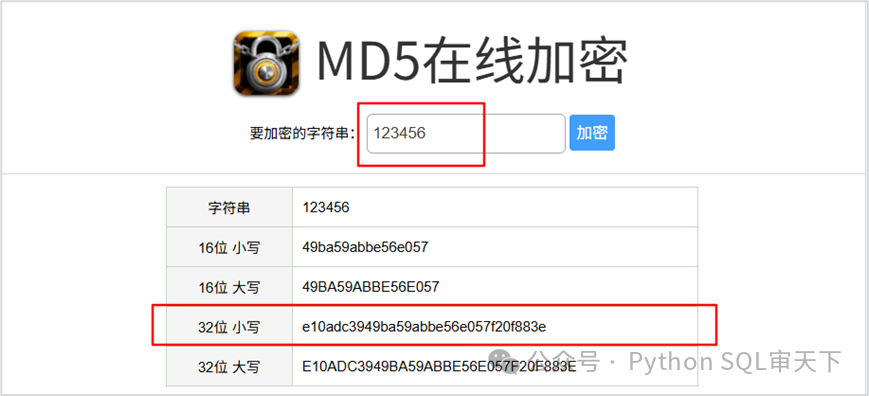
If your plaintext password is 123456, and the encryption method is standard MD5 encryption, then its ciphertext is:
e10adc3949ba59abbe56e057f20f883e
We verified it using an online MD5 encryption tool, and the result is consistent.
That’s all for today’s sharing. Thank you very much for your attention and likes for the “Python SQL Review” public account. If you think my public account can bring you some gains, please share it with your friends, so more people can see and understand it. Perhaps your casual like and share will bring others a unique experience and feeling.