2025.09.18
Word count: 1091, estimated reading time: about 2 minutes
Author | Yicai Global Li Na
At the 2025 Global Connectivity Conference, Huawei rarely announced the research and development progress of several self-developed chips.
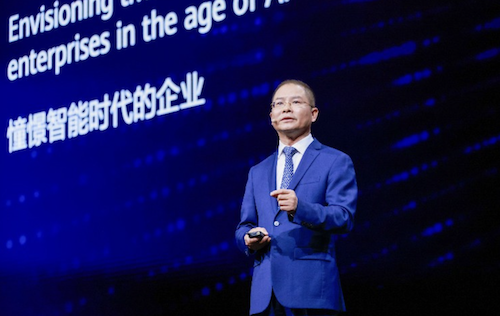
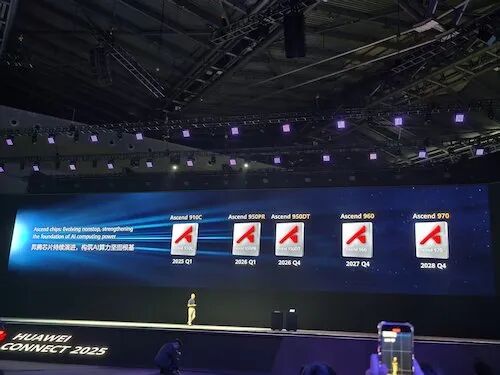
On September 18, Huawei’s Vice Chairman and Rotating Chairman Xu Zhijun stated in his speech that over the next three years, Huawei has planned multiple Ascend chips, including the 950PR, 950DT, as well as the Ascend 960 and 970. The 950PR is set to be launched in the first quarter of 2026, and this chip utilizes Huawei’s self-developed HBM.
Additionally, he mentioned that super nodes have become the new norm in AI infrastructure construction, with over 300 Cloud Matrix 384 super nodes deployed cumulatively.
Xu Zhijun pointed out: “Computing power has been, and will continue to be, the key to artificial intelligence, and it is crucial for China’s artificial intelligence as well.” He further emphasized: “Based on the chip manufacturing processes available in China, Huawei is striving to create a ‘super node + cluster’ computing power solution to meet the continuously growing demand for computing power.”
Xu Zhijun believes that a super node is physically composed of multiple machines, but logically functions as a single machine for learning, thinking, and reasoning.
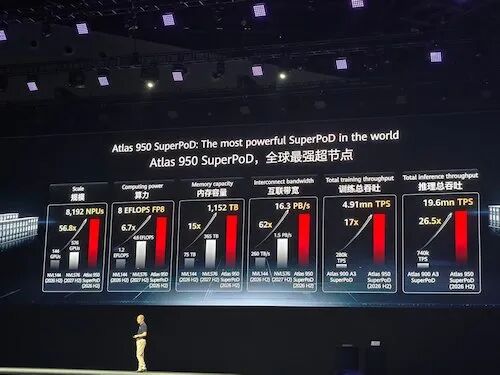
Huawei also unveiled the Atlas 950 SuperPoD and Atlas 960 SuperPoD super nodes on-site, which support 8192 and 15488 Ascend cards, respectively. In terms of card scale, total computing power, memory capacity, and interconnect bandwidth, they are positioned at a global leading level. Additionally, Huawei simultaneously released super node clusters, namely the Atlas 950 SuperCluster and Atlas 960 SuperCluster, with computing power scales exceeding 500,000 cards and reaching one million cards, respectively.
Xu Zhijun stated that based on the world’s strongest computing power super nodes and clusters, Huawei is confident in providing sustainable and abundant computing power for the long-term rapid development of artificial intelligence.
At the same time, Huawei has taken the lead in introducing super node technology into the general computing field, launching the world’s first general computing super node TaiShan 950 SuperPoD. Xu Zhijun stated that combined with the GaussDB distributed database, it can completely replace various large and small machines as well as Exadata database integrated machines, becoming the terminator of all types of large and small machines.
Notably, at the end of his speech, Xu Zhijun revealed that Huawei has overcome the significant challenges of interconnect technology for large-scale super nodes and launched the interconnect protocol Lingqu (UnifiedBus) for super nodes. Huawei will open the Lingqu 2.0 technical specifications in the future.
“Due to the sanctions imposed by the United States, we cannot go to TSMC for chip production, and our single chip computing power lags behind NVIDIA. However, Huawei has over 30 years of experience in connecting people and machines, so we are making strong investments and breakthroughs in connection technology, enabling us to achieve super nodes at the level of ten thousand cards, thus maintaining the strongest computing power in the world!” Xu Zhijun pointed out that Huawei is willing to continue working with the industry to build a solid foundation to support the AI computing power needs of China and the world.
WeChat Editor | Yulin
Yicai Global continues to track financial hotspots. If you have valuable information about company dynamics, industry trends, financial events, etc., please provide it.Dedicated email:[email protected]
(Note: We will verify the information. Your privacy will be strictly protected.)
Recommended Reading
Response from Luo Yonghao to Xibei’s Apology Letter