To cultivate an FPGA(Field Programmable Gate Array) engineer, one generally needs to go through both undergraduate and graduate stages; a shorter time frame makes it difficult to produce qualified talent. After graduating with a bachelor’s degree, if one wants to find a job relying on FPGA skills, they will generally be asked if they have project experience, and there will also be on-site testing environments. How to cope with this? Relying on superficial knowledge will definitely not work; companies do not support idle personnel! Unless you are a “connected person” who must be taken care of! The company I used to work for hired a large number of such individuals to pave the way for market work. Will this be considered corruption? That depends on when the state investigates. Many companies’ rapid development in earlier years relied on this path, but I won’t elaborate further; let’s continue discussing job hunting.
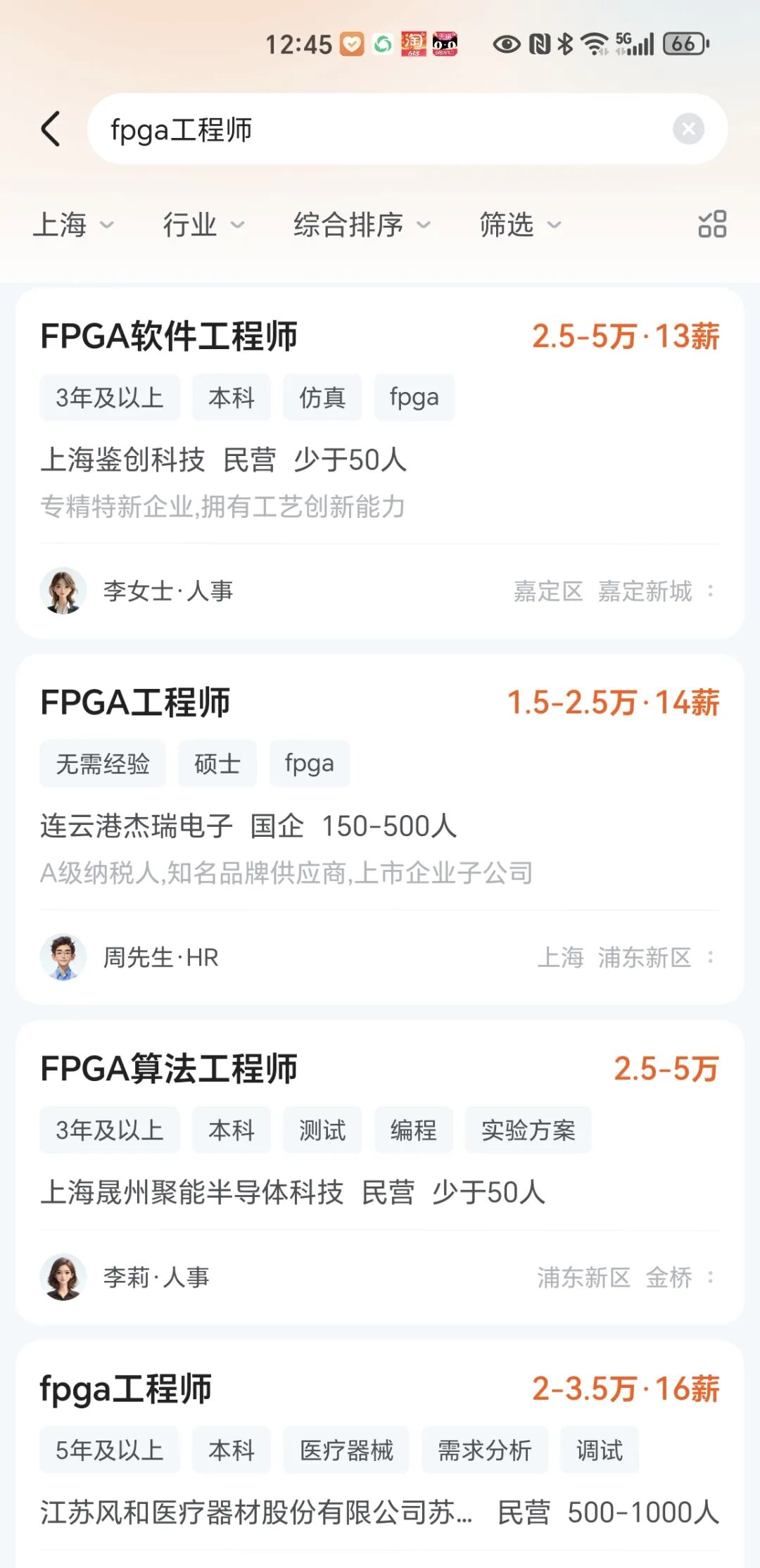
The larger the city, the more job opportunities there are!
Recently, by coincidence, I encountered a reader from my public account consulting about future employment issues. Considering her learning situation, I suggested she develop in the direction of an FPGA engineer. Below is a summary of our communication; this student is very serious about her work, and she diligently recorded our conversation while I made careful modifications. Please browse the content.
Master communication theory and build a solid foundation in digital signal processing. During the undergraduate stage, it is essential to learn the courses “Principles of Communication” and “Digital Signal Processing” well, and to deeply understand the course content through simulations. However, the level of communication knowledge learned during the undergraduate stage generally only reaches the basic theoretical parts such as modulation and demodulation, and students typically do not encounter advanced knowledge like spread spectrum and synchronization principles, let alone knowledge related to products such as upconversion, AGC, equalizers, signal capture, and feedback loops. Therefore, during the graduate stage, it is necessary to further study the course “Digital Communication” and related knowledge (still without exposure to engineering knowledge), such as “Adaptive Filters”.
-
If the undergraduate major is not in communication and the foundation in communication is relatively weak, encountering it again in graduate school will be very “painful”. Therefore, it is not recommended to engage in pure communication algorithm positions; one can consider a direction that combines algorithms with FPGA implementation. Based on personal circumstances, if there is a foundation in digital signal processing and FPGA, further in-depth study can serve as a “means” of livelihood. During student years, one may not be clear about the operational situation of enterprise R&D, so I will briefly mention a few points here. Any project developed by a communication company must ultimately “land” as a product, and FPGA implementation work is a key link close to the “landing” state.
-
In terms of products, each link requires specialized talent. MATLAB is used for algorithm simulation and performance testing, while the FPGA software programming process is used to convert MATLAB algorithm code into code that can run on chips. The chip not only contains communication content but also involves digital signal processing content, such as a series of operations like upconversion and downconversion that need to be performed before the algorithm after AD sampling. Therefore, working on FPGA implementation also requires mastering knowledge of digital signal processing.
Case Study of Communication Signal Processing: Development of Upconverter (3) Engineering Processing
FPGA engineers do not need to understand algorithms as deeply as algorithm engineers; they only need to be able to comprehend them. However, it is also necessary to thoroughly understand communication-related knowledge in the early stages of graduate school and to engage in more practical projects to increase engineering experience. The ability to independently debug programs and find problems can only be improved through project work. If one can spend three fulfilling years in graduate school like this, finding a high-paying job after graduation will not be a problem.
During the undergraduate stage, exposure to FPGA is mostly superficial (most learn control programming, with little exposure to algorithm programming), and theoretical learning occupies the majority of time (students only encounter Verilog HDL language when taking digital electronics courses in their second year). Why is there a separate position for this in employment, and why is the salary so high? Can undergraduates apply for FPGA engineer positions after graduation? Yes, but you must demonstrate real abilities, not just rely on superficial experience on your resume. Generally speaking, undergraduates may complete many control-related tasks (such as peripheral devices like AD, DA, sensors, WIFI, etc.) using FPGA after graduation, but they rarely get to engage in algorithm-related programming early on. As experience increases, they may gradually come into contact with this area of knowledge.
The reason FPGA engineers have become an independent and important position in the job market is due to their unique hardware programmability, high performance, and low latency advantages, as well as their irreplaceable role in specific fields. Although the FPGA content encountered during the undergraduate stage is relatively basic, the actual industrial application of FPGA engineers is very in-depth and specialized.
The technical threshold for this position is relatively high! At least one must simultaneously possess digital circuit design, software programming (Verilog HDL or VHDL), and specific domain knowledge (such as digital communication and digital signal processing).
The importance of FPGA positions stems from their irreplaceability in critical fields, while the “superficial” knowledge from undergraduate education is merely a foundational entry point. Companies need FPGA engineers who can solve practical engineering problems, which requires project accumulation and continuous learning to fill the gaps. If you are interested in FPGA, it is recommended to participate in actual projects or internships as early as possible, focusing on a specific vertical field (such as communication or AI acceleration) to deepen your skills. This type of work is often completed during the graduate stage. What jobs can one find after graduating from graduate school? Just look at the recruitment requirements for certain positions!
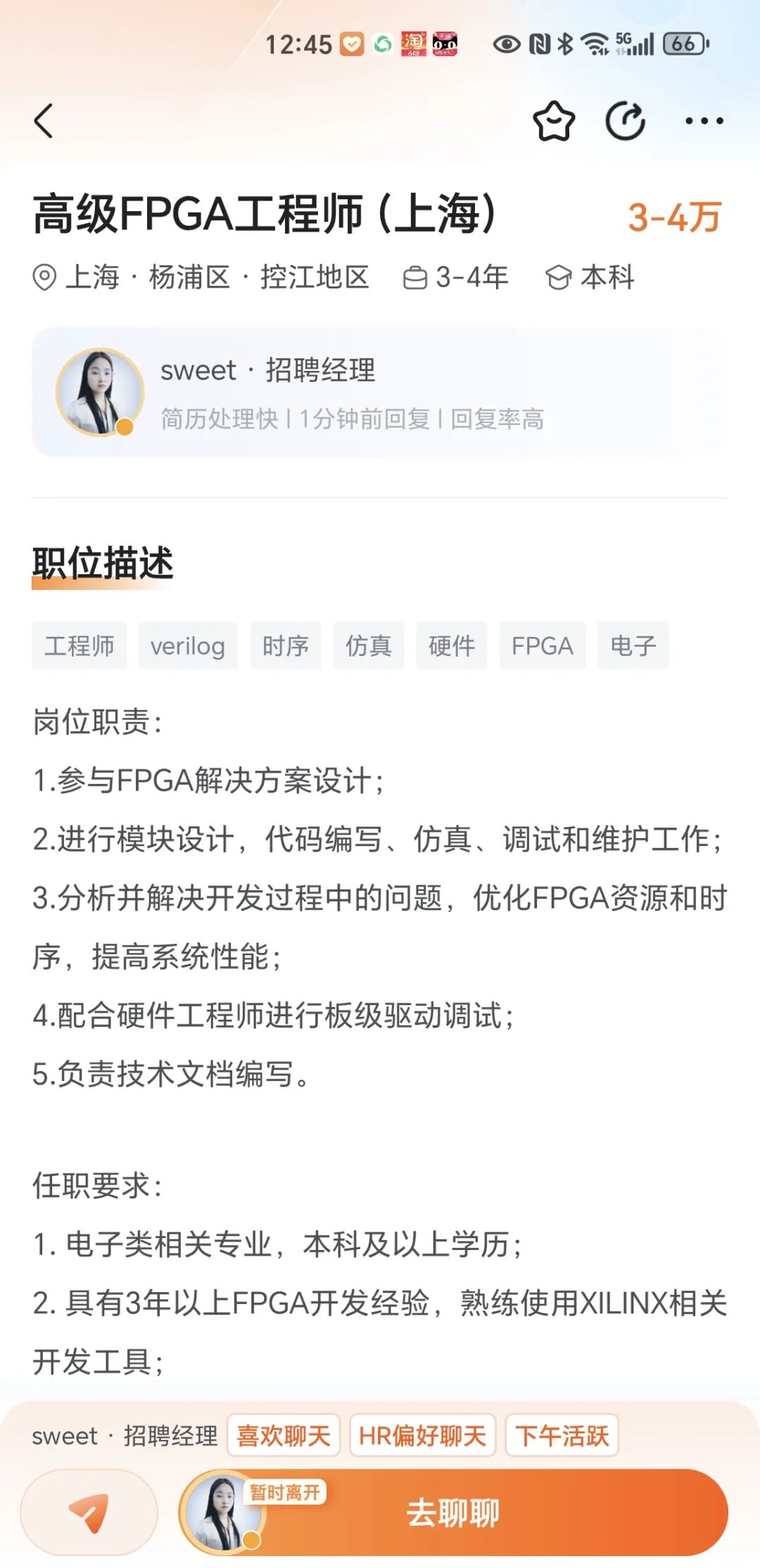 FPGA software programming skills are initially acquired through learning and later through experience. Working more will quickly enhance experience. However, to find a high-paying job, one also needs to accumulate specialized knowledge. In the past, I worked on communication algorithms in a company, and I had corresponding FPGA engineers collaborating with me. When working on satellite communication algorithms, Xiao Zhao helped me implement the algorithm on the company’s existing product hardware platform, continuously modifying it until we achieved information exchange between the stations in the field! Xiao Zhao graduated from Beihang University and initially learned navigation signal processing algorithms from me; he is now the R&D director of another listed company. This position indeed greatly enhances one’s level!Satellite Communication v2 Chapter 7 Simulation and Practice (9) Approaching ProductsWhen working on the communication algorithm for shortwave radio stations, Xiao Ma helped me implement the algorithm on FPGA, which was continuously modified until the final distance test. This project had a tight deadline and took us several months, with no breaks during holidays. For a female engineer, it was indeed very tough. She graduated from Harbin Institute of Technology and came to Guangzhou with her boyfriend; she is truly a courageous engineer and is still at her original unit! The articles below document part of the algorithm in the product R&D of the company. Both of them graduated with a master’s degree and started their careers as FPGA engineers.University Graduation Design Discussion Part 22 Digital AGC MATLAB Simulation (4) FPGA ImplementationThe knowledge points organized in these articles are the professional knowledge required for employment in the communication field. However, FPGA engineers who master communication algorithms can not only find employment in the communication industry but can also develop in fields such as radar, medical electronics, and chip design, where they are highly sought after. Many knowledge areas are interconnected, especially in the field of digital signal processing. Recently, I discussed future development directions with a former student. I first suggested he learn digital signal processing knowledge. After working for two years post-bachelor’s degree, he has been dealing with FPGA and has become a hardware programming coder, but he has never been exposed to algorithm knowledge, so he needs to catch up quickly; otherwise, his future career will face bottlenecks. I recommended the following articles to him to help him understand the concept of sampling and then grasp the filtering process.Digital Signal Processing Simulation Assistance Course v2 Lesson 1 Signal Sampling (1)Finally, a workplace summary:In the crucible of technology, continuous learning can keep one improving and always standing at the forefront.