Many friends ask
“How to use someone else’s network without a password?”
“But I feel embarrassed to ask for the password”
“How to log into someone else’s WiFi without a password?”
………
😅……
In today’s internet age, WiFi has become an indispensable part of our lives. Sometimes, we may wonder, without a WiFi password, is it possible to steal our neighbor’s wireless network? Here, I want to make it clear that, aside from the unethical and legal aspects, it is also technically quite difficult..
01
Easy to Crack a Few Years Ago
A few years ago, most WiFi networks used WEP encryption. WEP (Wired Equivalent Privacy) is an early technology used to secure data transmission over wireless networks, but it has several significant security flaws. WEP uses a 24-bit initialization vector (IV), leading to only 16 million possible IV values. In network communications, the IV quickly repeats, and the repetition allows attackers to analyze the key stream patterns to crack the encryption. Most users cracked it using the “Feeding Bottle” system (Beini is a wireless network security testing system built on Tiny Core Linux, which people can use to check the security and vulnerabilities of wireless networks. FeedingBottle is the GUI of the Aircrack-ng toolkit running on the Beini system, commonly known as “Feeding Bottle”).WEP encrypted passwords can generally be cracked within minutes or hours.
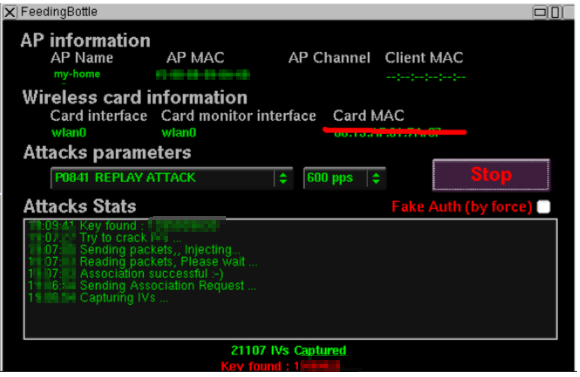 Due to the aforementioned security flaws, WEP is considered insecure and has been replaced by more advanced standards such as WPA, WPA2, and the latest WPA3.
02
More Difficult to Crack Now
Modern routers and devices now useWPA encryption, which offers significant improvements in security compared to its predecessor WEP, especially WPA2 has become the industry standard for wireless network security. WPA uses TKIP (Temporal Key Integrity Protocol) as its data encryption mechanism, while WPA2 employs the more secure AES (Advanced Encryption Standard). Some devices even use WPA3 encryption.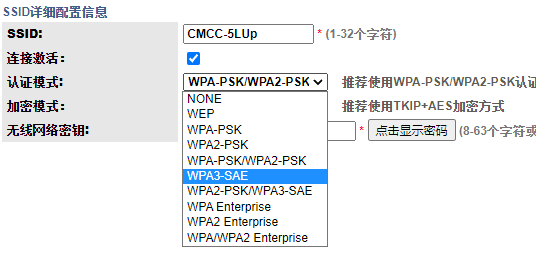 (Router WiFi encryption settings)WPA3 (Wi-Fi Protected Access III) encryption standard significantly enhances security compared to WPA2, directly increasing the difficulty of cracking.
- Enhanced Cipher Suites:WPA3 introduces stronger encryption algorithms, such as using a 192-bit security suite, providing additional protection for environments requiring a higher security level (like government and defense sectors).
- Individualized Data Encryption:Even in open Wi-Fi networks, WPA3 provides independent data encryption for each connected device, meaning different users on the same network cannot see each other’s communications, greatly enhancing resistance to side-channel attacks.
- Password Attempt Limit:The WPA3 standard limits the number of password guessing attempts, effectively preventing offline dictionary attacks and brute-force cracking. After multiple failed login attempts, the system locks down the attack behavior, significantly increasing the cost and time required for password cracking.
- Dragonfly Handshake:WPA3 adopts a new handshake protocol called “Simultaneous Authentication of Equals” (SAE) or “dragonfly,” replacing the four-way handshake in WPA2, enhancing resistance to offline dictionary attacks and addressing the key reinstallation vulnerability (KRACK attack) present in WPA2.
- Forward Secrecy:Even if the long-term key of the network is compromised at some point, the design of WPA3 ensures that previously communicated content remains secure, achieving forward secrecy.
03
No Absolute Security
If you do not pay attention to WiFi security, aside from the above-mentioned easy cracking using WEP encryption, even with WPA, it can still be cracked or used in the following ways.Using Weak Passwords:Even if you use the strong WPA encryption method, if you use simple passwords like “12345678,” “aabbccdd,” or “88888888,” they can still bequickly brute-forced by software. Therefore, try to use strong passwords with letters, numbers, and special symbols.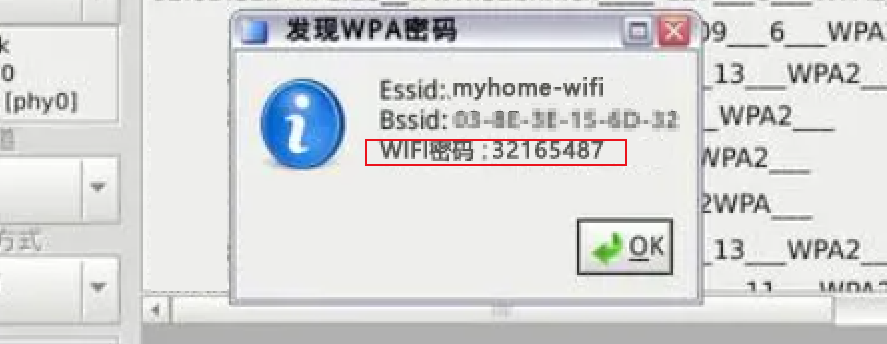 Using Password Sharing Software:Some WiFi software, like “**Key” may check and share your password by default. This way, others can obtain your WiFi password. So, be cautious when using them.
04
In Conclusion
First, stealing someone else’s wireless network is an infringement of their rights, potentially violatinglegal risks. Neighbors have the right to use and manage their WiFi, and using it without permission is inappropriate.If you really need to use the network, you can kindly negotiate with the other party , to see if sharing is possible, generally, people are still willing to share.Again, one should always be cautious, enable WPA encryption, and use complex passwords.Finally, installing broadband is quite cheap now, many operators are almost giving it away, you can install your own, there’s no need to use someone else’s anymore.