Artificial Rupture of Membranes (ARM), commonly known as “water breaking surgery”, is an intervention method to artificially rupture the amniotic membrane at the cervical opening to observe the color of amniotic fluid, enhance uterine contractions, and accelerate the progress of labor. It is a common induction method during natural childbirth.
History of ARM and Scholars’ Understanding
➢ ARM has been applied in obstetric clinical practice since the 11th century, as recorded in literature.
➢ In the late 20th century, some scholars began to question the surgical method of ARM, leading to different viewpoints.
➢ Obstetric practitioners have reached a consensus that ARM, as an invasive procedure, is no longer considered a necessary intervention during labor.
Clinical Applications of ARM
01
Inducing Uterine Contractions – Induction of Labor
Indication for ARM Induction: (1) Conditions suitable for vaginal trial of labor induction (IOL). (2) Bishop score of the cervix ≥ 7 points.
Relative Contraindications: (1) Fetal head not engaged. (2) Fetal head not closely applied to the cervix. The standard operational procedure for ARM is shown in Figure 1.
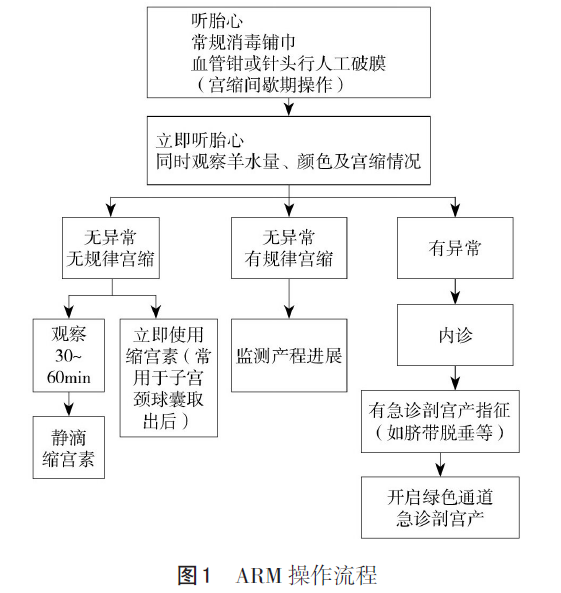
ARM Based on Balloon Catheter for Cervical Ripening
ARM is more often used after inducing regular uterine contractions with medication or mechanical methods. For example, if the Bishop score of the cervix is ≤ 6, a balloon catheter is placed for induction, removed after 12 hours, and immediate intravenous oxytocin is recommended after ARM; if the balloon catheter is ineffective or the effect is not obvious, and ARM cannot be performed, sequential use of dinoprostone to promote cervical ripening can be utilized, or the cervical balloon can be placed again after 24 hours.
Currently, some scholars in China believe that after ARM, observation for 30–60 minutes is necessary, and if contractions do not strengthen, a small dose of oxytocin should be used again.
02
Shortening Labor Duration – Augmentation of Labor
Routine ARM during labor is not advocated
The 2020 Clinical Practice Guidelines for Normal Delivery, jointly formulated by the Obstetrics Group of the Chinese Medical Association and the Perinatal Medicine Group, clearly state that routine ARM during labor is not recommended.
ARM during the latent phase is not recommended
ARM during the active phase is recommended
ARM is generally performed when the cervix is ≥ 5cm dilated. If there is a lack of coordinated contractions after ARM, oxytocin may be used to promote labor progress. The method of combining ARM with intravenous oxytocin can shorten the time from induction to delivery. If the membranes are still intact after full dilation, which affects the descent of the fetal head, ARM can be performed during contraction intervals to facilitate fetal head descent and rotation.
03
Adjusting Fetal Position (ARM + Manual Rotation of Fetal Head)
For pregnant women with abnormal fetal positions, after entering the second stage of labor, or when the cervix is nearly fully dilated, and the biparietal diameter of the fetal head reaches the level of the ischial spines or lower, manual rotation of the fetal position after ARM is the main corrective measure.
04
ARM in Vaginal Birth After Cesarean (VBAC)
A systematic review and meta-analysis by Wingert et al. in 2019 examined literature published in English and French from 1985 to 2019 regarding VBAC induction methods and delivery outcomes. The results showed that there was no difference in VBAC success rates between ARM and natural labor (RR 1.06, 95% CI 0.88–1.28). These studies evaluated the vaginal delivery rates of VBAC, but lacked high-quality evidence to support that ARM could increase the vaginal delivery rate of VBAC.
05
ARM in Twin Vaginal Delivery
ARM is not recommended during the first stage of labor. In our clinical practice, the interval between the delivery of the two fetuses should be 5–10 minutes.
After the first fetus is delivered, quickly position the second fetus longitudinally. If the feet are presenting, grasp the second fetus’s ankle through the relaxed cervical opening, pulling it to the vaginal opening during contraction intervals, and perform breech delivery or breech traction after ARM; if the second fetus’s head is presenting, an assistant can gently push down on the uterine fundus, and after the fetal head engages, ARM can be performed during contraction intervals to deliver the fetus. After the first fetus is delivered, oxytocin should be administered appropriately according to the contraction situation.
Special Cases of ARM
01
HSV Infection and ARM
The risk of vertical transmission of genital HSV infection from the mother to the newborn during vaginal delivery is 30%–50%. Even in the absence of symptoms, invasive procedures (ARM, forceps, surgical assistance, etc.) should be minimized during labor to reduce the time the fetus is exposed to vaginal secretions, thereby decreasing the likelihood of fetal infection.
02
GBS Infection and ARM
There is evidence that ARM does not increase the risk of early-onset GBS infection in newborns (Evidence Level: D). Any pregnant woman with GBS isolated from urine at any stage of pregnancy should receive intrapartum antibiotic prophylaxis (IAP), without the need for late pregnancy GBS screening. All other pregnant women should be screened for GBS colonization in the vagina and rectum at 35–37 weeks of gestation. Except for cesarean delivery performed with intact membranes, all GBS-positive pregnant women should receive IAP at the time of delivery or when membranes rupture.
The optimal timing for IAP is 4 hours before delivery. If there is no GBS urinary tract infection, antibiotics should not be used before delivery to clear GBS colonization from the genital or rectal tract (Evidence Level: Expert Consensus).
Indications for prophylactic antibiotic use for GBS during labor include:
(1) Positive prenatal GBS screening (AII).
(2) GBS bacteriuria during pregnancy (AII).
(3) History of GBS infection in previous newborn deliveries (AII).
(4) Unknown GBS colonization status with any of the following conditions (AII):
① Prematurity;
② Premature rupture of membranes >18h;
③ Maternal temperature ≥38℃;
④ Positive GBS nucleic acid amplification test during labor;
⑤ Previous pregnancy with positive GBS.
03
Hepatitis Virus Infection and ARM
The 2017 WHO clinical guidelines state that in areas with high prevalence of hepatitis virus infections among pregnant women, the integrity of the membranes should be maintained as much as possible to prevent vertical transmission from mother to child. When the newborn has been “immersed” in virus-containing fluids during delivery, care should be taken to clean the newborn’s mouth and nasal cavity gently to avoid excessive force, which may cause mucosal damage and allow the virus to enter the newborn’s body.
04
HIV Infection and ARM
The 2019 guidelines issued by the UK AIDS Society for the management of HIV during pregnancy and postpartum state that if the HIV viral RNA load is <50 copies/ml, invasive prenatal diagnostic examinations can be performed. Pregnant women with membrane rupture before labor, if the viral load is low, may undergo vaginal trial of labor, and should aim to deliver within 24 hours of membrane rupture.
Considerations for ARM Operation and Emergency Management of Cord Prolapse
The major complication of ARM is cord prolapse. Most cord prolapses occur within minutes after membrane rupture. A study found that 57% occurred within 5 minutes, and 67% occurred within 1 hour after membrane rupture. If fetal bradycardia or variable decelerations appear within minutes after ARM, especially if fetal heart monitoring abnormalities occur immediately after membrane rupture, one should be alert for possible cord prolapse. If a diagnosis of cord prolapse is established, vaginal delivery cannot be performed in the short term, and immediate cesarean delivery should be performed.
If the amniotic fluid is blood-stained after ARM, with or without fetal heart rate abnormalities, there should be a high suspicion of placental abruption.
In summary, the clinical applications of ARM are:
(1) When the cervical conditions are not mature, and the Bishop score is ≤ 6, simple ARM not only has a low success rate for induction but also cannot predict the timing of labor onset, and the long duration from membrane rupture to delivery may lead to infection; therefore, simple ARM is not recommended for cervical ripening. When cervical conditions are mature, and the Bishop score is ≥ 7, ARM can be combined with oxytocin for induction.
(2) If there is a history of cesarean section and the Bishop score is ≤ 6, a balloon catheter should be placed for induction, removed after 12 hours, and immediate intravenous oxytocin should be administered after ARM. If the balloon catheter is ineffective or the effect is not obvious, and ARM cannot be performed, sequential use of dinoprostone for cervical ripening can be used, or the cervical balloon can be placed again after 24 hours.
(3) The 2020 Guidelines for Normal Delivery clearly state that routine ARM during labor is not recommended.
(4) ARM during the latent phase is not advocated; if there are indications for ARM, it is recommended to perform ARM during the active phase.
(5) ARM in special circumstances must have indications, and all GBS-positive pregnant women should receive IAP at the time of delivery or when membranes rupture.
In our department, when performing ARM, we emphasize the “three musts”: there must be indications, medical orders, and records, and it must be executed after good communication with the mother and family.
Editor: Tingting | Reviewer: Zili
Source: Midwife Notes
For business cooperation, please contact: [email protected]