▲Click the above Leifeng Network to follow

Written by | Bao Yonggang
Reported by Leifeng Network (leiphone-sz)
According to Leifeng Network, it hasn’t been long since Arm first announced the new Cortex A76 CPU microarchitecture in June this year. When Cortex A76 was released, Arm made significant commitments regarding performance and efficiency improvements of the new core, and now we have seen smartphones that use chips based on this architecture hit the market. Has the performance of Cortex A76 met expectations? What does A76 mean for smartphones in 2019?
Leifeng Network’s article “Kirin 980 Performance Analysis: Both Expected and Unexpected” mainly introduced the performance of Kirin 980, but for those who haven’t purchased the Huawei Mate 20 and Mate 20 Pro, the interest may not be as high. This article will focus more on the new Cortex A76 architecture inside the Kirin 980, exploring the role the new architecture will play in the competition of the next generation SoCs and its impact on new smartphones in 2019.
Did It Meet Arm’s Performance Predictions?
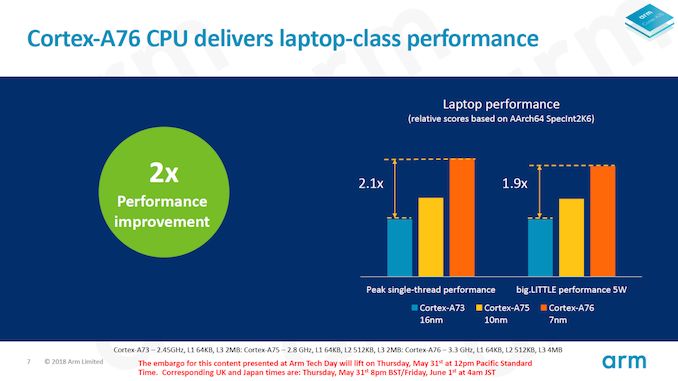
Arm previously stated that the Cortex A76 could reach clock speeds of up to 3GHz, and the performance predictions were based on this frequency. As Anandtech authors wrote in May, a 3GHz frequency is an overly optimistic target, and 2.5GHz is more realistic. Ultimately, the clock frequency of Kirin 980 is 2.6GHz, which aligns more with the author’s expectations.
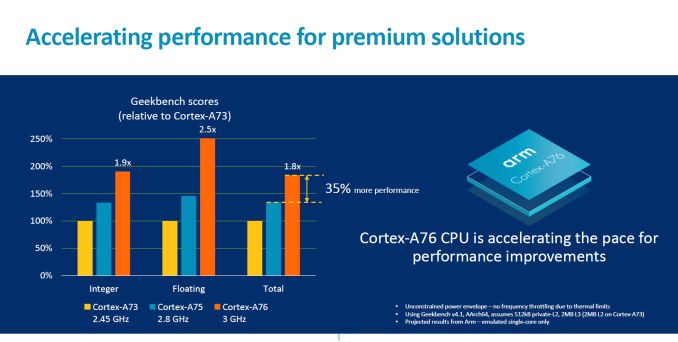
The performance of a 3GHz Cortex A76 is expected to improve integer and floating-point calculations by 1.9 and 2.5 times, respectively, compared to the 2.4GHz Cortex A73 (Qualcomm Snapdragon 835 configuration). If the clock frequency is 2.6GHz, the expected performance improvements are about 1.65 and 2.15 times.
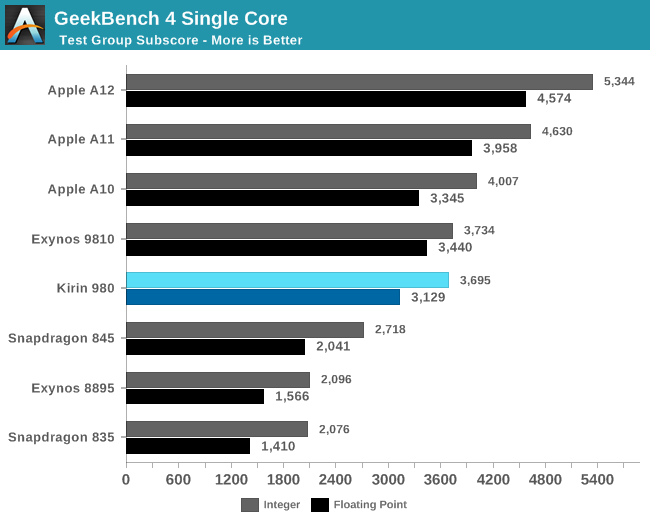
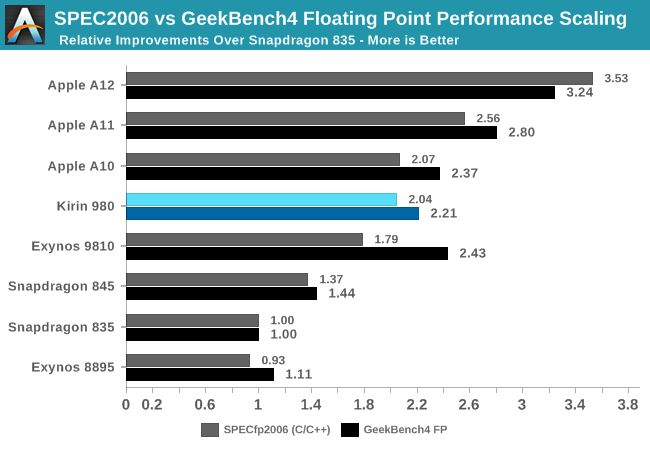
In practice, the Kirin 980 achieved a 1.77 times increase in integer computation scores and exceeded expectations with a 2.21 times increase in floating-point computation scores. The reason for the performance exceeding expectations may be that Arm simulated the operation using a 2MB L3 cache, while the Kirin 980 chip configuration includes a 4MB L3 cache.
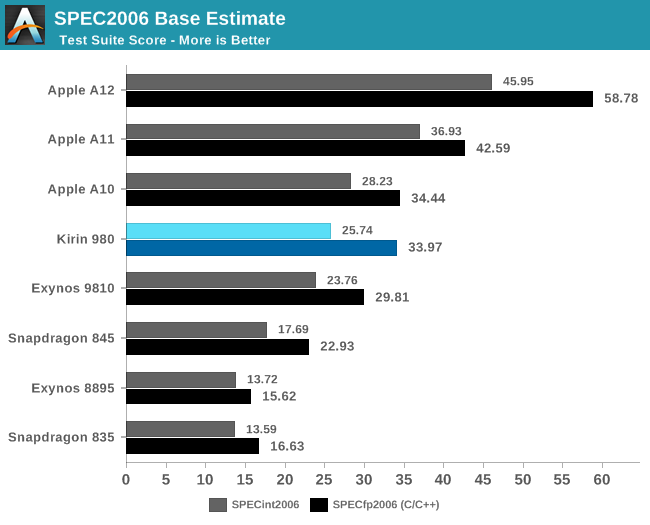
Looking at SPEC2006, it features a series of more complex and powerful workloads that better represent the broader application expectations of users.
Arm is more optimistic about this performance prediction because IPC comparisons and absolute score comparisons have been conducted. Arm claims that in absolute improvements at 3GHz, there is a 2.1 times improvement with “no thermal constraints”, and a 1.9 times improvement within a 5W TDP. The latter figure is quite confusing, as Arm’s marketing is contradictory about what this actually means. The author has long questioned whether the CPU would somehow reach thermal limits on single-threaded SPEC workloads, which would result in poor outcomes.
IPC comparisons are more straightforward, showing an increase of 1.58 times and 1.79 times in integer and floating-point performance compared to Cortex A73, respectively.
In real tests, the Kirin 980 and Cortex A76 provided more, with integer and floating-point scores improving by 1.89 times and 2.04 times. In terms of IPC, the increases for the Kirin 970 based on Cortex A73 and Snapdragon 835 were more significant, at 1.78 times and 1.92 times, respectively. In fact, because the performance of the Kirin 980 is better than expected, it effectively achieved the projected performance of the anticipated 3GHz Cortex A76 (based on Arm’s figures), while actually operating at a clock frequency of just 2.6GHz.
The Memory Subsystem Is Crucial
The memory subsystem in CPUs seems to have been misunderstood for a long time. The bandwidth of the CPU can be very wide, and it can have any number of execution resources, but regardless of how large the microarchitecture is, if the memory subsystem (cache, memory controller) cannot properly deliver data to the device, it doesn’t matter. In recent years, we have seen the same workload increase in mobile as seen on desktop devices over the past few decades, and the pace is accelerating. Mobile applications are becoming larger, more complex, and the data they handle is also growing significantly.
The problem with this change is that if they cannot accurately reproduce the microarchitecture workload characteristics of today’s daily applications, the benchmarking tools we commonly use may become outdated. With the launch of Kirin 980, based on GeekBench 4, I have seen some people get the wrong idea and draw incorrect conclusions about the actual performance of the chipsets.
To explain this, it is necessary to demonstrate the evolution of the latest generation SoCs, all of which relate to fixed starting numbers. Here, I choose Snapdragon 835 because it represents a balanced and popular mobile SoC.
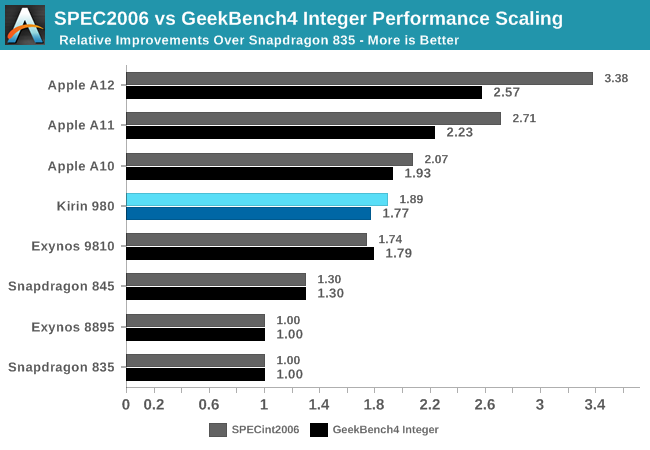
In SPECint2006, the scores seem to differ little from those in GeekBench4, which holds true for most SoCs. The only significant differences come from Apple’s A11 and A12 chips, which demonstrate greater SPEC workload performance than GB4.
Looking at SPECfp2006, aside from the obvious fact that benchmarks in their programs use more floating-point data types, we also see a larger proportion of workloads that place more demands on the memory subsystem, revealing more differences between different SoCs. Apple’s A12 can showcase larger upgrades in SPECfp compared to GB4 FP workloads, and it should be noted that Apple’s new generation processors have made significant improvements in memory subsystem performance. On the contrary, Exynos 9810 performs far below its performance in GeekBench4, again revealing the chipset’s fatal weakness, as this CPU’s memory and cache subsystems lag significantly behind competitors.
What should be noted is that the vast majority of applications used in practice behave more like GeekBench4 than SPEC, especially notable are Apple’s new A12 and Samsung’s Exynos 9810, which are compared at the extremes as shown above. In more representative benchmarks, such as browser JS framework performance tests (Speedometer 2.0), or PCMark 2.0 on Android, we see greater instruction and data pressure than SPEC reflects, multiplied by the differences observed in SPECfp.
There are also some benchmarks that contradict workload characterization, such as Dhrystone or Coremark, which have very little memory usage. Here, most benchmarks fit entirely within the CPU’s lower cache hierarchy, without putting pressure on larger caches or even DRAM. These are still their benchmarks, but they should not be seen as representatives of overall performance in modern applications. AnTuTu’s CPU test falls into this category, as it occupies little space and does not test any part outside the execution engine and first-level cache hierarchy.
The Kirin 980 from HiSilicon and Arm’s Cortex A76 seem to have achieved a great balance in this regard, with performance differences between SPEC and GeekBench4 not being significant.
Top Energy Efficiency, Absolute Performance Still Lags Behind Apple
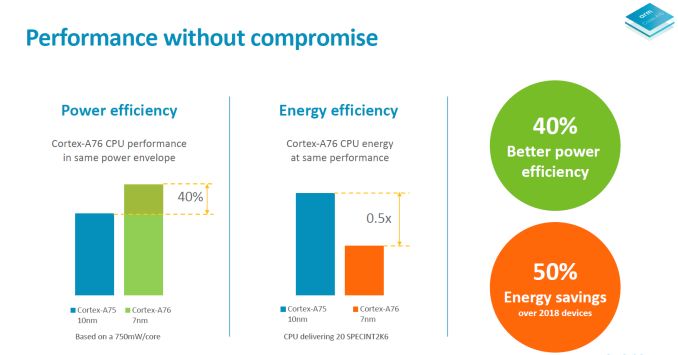
In terms of power and energy efficiency, Arm claims that the Cortex A76’s performance is 40% higher than that of Cortex A75 at the same power usage, and that the Cortex A76 uses only 50% of the power of Cortex A75 for the same performance. Of course, the significance of these two figures is not particularly large, as the process nodes are evolving.
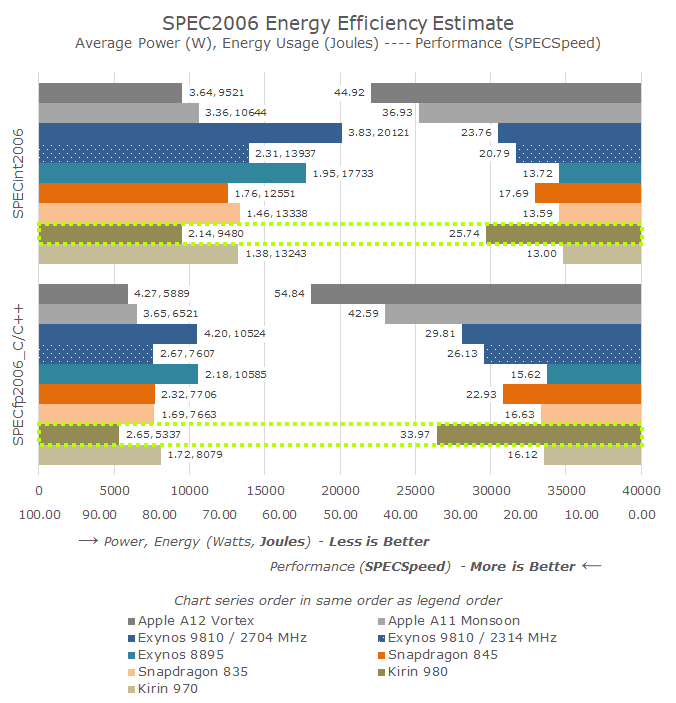
Looking at the SPEC results, they seem to confirm Arm’s claims. As previously mentioned, based on Arm’s data from May, performance and power predictions exceeded expectations. Because Cortex A76 surpassed IPC predictions, it was able to achieve target performance points at frequency points that are more efficient than the estimated 3GHz.
The results are outstanding, with the Kirin 980 outperforming the Snapdragon 845 by 45-48%, while consuming 25-30% less energy to complete the same work. If the clock frequency of Kirin 980 is reduced or the measured energy efficiency of the 1.9GHz A76 is adjusted to match the performance point of Snapdragon 845, it is easy to see that Kirin 980 uses less than half the energy.
One metric that is not entirely surprising for Arm is that the performance of Cortex A76 improves by 40% at the same power. Arm chose an arbitrary point of 750mW for comparison, which may make the statement accurate, but we do not know where this crossover point is and need to measure the frequencies of both chipsets more precisely. In fact, Cortex A76 is a more power-hungry CPU, with single-core active platform power rising by 14-21%.
Here, a comparison can be made with Apple’s latest products, where the energy efficiency of Kirin 980 is slightly higher than that of A12, indicating that the performance per watt of the two SoCs is almost identical. The main difference is that Apple achieves a 61-74% performance advantage, with a linear increase in power consumption of 60-70%.
What It Means for the Next Generation Snapdragon and Exynos 9820
The excellent performance of Kirin 980 bodes well for the upcoming flagship Snapdragon processors, but we expect Qualcomm to be more aggressive with core clock frequencies, slightly higher than Kirin 980’s 2.6GHz. The actual performance in terms of power and efficiency remains to be seen, but theoretically, performance should also be good.
Qualcomm does have one aspect that can become complex, which is the system cache of the SoC. Clearly, Qualcomm is trying to mimic Apple’s further possession of a system-wide cache hierarchy before entering DRAM. For Snapdragon 845, this is a double-edged sword, as memory latency is reduced compared to Snapdragon 835, but this downgrade seems to prevent the Cortex A75 in Snapdragon 845 from realizing its full potential. Hopefully, the impact of the new generation SoCs in this regard will be smaller, and good performance data can be expected.
Samsung officially released Exynos 9820 last week, but the outlook is not optimistic. Exynos 9810 performed poorly in benchmarks, not only due to scheduling issues but also because the microarchitecture seems unbalanced. Kirin 980 was able to exceed the peak performance of Exynos 9810 while consuming less than half the energy. At a more reasonable frequency point of 2.3GHz, the performance gap widens to 23-30%, still showing about a 42%-47% energy efficiency disadvantage compared to Kirin 980.
Samsung claims that Exynos 9820 has a 20% performance increase or a 40% increase in power consumption, with the key word being “or”. Using 2.7GHz as a baseline for comparison, a 20% performance increase may compete with Cortex A76, but the chip’s poor energy efficiency will remain unchanged. Similarly, using the more efficient 2.3GHz results as baseline performance, a 40% efficiency increase would match Kirin 980’s efficiency, but the performance would fall short.
Samsung’s market data is not good enough, based on performance, if the results are so balanced, then the competitiveness of Exynos 9820 is questionable. The only hope is that, just as Apple publicly advertised that A12’s performance is lower than actual performance, S.LSI is underestimating the improvements of Exynos 9820. The only possible scenario is to claim that the performance leap only represents GeekBench4 scores, while the actual improvements in SPEC and more realistic workloads see greater enhancements, narrowing the ratio gap discussed above; hopefully, it is the latter case.
Cortex A76 Is a Very Strong CPU
With the exposure of Deimos and Hercules, Arm promises a 15-20% performance improvement for the next generation CPUs. Arm’s advantage lies in delivering an entire suite of excellent performance across a strong power range. While PPA metrics are not something consumers should care about, Arm is also able to keep CPUs extremely small.
We just saw Arm’s new server core—Ares, which should be the infrastructure for Enyo / A76, and is part of the recently announced Neoverse series CPU cores. Setting up 32 or 64 of these cores on a single chip is not difficult. Overall, we look forward to more exciting products in the coming months, whether in the mobile or infrastructure sectors.
Leifeng Network compiled, via Anandtech
– END –
◆ ◆ ◆
Recommended Reading
Coolpad Sues Smartisan for Unpaid Debts; Musk’s Excitement May Ground SpaceX
Xiaomi Acquires Meitu Phone; China’s Smartphone Market Set for a New Round of Reshuffling
Samsung Phone CEO Admits Crisis; Liu Qiangdong Speaks for the First Time After Controversy

Follow Leifeng Network (leiphone-sz) and reply 2 to join the reader group and make friends