Click the blue text to follow us
The core of projection-based 3D printing (PBP) lies in utilizing spatial light modulators to generate dynamic masks and projecting optical patterns onto the surface of photosensitive materials, achieving selective and precise curing. This technology boasts the highest resolution/manufacturing time ratio (RTM) among all 3D printing techniques. However, in projection-based bioprinting (PBBP) using bioinks as printing materials, the printing resolution is often unsatisfactory, with a significant gap between the actual and theoretical printing resolutions. This is primarily due to the introduction of living cells, which renders traditional manufacturing strategies ineffective, and the stringent requirements for biocompatibility greatly limit the printing resolution.Professor He Yong’s team at Zhejiang University has been dedicated to bioprinting research for over a decade, providing bioprinting system solutions to more than 5,000 laboratories worldwide, covering photocurable bioinks and projection-based bioprinters. Through discussions with numerous peer scientists, we found that differences in background knowledge led to misunderstandings and confusion regarding many basic concepts. For example, “optical resolution” is often mistaken for “printing resolution”; many studies claiming “high-resolution bioprinting” exhibit discrepancies of several orders of magnitude; and the printing resolution of “bioinks” is confused with that of “biomaterial inks”, among other issues.
Due to the lack of a recognized definition of resolution, confusion often arises when describing new methods, undoubtedly hindering the field’s development. Therefore, we believe it is necessary to clarify some fundamental concepts of high-resolution PBBP to help scientists from different backgrounds gain a deeper understanding of its core logic. To this end, Professor He Yong’s team at Zhejiang University systematically summarizes the necessary steps and challenges to achieve high-resolution PBBP, outlining feasible optimization strategies for each technical aspect. They also share some insights on future development trends, hoping to provide core knowledge support for researchers and promote the rapid advancement of PBBP technology in tissue engineering and regenerative medicine.
 On August 27, 2024, the related review article titled“High-resolution projection-based 3D bioprinting”was published in Nature Reviews Bioengineering. PhD student He Chaofan from Zhejiang University is the first author, and Professor He Yong is the corresponding author. The “resolution” of projection-based bioprinting: commercial projection-based 3D printers typically indicate a nominal resolution value (usually between 2-50 μm). This resolution generally refers to the optical resolution, defined as the theoretically achievable highest resolution, which is determined by the size of individual pixels in the projected pattern and the magnification of the projection lens. However, in practical applications, we are more concerned with the actual resolution of the printed structure, defined as the printing resolution, which refers to the smallest distinguishable size in the printed structure. This is influenced not only by the printer’s optical resolution but also by the light-responsive characteristics of the printing materials. Therefore, even with the same printer, the printing resolution may vary significantly. Optical resolution has a clear definition and testing method, while the concept of “distinguishable” smallest size is relatively vague. Thus, the methods for testing printing resolution also differ. Generally, they can be categorized into four types: positive resolution (RP), negative resolution (RN), lateral resolution (RXY), and vertical resolution (RZ). Although they are collectively referred to as “printing resolution,” they each have different meanings and applicable scenarios.
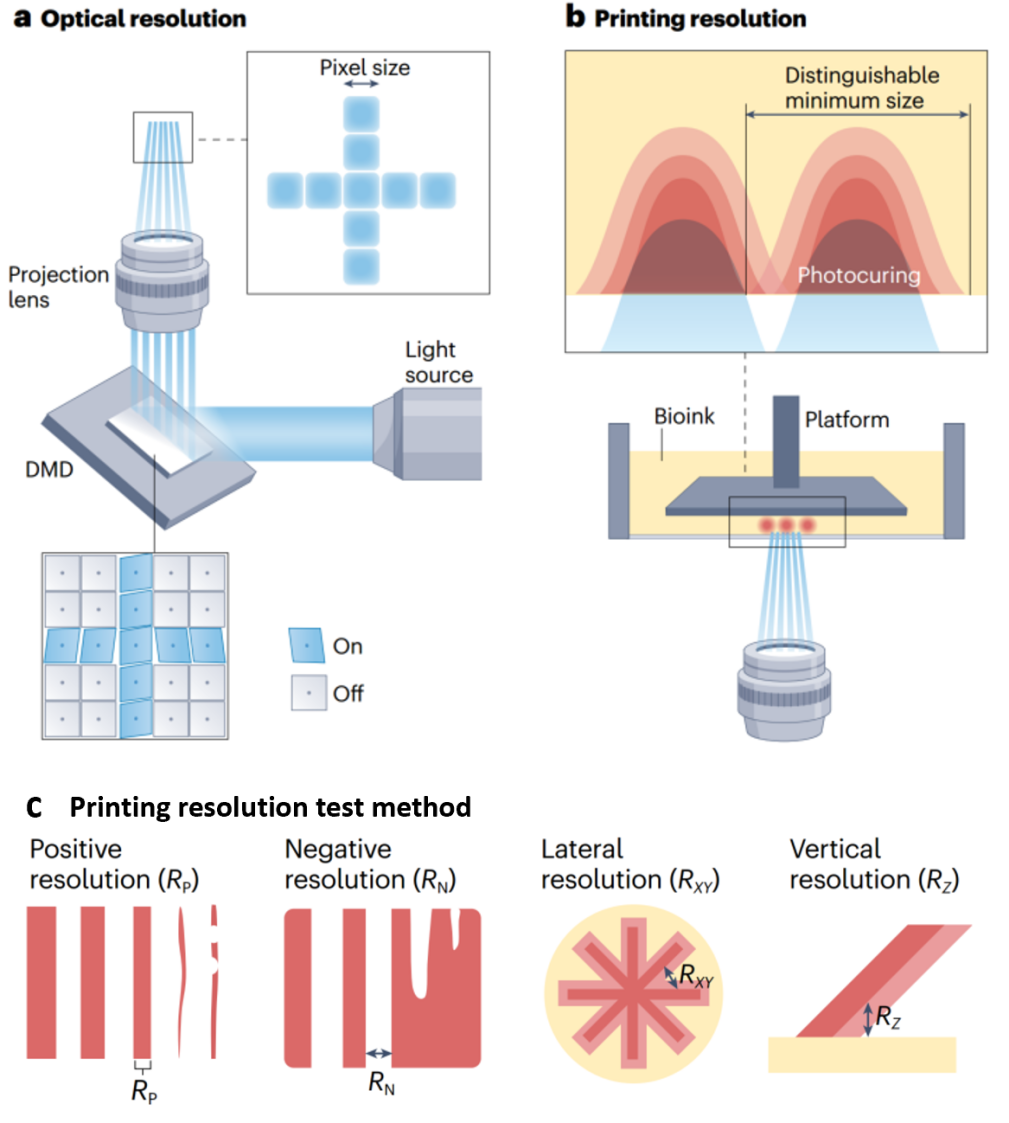 Figure 1. Resolution of projection-based 3D printing“High-resolution” bioprinting: High resolution is a relative and dynamic concept that changes with technological advancements. However, establishing an objective physical metric as a standard is necessary. In the field of bioprinting, a high-resolution standard can be set by analyzing the theoretically achievable maximum printing resolution and appropriately relaxing it (usually five to ten times the theoretical limit). Considering that accurate and reasonable definitions are crucial to avoid ambiguity and ensure the accuracy and reproducibility of research, we define:For bioprinting using bioinks containing living cells, a printing resolution of50μmis defined as high-resolution printing. For biomaterial inks (where the printed material serves as a scaffold for subsequent cell seeding), a printing resolution of10μmis defined as high-resolution printing.This is also consistent with many current studies.Strategies for High-Resolution Projection-Based Bioprinting:The printing resolution of traditional PBP using resin can be very close to the optical resolution (printing resolution can reach 2-3 times the optical resolution), while the printing resolution of PBBP using bioinks/biomaterial inks is far below the theoretical value (printing resolution is usually several times the optical resolution). Therefore, bioprinting requires comprehensive system optimization, rather than merely improving a single step. To promote the development of high-resolution PBBP technology, we summarize the three key steps needed to achieve this goal and provide comprehensive guidance for improving printing resolution by constructing an optimization roadmap.
Constructing Precise Light Fields
In PBP technology, a core aspect of improving printing resolution is constructing a controllable projection light field. This process relies on printing software to accurately slice the designed 3D model into a series of two-dimensional images. Subsequently, these images are projected through a complex optical system, typically composed of a light source, a uniform lens group, a digital micromirror device (DMD), and a projection lens. The light emitted from the light source first passes through the uniform lens group and then illuminates the DMD. Each micromirror in the DMD reflects light according to the preset sliced images, and after the scaling effect of the projection lens, a projected light field is formed. It is important to note that each step in this series directly impacts the optical resolution. Whether PBBP or PBP, the upper limit of printing resolution is constrained by optical resolution.
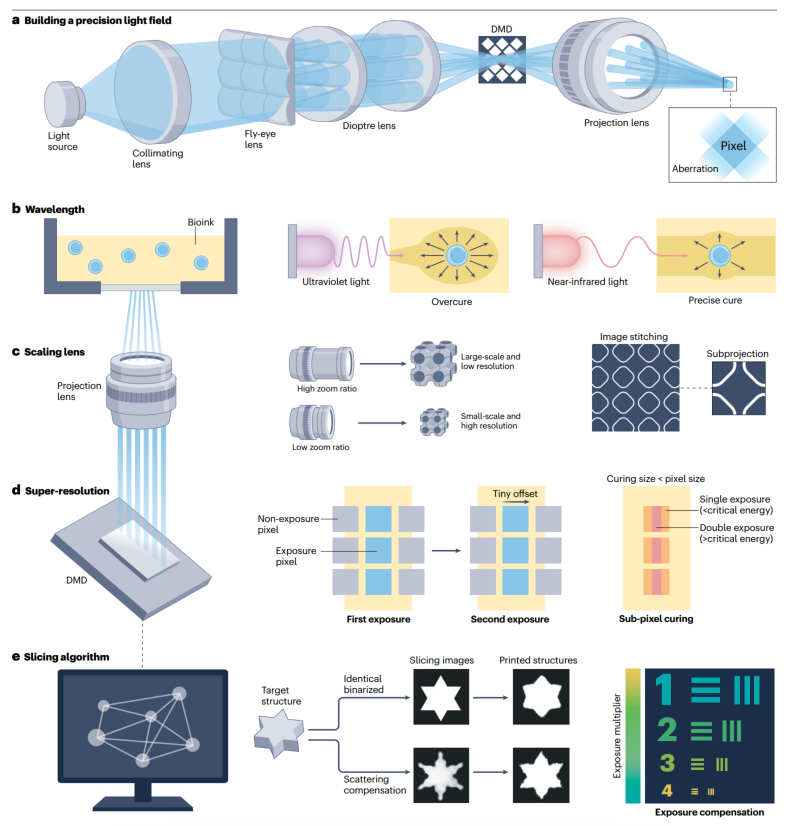 Figure 2. Constructing precise light fields
Ink Accurate Response
The second step to improve printing resolution is to ensure that bioinks can accurately respond to the light field. To achieve this, it is particularly important to enhance their light-responsive characteristics while maintaining the biological properties of the bioinks. Ideal bioinks should possess a high light crosslinking rate, appropriate crosslink density, and good flowability. Additionally, to ensure biocompatibility, the chemical additives in bioinks should be minimized. Therefore, bio (material) inks typically contain only biocompatible materials, photoinitiators, light absorbers, bioactive components, and possible cellular components.
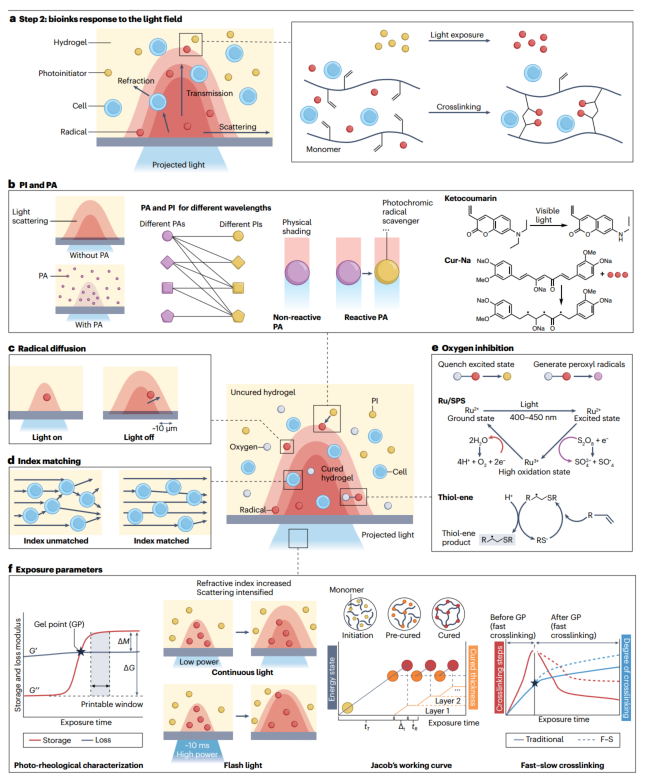 Figure 3. Ink accurate response
Maintaining Mechanical Balance
The final step to achieve high-resolution PBBP is to maintain mechanical balance during the printing process. This step is crucial because bioinks are typically ultra-soft materials (Young’s modulus below 103 Pa). Due to significant mechanical property differences between bioinks and traditional materials, careful operation is required during the printing process to maintain mechanical balance; otherwise, it is easy to cause fracture and deformation of the printed structure, which is a unique challenge of PBBP.
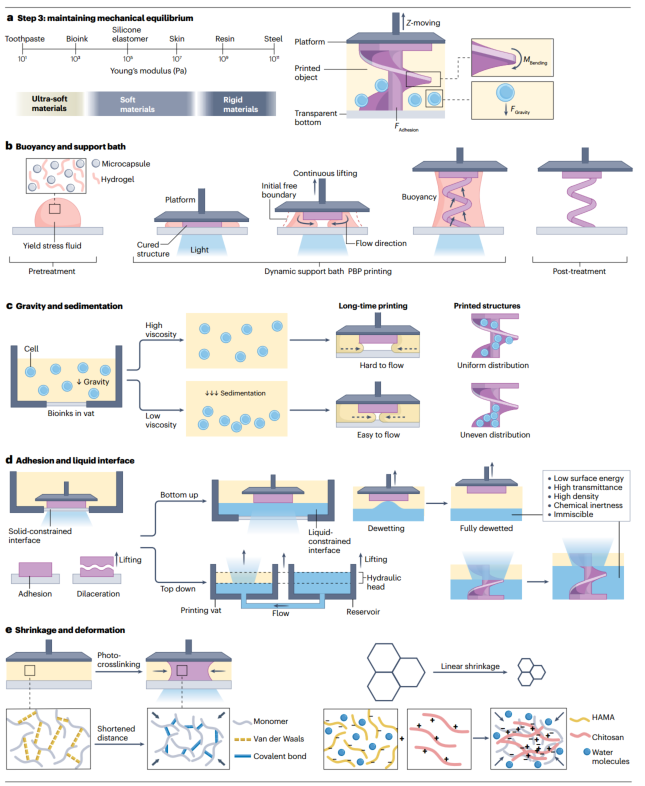 Figure 4. Maintaining mechanical balanceProfessor He Yong’s team has been engaged in biomanufacturing research for decades, covering ink formation theory, printing processes, printing equipment, and applications. Representative works in the last two years include:(1) Revealed the forming mechanism of photocurable bioinks, defining four precise evaluation metrics for the forming state of bioinks, including average reaction steps (Advanced Functional Materials, 2023), established naming conventions and standards for photocurable bioink GelMA (Advanced Healthcare Materials, 2023), and provided guidelines for high-precision photocurable bioprinting (Nature Review Bioengineering, 2024). Collaborated with Professor Li Wenyuan’s team to reveal the mechanism of controlled mechanical stress driving cell behavior and inducing the formation of sensory epithelium in the auditory nerve (Science Advances, 2023).(2) Proposed an in-situ 3D printing method based on the concept of “bioconcrete,” capable of rapid printing and wound repair in extreme environments such as disaster sites and battlefields (Nature Communications, 2022); proposed a new method for minimally invasive implantation of retractable scaffolds aimed at effective regeneration under minimally invasive surgery, providing new solutions for soft tissue repair (Nature Communications, 2024), and achieved effective controlled release of drugs in humid environments through the design of novel microneedles mimicking the structure of blue-ringed octopuses (Science Advances, 2023). Proposed a method for 3D printing self-adhesive stem cell scaffolds, developing efficient carrier tools for cell therapy (Advanced Science, 2023).(3) In organ reconstruction research, collaborated with Professor Chen Chang’s team to achieve long-segment active trachea reconstruction, proving that engineered organs can be transplanted and survive long-term (Science Translational Medicine, 2023).
Original Link
https://www.nature.com/articles/s44222-024-00218-w
Related Progress
Li Wenyuan/Li Huawei/He Yong team collaboration Sci. Adv.: Revealing a new mechanism of mechanical stress regulation of auditory sensory epithelium formation.
Professor He Yong from Zhejiang University and Associate Professor Shao Huifeng from Hangzhou Dianzi University in “Nano Energy”: Printable multifunctional conductive slime inspired by sesame candy.
Professor He Yong’s team at Zhejiang University in “Nat. Commun.”: In-situ bioprinting and its “bioconcrete” ink.
Professor Xu Jie from Harbin Institute of Technology and Professor He Yong from Zhejiang University collaborate in “Mater. Horiz.”: Implantable, in-situ monitored biohydrogel flexible electronics.
Professor He Yong’s team at Zhejiang University in “Mater. Horiz.”: In-situ printable conductive nanoclay/liquid metal-based flexible electronics.
Professor He Yong’s team at Zhejiang University in “Adv. Funct. Mater.”: All-printed manufacturing of flexible electronics using liquid metal-silicone ink.
Professor He Yong’s team at Zhejiang University: 3D printing to construct a complete vascular network and preliminary exploration of tumor-vascular interactions.
Professor He Yong’s team at Zhejiang University in ACS AMI: A universal method for 3D printing multi-material high-elasticity silicone.
Professor He Yong’s team at Zhejiang University: Hydrogel three-dimensional microfluidic chips and vascular chips constructed on them.
Professor He Yong’s team at Zhejiang University used micro-airflow to print 3D bioactive microstructures.
Disclaimer: Some materials may originate from the internet, and the purpose of reprinting is to convey more information and share, which does not imply endorsement of its views or verification of its authenticity, nor does it constitute other advice. It only provides a communication platform and is not responsible for copyright. If infringement is involved, please contact us for timely modification or deletion. Original articles are welcome for personal forwarding and sharing; for publications or media, please contact us for reprint permissions. Contact email: [email protected]

Scan the QR code | Follow us
WeChat ID: Chem-MSE
Call for Papers
Experts and scholars are welcome to submit manuscripts related to chemistry, chemical engineering, materials science and engineering, and biomedical engineering to [email protected], and please specify detailed contact information. The Chemical and Materials Science Society will promptly select and push them.