
On October 18, Xinch Technology successfully concluded the “Xinch Technology Automotive Chip Series Public Class · Automotive MCU Special Session” held by Zhixiaodong. The market director of Xinch Technology, He Xupeng, delivered a live presentation titled “Innovation and Application of Domestic Automotive MCUs Amid Chip Shortage”.
Mr. He Xupeng first discussed the opportunities and challenges of domestic alternatives for MCUs amid the chip shortage. He then provided an in-depth interpretation of the Xinch Technology E3 series automotive MCUs, covering key technologies, software development toolchains, reference designs, as well as applications in ADAS and Battery Management Systems (BMS).
This special session is divided into three parts and will cover the following five aspects:
Opportunities and Challenges for Domestic Alternatives to MCUs Amid Chip Shortage
Introduction to Xinch Technology E3 Series Automotive MCUs
Key Technologies of Xinch Technology E3 Series Automotive MCUs
Toolchain and Reference Design for E3 Series MCUs
Introduction to ADAS and BMS Application Solutions Based on E3
The content of this episode includes:
Opportunities and Challenges for Domestic Alternatives to MCUs Amid Chip Shortage
Introduction to Xinch Technology E3 Series Automotive MCUs
Opportunities and Challenges for Domestic Alternatives to MCUs
Amid Chip Shortage
In the past 1-2 years, the entire automotive electronics industry, especially automotive MCUs, has faced a severe shortage situation. During this period, many OEMs and Tier 1 suppliers began to seek supply security. Since its launch in April 2022, a significant portion of projects involving the Xinch E3 has focused on supply security and domestic alternatives.
In this process, we have seen opportunities for traditional ECU replacements. However, for Xinch’s products, there are often more opportunities, such as with the centralized development of automotive electronic and electrical architectures, where previously overlooked application opportunities are gradually emerging, including domain controllers that are not limited to autonomous driving domain controllers, chassis domain controllers, or body domain controllers. The upcoming content will also highlight the characteristics of Xinch products and some key technical points that match application needs.
Regarding challenges, Xinch Technology’s MCUs face many challenges in automotive applications, including but not limited to supply, quality, functional safety, and a certain degree of high-end substitution.
First, from a supply perspective, Xinch Technology has maintained a relatively good status. Currently, Xinch can offer customers a delivery time of 14 weeks, which is optimistic given the backdrop of shortages.
The second aspect is quality. The products Xinch currently manufactures are automotive-grade products, and all automotive-grade products undergo strict testing, represented by AEC-Q100, to ensure product safety and stability.
Functional safety is a very important aspect and is also one of the characteristics of Xinch MCUs. Before the E3 project, Xinch had already obtained ISO 26262 ASIL D functional safety system certification. This certification ensures that Xinch products meet functional safety requirements from the outset. By mid-year, E3 products had passed TÜV Rheinland’s functional safety concept certification. The final fortress being tackled is the SEooC ASIL D product certification, expected to be completed by mid-next year.
The last point is high-end substitution. Xinch products and specifications are on par with international advanced products in terms of computing power, storage, interfaces, etc., which can meet some high-end substitution needs.
Xinch Technology E3 Series
Automotive MCUs and Key Technologies
Here, we introduce the Xinch Technology E3 series automotive MCU product family and key technological characteristics. Key technological features mainly include computation, related peripherals, storage, functional safety, information security, and other modules.
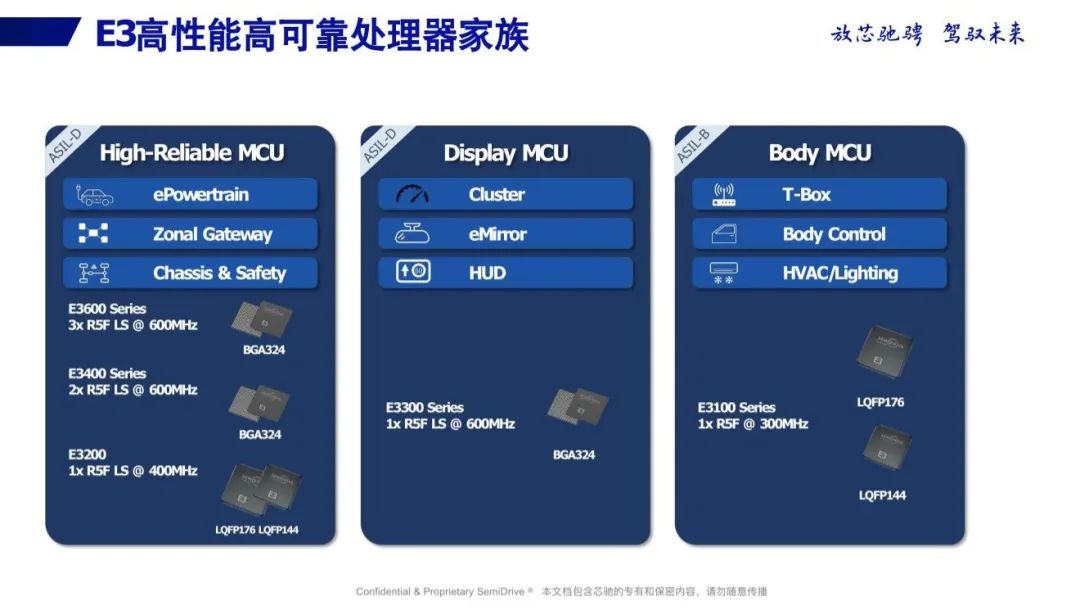
First is the introduction of the E3 product family. The above image categorizes the entire E3 product line, with each blue box representing a sub-series, each with different characteristics.
The leftmost series is the High Reliability Series. Its main features can be summarized as follows: first, the functional safety level is very high, and the entire product is planned to achieve ASIL D level certification; at the same time, the automotive temperature grade is also relatively high, reaching Automotive Grade 1. In automobiles, except for engine controllers or transmission controllers that require Grade 0 ECUs, our products can fully cover other applications. Second, this series of products has relatively high computing power, supporting up to 6 physical ARM cores, running up to 600MHz, with future products expected to reach 800MHz. For these high-reliability products, we provide different models from LQFP144, LQFP176 to BGA324 packages, each with different main frequencies and core counts, as well as varying peripheral configurations.
Next, we introduce the applications targeted by this series of products. The first category is electric powertrains, where the core components of new energy vehicles include VCU, EMS, and main drive motors. The second category involves area controller gateway applications, with an increasing number of body controls integrated with gateways to form area controller gateway applications. Different automotive forms may vary; some use four area controllers to complete the entire body control, while others may divide the left and right body. The third category is a chassis controller, as Xinch has LQFP packaged ASIL D products that can achieve high functional safety application designs with relatively few PCB layers or small chip areas, focusing on popular steer-by-wire chassis applications.
The middle category is display MCUs. This category has three main target applications: LCD dashboards, electronic rearview mirrors, and heads-up display controllers. For these applications, we have launched the E3300 series, which will be introduced later, including its chip block diagram, as well as some multimedia-related peripherals and special hardware engines. The 2D LCD dashboard developed by Xinch can achieve relatively high specifications.
The rightmost category is body control MCUs. This is an ASIL B level product series, which generally has lower temperature requirements as these applications do not have high temperature demands. Its applications are relatively broader, including but not limited to T-Box, body controllers, air conditioning controllers, and lighting. At the same time, we use a single-core R5F as the core, which can provide strong computing power, supporting both LQFP144 and LQFP176 packages to meet the packaging needs of different controllers.
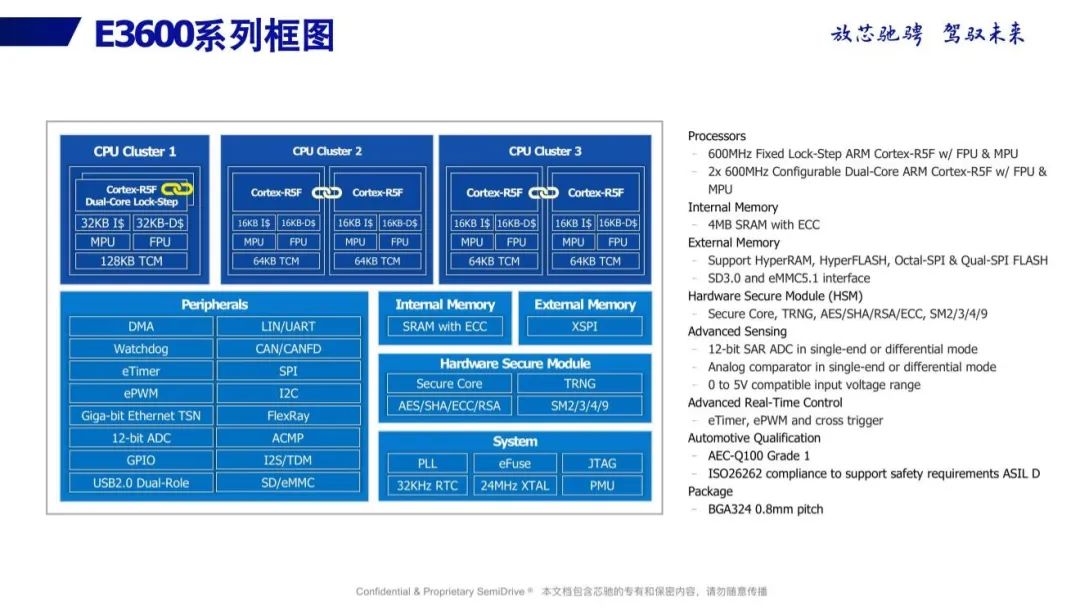
The above image is the block diagram of the E3600 series. Next, using the E3600 series as an example, I will briefly introduce its features. First, the deep blue part represents the computing core, which is a crucial aspect of Xinch. The E3600 series is a 32-bit CPU, and this ARM CPU has ASIL D functional safety certification, making it very suitable for high functional safety MCUs.
At the same time, the core shows deep yellow and light yellow locks. This indicates that the MCU can be configured for lock-step and separate operation. During lock-step operation, the diagnostic coverage of the entire CPU will be very high, suitable for meeting high functional safety specification applications. In separate operation, more independently programmable cores can be obtained, thereby increasing the overall chip computing power. This is a relatively flexible design, as many ECUs contain both functional safety computing power and non-functional safety computing power.
Additionally, the storage is protected by MPU storage protection, with each core having its own access boundaries for storage and registers, preventing interference from one another, protected by hardware. At the same time, it has an FPU to directly support hardware floating points. The CPU is configured with I-Cache and D-Cache. This is a significant difference from traditional MCUs without cache, ensuring that the high-performance core can fully utilize its performance.
After discussing the core part, let’s look at the storage. The storage includes both on-chip and off-chip storage, with a relatively large SRAM on-chip. Currently, the E3600 series has a maximum of 4MB SRAM, which also features ECC protection. At the same time, there is external storage that can expand Flash and RAM.
Next is an information security module. The information security module is quite important for MCUs, and we will also have it undergo some information security certifications, including national secret level two, etc. Currently, all E3600 series products are equipped with information security modules to meet various application information security needs.
Next, there will be a system management module, which includes a built-in clock. The main domain has a 24MHz clock, and there is a low-power domain called RTC with a 32KHz clock. The clock can be provided externally or directly by the internal RC circuit. Additionally, there is an eFuse, which is crucial for information security encryption for OTA, etc. Furthermore, there are JTAG and SWD interfaces, allowing us to debug using conventional debuggers like J-LINK.
Finally, there is a PMU, which includes DCDC and LDO controllers. Without specific functional safety requirements, the MCU only requires a 3.3V power supply. For core power supply, it is provided by the DCDC and LDO on the internal PMU, and the PMU also facilitates connection to external PMIC for functional safety power design.
In the peripheral section, the left bottom of the image lists some key points, including DMA, which is an important channel for improving performance. Internally, there are multiple watchdog timers to ensure the safe operation of each core. Although internally, this watchdog is a hardware watchdog that can meet ASIL D system design.
Next are two real-time control peripherals, including eTimer and ePWM. eTimer can capture digital signals and perform soft decoding of digital signals, such as SENT signals and quadrature encoded signals, and even implement some digital logic functions; ePWM is generally used for complex waveform output.
In the communication peripheral section, we can see Gigabit Ethernet TSN; the E3600 series is also equipped with two Gigabit Ethernet ports, making the configuration quite luxurious. At the same time, TSN is increasingly used in many automotive applications. Others include FlexRay, SPI, etc., with flexible and diverse interfaces.
CAN/CANFD supports up to 24 channels, while LIN/UART supports 16 channels. For domain controllers with many sensor and actuator nodes, such peripheral configurations are more than sufficient. Additionally, there are real-time control related peripherals like ADC and analog comparators. Through the above introduction, we can initially see what the main functional modules inside the chip are.
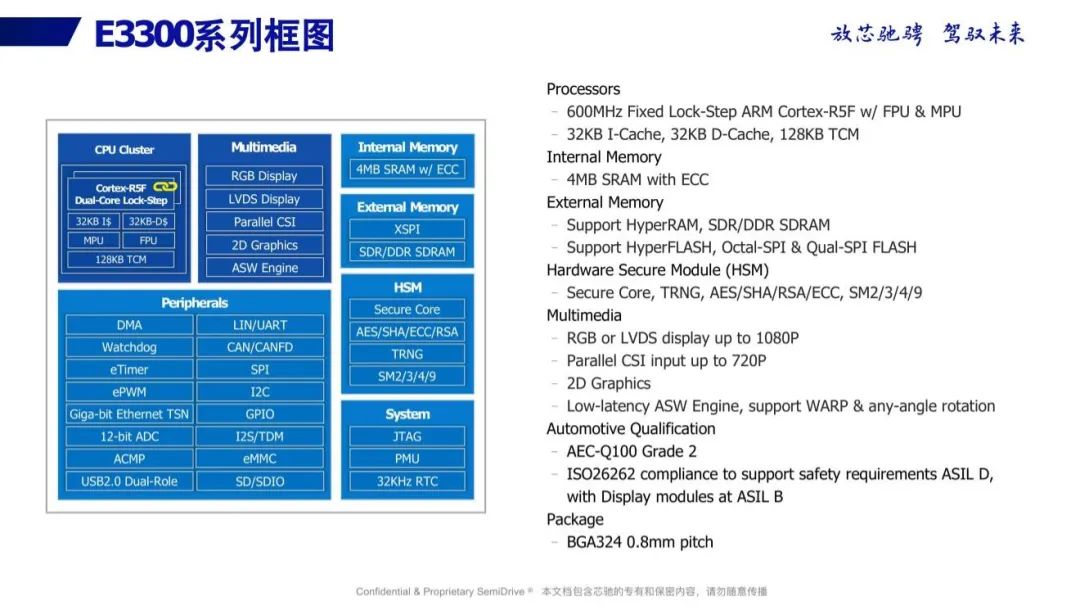
The next product is the display MCU. This section mainly introduces the hardware differences from the E3600 series, focusing on media function modules. It first has an RGB interface that supports RGB888 for video input and output; at the same time, it is equipped with an LVDS interface, and Xinch’s dashboard demos are all implemented through the LVDS interface. The chip has a parallel CSI interface that supports 720P video input, and when the chip is used for electronic rearview mirrors, HUDs, or dashboards, video input may be required through the parallel CSI interface. The E3300 features Xinch’s self-developed 2D GPU for rendering functions, which is quite important for dashboard and HUD applications. Additionally, there is a hardware distortion engine (ASW), which is crucial for achieving high-performance dashboard UIs or for correcting image distortion in HUDs and electronic rearview mirrors.
The external storage interface of the E3300 series will also differ; this series can support SDR and DDR storage, with a maximum bandwidth of 400 megabytes per second, allowing for larger image buffers and more complex dashboard UI effects. This product is AEC-Q100 Grade 2, as it does not have very high temperature requirements and comes in a BGA324 package with relatively rich IO resources.
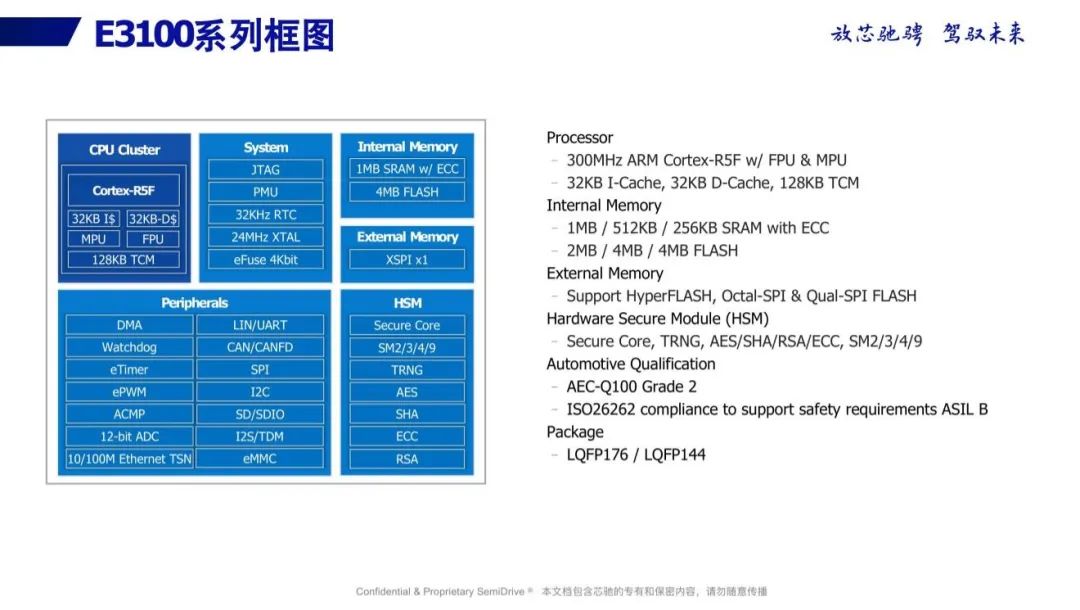
The last series is the body E3100 series. In terms of the core, it is a single-core Cortex-R5F, not a lock-step operation, which differs from the previous series. Generally, this type of application does not have high functional level requirements and does not require a lock-step core. At the same time, this series is configured with Flash memory ranging from 1MB to 4MB to meet the program and data storage needs of related applications. More detailed information on this series of products can be found in the selection table on the right of the above image, which is generally aimed at general-purpose MCUs for body applications.
—END—