
1. Nature of the Problem: The Fatal Impact of Disconnections on IoT Systems
The 4G module, as the “nervous system” of IoT devices, directly determines the reliability of the data link. According to industry statistics (2024 GSMA report), 30% of IoT device failures stem from communication module anomalies, with frequent disconnections ranking first. The consequences spread in a chain reaction:
- Data Gaps: Continuous monitoring interruptions of industrial sensors lead to failures in predictive maintenance, with error rates increasing by over 40%;
- Control Failures: Loss of remote commands causes misoperations in smart meters and even delays in emergency braking in vehicle networks;
- Cost Increases: Each device incurs an additional power consumption of about 2.3 kWh per month due to abnormal reconnections, leading to skyrocketing operational costs after large-scale deployment.
❝
Case Evidence: A smart agriculture project experienced an average of 12 disconnections per day in its 4G module, resulting in misjudgment of soil moisture in the irrigation system, causing a 17% reduction in yield across a thousand acres of farmland.
2. Root Cause Analysis: The Interplay of Multiple Factors
The frequent disconnections of 4G modules are not caused by a single factor but are the result of the interplay between hardware design, network environment, and software configuration. Based on failure attribution analysis of over 500 industrial IoT projects, the three major categories of issues account for 45%, 35%, and 20%, forming a typical “failure triangle.”
(1) Hardware Design Defects – 45% of Failures
Hardware is the physical foundation of communication stability; any design oversight can become the system’s “Achilles’ heel.”
| Defect Type | Specific Manifestation | Example Consequence |
|---|---|---|
| Power Disturbance | Voltage fluctuations > ±10% (e.g., vehicle equipment start/stop) | Module forced to reset due to under-voltage/over-voltage |
| Antenna Mismatch | Impedance deviating from 50Ω or insufficient gain | Signal attenuation > 20dB, decreased receiving sensitivity |
| Thermal Stress Accumulation | Operating temperature > 85℃ without heat dissipation | Baseband chip overheating triggers protective shutdown |
Power disturbances are the most common hardware issues in industrial settings. Many devices use switch-mode power supplies or draw directly from industrial buses, leading to severe voltage fluctuations. 4G modules have very high stability requirements for power supply, with typical operating voltage between 3.3V and 4.2V. If the input voltage fluctuates beyond ±10%, the internal LDO (Low Dropout Regulator) of the module may fail to operate normally, causing the module to restart or freeze. For example, a remote monitoring device for construction machinery experienced a voltage drop to 2.8V at the moment of engine start, causing the 4G module to repeatedly reset and fail to upload data.
Poor antenna system design can also be fatal. Antenna impedance mismatch (e.g., failing to match 50Ω) can lead to signal reflection, severely weakening transmission power. In enclosed environments such as metal cabinets or underground wells, signal attenuation can reach 30-50dB, drastically reducing module receiving sensitivity. Additionally, insufficient antenna gain or incomplete frequency band coverage (e.g., only supporting FDD-LTE while ignoring TDD) can lead to instability in specific operator networks.
Thermal stress is an invisible killer during long-term operation. The 4G module can consume over 2W during data transmission, and if the device is sealed without heat dissipation design, the internal temperature can quickly rise above 85℃, triggering the chip’s overheating protection mechanism. In a smart streetlight project, the module was enclosed in an aluminum lamp post, and under direct sunlight in summer, the internal temperature exceeded 90℃, causing the module to restart an average of 8 times a day, severely affecting lighting control.
(2) Dynamic Network Environment – 35% of Failures
The deployment environment of IoT devices is complex and variable, and the dynamic nature of network signals is another major cause of disconnections.
-
Signal Blind Spots and Interference: In scenarios such as underground garages, tunnels, and metal workshops, signal penetration loss is significant. Additionally, electromagnetic interference (EMI) from industrial equipment such as inverters, motors, and high-voltage cables can severely impact 4G signal quality. Tests show that a 5.5kW inverter can cause a drop of over 15dB in RSRP (Reference Signal Received Power) within a 10-meter range.
-
Base Station Handover Delays: For mobile devices (e.g., logistics trackers, vehicle network terminals), handover between base stations is common. According to the 3GPP TS 36.331 standard, the ideal handover delay should be less than 100ms, but in actual networks, due to improper neighboring configurations or excessive load, the handover failure rate can exceed 15%, leading to brief disconnections.
-
Operator Policy Restrictions: To optimize network resources, some operators may forcibly disconnect TCP connections with no data flow for extended periods (usually 30 minutes). If the device does not set a heartbeat packet or has a heartbeat interval that is too long, it can easily be “kicked offline,” with reconnection times reaching several seconds.
(3) Software Configuration Errors – 20% of Failures
Software is the “brain” connecting hardware and networks; improper configuration amplifies the vulnerabilities of both hardware and networks.
# Typical Misconfiguration: AT Command Timeout and Reconnection Logic Flaw
def send_at_command(cmd, timeout=3):
    try:
        response = serial_port.write(cmd, timeout)  # Timeout threshold too low, prone to misjudgment
    except TimeoutError:
        reboot_module()  # Direct hard reboot, exacerbating hardware wear

# Correct Approach: Use exponential backoff reconnection algorithm to avoid avalanche effect
def smart_reconnect(attempts):
    wait_time = min(2 ** attempts, 60)  # Dynamic wait, max 60 seconds
    time.sleep(wait_time)
    init_network_connection()
Common errors include: setting AT command timeout too short (e.g., 3 seconds), misjudging failures in weak signal conditions; overly simplistic reconnection strategies (immediate restart), leading to frequent module restarts and reduced lifespan; failing to enable APN (Access Point Name) automatic switching or multi-network registration features, lacking fault tolerance.
3. Industrial Solutions: Comprehensive Reinforcement from Design to Operation
To fundamentally address the disconnection issues of 4G modules, it is essential to build an industrial-grade protection system that integrates “hardware-network-software.”
(1) Hardware Layer – Triple Protection for Durability Design
-
Power Purification Circuit
- Use TVS diodes (e.g., SMBJ5.0A) to absorb transient surge currents, protecting the module from voltage spikes;
- Pair with a 470μF low ESR tantalum capacitor to smooth voltage fluctuations, ensuring stable operation of the module during power supply variations;
- Integrate PMIC (Power Management IC) such as TI BQ25703A, supporting wide voltage input of 9-36V, and featuring dynamic voltage scaling (DVS) to adapt to complex power supply environments.
Antenna System Optimization
- Prioritize high-gain PCB snake antennas (≥3dBi) or external ceramic antennas to ensure frequency band coverage for LTE Cat1/CatM1;
- Use a vector network analyzer (VNA) to debug Smith charts, optimize impedance matching, and ensure return loss < -10dB (i.e., over 90% of energy is effectively radiated);
- In devices with metal enclosures, use external antennas and lead them out through feed lines to avoid signal shielding.
Thermal Management Strategy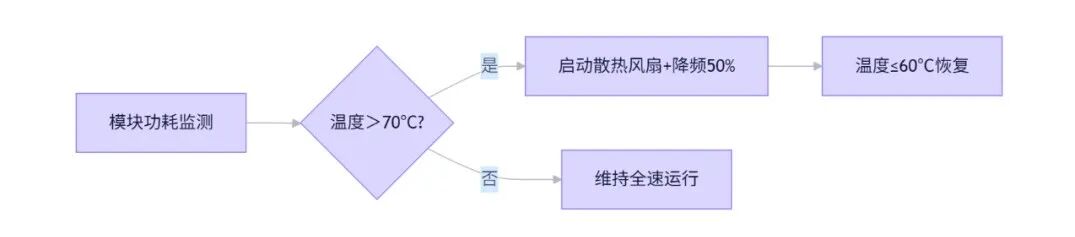
Real-time monitoring of module temperature using temperature sensors, activating active cooling (e.g., fans) when exceeding 70℃, and reducing module transmission power to avoid overheating shutdown.
(2) Network Layer – Intelligent Connection Management Engine
-
Dual SIM Redundancy: Use modules that support dual SIM standby (e.g., Quectel BG77), automatically switching to a backup operator network within 5 seconds when the primary card signal is weak or disconnected, enhancing connection availability.
-
Signal Quality Awareness: Built-in monitoring of RSRP and SINR (Signal Interference Noise Ratio), actively reporting warnings when RSRP < -110dBm, triggering device-side optimization strategies (e.g., reducing reporting frequency, switching APN).
-
Heartbeat Packet Optimization: Implement a dual mechanism of “TCP Keep-Alive + application layer heartbeat,” dynamically adjusting heartbeat intervals based on signal quality (300s when strong, 15s when weak), avoiding disconnections by operators while saving data.
(3) Software Layer – Adaptive Fault Recovery Framework
-
Hierarchical Reconnection Strategy
- First disconnection: reconnect immediately (< 2s);
- Continuous failures: enable exponential backoff algorithm (max interval 120s) to avoid network congestion;
- More than 3 failures: switch APN or fall back to 2G network to ensure basic communication capability.
OTA Remote Diagnosis and Repair
# Pseudo code: Fault reporting system based on MQTT
def report_failure(reason_code):
    payload = {
        "device_id": DEVICE_UID,
        "error": reason_code,        # 1=weak signal 2=authentication failure 3=hardware error
        "cell_id": get_current_cellid(),  # Locate the faulty base station
        "rsrp": get_rsrp(),
        "uptime": get_uptime()
    }
    mqtt_client.publish("diag/4g_status", json.dumps(payload))
Real-time analysis of fault data through cloud platforms enables remote diagnosis, configuration updates, and firmware upgrades, significantly reducing on-site operational costs.
4. Future Outlook: The Evolution of 5G RedCap and LPWAN Integration
With the advancement of the 3GPP Release 18 standard, 5G RedCap (Reduced Capability) technology is set to enter commercial use in 2026, providing a new option for mid-speed IoT. RedCap modules maintain the low latency and high reliability advantages of 5G while significantly reducing power consumption and costs, with power consumption expected to be 40% of that of 4G modules, and battery life extended to 10 years.
Moreover, 5G NR-U (Unlicensed Spectrum) technology will effectively avoid co-frequency interference, enhancing communication stability in complex electromagnetic environments, with a projected 60% reduction in disconnection rates. Additionally, terminal-side AI models (e.g., Qualcomm’s AI-Enhanced Modem) can learn from historical signal data to predict signal degradation trends, proactively switching networks or adjusting transmission power with over 92% accuracy.
Furthermore, LPWAN (Low Power Wide Area Network) technologies such as NB-IoT and LoRaWAN, when integrated with 4G/5G, will form a complementary network architecture of “high reliability + low power consumption” to meet the needs of various scenarios.
Conclusion: Stability is the Cornerstone of IoT
The disconnections of 4G modules are not isolated technical failures but a comprehensive reflection of the collaborative failure of hardware design, environmental adaptation, and software strategies. Only through a triad of hardware reinforcement in power, antenna, and thermal management, network optimization with dual SIM redundancy and intelligent heartbeat, and software frameworks with hierarchical reconnection and remote diagnosis can the device online rate be improved to over 99.8%.
❝
Data Facts: A smart streetlight project that adopted the above comprehensive optimization scheme reduced module downtime from 53 hours to 1.2 hours annually, with operational costs decreasing by 76% (2024 Huawei IoT Case Library).
 Recommended Reading:The Revolutionary Protection of Intelligent Driving Induction SystemsHow Sound Field + Quick Intervention Systems Mitigate 40% of Merging Conflict RisksIntelligent Perception Sound Field Warning System: Reshaping Road Safety with Scenario-Based SolutionsDirectional Sound Waves Penetrate Car Windows! Unveiling the “Strong Reminder” Black Technology of Highway Warning DevicesHow DeepSeek Reshapes Smart Transportation in China? Unveiling AI Implementation Practices in Various Provincial Transportation DepartmentsApplication Scenarios and Typical Case Compilation of Low Altitude Economy in Emergency Management (Part 1)Comprehensive Interpretation of the “Highway Maintenance Technical Standards” (JTG 5110—2023)Smart Highway Renovation: How Traditional Equipment Upgrades to Intelligent “Seamless”?Technical Challenges Facing Low Altitude Economy on Highways