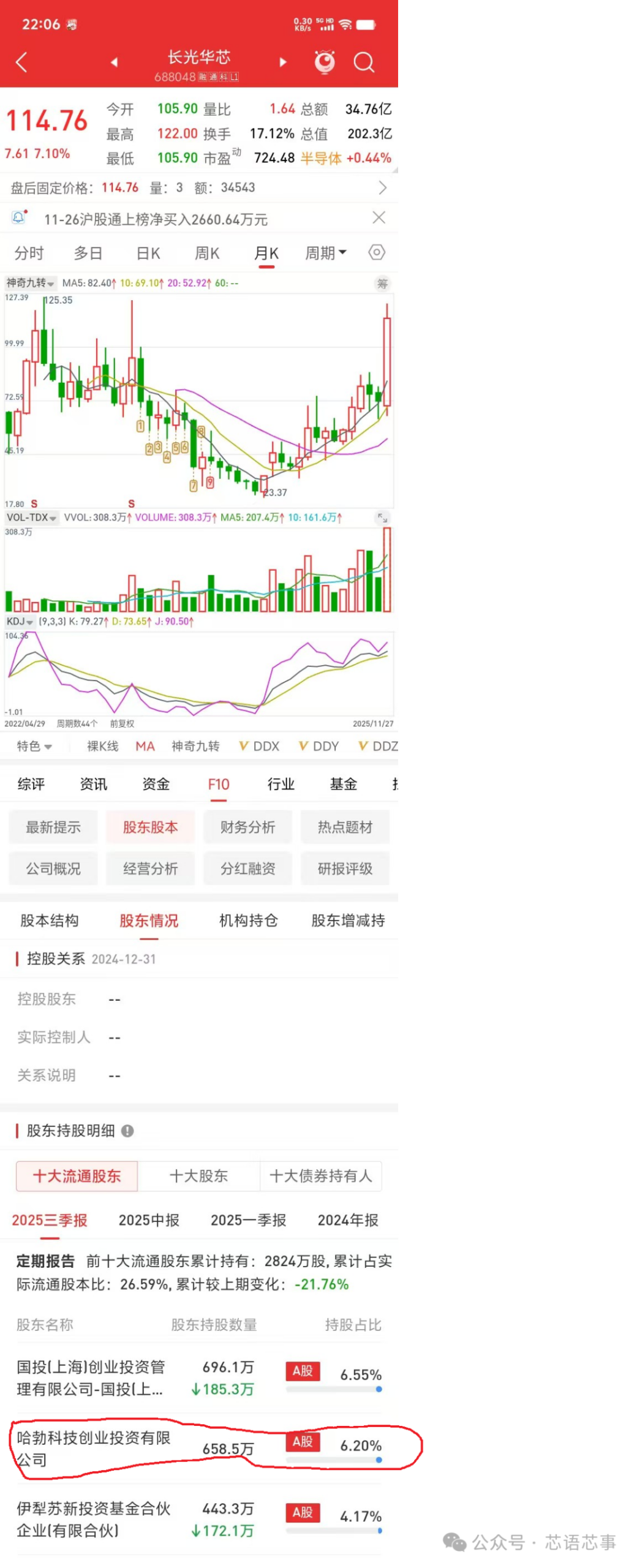
If you follow the stock market, you may have noticed an interesting phenomenon: some companies, despite not making any profit, see their stock prices soar like a rocket. Suzhou Changguang Huaxin Optoelectronic Technology Co., Ltd. (referred to as “Changguang Huaxin”) is one such company—by September 2024, its stock price was as low as 23.37 yuan, but by November 2025, it skyrocketed to 115 yuan, a fivefold increase in just over a year! What’s even more curious is that during this period, its “deducted net profit” (the real profit after removing incidental income) was still negative.
How can a company that isn’t making money be so sought after by the market? Today, let’s discuss in simple terms what Changguang Huaxin is all about and what justifies its title of “fivefold stock”.
First, let’s understand: What does Changguang Huaxin do?
To understand the value of Changguang Huaxin, we need to first grasp its “main business”—to put it simply, it is a company that specializes in “special chips”, but not the ordinary chips found in our phones and computers, rather “semiconductor laser chips”.
The core capability of these chips is “light emission”, but not ordinary light; they emit lasers or high-speed optical signals that meet the needs of high-end scenarios in industries such as communications and automotive. For example, the “optical modules” that enable rapid data transmission in data centers, the laser radars used by autonomous vehicles to “see the road”, and high-power lasers for cutting metals in industrial production—all core components are chips from this company.
Changguang Huaxin was established in 2012 and went public on the Science and Technology Innovation Board in March 2022, making it a “rising star” in the semiconductor field. However, it possesses a “trump card”—a gallium arsenide 6-inch wafer production line, which is a rare asset, with only two in the world and the only one in China.
Some may wonder: “Is a 6-inch production line really impressive?” Let’s use pizza as an analogy: traditional chip production lines mostly use 3-inch wafers, akin to a small pizza, which limits the number of “chip pieces” that can be cut at once; a 6-inch wafer is like a giant pizza, capable of accommodating five times more chips, thus increasing production capacity by 5-10 times. More importantly, the cost of making a large pizza is lower—labor costs drop by five times, material waste decreases by 40%, and the defect rate is reduced by a third.
Moreover, the technical difficulty of this production line is extremely high: the wavelength standard deviation within the wafer is only 0.56 nanometers (equivalent to one ten-thousandth of a human hair’s diameter), and the substrate warpage is controlled to below 20 km⁻¹ (simply put, the chips are “very uniformly flat”). With this production line, Changguang Huaxin has achieved “full-process autonomy” from chip design, production to packaging and testing, breaking the foreign technology blockade on high-power laser chips, allowing China to achieve a 50% domestic market share in high-power laser chips, effectively solving the “bottleneck” problem of “having equipment but lacking core chips”.
Key Question: Why has the stock price increased fivefold despite not making a profit?
Having understood the company background, let’s return to the core question: why has Changguang Huaxin’s stock price risen so much when it has not yet achieved real profitability (with a negative deducted net profit)? The answer is quite simple—the stock market speculates on “future expectations”, not “current profits”. The market believes this company can make big money in the future, so it is willing to pay for its “potential” now.
Specifically, there are four core reasons that have made Changguang Huaxin a “hot commodity” in the market.
Reason 1: It has hit two major “windfall tracks”, with enormous future market potential
Stock traders often say, “When you stand on the wind, even pigs can fly”; Changguang Huaxin is not only standing on the wind but is also a “core player” in it—it has perfectly entered the two hottest fields of the next decade: AI computing power and intelligent driving.
1. Optical Communication Chips: The “Data Couriers” of AI Large Models
Everyone is talking about AI large models (like ChatGPT, Wenxin Yiyan); behind these “smart AIs”, massive amounts of data need to be quickly “run” in data centers. How can data run quickly? Through “optical signals”—which are much faster than the “electrical signals” we usually use, just like using planes instead of cars for delivery.
The “emitter” of optical signals is the “optical module”, and the optical communication chip is the “heart” of the optical module—without it, the optical module cannot emit light, and data cannot be transmitted. Previously, domestic manufacturers could not produce high-end optical chips above 25G, with 99% needing to be imported, which was not only expensive but also posed a risk of being “bottlenecked”.
Changguang Huaxin has broken this situation: its 100G EML chip (a type of high-end optical communication chip) is already in mass production, and samples of the 200G chip have been sent to leading optical module companies like Zhongji Xuchuang and Huawei for testing, and its performance is impressive—it consumes 25% less power than international giants’ chips (which is crucial for data centers) and is 40% cheaper (saving costs for enterprises). Currently, it has secured over 600 million yuan in orders, making it a core player in the “domestic optical chip replacement” market, and as AI data centers expand, its orders are expected to increase.
2. Automotive Laser Radar Chips: The “High-Definition Eyes” of Autonomous Driving
Autonomous vehicles need to “see the road” not with the cameras we use for driving (which are easily affected by weather) but with “laser radar”—which emits laser beams to scan the surrounding environment, accurately detecting obstacles up to 100 meters away and even distinguishing between pedestrians and telephone poles, akin to equipping cars with “high-definition night vision”.
2025 is set to be the “explosion year” for laser radar—more and more new cars are beginning to be equipped with laser radar as standard (the pre-installed delivery volume has increased by 76% compared to last year), and Changguang Huaxin’s 905nm VCSEL chip is the “core component” of laser radar. This chip has passed the strict certification of the automotive industry (which is ten times stricter than mobile phone chip certification), with a monthly production capacity of 1 million units, and it has deep collaborations with top global laser radar companies like Hesai and Suteng Juchuang—these companies supply to automakers like NIO and XPeng, and are even in talks with Tesla for collaboration.
In simple terms: the more autonomous vehicles on the road in the future, the more chips Changguang Huaxin will sell, and this market potential could be tenfold or even twentyfold compared to now.
Reason 2: Performance shows an “upward turning point”, moving from loss to profit
Although Changguang Huaxin is not yet fully profitable, its performance has begun to “improve”, like a patient recovering from being bedridden to being able to walk. The market sees hope for “recovery”.
Let’s look at a few simple data points:
-
Rapid Revenue Growth: In the first three quarters of 2025, the company’s revenue reached 339 million yuan, a 67.4% increase compared to the same period last year; in the third quarter alone, revenue was 125 million yuan, also up 66.3% year-on-year—this growth rate far exceeds the industry average, indicating that its products are selling increasingly well.
-
Significant Increase in Gross Margin: Gross margin is a key indicator of a company’s “profitability”; in the third quarter of 2025, Changguang Huaxin’s gross margin reached 40.75%, an increase of 11.76 percentage points compared to the same period last year, already approaching the level of Apple’s supply chain companies. This improvement is due to a better product mix—high-margin optical communication chips and high-power single-tube chips are selling more, and economies of scale are kicking in (the more produced, the lower the unit cost).
-
Starting to Make Money (Though Not Fully): In the first half of 2024, the company lost 42.48 million yuan; in the first half of 2025, it made a profit of 8.97 million yuan; by the third quarter, it earned 20.94 million yuan in a single quarter. Although the deducted net profit is still negative (mainly due to high R&D expenses), the market predicts that it will definitely achieve profitability in 2025, and even reach a net profit of 96 million yuan by 2027—this trend of “moving from loss to profit” is what the stock market values most.
Reason 3: Strong “Scarcity of Technology”, Others Cannot Easily Replicate
In the semiconductor industry, “technical barriers” are the “moat”—whoever masters technology that others cannot replicate can earn money in the long term. Changguang Huaxin’s “moat” lies in its “IDM model” and independent production capacity.
First, let’s explain the “IDM model”: there are two mainstream models for making chips: one is “Fabless” (only responsible for chip design, outsourcing production), like Qualcomm and MediaTek; the other is “IDM” (doing everything from chip design, wafer manufacturing, to packaging and testing in-house), like Intel and Texas Instruments.
Changguang Huaxin is the only company in China capable of producing “semiconductor laser chips IDM”—like a restaurant that handles everything from growing vegetables and raising livestock to cooking and serving, without relying on others. The benefits of this model are clear: it doesn’t have to worry about foundries “bottlenecking production” (for example, when chip demand exceeds supply, foundries may prioritize supplying large clients), and it can better control product quality and costs.
More importantly, it has a 6-inch high-power laser chip production line, one of only two in the world, with a yield rate of 85% (foundry yield rates typically only reach 70%). In the current context of the U.S. restricting semiconductor equipment exports, this ability to be “self-controlled” is particularly valuable—regardless of whether foreign equipment is sold, it can still produce chips, unlike some companies that would “stop production” if supplies were cut off.
This dual scarcity of “technology + production capacity” makes the market perceive its value as higher than that of ordinary companies, willing to give it a higher “valuation” (simply put, willing to spend more money to buy its stock).
Reason 4: Funds “Vote with Their Feet”, Institutions and Market Trends Favor It
Stock prices ultimately rise due to “funding momentum”—the more money that buys its stock, the higher the price naturally goes. Changguang Huaxin has coincidentally benefited from two waves of “funding dividends”:
1. Institutions Increasing Holdings, Giving It “Endorsement”
Since 2025, professional investment institutions like Zhongyou Securities and Tianfeng Securities have successively rated Changguang Huaxin as “buy” or “increase holdings”—equivalent to experts telling everyone, “This company has potential”. Funds and social security funds that follow institutional investors have also begun to increase their holdings, raising the proportion of institutional holdings and driving up the stock price.
2. Market Trend Shifts to “Tech Growth”
Before 2024, the A-share market favored “low-valuation defensive stocks”, such as banks, real estate, and public utilities (these companies have low volatility and stable dividends); but from 2024 to 2025, the market trend changed, with funds starting to flow into semiconductor, AI, and intelligent driving “tech growth stocks”—because everyone believes these fields have significant future growth potential and can earn more money.
As the leader in the “optical communication + automotive laser radar” dual tracks, Changguang Huaxin naturally became a target for funds. It’s like a “model student” in school, perfectly aligning with the teacher’s preference for “well-rounded students”, thus attracting more attention.
Don’t Ignore the “Other Side”: It Also Has These Risks
Although the future of Changguang Huaxin looks bright, we must also view its “shortcomings” objectively—after all, investment carries risks, and we cannot only focus on the positives.
First, its “historical operational pressures” have not been completely resolved. In 2021, Changguang Huaxin was still able to earn 115 million yuan, with a gross margin of 53%, and positive operating cash flow; however, in 2023-2024, it suffered losses for two consecutive years, with gross margin dropping to a historical low of 23.85%, and operating cash flow turned into a “huge negative value” (simply put, it spent much more than it earned), nearly leading to its collapse.
Although performance improved in 2025, the “foundation” has not yet stabilized: the deducted net profit is still negative (indicating that the main business has not yet truly made money, and part of the profits in the first half of the year came from government subsidies and incidental income), and operating cash flow is still deteriorating (the cash on hand is decreasing). This means it still needs time to “digest” previous losses and truly achieve “healthy profitability”.
Secondly, “industry competition” will become increasingly fierce. Both optical communication and automotive laser radar are hot tracks, with not only foreign giants (like Broadcom and ON Semiconductor) but also many domestic companies catching up (like Shijia Photon and Zonghui Xinguang). If Changguang Huaxin cannot maintain its technological lead or keep up with demand, it risks losing market share to competitors.
Finally, the “risk of technological iteration” cannot be ignored. The semiconductor industry updates technology rapidly; today’s “high-end chips” may become “low-end products” in a few years. If Changguang Huaxin does not invest sufficiently in R&D or misjudges the technological direction (for example, if laser radar chips are replaced by more advanced technologies in the future), its previous advantages may quickly disappear.
Conclusion: What is the Logic Behind Changguang Huaxin’s “Fivefold Stock”?
In fact, it can be summarized in one sentence: the rise in Changguang Huaxin’s stock price is essentially about “expectations leading the way”—the market is not paying for its current losses but is betting on its “future potential”:
-
It has hit two “trillion-level tracks” in AI computing power and intelligent driving, with ample future market space;
-
It possesses an “IDM model” and independent production capacity that others cannot easily replicate, with sufficiently high technical barriers;
-
Its performance has begun to shift from loss to profit, with a clear growth trend;
-
It has also received investment from Huawei Hubble (which invested 76 million yuan in 2020 and is still an important shareholder), equivalent to having “industry giants” backing it.
This “growth logic > current profitability” valuation method is very common in tech stocks—just like Apple a decade ago, when its iPhone had just launched and it wasn’t making much money, but the market was optimistic about the future of smartphones, and its stock price still rose; or Tesla, which was often in the red before 2020, but the market believed it could change the automotive industry, and its stock price soared by dozens of times.
However, it’s important to remind everyone: “Expectations” do not necessarily become “reality”; if Changguang Huaxin’s future orders fall short of expectations or its technology is surpassed, the stock price may also correct. Before investing, it’s essential to do thorough research to understand the company’s true situation and not blindly follow trends.
After all,investing without research is like sowing seeds blindly, with little chance of harvest.— Whether buying stocks or understanding a company, in-depth research is the most important.