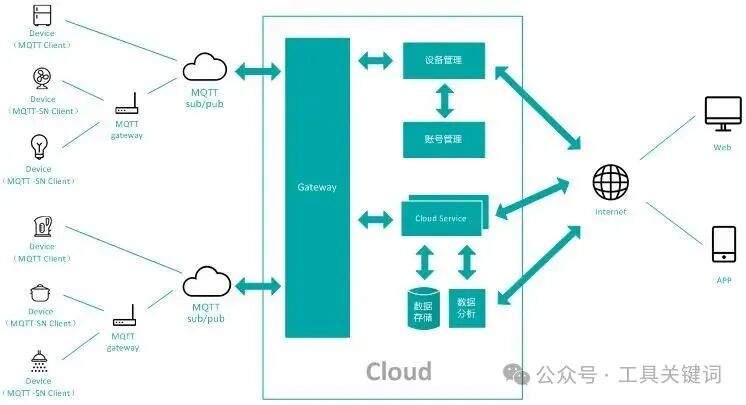
 In today’s interconnected world, Internet of Things (IoT) technology is transforming our lives and work at an unprecedented pace. From smart homes to industrial automation, from intelligent transportation to environmental monitoring, various devices are interconnected through networks, enabling data exchange and sharing. Within this vast IoT ecosystem, communication protocols play a crucial role, among which MQTT (Message Queuing Telemetry Transport) has become one of the preferred choices for IoT communication due to its unique advantages. Today, let us delve into the applications of MQTT in the IoT.What is MQTT?MQTT is a lightweight messaging protocol based on the Publish/Subscribe model. It was developed by IBM in 1999, aimed at providing efficient communication solutions for resource-constrained devices and low-bandwidth, high-latency, or unreliable network environments. Over the years, MQTT has become one of the most widely used communication protocols in the IoT field and was standardized by OASIS (Organization for the Advancement of Structured Information Standards) in 2014.The core concepts of MQTT include Publisher, Subscriber, and Broker. The Publisher is the device or application that generates and sends messages, publishing them to specific topics. The Subscriber is the device or application interested in specific topics, receiving related messages by subscribing to those topics. The Broker serves as the central hub of MQTT communication, responsible for receiving messages from Publishers and distributing them to the appropriate Subscribers based on subscription relationships. Publishers and Subscribers do not need to communicate directly, which greatly enhances the flexibility and scalability of the system.Features and Advantages of MQTTLightweight DesignThe design of the MQTT protocol is very lightweight, with a minimum message header of only 2 bytes. In contrast to other protocols (such as HTTP, where even the simplest request has a header of at least several hundred bytes), this significantly reduces data transmission overhead. This makes MQTT particularly suitable for resource-constrained IoT devices, such as various sensors and microcontrollers, which typically have limited computing power, small memory, and low bandwidth. The lightweight MQTT protocol enables efficient data transmission without consuming excessive resources.Publish/Subscribe ModelThe Publish/Subscribe model is a major core advantage of MQTT. In this model, Publishers do not need to know the specific information of Subscribers; they simply publish messages to specific topics, while Subscribers only need to focus on the topics they are interested in to receive relevant messages. This one-to-many message distribution mechanism allows MQTT to adapt well to scenarios where numerous devices interact simultaneously, achieving decoupling between devices and enhancing system flexibility and scalability. For example, in a smart home system, a temperature sensor acts as a Publisher, publishing the collected temperature data to the “home/temperature” topic, while smart air conditioners and humidifiers act as Subscribers, automatically adjusting their operating states based on the temperature data. The entire system architecture becomes simple and efficient.Reliability AssuranceMQTT provides three different levels of Quality of Service (QoS) to meet the reliability requirements of message transmission in different application scenarios: QoS 0 (At most once): Messages may be lost; the Publisher sends the message once without waiting for confirmation, suitable for scenarios where data loss is not critical and real-time requirements are low, such as non-critical data collection in environmental monitoring. QoS 1 (At least once): Ensures that messages are received at least once; the Publisher must wait for the receiver’s acknowledgment (PUBACK message) after sending the message. If no acknowledgment is received, the message will be resent until confirmation is received. This level is suitable for most IoT control scenarios, such as sending control commands to devices, ensuring that devices ultimately receive and execute the commands even if network instability causes message retransmission. QoS 2 (Exactly once): This is the highest level of service quality, ensuring that messages are transmitted only once without loss or duplication. It uses a complex four-step handshake process (PUBLISH→PUBREC→PUBREL→PUBCOMP) to ensure reliable message transmission, suitable for scenarios requiring high data accuracy and integrity, such as financial transactions and medical data transmission.Low Power Consumption and Long Connection SupportMany IoT devices, especially those powered by batteries, such as smart wristbands and wireless sensor nodes, have strict power consumption requirements. The MQTT protocol maintains a long connection between clients and the Broker through a Keep Alive mechanism. When the connection is idle, devices only need to periodically send a small number of heartbeat packets to maintain the connection state, avoiding frequent connection establishment and disconnection, thus significantly reducing device power consumption and extending battery life. Additionally, when a brief network interruption occurs, the MQTT client can automatically reconnect to the Broker, ensuring communication continuity.SecurityAlthough MQTT itself does not provide a complete security solution, it supports various security mechanisms to ensure the security of data transmission. For example, MQTT can encrypt data using Transport Layer Security (TLS/SSL) to prevent data from being stolen or tampered with during transmission. Furthermore, it can use username/password authentication, client certificate authentication, and other methods to authenticate devices connecting to the Broker, ensuring that only legitimate devices can communicate, effectively enhancing the security of IoT systems.Application Scenarios of MQTT in IoTSmart HomeSmart homes are one of the most widely used fields for MQTT applications. In a smart home environment, various devices such as smart bulbs, smart plugs, smart locks, smart cameras, and smart speakers can connect to a home gateway or cloud server via the MQTT protocol. Users can easily control and manage smart devices in their homes remotely through mobile apps or voice assistants. For example, on the way home from work, a user can send commands to the smart air conditioner via a mobile app to adjust the home temperature to a comfortable level in advance; when someone breaks into the house, the smart lock and smart camera can promptly push alarm information to the user’s phone via MQTT, achieving real-time security monitoring. Additionally, smart home devices can interconnect through MQTT to realize automated scene linkage. For instance, when a smart sensor detects that indoor light levels are dimming, it automatically sends a message to the smart bulb to increase brightness; when the indoor temperature is too high, it automatically triggers the smart fan or air conditioner to enter cooling mode.Industrial IoTIn the industrial sector, MQTT also plays a vital role. Industrial IoT (IIoT) involves a large number of device connections and data exchanges, such as various sensors (temperature sensors, pressure sensors, vibration sensors, etc.), actuators (motors, valves, robots, etc.), production equipment, and monitoring systems in factories. Through the MQTT protocol, these devices can collect various data in real-time during the production process and upload it to industrial cloud platforms or internal management systems for analysis and processing. Managers can use remote monitoring systems to understand the operational status of each device on the production line in real-time, promptly identify potential faults, and perform remote diagnostics and maintenance. For example, in a large factory, sensors can be installed on each machine to collect real-time operational parameters (such as temperature, speed, vibration, etc.) and send this data to the cloud via MQTT. The data analysis system monitors and analyzes this data in real-time, and once a parameter exceeds the normal range, it immediately sends a warning message via MQTT to the relevant personnel’s phone or computer, while automatically triggering the corresponding maintenance process to arrange for repair personnel, thus greatly improving production efficiency and reducing equipment failure rates and maintenance costs. Additionally, MQTT supports collaborative control between industrial devices, such as achieving more efficient production processes through coordinated control of multiple robots or automated production lines.Intelligent TransportationIntelligent transportation systems are also an important application scenario for MQTT. In the Vehicle-to-Everything (V2X) domain, MQTT is widely used for communication between vehicles (V2V), between vehicles and infrastructure (V2I), between vehicles and people (V2P), and between vehicles and the cloud (V2C). For example, through MQTT, vehicles can upload their location, speed, and driving status information to cloud servers in real-time while receiving traffic condition information and navigation instructions from the cloud. Traffic management departments can utilize this data for real-time traffic flow monitoring and scheduling, optimizing traffic signal timing to alleviate congestion. In the field of autonomous driving, MQTT also plays a key role, as vehicles exchange information with other vehicles and infrastructure in the surrounding environment via MQTT to obtain more comprehensive road condition information, enabling more accurate driving decisions and enhancing the safety and reliability of autonomous driving. Additionally, MQTT can be applied in intelligent parking systems, where car owners can check real-time parking space information through mobile apps and interact with parking management systems via MQTT to achieve remote reservation of parking spaces and automatic payment functions.Agricultural IoTThe development of agricultural IoT is crucial for improving agricultural production efficiency and ensuring the safety of agricultural products. The application of MQTT in agriculture mainly focuses on monitoring agricultural production environments and smart irrigation and fertilization systems. By deploying various sensors in the fields, such as soil moisture sensors, temperature sensors, light sensors, and weather stations, real-time data on soil moisture, weather conditions, and crop growth status can be collected and transmitted to farmers’ mobile phones or agricultural management platforms via MQTT. Farmers can use this real-time data to understand the actual conditions of their fields and make informed decisions regarding irrigation, fertilization, and pest control. For example, when a soil moisture sensor detects that the soil moisture content is below a set threshold, it automatically sends a signal to the smart irrigation system via MQTT to activate irrigation equipment; when a weather station detects impending severe weather, it promptly sends a warning message to farmers via MQTT, reminding them to take appropriate protective measures. Additionally, MQTT can be used for environmental control in greenhouses, monitoring and adjusting parameters such as temperature, humidity, and light to provide optimal growing conditions for crops, achieving precision agriculture production.Remote HealthcareWith the development of internet technology, remote healthcare has gradually become an important means to address uneven distribution of medical resources and improve accessibility to healthcare services. MQTT also has broad application prospects in the field of remote healthcare. For example, through wearable medical devices (such as smart wristbands, smartwatches, ECG monitors, blood glucose meters, etc.), patients can collect their physiological data (such as heart rate, blood pressure, blood glucose, ECG, etc.) in real-time and transmit this data to the hospital’s remote healthcare platform or doctors’ mobile devices via MQTT. Doctors can monitor and diagnose patients’ health conditions remotely based on this real-time data, promptly identifying potential health issues and providing appropriate treatment recommendations. In emergency situations, such as a patient experiencing a heart attack or stroke, wearable medical devices can immediately send a distress signal to emergency centers via MQTT, transmitting the patient’s real-time physiological data to provide critical reference information for emergency personnel to make accurate rescue decisions in the shortest time possible. Additionally, MQTT can be used for remote management and maintenance of medical devices, allowing hospital management personnel to monitor the operational status of medical devices distributed across various departments in real-time, arrange for maintenance and servicing, and improve the reliability and lifespan of medical equipment.Challenges and Solutions for MQTT in IoT ApplicationsDespite the numerous advantages of MQTT in the IoT field, it also faces several challenges in practical applications:Security IssuesAlthough MQTT supports various security mechanisms, the security risks remain high in IoT environments due to the large number of devices and complex network environments. For example, malicious attackers may use network attack methods to steal MQTT communication data, tamper with message content, or impersonate legitimate devices to connect, causing severe damage to IoT systems. To address these security issues, in addition to strengthening the security configuration of MQTT itself (such as enabling TLS encryption, setting strong passwords, and using client certificate authentication), it is necessary to adopt multi-layered security measures in conjunction with the overall architecture of IoT security, such as network isolation, intrusion detection systems, and security audits. Additionally, regular security vulnerability scanning and remediation of IoT devices and systems should be conducted, and user and device identity management and access control should be strengthened to ensure that only authorized devices and users can access and operate the IoT system.Device CompatibilityThe variety of IoT devices can lead to compatibility issues with MQTT, as devices from different manufacturers may differ in hardware architecture, operating systems, and communication interfaces. For example, some older devices may not support the latest version of the MQTT protocol or may encounter technical difficulties when integrating MQTT clients. To improve device compatibility, the MQTT protocol itself is continuously evolving and improving to better meet the needs of different types of devices. Additionally, device manufacturers should adhere to unified standards and specifications when developing devices, choose mature and stable MQTT client libraries for integration, and conduct thorough compatibility testing. Furthermore, some IoT platform providers offer device adaptation layers that abstract and encapsulate different devices, achieving seamless integration with the MQTT protocol and reducing the difficulty of device access.Management of Large-Scale Device ConnectionsWith the rapid development of IoT, billions or even trillions of devices will connect to the network in the future, making effective management of these large-scale device connections a significant challenge for MQTT. When a large number of devices connect to the MQTT Broker simultaneously, it may lead to server overload, performance degradation, and even connection timeouts or message loss. To address the management of large-scale device connections, distributed architecture MQTT Broker servers should be employed, using load balancing techniques to evenly distribute device connection requests across multiple server nodes, enhancing the server’s processing capacity and reliability. Additionally, optimizing the connection management mechanism of the MQTT protocol, such as reasonably setting heartbeat intervals and optimizing session recovery mechanisms, can reduce unnecessary communication overhead between devices and servers. Moreover, utilizing cloud computing and edge computing technologies can offload some data processing and device management functions to edge nodes, alleviating the pressure on cloud servers and improving system response speed and real-time performance.ConclusionAs a lightweight, efficient, and reliable messaging protocol, MQTT plays an indispensable role in the IoT field. Its unique Publish/Subscribe model, lightweight design, reliability assurance, and support for low power consumption and long connections make it an ideal choice for communication among IoT devices. From smart homes to industrial IoT, from intelligent transportation to agricultural IoT and remote healthcare, MQTT has extensive and profound applications in various fields, providing solid technical support for realizing the beautiful vision of interconnected everything. Although there are challenges in the application process, these issues will gradually be resolved with continuous technological development and improvement. It is believed that in the future, MQTT will continue to drive innovation and development in IoT technology, bringing more convenience and value to our lives and society.If you are interested in the application of MQTT in IoT, why not try building an IoT project based on MQTT yourself to experience its charm and power? In the process of practice, you may encounter various problems, but this is also an opportunity for learning and growth. Feel free to share your experiences and insights in the comments section, and let us explore the infinite possibilities of IoT technology together!