
Click the blue text above to follow us
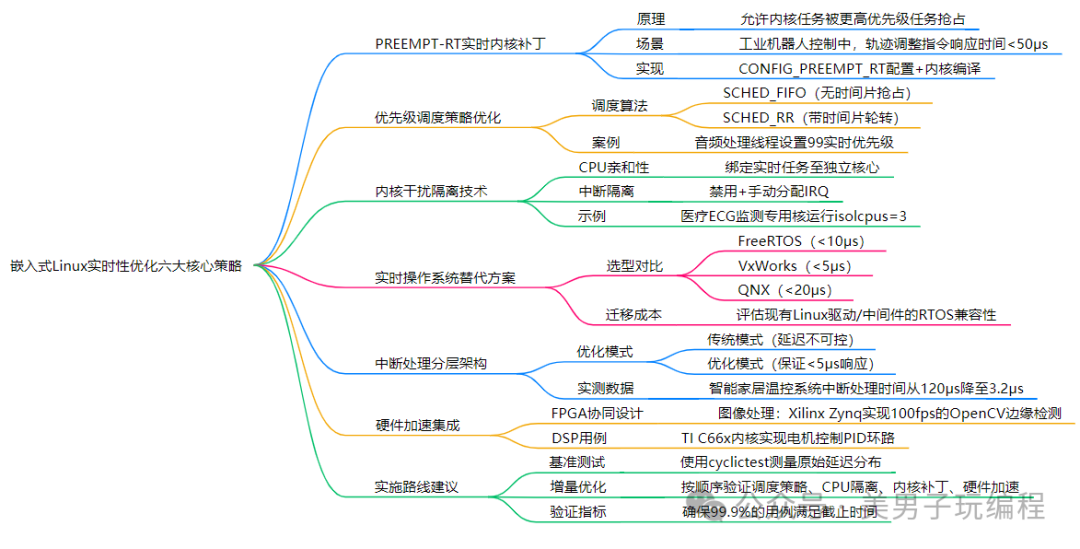
In embedded systems, although Linux itself is not a real-time operating system, its real-time performance can be significantly improved by implementing PREEMPT-RT patches, rational scheduling, optimizing interrupt handling, limiting kernel interference, and leveraging hardware acceleration.
1
Using Real-Time Linux (PREEMPT-RT)
PREEMPT-RT is a set of patches that can transform the Linux kernel into a version with better real-time performance.
It increases the kernel’s preemptibility, allowing real-time tasks to obtain CPU time with shorter delays.
When a high-priority real-time task is ready, the kernel immediately interrupts lower-priority tasks to ensure timely responses.
For example, in industrial automation, a Linux system using PREEMPT-RT can control the movement of a robotic arm in real-time.
When the robot is handling items, if a real-time trajectory adjustment is required, PREEMPT-RT can ensure that control commands respond quickly to avoid collisions or misoperations.
This ability to respond promptly is crucial for ensuring the efficiency and safety of production lines.
2
Priority Scheduling
In Linux, the scheduling order of processes or threads can be controlled by setting their priority.
Using SCHED_FIFO and SCHED_RR policies can achieve real-time scheduling.
SCHED_FIFO is a first-in-first-out scheduling policy suitable for tasks with strict real-time requirements, while SCHED_RR is a round-robin scheduling suitable for tasks that need to share CPU time.
For example, in audio processing applications, if the audio stream processing thread uses the SCHED_FIFO policy, it can run ahead of other normal threads, ensuring that audio playback has no delays or stutters.
This scheduling strategy ensures the continuity of audio data, enhancing user experience.
3
Limiting Kernel Interference
To meet real-time requirements, kernel interference should be minimized, which can be achieved through the following measures:
-
Disabling Unnecessary Kernel Features: Such as disabling certain device drivers, file systems, and network functions to reduce context switching and interrupts. This helps lower unnecessary system overhead.
-
Setting CPU Affinity: Binding real-time tasks to specific CPU cores to avoid delays caused by context switching. This ensures that real-time tasks are unaffected by other tasks during execution.
For example, in medical devices, tasks that monitor heart rates can be bound to specific cores to ensure they can respond quickly when needed, thus improving the reliability of patient monitoring.
4
Considering RTOS Alternatives
In some cases, using a real-time operating system (like FreeRTOS, VxWorks, etc.) may be more appropriate.
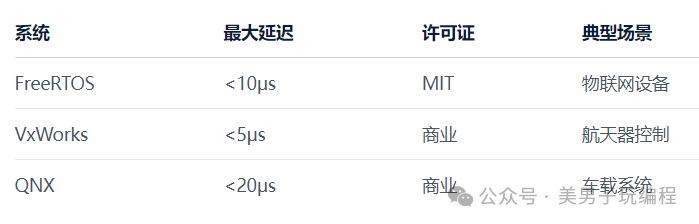
These operating systems are specifically designed for real-time performance, offering better determinism and low-latency characteristics.
For example, in flight control systems, using an RTOS can ensure that sensor data is collected and processed within strict time windows, thereby ensuring the stability and safety of the aircraft.
The deterministic characteristics of RTOS make it an ideal choice for critical task systems.
5
Interrupt Handling Optimization
Real-time systems require efficient interrupt handling mechanisms.
Properly designing interrupt handlers can significantly reduce delays.
When using interrupt service routines (ISR), simplify the handling logic as much as possible, moving complex processing to worker threads after the interrupt.
For example, in smart home systems, temperature sensor interrupts should quickly acquire data and pass it to worker threads for analysis, ensuring real-time control of the air conditioning system to maintain stable indoor temperatures.
This design ensures timely data processing, improving comfort in living environments.
6
Using Hardware Acceleration
For some compute-intensive real-time tasks, dedicated hardware (such as FPGA or DSP) can be used for accelerated processing.
This effectively reduces the burden on the CPU and increases response speed.
For example, in image processing applications, FPGAs can be used for real-time processing of image data, such as edge detection or feature extraction, achieving faster response and processing.
By leveraging hardware acceleration, the system can perform complex image analysis tasks under strict time constraints.
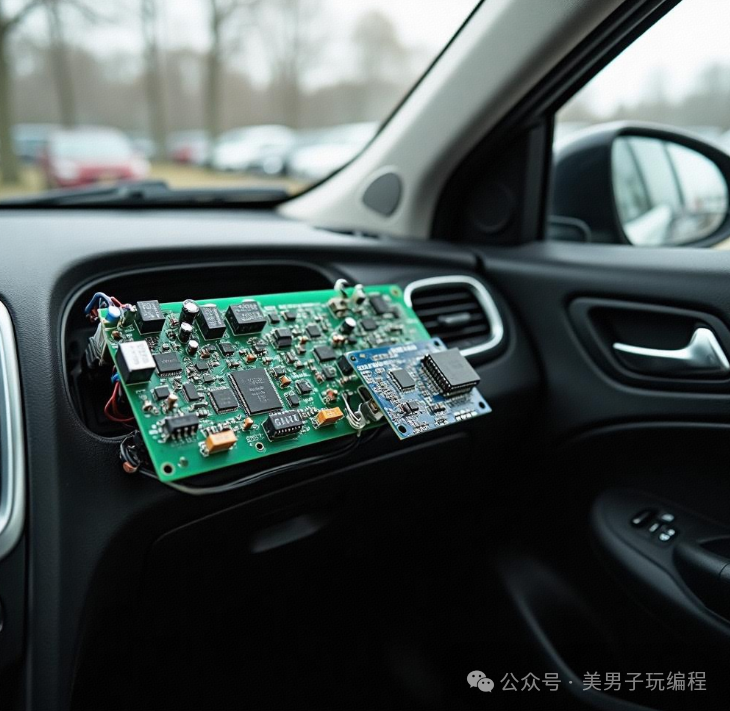
By appropriately applying the above techniques, systems can ensure timely task completion in applications requiring real-time responses, thus achieving higher reliability and performance.
These measures not only enhance the real-time performance of embedded systems but also provide a solid foundation for effective responses in complex application scenarios.

 Click Read Original for more exciting content~