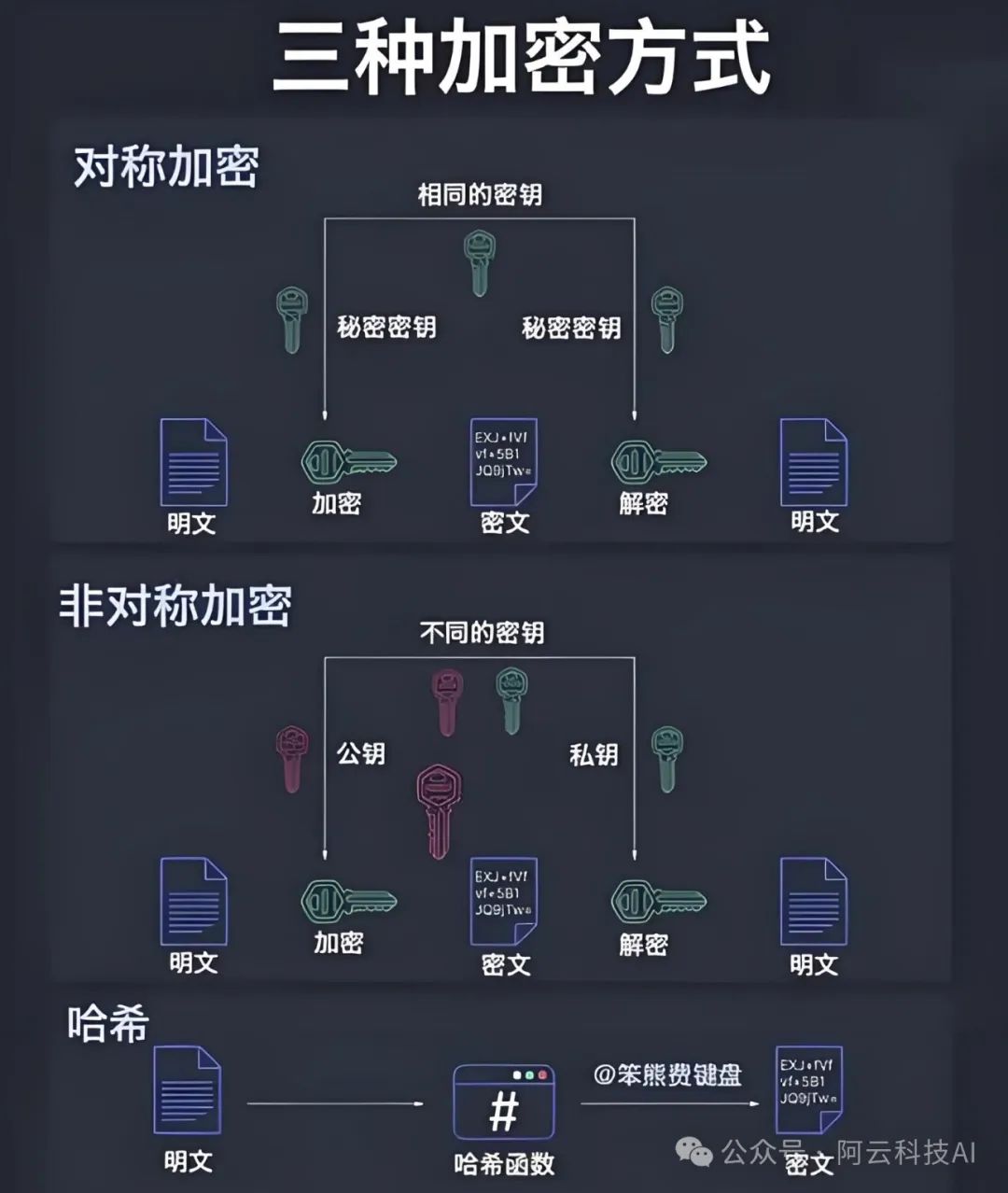
 Common encryption algorithms can be divided into three main categories: Symmetric Encryption Algorithms, Asymmetric Encryption Algorithms, and Hash Algorithms. Here are some common encryption algorithms along with their easy-to-understand explanations:
Symmetric Encryption Algorithms
The characteristic of symmetric encryption algorithms is that the same key is used for both encryption and decryption, much like using the same key to lock and unlock a door. • AES (Advanced Encryption Standard) • Features: AES is currently the most widely used symmetric encryption algorithm, supporting key lengths of 128, 192, and 256 bits, with high security and fast encryption speed, suitable for processing large amounts of data. • Application scenarios: Commonly used to protect sensitive information stored in databases, such as bank card numbers and ID card numbers. • DES (Data Encryption Standard) • Features: DES is an early symmetric encryption algorithm that uses a 56-bit key, but due to its short key length, its security is low and it is easily cracked. • Application scenarios: Now basically obsolete, but may still be seen in some outdated systems. • 3DES (Triple DES) • Features: To compensate for the shortcomings of DES, 3DES improves security through triple encryption, but it still uses a 56-bit key, just applied three times, making it less efficient. • Application scenarios: Used in scenarios requiring high security but not wanting to completely replace old systems.
Asymmetric Encryption Algorithms
The characteristic of asymmetric encryption algorithms is that different keys are used for encryption and decryption, typically referred to as the public key and private key. The public key can be shared, while the private key must be kept secret. • RSA • Features: RSA is one of the most widely used asymmetric encryption algorithms, based on the mathematical problem of large number factorization. It has high security, but slower computation speed, making it unsuitable for encrypting large amounts of data. • Application scenarios: Commonly used for data encryption in network transmission, such as SSL/TLS protocols, as well as digital signatures. • DSA (Digital Signature Algorithm) • Features: DSA is mainly used for digital signatures and cannot be used for data encryption. Its signing speed is fast, making it suitable for generating digital certificates. • Application scenarios: Used to verify data integrity and origin, such as in digital certificates.
Hash Algorithms
Hash algorithms are a type of one-way encryption algorithm that converts data of arbitrary length into a fixed-length hash value. The hash value is unique but cannot revert to the original data. • MD5 (Message-Digest Algorithm) • Features: MD5 can generate a 128-bit hash value, but its security is low and it is easily cracked. • Application scenarios: Mainly used to verify data integrity, such as checking if a file has been tampered with. • SHA (Secure Hash Algorithm) • Features: The SHA series of algorithms (such as SHA-1, SHA-256, SHA-3) generate hash values of different lengths, with SHA-256 and SHA-3 having higher security. • Application scenarios: Widely used for password storage, data integrity verification, and digital signatures. • HMAC (Hash-based Message Authentication Code) • Features: HMAC combines hash algorithms with keys to verify the integrity and origin of messages. • Application scenarios: Commonly used for API authentication and message authentication in data transmission.
These encryption algorithms each have their own characteristics and applicable scenarios. Choosing the right algorithm can effectively protect the security and privacy of data.