✅ Author’s Profile: A research enthusiast and Matlab simulation developer, skilled in data processing, modeling and simulation, program design, obtaining complete code, reproducing papers, and scientific simulation.
🍎 Previous Reviews: Follow my personal homepage:Matlab Research Studio
🍊 Personal Motto: Seek knowledge through investigation; complete Matlab code and simulation consultation available via private message.
🔥 Content Introduction
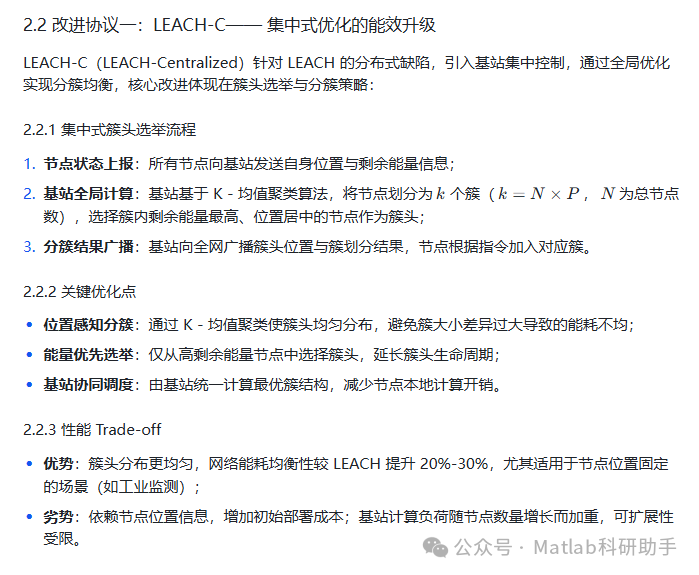
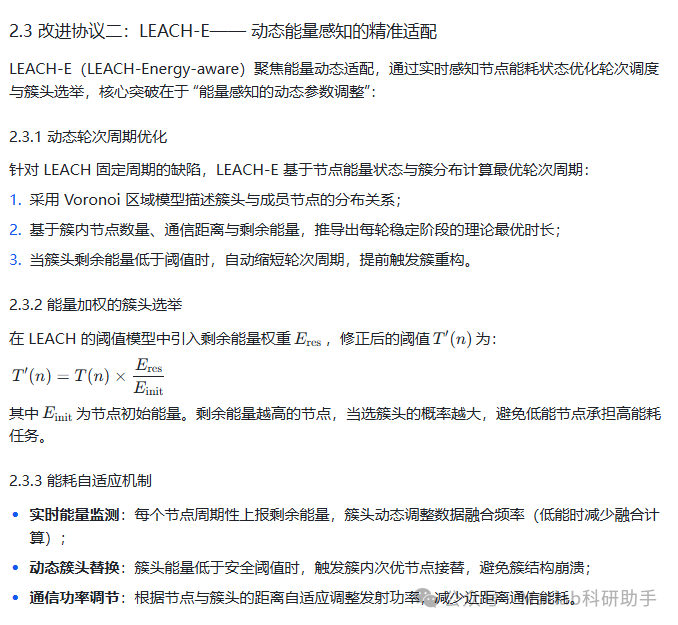
The Wireless Sensor Network (WSN) consists of numerous energy-constrained sensor nodes, where the node batteries are often difficult to replace. Energy consumption balance and network lifetime have become core objectives in protocol design. The Low Energy Adaptive Clustering Hierarchy (LEACH) protocol, as the first energy consumption adaptive protocol based on clustering, breaks through the energy consumption bottleneck of traditional flat routing through dynamic cluster head election and data fusion mechanisms. However, its randomized design has defects such as uneven cluster head distribution and imbalanced energy consumption, leading to the derivation of improved protocols like LEACH-C (Centralized version) and LEACH-E (Energy-aware Enhanced version).
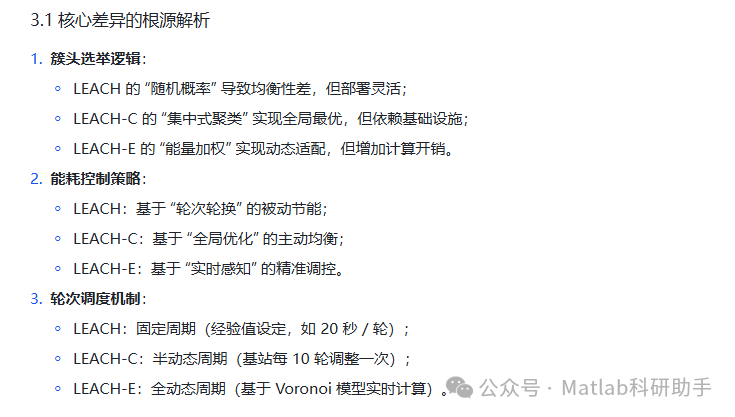
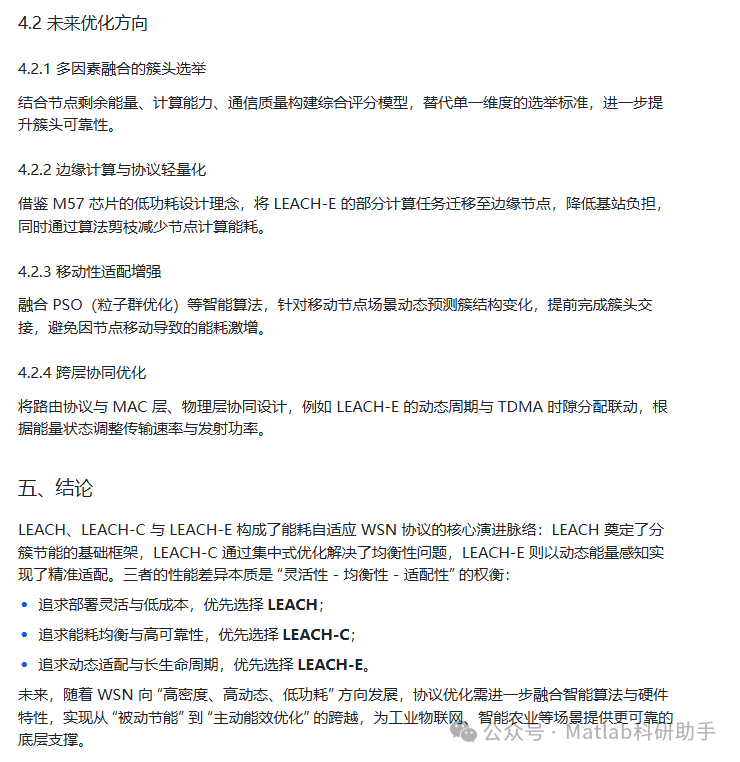
The evolution logic of the three protocols revolves around the core of “energy consumption adaptation”: from LEACH’s “probabilistic energy saving” to LEACH-C’s “centralized optimization”, and then to LEACH-E’s “dynamic energy awareness”, gradually achieving a transition from “empirical” to “precise” energy control, with core differences reflected in three dimensions: cluster head election, clustering strategy, and periodic scheduling.
II. Core Protocol Mechanism Analysis: The Path to Achieving Energy Consumption Adaptation
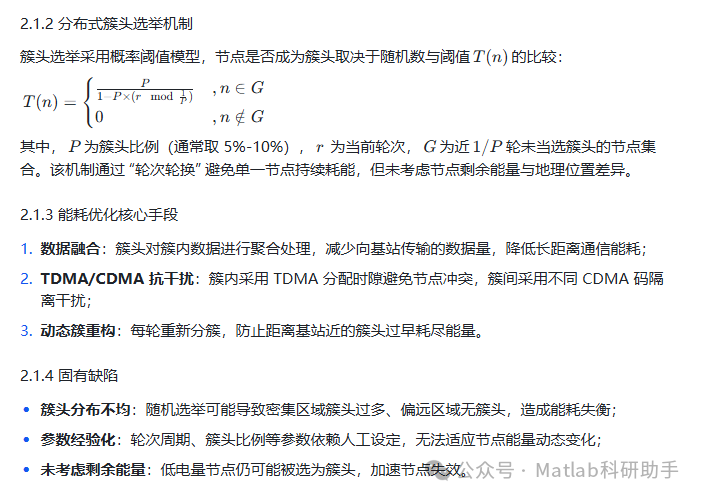
2.1 Basic Protocol: LEACH – The Pioneer of Distributed Probabilistic Clustering
LEACH is the first energy consumption adaptive protocol that combines “cluster routing” with “dynamic cluster heads”, achieving energy balance through a “round cycle” mechanism. Its core mechanism is as follows:
2.1.1 Round Dual-Phase Operating Mode
Each round is divided into cluster establishment phase (Setup Phase) and stable operation phase (Ready Phase), with the total duration of both phases constituting the round cycle, where the duration of the stable phase is usually 5-10 times that of the establishment phase to reduce clustering overhead.
- Cluster establishment phase: Completes cluster head election and cluster structure construction, taking a short time but concentrating energy consumption;
- Stable operation phase: Nodes within the cluster transmit data through TDMA time slots, and the cluster head fuses the data before uploading it to the base station, which is the core phase of data collection.
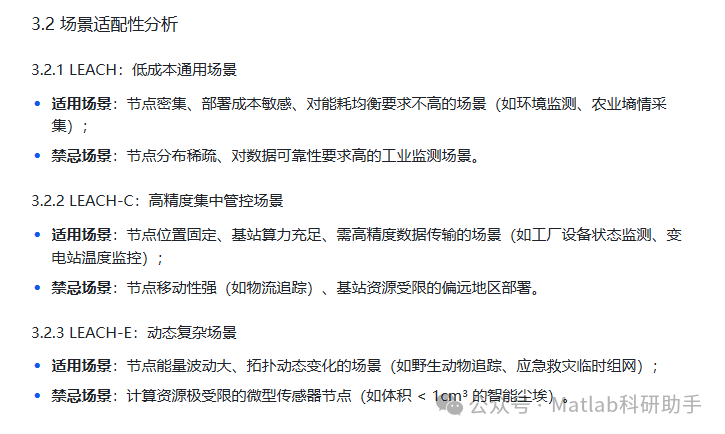
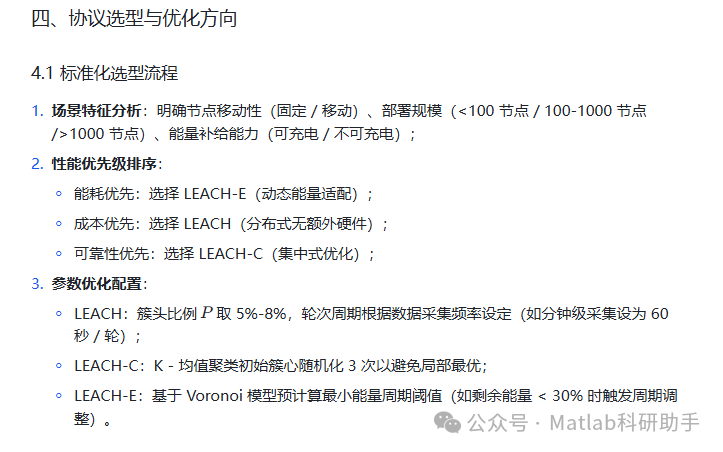
III. Multi-dimensional Performance Comparison: Quantitative Indicators and Scenario Adaptability
⛳️ Operating Results
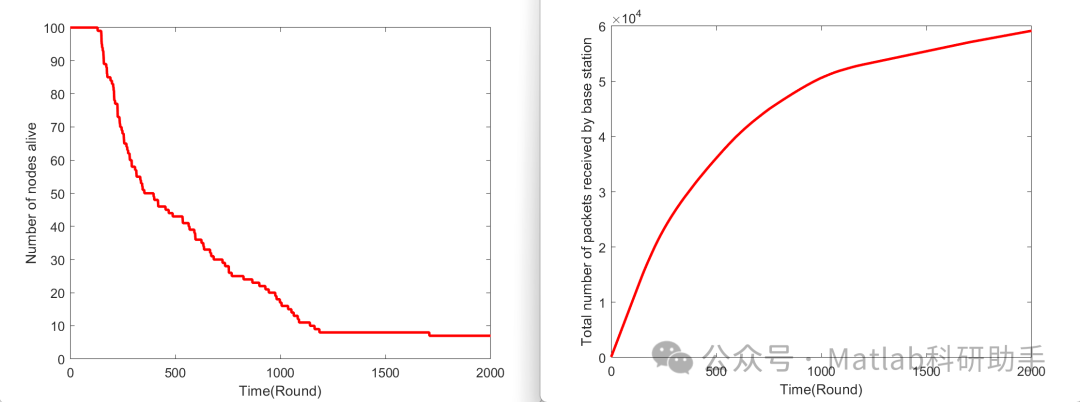
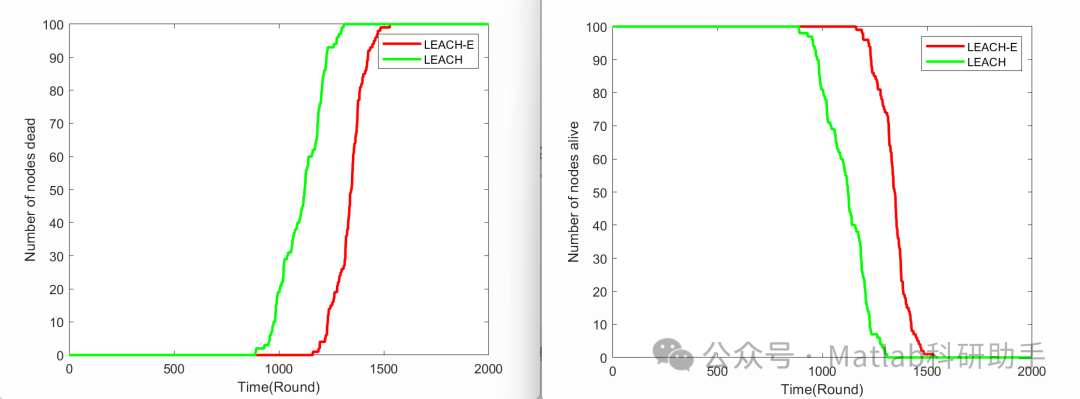
🔗 References
[1] Ma Ge. Improvement of LEACH Routing Protocol for Wireless Sensor Networks [J]. Computer Knowledge and Technology, 2009(5X):3. DOI:10.3969/j.issn.1009-3044.2009.14.037.
[2] Su Zhenzhen. Research and Improvement of Cluster-based Wireless Sensor Network Routing Protocol [D]. Jilin University [2025-09-25]. DOI:CNKI:CDMD:2.1016.091881.
[3] Shi Weiren, Bai Dang, Gao Peng, et al. Adaptive Adjustment Routing Algorithm for Cluster Head Radius in Wireless Sensor Networks [J]. Journal of Instrumentation, 2012, 33(8):1779-1785. DOI:10.3969/j.issn.0254-3087.2012.08.015.
📣 Partial Code
🎈 Some theoretical references from network literature; please contact the author for removal if there is any infringement.
👇 Follow me to receive a wealth of Matlab e-books and mathematical modeling materials.
🏆 Our team specializes in guiding customized Matlab simulations in various research fields, helping to realize research dreams:
🌈 Various intelligent optimization algorithm improvements and applications
Production scheduling, economic scheduling, assembly line scheduling, charging optimization, workshop scheduling, departure optimization, reservoir scheduling, three-dimensional packing, logistics site selection, cargo location optimization, bus scheduling optimization, charging station layout optimization, workshop layout optimization, container ship loading optimization, pump combination optimization, medical resource allocation optimization, facility layout optimization, visual domain base station and drone site selection optimization, knapsack problem, wind farm layout, time slot allocation optimization, optimal distributed generation unit allocation, multi-stage pipeline maintenance, factory-center-demand point three-level site selection problem, emergency supply distribution center site selection, base station site selection, road lamp post arrangement, hub node deployment, transmission line typhoon monitoring devices, container scheduling, unit optimization, investment optimization portfolio, cloud server combination optimization, antenna linear array distribution optimization, CVRP problem, VRPPD problem, multi-center VRP problem, multi-layer network VRP problem, multi-center multi-vehicle VRP problem, dynamic VRP problem, two-layer vehicle routing planning (2E-VRP), electric vehicle routing planning (EVRP), hybrid vehicle routing planning, mixed flow shop problem, order splitting scheduling problem, bus scheduling optimization problem, flight shuttle vehicle scheduling problem, site selection path planning problem, port scheduling, port shore bridge scheduling, parking space allocation, airport flight scheduling, leak source localization.
🌈 In the field of machine learning and deep learning: time series, regression, classification, clustering, and dimensionality reduction.
2.1 BP time series, regression prediction, and classification
2.2 ENS voice neural network time series, regression prediction, and classification
2.3 SVM/CNN-SVM/LSSVM/RVM support vector machine series time series, regression prediction, and classification
2.4 CNN|TCN|GCN convolutional neural network series time series, regression prediction, and classification
2.5 ELM/KELM/RELM/DELM extreme learning machine series time series, regression prediction, and classification
2.6 GRU/Bi-GRU/CNN-GRU/CNN-BiGRU gated neural network time series, regression prediction, and classification
2.7 Elman recurrent neural network time series, regression prediction, and classification
2.8 LSTM/BiLSTM/CNN-LSTM/CNN-BiLSTM long short-term memory neural network series time series, regression prediction, and classification
2.9 RBF radial basis function neural network time series, regression prediction, and classification
2.10 DBN deep belief network time series, regression prediction, and classification
2.11 FNN fuzzy neural network time series, regression prediction
2.12 RF random forest time series, regression prediction, and classification
2.13 BLS broad learning system time series, regression prediction, and classification
2.14 PNN pulse neural network classification
2.15 fuzzy wavelet neural network prediction and classification
2.16 Time series, regression prediction, and classification
2.17 Time series, regression prediction, and classification
2.18 XGBOOST ensemble learning time series, regression prediction, and classification
2.19 Transform various combinations of time series, regression prediction, and classification
Directions cover wind power prediction, photovoltaic prediction, battery life prediction, radiation source identification, traffic flow prediction, load prediction, stock price prediction, PM2.5 concentration prediction, battery health status prediction, electricity consumption prediction, water body optical parameter inversion, NLOS signal identification, subway stop precise prediction, transformer fault diagnosis.
🌈 In the field of image processing:
Image recognition, image segmentation, image detection, image hiding, image registration, image stitching, image fusion, image enhancement, image compressed sensing.
🌈 In the field of path planning:
Traveling salesman problem (TSP), vehicle routing problem (VRP, MVRP, CVRP, VRPTW, etc.), drone three-dimensional path planning, drone collaboration, drone formation, robot path planning, grid map path planning, multimodal transport problem, electric vehicle routing planning (EVRP), two-layer vehicle routing planning (2E-VRP), hybrid vehicle routing planning, ship trajectory planning, full path planning, warehouse patrol.
🌈 In the field of drone applications:
Drone path planning, drone control, drone formation, drone collaboration, drone task allocation, drone secure communication trajectory online optimization, vehicle collaborative drone path planning.
🌈 In the field of communication:
Sensor deployment optimization, communication protocol optimization, routing optimization, target localization optimization, Dv-Hop localization optimization, Leach protocol optimization, WSN coverage optimization, multicast optimization, RSSI localization optimization, underwater communication, communication upload and download allocation.
🌈 In the field of signal processing:
Signal recognition, signal encryption, signal denoising, signal enhancement, radar signal processing, signal watermark embedding and extraction, electromyography signals, electroencephalography signals, signal timing optimization, electrocardiogram signals, DOA estimation, encoding and decoding, variational mode decomposition, pipeline leakage, filters, digital signal processing + transmission + analysis + denoising, digital signal modulation, bit error rate, signal estimation, DTMF, signal detection.
🌈 In the field of power systems:
Microgrid optimization, reactive power optimization, distribution network reconstruction, energy storage configuration, orderly charging, MPPT optimization, household electricity.
🌈 In the field of cellular automata:
Traffic flow, crowd evacuation, virus spread, crystal growth, metal corrosion.
🌈 In the field of radar:
Kalman filter tracking, trajectory association, trajectory fusion, SOC estimation, array optimization, NLOS identification.
🌈 In the field of workshop scheduling:
Zero-wait flow shop scheduling problem (NWFSP), permutation flow shop scheduling problem (PFSP), hybrid flow shop scheduling problem (HFSP), zero idle flow shop scheduling problem (NIFSP), distributed permutation flow shop scheduling problem (DPFSP), blocking flow shop scheduling problem (BFSP).
👇