01Basic Understanding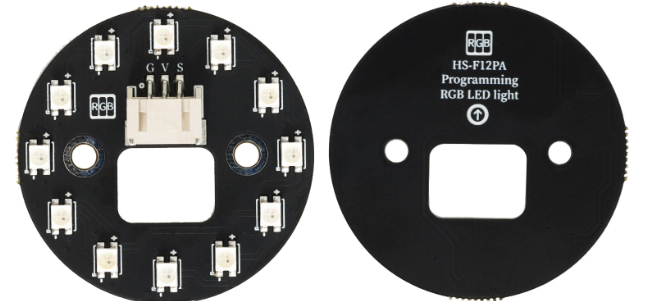 Model:HS-F12PAName:RGB Ring LightSeries:Displayand Lighting ModuleDescription:This is an integrated ring lighting module with 12 WS2812B full-color LEDs, using single-wire control technology. Each LED can independently adjust the brightness of red, green, and blue colors (256 levels), capable of presenting over 16 million colors and dynamic flowing light effects. It features low power consumption, simple control, and uniform color, making it a core display component for ambient lighting, visual feedback, and interactive devices.Usage Scenarios:Smart home ambient light (e.g., changing colors with music rhythm); camera fill light (providing uniform RGB adjustable light source); interactive art installations (controlling light dynamic effects through sensors); children’s programming teaching tools (visualizing code logic and color mixing principles); primary and secondary school science experiments (exploring the mixing of the three primary colors of light and the phenomenon of visual persistence), in line with the “General Education Guidelines for Artificial Intelligence in Primary and Secondary Schools (2025 Edition)” practical requirements; color therapy lights designed for emotional management (e.g., blue sleep mode, orange vitality mode).Disciplinary Integration:Physics, MathematicsMaterials Science, Information TechnologyEthical Education:The brightness and flicker frequency of lights may affect human health (e.g., strong light can harm eyes, high-frequency flicker can cause discomfort), requiring reasonable parameter design; the recycling of LEDs and chips in electronic waste needs attention to the recycling of rare metal resources; different cultural interpretations of colors (e.g., the different meanings of red in Eastern and Western cultures) reflect the inclusivity of design; excessive reliance on artificial lighting may disrupt biological clocks, necessitating a balance between technological convenience and natural rhythms; light effect design should consider photosensitive epilepsy patients, avoiding dangerous flicker patterns.Note: Images are sourced from the internet, and the product is based on the actual purchase.
02Technical Parameters
Working Principle:The core of the module consists of 12 series-connected WS2812B smart LEDs, each with an RGB light-emitting chip and control circuit, receiving serial data signals through a single wire (DATA). Data is transmitted between LEDs in a high-first-out manner, with each LED receiving 3 bytes (24 bits) of data (corresponding to green, red, and blue in GRB format) to set its own color; excess data is automatically forwarded to the next LED. By programming the data sending order and content, independent color control of single, multiple, or all LEDs can be achieved, creating dynamic effects such as flowing, gradient, and breathing.
Parameter Analysis:
G(GND): Power input negative/groundV (VCC): Power input positive/levelS(Signal): Signal output interfaceControl Chip: WS2812B (built-in driver and control circuit)Color Depth: 8 bits per color (0-255 levels), totaling 16,777,216 colorsCommunication Protocol: Single wire (non-standard UART, requires precise timing control)Maximum Current: ≤600mA (when all 12 LEDs are fully lit with white light)Light Emission Angle: 120° (per LED)03Code Example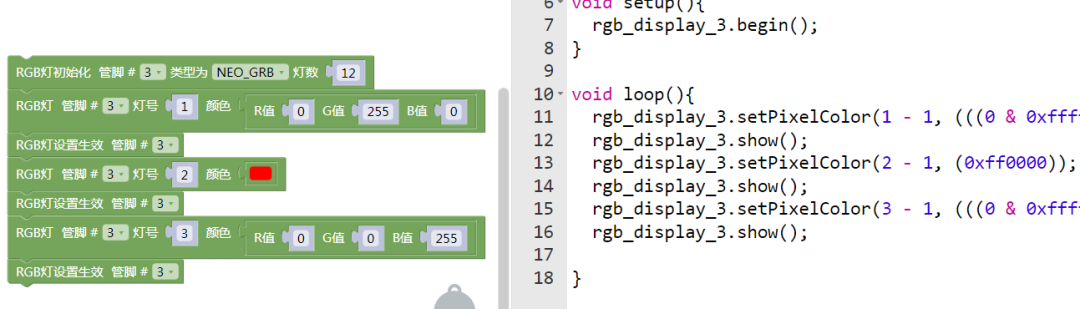
The link pin is D3.
Note: Students should ensure that each code pin remains consistent; otherwise, errors will occur.
Membership group limited-time free entry remaining4days, those who want to learn together should hurry to add,charging mode will start after August 20.
 04Safety Measures
1. Power must be turned off before wiring, and it must be strictly confirmed that VCC is 5V; connecting to 3.3V may result in insufficient brightness, and connecting above 5V will burn the WS2812B chip;
2. The current is relatively high when fully lit, and it is prohibited to power through the Arduino’s 5V pin for long periods; an external independent 5V power supply must be used with a common ground;
3. Avoid direct exposure to strong light (especially in white light mode); prolonged exposure may damage the retina;
4. The data signal line (DIN) should be kept as short as possible (≤1 meter); for long line transmission, a 470Ω current-limiting resistor and a 100nF filter capacitor should be added;
5. When soldering, the soldering iron temperature should be ≤300℃, and the soldering time should be ≤3 seconds to prevent high temperatures from damaging the LED pins;
6. If the module is used for children’s toys, it must be encapsulated and fixed to prevent children from accessing the circuit board and pins;
7. If some LEDs do not light up or show abnormal colors during debugging, check for data transmission errors (brightness can be reduced for testing).
05Extensions
Students can try the following methods:
1. Create an “Emotion Sensing Light Ring”: linked with the HS-S70-P heart rate sensor, displaying red tones when heart rate increases and blue tones when calm;2. Build a “Music Spectrum Light”: combining with the sound sensor, converting audio signals into color and brightness changes of the ring light, dancing with the music;3. Design an “Environment Adaptive Light”: in conjunction with the HS-S42A color sensor, automatically displaying complementary colors after detecting the main color tone of the environment, creating a harmonious atmosphere;4. Develop an “Interactive Game Controller”: selecting light modes through the HS-S39A touch keyboard or controlling the light flow direction with an accelerometer. Arduino Sensor: HS-S01A Infrared SensorArduino Sensor: HS-S02P Infrared Sensor (Obstacle Avoidance)Arduino Sensor: HS-S03P Ultraviolet SensorArduino Sensor: HS-S05P Sound SensorArduino Sensor: HS-F07P Active BuzzerArduino Sensor: HS-F02P Passive BuzzerArduino Sensor: HS-S08P Flame SensorArduino Sensor: HS-S09LB Raindrop SensorArduino Sensor: HS-S09PC Soil Moisture Sensor
Arduino Sensor: HS-S10P Mist Sensor
Arduino Sensor: HS-S11-L Gas Sensor
Arduino Sensor: HS-S20P Ambient Light Sensor
Arduino Sensor: HS-S21P Tilt SensorArduino Sensor: HS-S22P Grayscale SensorArduino Sensor: HS-S24P Digital Temperature SensorArduino Sensor: HS-S26A Temperature and Humidity SensorArduino Sensor: HS-S28P Potentiometer
Arduino Sensor: HS-S31P Touch Sensor
Arduino Sensor: HS-S37PS Water Level Sensor
Arduino Sensor: HS-S38P Human Sensor
Arduino Sensor: HS-S40P Hall Magnetic Sensor
Arduino Sensor: HS-S45P Pressure Sensor
Arduino Sensor: HS-S46P Weight Sensor
Arduino Sensor: HS-S59P Slot Photoelectric Sensor
Arduino Sensor: HS-S70P Heart Rate and Blood Oxygen Sensor
Arduino Sensor: HS-S71P Thin Film Pressure Sensor
Arduino Sensor: HS-S72P Metal Detection Sensor
Arduino Sensor: Infrared Receiver Module
Arduino Sensor: Infrared Transmitter Module
Arduino Sensor: Clock Module
Arduino Sensor: Rotary Encoder Module
Arduino Sensor: Dual-axis Joystick Module
Arduino Sensor: Gyroscope Module
Arduino Sensor: Voice Broadcast Module
Arduino Sensor: Voice Recognition Control Module
Arduino Display Module: LED Light Module
Arduino Display Module: RGB Light Module
Arduino Control Module: Traffic Light Module
Arduino Positioning Module: Linear Laser Spotlight Module
Arduino Control Module: Self-locking Button Module
Arduino Storage Module: SD Card Module
Arduino Control Module: Conductive Switch Module

— Previous Recommendations —