
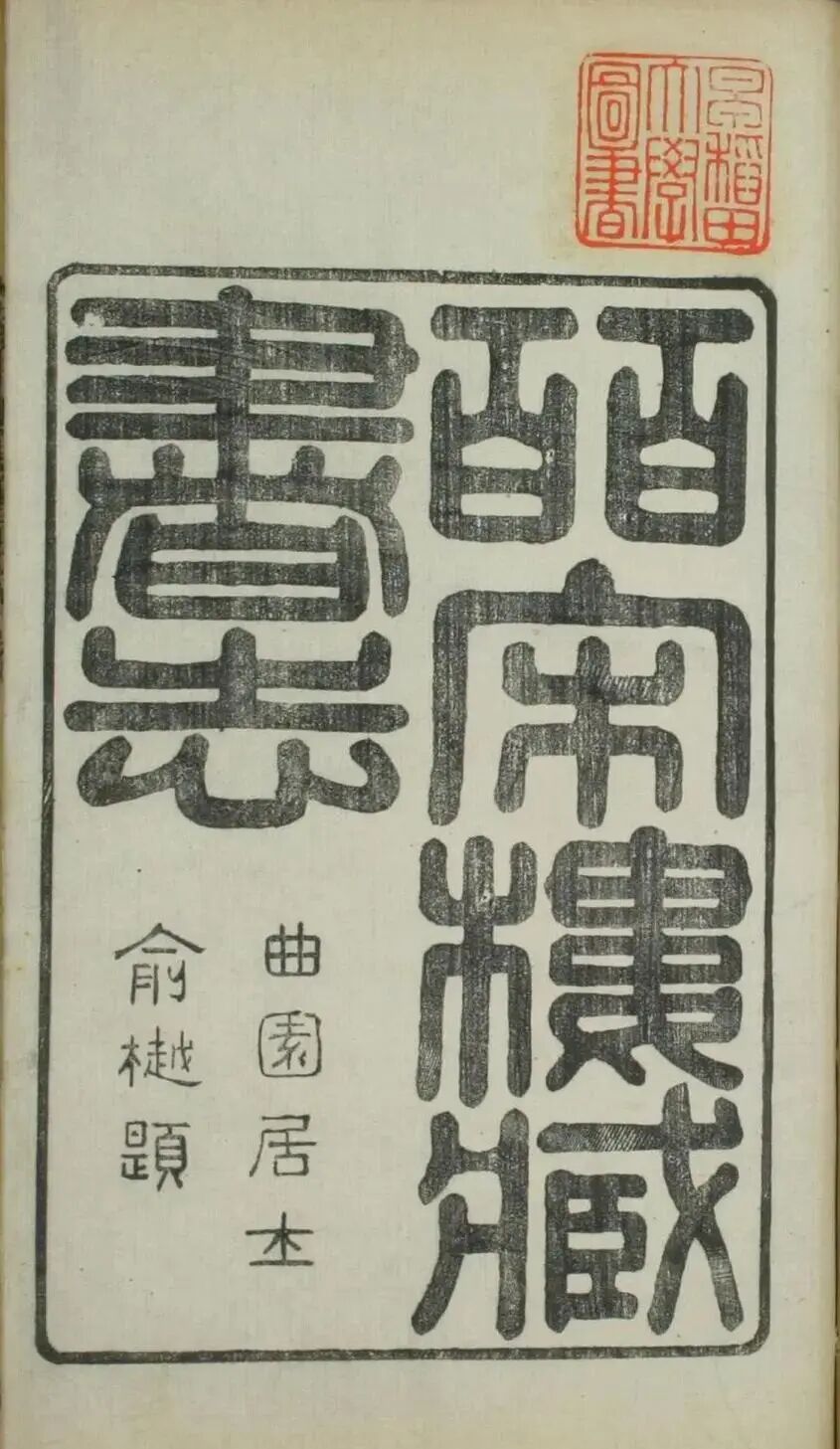
The “Catalog of the Collection at Baisong Tower” was compiled by the late Qing dynasty bibliophile Lu Xinyuan and his disciple Li Zonglian, completed in the eighth year of the Guangxu era (1882). The entire work consists of 120 volumes, with an additional 4 volumes of “Supplementary Catalog.” This catalog systematically records the Song and Yuan editions and famous manuscript versions held in Lu’s Baisong Tower collection, including over 600 ancient texts, among which there are more than 200 Song editions and 400 Yuan editions, making it twice the size of the Tianyi Pavilion collection. Li Zonglian’s preface highlights its characteristics from five aspects: the quantity of the collection, the quality of the editions, and the degree of accessibility, reflecting a model for catalog compilation in the Qing dynasty. In the thirty-third year of Guangxu (1907), the entire collection was sold to the Seikado Bunko in Japan, resulting in the loss of these texts.
Fan Wenzheng’s Government Memorials, 2 volumesSongby Fan Zhongyan, Yuan edition.Belongs to the “Catalog of the Collection at Baisong Tower” Historical Section – Memorials and EdictsNote: Following the catalog, there is a stele inscription from the Yuan Dynasty, published by the Baoxian Family in the year of Jiaxu. Each leaf contains 24 lines, with 22 characters per line. The center of the page has a character count.Fan Wenzheng’s Government Memorials, 2 volumesSongby Fan Zhongyan, Ming edition.Belongs to the “Catalog of the Collection at Baisong Tower” Historical Section – Memorials and EdictsQi once said that since ancient times, the governance of a country and the welfare of its people depend on the people, not on heaven. If people do not agree, it is different. Now, after the time of Wenzheng Fan, we know that his arguments are superior, which may not be doubted and can supplement education. The public, with the talent of a king’s assistant, encountered an extraordinary ruler, devoted himself wholeheartedly, and did everything possible, thus being promoted from a minor official to a position of counsel, speaking candidly and establishing clear regulations. Although his position may be removed, his righteousness is hard to take away. The path of the righteous in the world began with him. Later, he cared for disasters in the south, defended against invasions in the west, participated in political affairs, accompanied the prime minister, and formulated grand strategies, embodying benevolence and righteousness, thinking day and night, with deep and insightful proposals, aiming to benefit the central plains and chastise the four barbarians, ensuring that the foundation of our Song dynasty remains unshaken for generations. Unfortunately, he was often criticized for being far-sighted and not aligning with the immediate situation, thus his words were often disregarded or implemented but later obstructed, almost fourteen or fifteen times. When he passed away, all who heard of him were moved and lamented, regretting that he could not fully apply his wisdom to the world, and even attributed it to heaven, claiming that human efforts were insufficient. Alas! What he proposed for the time, whether grand or minor, was significant. Those that were not implemented are now preserved in the archives, clearly traceable. Once the court adopts and implements them, peace will arise as easily as pointing a finger. Is this heaven? It must depend on people alone. His son, the temple minister, compiled the public’s remaining writings, obtaining 17 volumes of “Memorials” and 2 volumes of “Government Discussions.” Qi, who once led the western troops, assisted the inner court, and was in the same position as him, was tasked with arranging them. With his military and civil talents, he stabilized the royal family, and the discussions of the court and the world, regarding the smoothness or difficulty of the path, were closely tied to his use or disuse, thus his virtue and achievements have long been recognized in the world. It is not that one can only know through inferior writings. However, being connected to the old officials, enjoying the public’s praise, I dare not yield, and also wish to comfort the virtuous descendants.Preface by Han Qi.Preface by Hu Song, Jiajing Year of the RoosterFan Wenzheng’s Poyang Chronicles, 1 volumeSongcompiled by Chen Yifan, Song edition.Belongs to the “Catalog of the Collection at Baisong Tower” Historical Section – BiographiesEmperor Xuan of Han often said: Among those who govern with me, are there not good officials of two thousand stones? In the vast world, how many governors can use good officials? Moreover, Poyang, as recorded in the “Tribute of Yu,” is part of the Yangzhou region. In the Spring and Autumn period, it was the eastern boundary of Chu, later belonging to Wu. The “Records of the Grand Historian” states that in the twelfth year of King Zhao, Wu attacked Chu and took Fan, which is the matter. The Qin unified the world and named it Poyang County, belonging to Jiujiang. The Han renamed it Poyang County, associated with Yuzhang. In the fifteenth year of Jian’an in the Later Han, during the time of Wu’s Great Emperor, Zhang Zhao and others proposed to divide the land of Yuzhang, which was vast and populous, into the two counties of Luling and Poyang. Initially, the capital was in the old city, later moved to Wuru, which is where it is governed today. During the Tianjian period of Liang, Wuzhou was established, and Chen was abolished as a county. The Sui pacified Chen, abolishing the county and making it a state. The Great Yike restored it as a county. In the fourth year of the Tang Wude period, after pacifying Jiangzuo, it was restored as a state, thus Poyang has been a state for nearly four or five hundred years. Looking at the governors, there are no less than a thousand, yet among those recorded on the hall walls, since the eighth year of Kaibao, there have been 68 people, including Zhang Renzhong, who was in charge of the Iron Forest Army, up to the Yuan Dynasty’s Ren Shen year, the court official Zou Ke. However, among the recorded governors, only Wu, Zhou, Yu, Liang, Liu, Ma, and Li are mentioned, along with Yan, Lu, and Fan, totaling nine, which is not many for two thousand stones. I, serving in Rao, saw the incident of Lu Gong’s snow-covered Cheng Xiaoniang being attacked, and specifically recorded its beginning and end, and depicted its image to attach to the memorial hall of Wenzheng Gong, as the virtuous governor cannot be easily found. Alas! In Poyang, there are nearly a thousand governors, yet only nine are recorded in images, while the virtue of the public remains unforgotten, and the people of Rao built temples for him at the Spring Hall, Tianqing Temple, and the lecture hall of the state school, totaling three. Since Jingyou, it has only been sixty years, and the incense has not ceased, with offerings increasing daily, compared to the distant benefits of a thousand people, the love and kindness bestowed are solely from the public. However, the public’s legacy and beauty truly permeate all things, and every time the people think of him, it is not just the memorial hall. The public viewed governance daily, thus creating and repairing the traces of governance, enjoying the old sites of poetry and song, all of which are respected and remembered. I, therefore, collected what is respected and remembered, naming it “Chronicles of Poyang by Fan Gong,” not daring to seek fame in the world, but hoping it will be passed down for future generations, and not merely for the songs of the memorial hall. Moreover, the public began as the judge of Hezhong, moved to Wanqiu, and successively governed twelve counties including Yan, Qing, Hang, Yue, Su, Run, Qing, Ying, Bin, Yao, Deng, and Yongxing, with pure and virtuous deeds shining in national history, family collections, and memorials, what need is there for this? As for the public’s arrival, there were benefits in Deng and Qing counties, and the people painted images and built temples for him, with imperial inscriptions praising the virtuous stele, and the blue history recorded for thousands of years, which has long been known. I suspect that the chronicles of Rao may have some unrecorded matters, how can they be discarded? In the sixth month of the year of Yihai, Shaosheng, at Tiantai,Chen Yifanprefaced.Chronicles of Fan Wenzheng, 1 volume, with supplementary materials, memorials, and praises for the temple of the virtuous.Compiled by Fan Zuyou, the fifth generation descendant,and edited by Fan Yao, the Song edition, Yuan printed edition.Belongs to the “Catalog of the Collection at Baisong Tower” Historical Section – BiographiesThe late public was born in the Song dynasty during the Duan Gong period and passed away during the Huangyou period, coinciding with the peak of prosperity, with loyalty and virtue, able to display loyalty and integrity, with achievements in the court and prestige on the borders, benefiting descendants. The Grand Historian has a record, and the tomb path has a stele, with great public names and virtuous discussions praised, shining eternally. However, the “Chronicles” have not been engraved, is it not a deficiency? The national scholar, who is honored to serve the temple affairs, respectfully orders the work to be printed, along with the collected works and memorials, so that readers may have a reference. On the fifteenth day of the first month in the third year of Tianli, the year of Gengwu,the eighth generation descendantGuojunrespectfully inscribes.In the past, the collected works of Wenzheng Gong that circulated in the world were more than dozens of volumes, but over the years, none have survived. Recently, I obtained an old edition, imitating its characters and illustrations, and published it in the Yuhan Hall of the Wumen family, hoping to pass it down to descendants. Recently, I was fortunate to acquire a separate edition of Poyang, thus knowing that there are still deficiencies, and therefore continued to publish to supplement the collection. Future generations may encounter good editions and further revise and pass them down. On the day of Jiachen in the third year of Yuan Tong,the eighth generation descendantWen Yingrespectfully inscribes.Fan Wenzheng’s collected works, 20 volumes, separate collection 4 volumes, letters 2 volumesSongby Fan Zhongyan, preface by Su Shi, Song Qian Dao edition.Belongs to the “Catalog of the Collection at Baisong Tower” Collection Section – Separate CollectionPoyang is located on the left bank of the Yangtze River, known as an ancient county, and many have been governors, but only nine are known for their virtue, and among the nine, only the Tang’s Yan Lu Gong and the current Fan Wenzheng Gong stand out, which is indeed rare. The names of these two public figures are recorded in the historical records, and their great integrity is known throughout the world. As for their writings, scattered among the people, although they are playful in style, they are elegant and pure, capable of governing the world and enduring for a long time, as they embody the righteous spirit of heaven and earth, thus their writings are likewise. However, this region indeed lacks the writings of these two public figures, and they are only occasionally seen elsewhere, which is truly a deficiency. Since the beginning of the Song dynasty, I have sought to obtain them, and I have been fortunate to find them in the collection of the family of the late public. I have thus compiled them and engraved them to pass down. On the day of the fifth month in the year of Dinghai,Yuan Zhirespectfully inscribes.In the past, the writings of the late public have been widely circulated, and I have not seen the complete collection, which is a regret. I have been fortunate to obtain the complete collection from the family of the late public, and I have returned to my home. On the day of the fifth month in the year of Dinghai,Yuan Zhirespectfully inscribes.Fan Wenzheng’s collected works, 20 volumes, separate collection 4 volumes, letters 2 volumesSongby Fan Zhongyan, preface by Su Shi, Song Qian Dao edition.Belongs to the “Catalog of the Collection at Baisong Tower” Collection Section – Separate CollectionIn the past, the writings of the late public have been widely circulated, and I have not seen the complete collection, which is a regret. I have been fortunate to obtain the complete collection from the family of the late public, and I have returned to my home. On the day of the fifth month in the year of Dinghai,Yuan Zhirespectfully inscribes.Fan Deji’s poetry collection, 7 volumesQingby Huang Rao Puedited, Yuanby Confucianism’s academic leaderSun Cunwuas a mountainedited, Yuanby LinchuanGe Yangcompiled, old manuscript.Belongs to the “Catalog of the Collection at Baisong Tower” Collection Section – Separate CollectionNote: Following the catalog, there is a new edition published by the Yi You Book Hall in the year of the Geng Chen, with a hand-written note by Huang stating: The poetry of Fan Deji is not mentioned in the manuscript, but it is said that this collection and the “Jie Man Shuo Collection” were both given by Zhou Zhongrong of Furong River, and it has not been mentioned whether it is a manuscript or a printed edition. This old manuscript, based on the previous catalog and the publication date, is known to be based on the Yuan edition, but many discrepancies with the family collection’s Yuan edition are noted. Therefore, it has been hand-corrected, and the old text is not to be taken as the final version. It seems that the manuscript has been revised, and it is not the edition used by Xiaozhang when he edited it, hence the frequent discrepancies. Therefore, I have taken the revised version for correction, and it is noted as a continuation of the manuscript correction. On the tenth day of the fifth month, I completed the corrections.Again, it is noted: On the day before the Dragon Boat Festival, a book friend brought a book to show me, saying it was obtained from a merchant in Wujiang. Upon opening the book, I recognized it as an old manuscript of “Fan Deji’s Poetry Collection,” which had been corrected by someone. When I asked for the price, he asked for a thousand coins. I said: Do you know why this book is valuable? He replied: I do not know. I smiled and kept it. This book is an old manuscript, and it has been corrected. The reason the merchant asked for a thousand coins is that the corrector is not a common person. There is no illustration to prove it, and there are discernible characters, so it is precious. Moreover, my desire to obtain this book is because, although it has been corrected, it has also been revised, and I have not seen the Yuan edition, so there are still many omissions. I happen to have the Yuan edition, and after hand-correcting it once, it has become a good edition. This book must return to me, and it has finally been perfected, and there are indeed some remaining copies.Fu Wengnotes.Again, it is noted: The “Xiao Ci Tang Book Catalog” states: “Fan Deji Collection,” by Fan Deji, 7 volumes, manuscript with 134 sections, one volume, hand-corrected by Jin Xiaozhang. This is indeed the book. Fu Weng noted this on the sixth day of the month. Again, it is noted: In the winter of the year of Ren Chen, on the tenth month, I compared it with the Ji Gu Ge edition, and noted the discrepancies and doubts.

 Warm Reminder:Due to WeChat’s changes in push rules, those who do not frequently click “View” will gradually stop receiving pushes.If you still want to see the information pushed by this platform, please add us as a star, and don’t forget to click “Like” and “View” after reading each time.