Comparative Analysis of Open Source Hardware for Elementary AI Education Based on DeepSeek
Gao Jiaxuan Li Zeyu Lu Kanghan Fang Haiguang
Capital Normal University, Beijing 100048
Author Introduction
Gao Jiaxuan, Master’s student.
Li Zeyu, Master’s student.
Lu Kanghan, Master’s student.
Fang Haiguang, PhD, Professor.
Table of Contents

Abstract
Elementary AI education is rapidly developing, and the advancement of DeepSeek facilitates the integration of AI, IoT, and big data into the elementary AI curriculum. Therefore, applying smart hardware in AI teaching is becoming increasingly important. This study selects four types of open-source hardware: Arduino, micro:bit, HarmonyOS with Hi3861, and ESP32, analyzing their adaptability in elementary AI courses and how open-source hardware can effectively help students develop logical and practical skills. Through a teaching case study of “Designing an Intelligent Air Conditioning System,” the impact of open-source hardware on teaching is demonstrated, showcasing the application of open-source hardware based on DeepSeek in elementary AI education.

Keywords
Arduino; micro:bit; HarmonyOS with Hi3861; ESP32; open-source hardware; generative AI
As AI education gradually integrates into various levels of the education system, AI-related content is also being incorporated into the basic education curriculum. Computers are equipped in primary and secondary schools, but the application of smart hardware is still in its infancy, and differences in local economies and teacher qualifications affect the advancement of educational digitization and the construction of AI courses.[1].
The elementary stage is a critical period for cognitive development and thinking training. According to Piaget’s theory of cognitive development, elementary students are in the concrete operational stage, where their thinking development shows significant characteristics of visualization, demonstrating a stronger acceptance of intuitive and manipulable learning content. This cognitive characteristic sharply contrasts with the abstract nature of AI general education, highlighting the importance of selecting appropriate teaching tools. Utilizing smart hardware and human-computer collaboration in elementary education can effectively promote learners’ cognitive transfer from concrete experiences to abstract concepts.[2] The rapid development of intelligent education platforms provides new technical support for AI education. By leveraging DeepSeek, algorithm optimization is achieved through a hybrid expert model, and the knowledge distillation technology can compress complex models into lightweight versions suitable for educational scenarios, significantly enhancing the appropriateness of AI education.[3] The application of open-source hardware in education can stimulate students’ interest in learning; intuitive hardware equipment helps students improve practical skills while transforming abstract programming concepts into concrete behaviors.
1. Necessity Analysis of Integrating Open Source Hardware into AI General Education
In recent years, the central government has placed great importance on the construction of open-source systems. The “14th Five-Year Plan for National Economic and Social Development of the People’s Republic of China and the Long-Range Objectives Through the Year 2035,” released in 2021, included “open source” for the first time, requiring the strengthening of key digital technology innovation applications and accelerating the promotion of digital industrialization. Therefore, cultivating top innovative talents autonomously to provide talent support for tackling key core technologies in China has become particularly important.[4] The Ministry of Education’s notice issued in 2024 on strengthening AI education in primary and secondary schools states that lower-grade elementary students should focus on perceiving and experiencing AI, while upper-grade students should focus on understanding and applying AI. Additionally, attention should be paid to the ethical application of AI education, guiding students to use various AI technologies scientifically and reasonably, especially generative AI. Schools are encouraged to incorporate AI education into after-school service projects and research practices, promoting the integration of industry, academia, research, and application, collaborating with AI companies, universities, research institutions, and industry associations to develop a batch of AI education courses and teaching cases to support teaching.
Analysis based on curriculum frameworks and standards indicates that machine learning has become a core module in elementary AI general education. Teaching guided by gamified learning and embodied cognition theory can significantly enhance learners’ conceptual understanding and knowledge transfer abilities. The application of dynamic teaching tools, such as programmable robots, not only provides timely feedback mechanisms but also effectively stimulates learners’ intrinsic motivation.[5] The introduction of open-source hardware platforms provides new ideas for solving cognitive disconnection issues in traditional teaching. Based on constructivist learning theory, these platforms can support learners in developing computational thinking through a “learning by doing” approach while solving real-world problems.[6] Furthermore, the design of AI general education needs to pay special attention to interactivity and fun, avoiding overly abstract and complex content.[7] The scalability of open-source hardware provides possibilities for interdisciplinary project-based learning.
2. Comparison of Open Source Hardware Functions
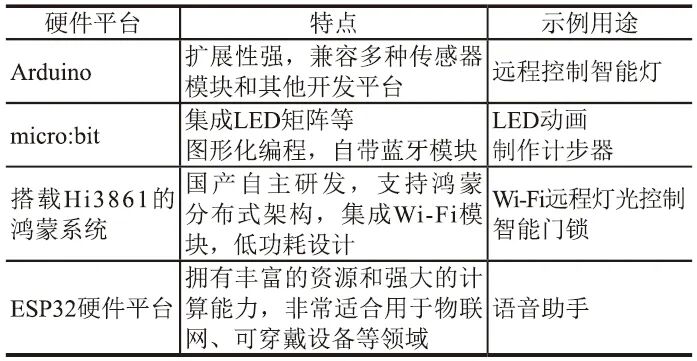
Different open-source hardware platforms exhibit significant differences in technical characteristics and practical applications due to their design concepts and application goals (Table 1). Arduino, with its modular design features, shows significant advantages in the field of information technology education in primary and secondary schools. This platform’s support for visual programming tools like Scratch significantly reduces the cognitive load for beginners. The micro:bit platform, designed for the cognitive characteristics of adolescents, provides technical support for interdisciplinary project-based learning through the integration of multimodal sensors, visual interactive interfaces, multi-system compatibility, and standardized peripheral interface design. The HarmonyOS with Hi3861 is a domestically developed open-source hardware that supports the Harmony distributed architecture and integrates a Wi-Fi module. Its derivative products also demonstrate strong applicability in graphical programming and can effectively simulate smart home environments for learners to practice. The ESP32 chip, with its dual-mode communication and high-performance computing characteristics, has significant advantages in IoT education. Its powerful computing capabilities can support AI functions such as image recognition and voice control, providing an ideal experimental platform for teaching embedded systems.[8].
Table 1 Comparison of Characteristics and Uses of Different Open Source Hardware
3. Comparison of Focus in AI General Education Using Open Source Hardware
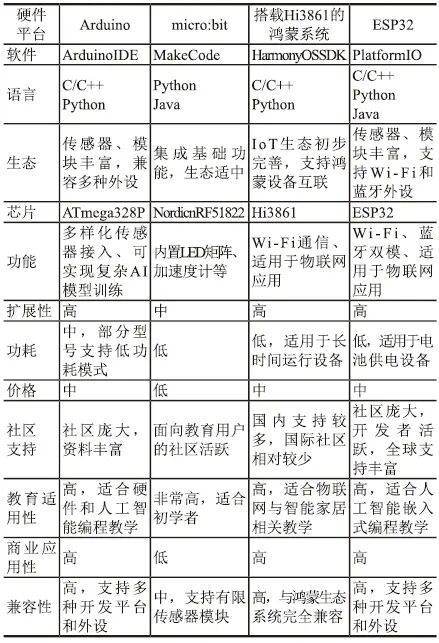
Based on the samples of the four types of open-source hardware and the collected information data, a specific analysis of their various aspects is conducted (Table 2), aiming to showcase the overall characteristics of these samples across different dimensions, reflecting the current advantages and disadvantages of open-source hardware. The software support system of open-source hardware platforms shows obvious hierarchical characteristics. At the basic level, platforms generally integrate graphical programming tools (such as Scratch), which lower the learning threshold for beginners through visual interfaces. As users’ skill levels improve, platforms can gradually provide interfaces for advanced programming languages like Python and C++ to support more complex project implementations. In recent years, some platforms have begun to integrate AI frameworks like TensorFlow Lite, providing possibilities for developers to explore machine learning applications. In AI general education, the popularity of graphical programming tools enables beginners to quickly grasp core concepts. Taking Raspberry Pi as an example, its rich educational resources and community support make it an ideal choice for programming education in primary and secondary schools. Additionally, the development of open-source hardware communities shows significant differences across fields. Community support in the education sector is relatively active, providing learners with abundant learning resources.
Table 2 Comparative Analysis of Different Dimensions of Open Source Hardware
4. Teaching Design Supported by Hardware
The introduction of open-source hardware provides a technical carrier for achieving layered teaching objectives (Figure 1). For example, the distributed architecture design of HarmonyOS with Hi3861 provides a “physical-digital” integrated practical environment for collaborative learning in smart home scenarios, which aligns closely with George Siemens’ connectivism learning theory. Therefore, goal-oriented teaching design should follow the three-part framework of “problem context – technical tools – cognitive scaffolding”; the teacher’s role should also shift from knowledge transmitter to learning facilitator. In this regard, the intelligent assistance system of the DeepSeek platform reconstructs teaching interaction through two mechanisms: first, the real-time debugging feedback function forms a dynamic cognitive scaffold, automatically pushing targeted debugging suggestions when learners encounter logical errors; second, the semantic retrieval function of the project case library supports teachers in quickly matching teaching objectives with hardware resources. This dual-channel support model significantly enhances classroom interaction efficiency. The natural language interaction module of the DeepSeek platform allows learners to obtain technical guidance in a conversational format, thereby reducing cognitive barriers commonly encountered in traditional programming teaching. The multi-dimensional evaluation of open-source hardware projects needs to integrate process data and outcome indicators. In the process dimension, DeepSeek can record these behavioral trajectories in real-time, providing a data foundation for analyzing learners’ metacognitive strategies.
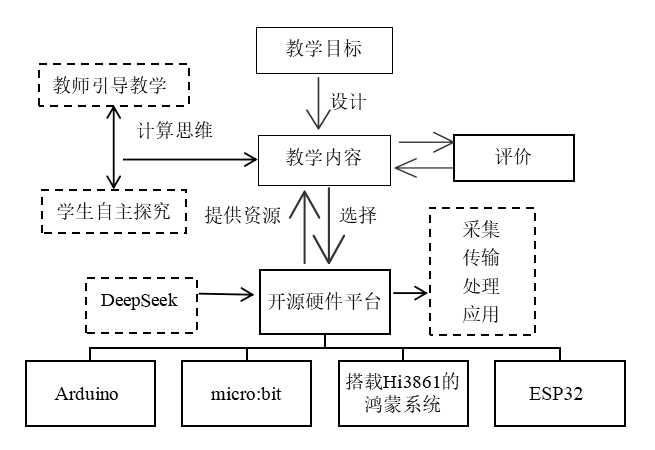
Figure 1 Teaching Integration Model Based on Open Source Hardware
5. Application of Open Source Hardware in Teaching
This case study uses open-source hardware with HarmonyOS and takes the teaching of “Designing an Intelligent Air Conditioning System” as an example (Figure 2). Students are required to design and implement: when the indoor temperature reaches or exceeds 30°C, or the humidity exceeds 40%, the fan automatically starts, and the window opens; when the indoor temperature and humidity return to normal ranges, the fan stops running, and the window closes. The design and implementation of the smart home system aim to cultivate learners’ comprehensive practical abilities in the IoT field. The teaching objectives can be broken down into three dimensions: first, understanding the architecture and functional modules of the smart home system and mastering requirement analysis methods; second, applying modular design concepts to achieve computational and control logic; third, completing project development through teamwork to enhance practical abilities and innovative awareness. In the smart home system design project, students first need to conduct functional design based on actual needs, using DeepSeek for literature research to clarify the specific positioning of each functional module and decompose system requirements into several sub-modules; secondly, they formulate an environmental data collection plan, determining the tools and methods for collecting data from each functional module; finally, they conduct modular logic design to arrive at the final implementation plan, deeply understanding the complete process of “collection – transmission – processing – application” in IoT systems. Throughout the teaching implementation process, DeepSeek’s intelligent analysis tools can provide guidance and design optimization support for students.
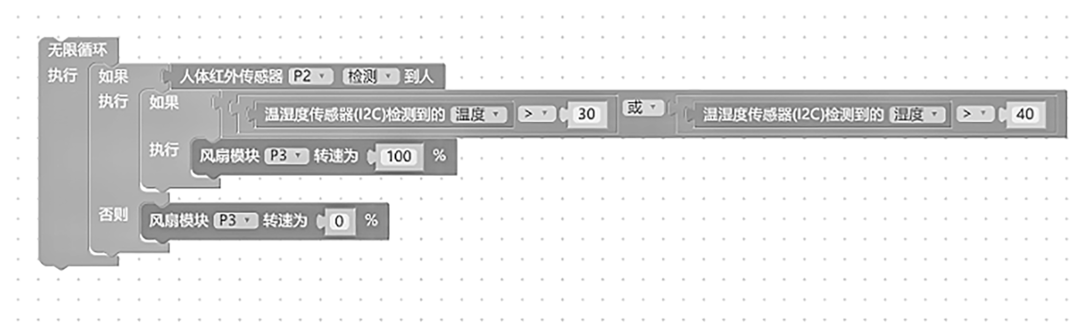
Figure 2 Open Source Hardware Teaching Code Display
6. Conclusion
Open-source hardware, with its advantages of openness, low cost, and community support, plays a positive role in elementary AI general education, helping students cultivate logical thinking, practical skills, and innovative spirit through intuitive operations. The case of “Designing an Intelligent Air Conditioning System” validates the teaching potential of open-source hardware in requirement analysis, data collection, logic design, and outcome presentation.
However, the research still has several shortcomings. First, the types of hardware platforms used are relatively limited, failing to fully cover the various needs in elementary AI general education, which somewhat restricts the diversity and innovation of teaching content. Second, the sample size for data analysis is small, limiting the applicability and depth of the research results. In elementary AI general education, AI education software is also an important auxiliary tool that needs to be emphasized in research. Finally, AI education software includes three categories: integrated development environments, firmware, and dedicated training platforms, which means that research on it should also refer to the processes and methods of hardware research. In the future, data can be collected from the teaching practice dimension regarding various representative hardware usage situations, teacher-student experiences, actual needs, and application barriers to comprehensively evaluate the development status of smart hardware, thereby developing more suitable dedicated hardware for elementary AI general education and conducting in-depth research on interdisciplinary integrated teaching models.
References
[1] Fang Haiguang, Shu Lili, Wang Xianchuang, et al. The Possibilities and Potential of Digital Transformation in Education in the Era of Generative AI: Reflections on Sora [J]. Journal of the National Academy of Education Administration, 2024(4):69-75.
[2] Fang Haiguang, Kong Xinmei, Li Haiyun, et al. Research on Human-Computer Collaborative Education Theory in the Era of AI [J]. Modern Educational Technology, 2022, 32(7):5-13.
[3] Tu Liangchuan, Gao Meiqi. Philosophical Narratives of the Essence of Intelligence in the Era of Large Models: Starting from the Technical Narrative of the DeepSeek Effect [J]. Journal of Northwestern Polytechnical University (Social Sciences Edition), 2025(2):1-10.
[4] Xu Xiaojun, Tian Haoxuan. Current Application Status and Situation Analysis of Open Source Hardware in Primary and Secondary Schools in Shanghai [J]. China Modern Educational Equipment, 2024(24):1-5.
[5] Zhong Baichang, Yu Junzhan, Xie Zuoru. What Kind of Smart Hardware is Needed for AI Courses in Primary and Secondary Schools: Status Analysis and Development Direction [J]. Distance Education Journal, 2024, 42(1):74-83.
[6] Huang Ran. Practical Research on Cultivating Students’ Innovative Abilities in Open Source Hardware Creative Manufacturing Competitions [J]. Educational Information Technology, 2024(9):62-65.
[7] Huang Xingqiu. Open Source Manufacturing, Practical Innovation: AI Education Practice Based on Open Source Hardware [C]//Beijing International Exchange Association. Proceedings of the 4th Education Innovation and Experience Exchange Seminar, 2024:4.
[8] Wang Hao. Teaching Case Design of AI Voice System Based on ESP32 Platform [J]. Office Automation, 2024, 29(24):13-15.
This article was published in the 16th issue of China Modern Educational Equipment in August 2025. Please indicate the source if reprinted.
Editor | Miao Xuanming
Review | Zhao Yuan
Release | Li Yuewei