Source: IoT Space Station
Author: Silver Craftsman
Translated from i-scoop
Reprinted by IoT Think Tank

Introduction
The role of IoT platforms in the entire IoT ecosystem is self-evident. However, the demand for platforms is increasingly not just for remote management but also for powerful edge capabilities. Edge capabilities are becoming a key indicator that distinguishes the performance of all IoT platforms.
The rise of the IoT has greatly increased attention to data processing capability platform technologies, including cloud computing, edge computing, and fog computing concepts. In simple terms, edge computing and fog computing bring data processing, analysis, and computing capabilities closer to the edge of the network.
Currently, supporting edge computing and fog computing capabilities is one of the main trends in the IoT platform market. Even though edge computing is still in a very early stage, some enterprises and industry applications increasingly require edge computing capabilities for functionality, such as real-time data invocation and analysis. Of course, not all IoT deployments or data require edge computing. However, as IoT projects mature and expand, more and more IoT use cases will need it.
At present, several major verticals in IoT, such as smart cities and industrial IoT, place great importance on the empowerment of IoT platforms. Therefore, the importance of edge functionality becomes higher when these application areas choose the best IoT platform.
Why Edge Functionality is Important When Enterprises Choose IoT Platforms
When IoT enterprises or projects choose a platform, they need to comprehensively consider project functional requirements and budget costs. Currently, the most obvious situations requiring edge computing include the following aspects:
Having a large number of IoT nodes, possessing a significant amount of critical data, and needing to quickly invoke, analyze, and apply data;
Due to constraints, the cost of transmitting data to data centers or cloud platforms is relatively high, and the latency is also considerable;
Quickly filtering local data to extract specific data for sending to the cloud platform for application, thus maintaining high efficiency in device management;
Needing a higher level of security, as data can be better encrypted and authenticated at the edge, embedding security in a distributed manner;
Projects require lower costs and higher efficiency; after comparing real-time performance, storage, and bandwidth costs, edge computing has advantages over cloud computing.
Why is edge computing also an important platform capability for these enterprises?
First, enterprises need to find the most suitable IoT platform to meet their needs. In many industries, the demand for edge computing is very evident, such as the need for rapid processing feedback of specific data and low latency requirements. For example, gateways, edge servers, and controllers in industrial IoT all require edge capabilities.
Second, an IoT project does not connect all components from the beginning. Often, IoT is a stock market, meaning retrofitting existing devices. Therefore, the cost of connecting to a cloud platform may be too high, while adopting localized edge computing capabilities may be more cost-effective.
Choosing the best IoT platform is not just a current issue. As the next phase of IoT deployment arrives, enterprises often migrate in stages, learning from experience and adding more applications and use cases.
Therefore, although edge computing is still maturing, some IoT platforms already offer edge/fog capabilities. Thus, users choosing the best IoT platform typically do not complete this in the short term; they also need to consider edge intelligence.
In summary, edge functionality is a very important criterion when enterprises choose the best IoT platform.
When enterprises select the best IoT platform based on their needs, they need to fully consider the current and future requirements for edge functionality.
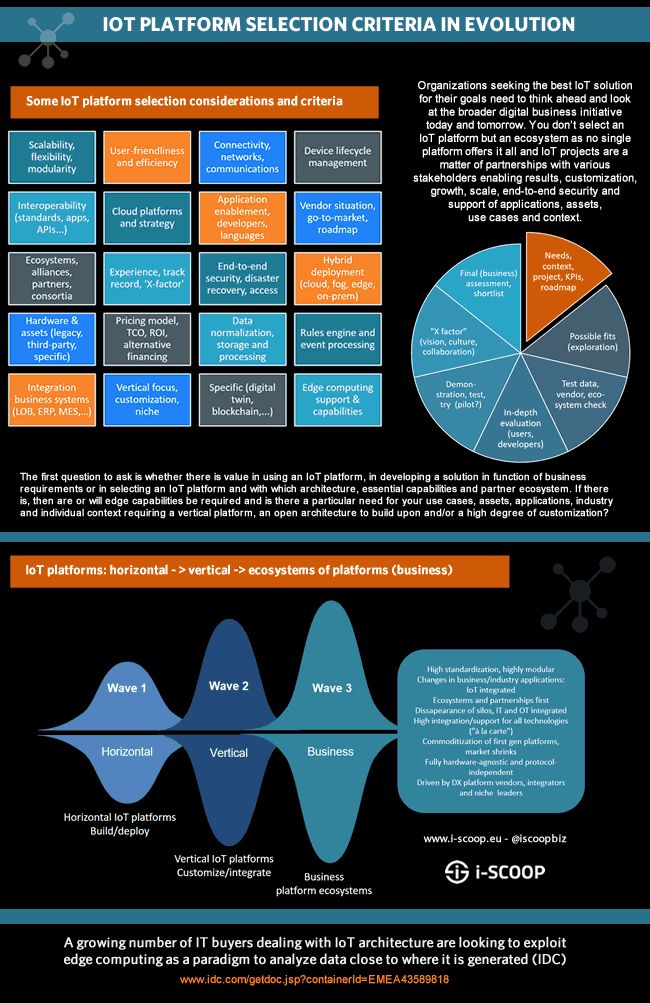
The Position of IoT Edge Platforms in the IoT Platform Architecture
Clearly, choosing the best platform that supports edge functionality is not just about these edge features themselves; it also requires consideration of the specific capabilities of the edge computing platform.
Edge capabilities are part of several performance parameters in the MachNation IoT platform architecture model. In this model, the device, edge, and cloud levels are well illustrated, with colors representing the categories of performance parameters of the IoT platform, including functionalities in application enablement, monitoring, access control, analytics, integration, device management, event processing, and data management. Choosing the best IoT platform will depend on the performance of several architectural components in executing tasks and their importance at deeper levels.
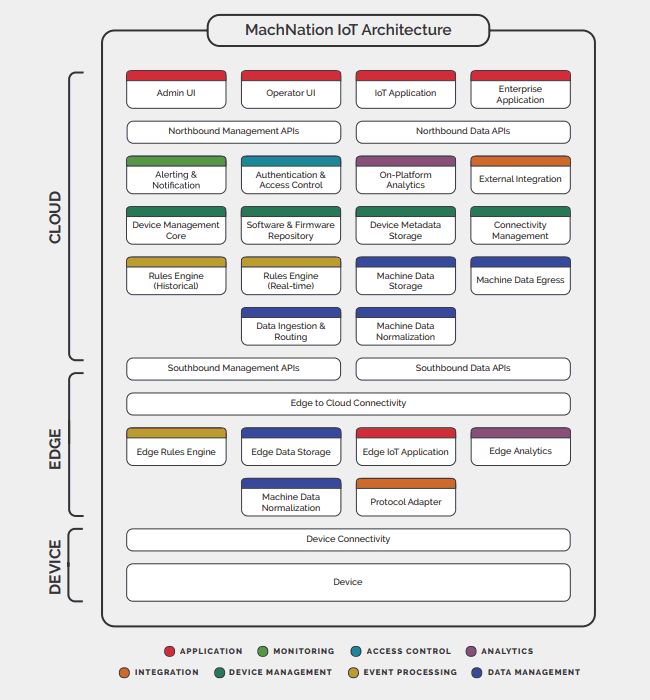
(MachNation IoT architecture model, divided into 8 categories, distinguished by different colors)
Selection Criteria for the Best Edge Platforms and IoT Platforms with Strong Edge Capabilities
What are the important selection criteria for IoT platforms with edge capabilities and IoT edge platforms?
Craig Resnick from ARC Advisory Group shared a blog post in April 2018 about edge computing in industrial environments. According to Craig Resnick, the key decision criteria for IoT edge platforms include:
The platform’s ability to connect to a wide variety of devices;
The ability to ensure data security using the latest cybersecurity technologies;
The coordination capability when edge computing is used in conjunction with cloud computing.
Craig Resnick defines the edge as a local count, with edge computing being closer to machines and data sources. The development of edge devices in the service domain has exceeded the traditional upper-layer network role, becoming an integral part of the IoT architecture, which is key to integrating IT and OT.
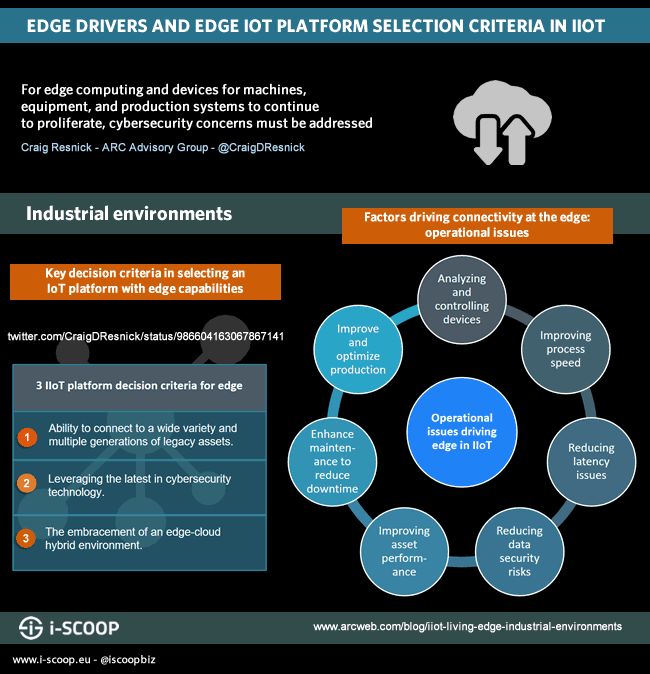
Challenges of IoT Edge Software and Hardware When Choosing Vendors
Dima Tokar, CTO of MachNation, also pointed out that about 90% of edge complexity is related to software. Many vendors provide hardware, but that is not enough. Tokar states that software is the key to distinguishing the quality and complexity of edge computing.
The following image shows how edge computing vendors are using their own IoT gateways as a breakthrough, as deploying edge computing on gateways is easier than on devices. However, this may not necessarily be a good choice for IoT platform buyers.
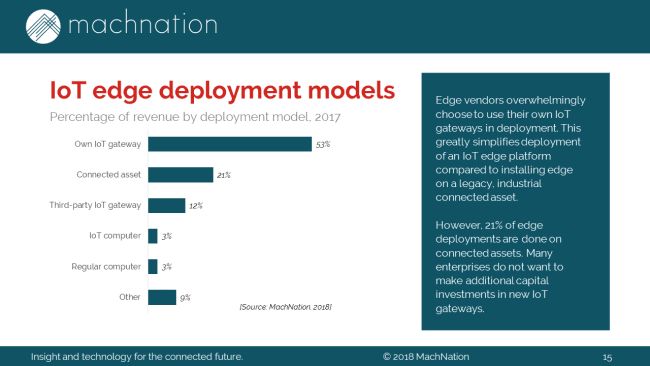
MachNation states that IoT edge platform software vendors choose to use their own IoT gateways, but many edge deployments are conducted on connected assets because enterprises do not want to invest in new IoT gateways. 21% of edge deployments are completed on industrial equipment, followed by third-party IoT gateways.
Key Features Required for IoT Edge Platforms
Regarding the selection criteria for connected platforms, MachNation mentioned five very important features.
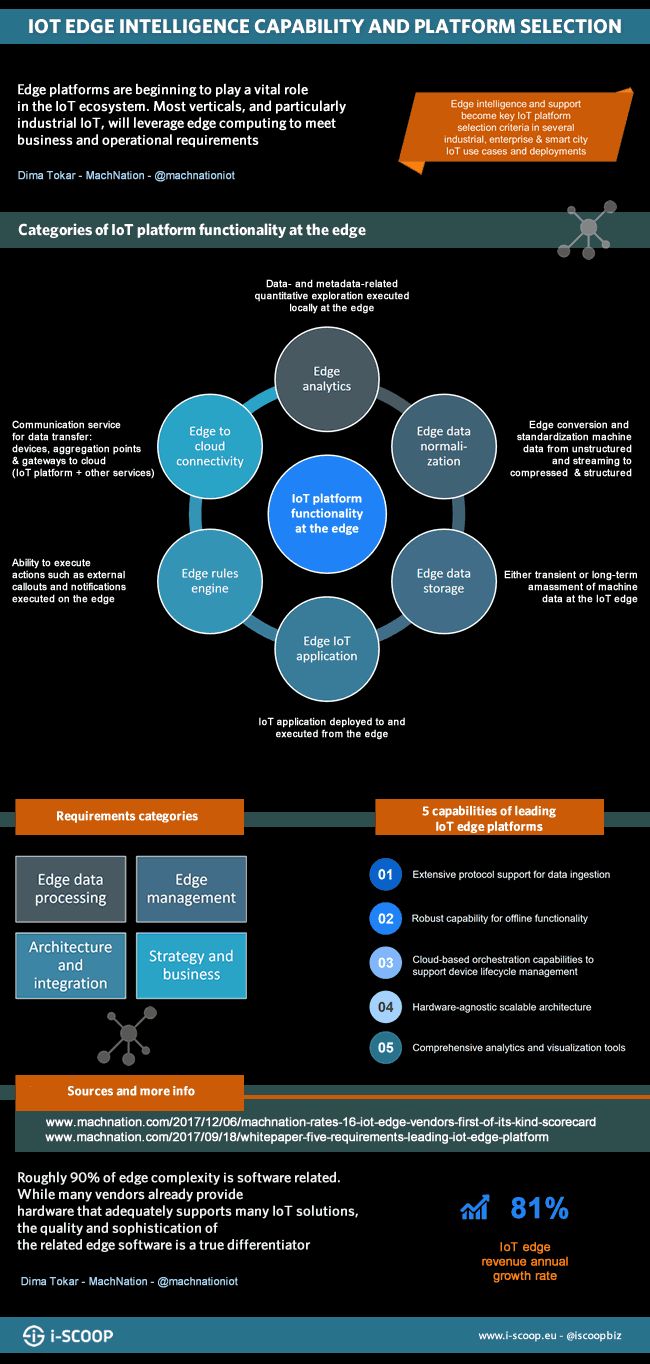
Compatibility with Multiple Data Protocols
The first feature of an IoT edge platform is broad protocol support for data ingestion, as well as the security performance of the IoT platform. MachNation also states that the platform’s support for protocols should be modular, allowing for customized asset communication, and in terms of security, encryption, authentication, and data protection capabilities are key.
Strong Offline Processing Capabilities
The second feature of an IoT edge platform is local processing performance when offline. According to MachNation, the offline capabilities of edge systems mainly include four functions:
Data normalization, which can eliminate noise from sensor data.
Storage that supports intermittent or limited connections between edge and cloud.
An event processing engine that is flexible at the edge.
Strong system integration capabilities, including ERP, MES, inventory management, and supply chain management, to help ensure business continuity and real-time access to machine data.
Cloud-Based Orchestration Capabilities
Cloud orchestration capabilities that support device lifecycle management, IoT device access, monitoring, and updating functions.
API-based interactions need to allow devices to pre-install such certificates and keys. Additionally, the edge platform should be able to monitor devices using machine flow and operational data, which can selectively synchronize with cloud instances and should push updates wirelessly to edge applications, the platform itself, gateway operating systems, device drivers, and devices connected to the gateway.
Hardware-Agnostic and Comprehensive Analytics/Visualization Tools
Depending on the IoT project and specific applications, the range of capabilities in comprehensive analytics and visualization tools is also an important feature. The IoT platform needs to provide out-of-the-box functionality to aggregate data, run common statistical analyses, and visualize data.



Previous Hot Articles (Click on the article title to read directly):
-
“How Difficult is it to Make Smart Locks for Shared Bicycles?”
-
“Cognitive Computing, Blockchain IoT, IoT Security… Those Who Understand Will Control the Future”
-
“[Heavy Release] 2017-2018 China IoT Industry Panorama Report – The Deep Transformation of the Industry by IoT Has Begun”
-
“[Heavy] IoT Industry Panorama Report, Leading the Domestic IoT Industry’s Two-Dimensional Perspective Panorama”
-
“A Cartoon Explains: Besides WiFi and Bluetooth, What Can the Recently Popular NB-IoT Do?”
-
“A Cartoon Explains: What is LoRa, which Everyone is Talking About Behind NB-IoT?”