Author Introduction

Dong Tingyue
Beijing Party School of the Communist Party of China

Chen Zhizhi
Beijing Party School of the Communist Party of China

Chen Zhiguang
Beijing Party School of the Communist Party of China
Challenges and Optimization Paths for Community Embedded Elderly Care Service Policy Implementation
——Analysis Based on Fuzzy-Conflict Model
Dong Tingyue, Chen Zhizhi, Chen Zhiguang
Abstract:Currently, community embedded elderly care services face the challenge of favorable policies but difficult implementation. Taking the development process of a chain elderly care institution in Nancheng as an example, based on the fuzzy-conflict model, this paper provides a theoretical explanation for the issues arising during policy implementation, such as cumbersome assessments, difficulties in government land allocation, rental pressure, and the NIMBY effect. Key factors affecting the implementation of community embedded elderly care service policies include the circulation of information resources, government attention allocation, departmental power supervision, and community interest alliances. Effective supervision of power and the reorganization of interest alliances are effective means to reduce the conflict among policy implementers, which can promote the transition from political implementation to administrative implementation, and from symbolic implementation to experimental implementation. Relevant government departments can advance the implementation of community embedded elderly care service policies from four aspects: enhancing the coordination of macro and micro policies, promoting inter-departmental information sharing, optimizing government attention allocation, and enhancing social governance effectiveness.
Keywords:Fuzzy-Conflict Model; Community Embedded Elderly Care Service; Policy Implementation; Model Transformation; Community Governance
[Citation] Dong Tingyue, Chen Zhizhi, Chen Zhiguang. Challenges and Optimization Paths for Community Embedded Elderly Care Service Policy Implementation——Analysis Based on Fuzzy-Conflict Model. Social Construction. 2025, 12(4): 135-160.Click to download the original text
Table of Contents
1. Introduction
2. Literature Review
3. Case Introduction and Research Method
4. Analysis of Challenges and Causes in Community Embedded Elderly Care Service Policy Implementation
5. Key Elements and Model Transformation of Community Embedded Elderly Care Service Policy Implementation
6. Conclusion and Recommendations
1. Introduction
Promoting the high-quality development of community elderly care services is a key aspect of implementing the national strategy for actively responding to population aging. It is essential for enhancing people’s well-being and improving the quality of life, and is a necessary path for actively integrating into the new development pattern and expanding the silver economy. The decision made by the Third Plenary Session of the 20th Central Committee of the Communist Party of China systematically deployed the need to “actively respond to population aging and improve the policy mechanism for developing elderly care services and industries,” specifically mentioning the “cultivation of community elderly care service institutions.” In January 2025, the “Opinions of the Central Committee of the Communist Party of China and the State Council on Deepening the Reform and Development of Elderly Care Services” proposed to “coordinate the three types of elderly care service forms: home-based, community-based, and institutional care,” and to “develop embedded community elderly care service facilities.” Despite the high demand, the implementation of community embedded elderly care service policies still faces numerous challenges, including significant regional disparities, difficulties in multi-party collaboration, and mismatches between supply and demand. Existing research has analyzed the development history, challenges, and countermeasures of community embedded elderly care services, but lacks a theoretical exploration of the causes of these issues. Therefore, this paper focuses on the difficulties in implementing community embedded elderly care service policies, using the fuzzy-conflict model as a framework to examine the challenges faced by a chain elderly care institution named “Sunshine” in Nancheng during its development process. It analyzes the distribution of resources and roles among the government, society, market, community, and families in the implementation of community embedded elderly care service policies, and explores the formation mechanisms and practical paths of multi-party cooperation in the field of community embedded elderly care services, providing empirical evidence for the implementation of community embedded elderly care service policies.
2. Literature Review
(1) Concept of Community Embedded Elderly Care Services
“Embedding” is a core concept in new economic sociology, first proposed by Polanyi (1944) in “The Great Transformation: The Political and Economic Origins of Our Time,” where he argued that “human economy is closely embedded and intertwined between economic and non-economic institutions.” Sociologist Granovetter (1985) further developed the theory of embedding, introducing concepts such as relational embedding and structural embedding. Subsequently, Andersson et al. (2002) proposed two analytical frameworks: business embedding and technical embedding. The application scope of the embedding concept and theory has gradually extended from the initial economic domain to management and sociology, especially in research areas such as community governance, organizational participation, and public services. “Community embedded elderly care services” is a new concept proposed after introducing embedding theory into gerontology research. Hu Hongwei et al. (2015) suggested from the perspective of operational mechanisms that community embedded elderly care services effectively supplement and integrate the functions of institutional and community home-based elderly care, introducing a market competition mechanism within the community. Song Xiaoyu (2020) outlined the threefold connotation of community embedded elderly care services from the perspective of relational embedding: embedding facilities in the community, embedding services in demand, and embedding individual actions in social relational networks. Du Peng and Ma Qifeng (2024) defined community embedded elderly care services from the perspective of service models as a new type of elderly care model that integrates home, community, and institutional services by sinking and integrating various service resources within the community, allowing for high-quality elderly care services to be enjoyed conveniently at one’s doorstep. They categorized “community embedding” into four dimensions: demand embedding, resource embedding, subject embedding, and concept embedding. The “Guidelines for Community Embedded Elderly Care Services Work” issued by the Shanghai Civil Affairs Bureau in 2019 defined this concept as embedding corresponding functional facilities, adaptive services, and emotional support around the basic needs of elderly people, such as daily care, rehabilitation, and mental comfort, within the community, enabling communities facing deep aging to have sustainable care capabilities, allowing elderly people to live in familiar environments with family companionship.
Overall, existing research and policy documents mostly define the concept and form of community embedded elderly care services from the perspective of elderly people’s needs, lacking consideration of the interaction and cooperation among different actors during the “community embedding” process. Based on this, this paper defines community embedded elderly care services as a new integration of diverse elderly care models within the framework of a social elderly care service system that coordinates home, community, and institutional services, combining medical care and health care, where various elderly care entities fully leverage their resource advantages to achieve multi-party collaborative cooperation, resolve conflicts, and create a win-win elderly care service pattern.
(2) Policy Development and Practical Exploration of Community Embedded Elderly Care Services
The proposal of community embedded elderly care service policies reflects the deepening understanding of the development laws of elderly care services by the Party and government. In 2011, the “Notice of the State Council on Printing and Distributing the 12th Five-Year Plan for the Development of China’s Aging Undertakings” (Guo Fa [2011] No. 28) proposed to build a social elderly care service system based on home care, supported by communities and institutions, which promoted the rapid development of specialized elderly care services. In 2017, the “Notice of the State Council on Printing and Distributing the 13th Five-Year Plan for the Development of National Aging Undertakings and the Construction of the Elderly Care System” (Guo Fa [2017] No. 13) proposed the development goal of a more complete elderly care service system that is home-based, community-supported, institutionally supplemented, and integrated with medical care. In 2019, the “Opinions of the State Council on Promoting the Development of Elderly Care Services” (Guo Ban Fa [2019] No. 5) proposed to promote the integrated development of home, community, and institutional elderly care. In 2020, the “Suggestions of the Central Committee of the Communist Party of China on Formulating the 14th Five-Year Plan for National Economic and Social Development and the Long-Range Objectives Through the Year 2035” proposed to build a coordinated elderly care service system that integrates home, community, and institutional services. In 2024, the “Opinions of the Central Committee of the Communist Party of China and the State Council on Deepening the Reform and Development of Elderly Care Services” proposed to coordinate the three types of elderly care service forms. Over the past decade, the dynamic adjustments made by national policies regarding institutional, community, and home-based elderly care align with the objective laws of elderly care service development and the real needs of elderly people and their families.
During this process, community embedded elderly care service policies have continuously developed and improved. Some regions began practical explorations of community embedded elderly care services earlier. In November 2015, the “Notice of the Shanghai Civil Affairs Bureau and the Shanghai Finance Bureau on Accelerating the Construction of Elderly Care Homes in the City” (Hu Min Fu Fa [2015] No. 27) promoted the pilot project of “Elderly Care Homes” in the Zhuangqiao Town of Minhang District to the whole city. After years of exploration, in November 2019, the “Shanghai Civil Affairs Bureau issued the ‘Guidelines for Community Embedded Elderly Care Services Work'” (Hu Min Yang Lao Fa [2019] No. 27) began to promote the community embedded elderly care service model in Shanghai, also introducing the policy concept of “community embedded elderly care services” for the first time. Beijing also proposed plans for the construction of community embedded elderly care service facilities such as “Community Elderly Care Service Stations” and “Community Elderly Care Centers” in 2014, and further proposed the construction of “Regional Elderly Care Service Centers” in 2023. In March 2022, the “Notice of the Chongqing Municipal People’s Government on Printing and Distributing the ’14th Five-Year Plan for the Construction of the Elderly Care Service System (2021-2025)'” (Yu Fu Fa [2022] No. 15) proposed to promote the coordinated development of community home-based and institutional elderly care services, jointly building a community home-based elderly care service network with precise positioning and complementary functions, and improving the full-chain service model of “building centers, bringing stations into families.”
As the practical effects in various regions continue to emerge, the national level has also begun to provide policy support for community embedded elderly care services. In 2017, the “Notice of the Ministry of Civil Affairs and the Ministry of Finance on Doing a Good Job in the First Batch of Central Financial Support for Home and Community Elderly Care Service Reform Pilot Work” (Min Fa [2017] No. 54) proposed to list “promoting the formation of a multi-supplier pattern of home and community elderly care services led by social forces” as a basic pilot task, which pointed the direction for embedding multiple forces into the community and providing elderly care services. In 2019, the “Implementation Opinions of the Ministry of Civil Affairs on Further Expanding the Supply of Elderly Care Services and Promoting the Consumption of Elderly Care Services” (Min Fa [2019] No. 88) proposed to establish embedded elderly care service institutions or day care centers at the community level, further clarifying the development forms and positioning of community embedded elderly care services. In November 2023, the “General Office of the State Council forwarded the Implementation Plan for the Construction of Urban Community Embedded Service Facilities” (Guo Ban Han [2023] No. 121), proposing to “increase resource integration and intensive construction efforts” and “focus on promoting and prioritizing the construction (renovation) of multifunctional integrated community embedded service complexes (community service centers),” providing clear guidance for the development of community embedded elderly care services. In 2024, various regions have successively introduced local implementation plans for the construction of community embedded service facilities under the guidance of national policies.
Despite the rapid development of community embedded elderly care services driven by strong policy support, existing research has found that there are still many challenges in the development of community embedded elderly care services. First, there is a supply shortage in community embedded elderly care services. Some scholars believe that there is a non-cooperative game supply trap among service entities, where in the government-led public construction and private operation model, social capital participation is low, and social organizations play a supporting role with little voice, leading to insufficient enthusiasm for participating in community embedded elderly care services (Sun Yuying, Tian Kan, 2023). Low bed turnover rates, high operating costs, and a shortage of professional frontline caregivers are also practical issues in the supply of community embedded elderly care services (Song Xiaoyu, 2020; Meng Rongfang, 2024; Wang Mian, 2021). Second, community embedded elderly care services also face challenges in supply-demand matching. Some scholars have found through surveys that elderly people have a low acceptance of community embedded elderly care services and are hesitant about whether to choose to move in or purchase services from elderly care institutions (Qin Jianyi, 2024), lacking trust in the medical assistance services provided by elderly care institutions (Ding Hang, Chen Xiaohong, 2024), and even rejecting the entry of elderly care institutions into the community due to sensitivity to death and fear of serious illness (Huang Jian, 2022). Additionally, some studies have pointed out that the existing content, service entities, forms, and frequencies of community embedded elderly care services are difficult to meet the personalized and diversified service preferences of elderly people (Liu Hanyue et al., 2024). Finally, there are still issues in the service supervision process, such as unclear departmental responsibilities, information asymmetry, insufficient refinement of evaluation mechanisms and subsidy standards, incomplete process specifications, and strict qualification reviews faced by private entities (Zhang Qian et al., 2023; Liu Jinhua, Fang Yutong, 2024; Xiao Yang, 2023; Dong Yang et al., 2024), leading to uneven service quality in community embedded elderly care services.
(3) Research Overview on Community Embedded Elderly Care Services
In response to the practical development challenges of community embedded elderly care services, existing research has mainly utilized theories of multi-governance, embedding theory, welfare pluralism theory, and new public service theory to analyze how community embedded elderly care services can be supplied. Luo Peng et al. (2024) believe that the success of community embedded elderly care services in Japan lies in its embodiment of the multi-governance concept, where multiple entities such as government, enterprises, social organizations, and residents collaboratively participate in elderly care services, forming a synergy. Li Yanyan et al. (2023) analyzed the issues in the community embedded elderly care service model in Xi’an from four dimensions: cognitive, political, cultural, and structural embedding, drawing on embedding theory (Zukin & DiMaggio, 1990), including low levels of cognitive embedding, the need for improvement in political embedding, inadequate cultural embedding, and structural embedding dissonance. Yao Yiying (2022) argued based on new public service theory that community embedded elderly care services in Baotou, Inner Mongolia, should not only be led by the government but also emphasize citizens’ rights to express and participate. Li Lei and Cong Hongbin (2024) proposed exploring the integration of community embedded elderly care services with childcare services based on intergenerational integration theory. Based on the SWOT analysis framework, existing research has also found that community embedded elderly care services in China have advantages such as cost savings, service radiation, and resource integration, but also disadvantages such as funding shortages, low treatment for caregivers, and limited space resources, as well as opportunities such as high demand for elderly care services, strong government support, and the increasing maturity of internet technology, and threats such as unclear functional positioning, deeply rooted traditional elderly care concepts, and a lack of service evaluation mechanisms (Zhao Huan, Jiang Guohong, 2021; Wang Siyuan et al., 2023).
In summary, existing research has thoroughly discussed the supply challenges of community embedded elderly care services, but lacks in-depth exploration of the causes of these issues, especially from the perspective of policy implementation. Therefore, this paper employs the fuzzy-conflict model to delve into the specific reasons for the difficulties in implementing community embedded elderly care service policies based on the case of the Sunshine institution.
(4) Fuzzy-Conflict Model Analysis Framework
The fuzzy-conflict model was proposed by Matland (1995), who argued that fuzziness and conflict are two basic attributes of public policy. To flexibly alleviate the significant tension between the uniformity of central policies and the differences in local policies (Zhou Xueguang, 2008), effectively addressing the difficulties in reaching consensus among various departments (Xu Xiaoxin, 2018), and constrained by development needs and time (Xue Lan, Zhao Jing, 2017), policy goals and means inevitably possess a certain degree of fuzziness (Shi Tianqiong, Xu Xiaoxin, 2024). At the same time, during the policy implementation process, different stakeholders can only reach a consensus on policy goals to a certain extent to maintain their own interests; if interests cannot be aligned, conflicts in policy implementation will inevitably arise.
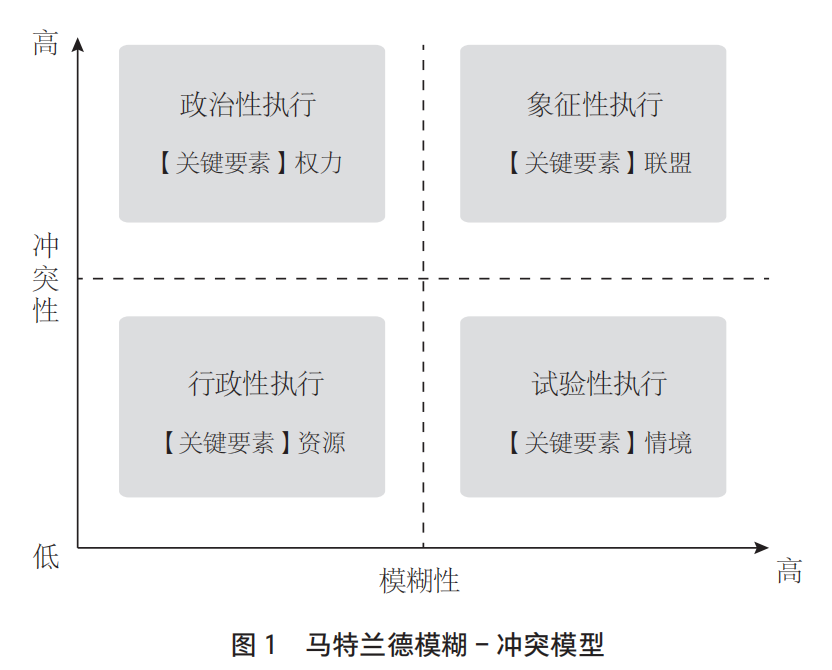
Matland (1995) distinguished four types of policy implementation processes based on the levels of fuzziness and conflict, where resources, power, context, and alliances are key factors influencing the four types of policy implementation processes (see Figure 1). The first type, low fuzziness – low conflict, is called administrative implementation, where policy goals are clear, information flows hierarchically from top to bottom, and implementation methods are clear and definite. In this process, the adequacy of resources determines the effectiveness of implementation. The second type, low fuzziness – high conflict, is called political implementation, where policy goals are clear, but there are inherent conflicts in the interests of the implementing entities during the implementation process. Therefore, the key to successfully implementing this policy lies in whether the implementing entities have sufficient coercive power to ensure compliance from other participants. The third type, high fuzziness – low conflict, is called experimental implementation, where policy goals are fuzzy, mostly directional guiding policies, but the interests of policy implementers are aligned, so the specific policy implementation results are mainly influenced by situational factors such as the enthusiasm of policy participants in the micro-execution environment. The fourth type, high fuzziness – high conflict, is called symbolic implementation, where relevant policies are usually directional guiding opinions, lacking specific measures, and stakeholders in policy implementation have divergent or conflicting views. During the policy implementation process, people may have diverse and even contradictory understandings of the policy, and stakeholders with similar understandings will form alliances. When these alliances cannot compromise, the policy is difficult to achieve substantial implementation, resulting in symbolic implementation outcomes that vary by location (Wang Conghu et al., 2023).
The fuzzy-conflict model, as a classic theory in policy research, has been widely applied in the study of public service policy implementation methods and their consequences, demonstrating strong applicability and explanatory power for policies such as housing security (Wang Xue, 2023), hierarchical diagnosis and treatment policies (Sun Mengqi et al., 2023), central-local government data sharing policies (Wei Wei, Zhang Xuefeng, 2023), parking autonomy policies (Shi Tianqiong, Xu Xiaoxin, 2024), and poverty alleviation relocation policies (Yuan Fangcheng, Fan Jinghui, 2022). Furthermore, based on static analysis of the fuzzy-conflict model, some scholars have combined local experiences, pointing out that the passage of time can affect policy implementation models, suggesting that policy implementation models are not static. For example, Shi Tianqiong and Xu Xiaoxin (2024) studied parking autonomy policies and found that they transitioned from policy stagnation to suspended implementation and then to administrative implementation. Yuan Fangcheng and Fan Jinghui (2022) discovered a pattern of transitioning from experimental implementation to symbolic implementation and finally to political implementation through research on poverty alleviation relocation policies. These scholars provide a dynamic perspective for empirical research on the fuzzy-conflict model, offering insights for examining the dynamic transformation of community embedded elderly care service policy implementation.
As an important area of public service, the policy implementation model of community embedded elderly care services can also be interpreted using the fuzzy-conflict model. This paper applies the fuzzy-conflict model to the field of community embedded elderly care service policies, helping to explain the deep-seated reasons for the multiple challenges faced by community embedded elderly care services under the circumstances of intensive policy issuance from three dimensions: the refinement of policy formulation, the conflict of policy implementation, and the transformation of policy implementation models.
3. Case Introduction and Research Method
(1) Case Introduction
This paper selects the Sunshine institution as a typical case based on its model representativeness and problem representativeness. On one hand, the Sunshine institution was established in 2011 and is one of the earliest institutions in the country to explore community embedded elderly care services. Its facility construction and service model are characterized by “location embedding, functional compatibility, and service integration,” providing elderly people with unique services that allow them to “stay close to home, stay close to family, and stay close to medical care.” In terms of location, the Sunshine institution is embedded within the community, with a bed capacity of fewer than 100, and has set up a spacious activity area on the first floor to provide activity and service areas for elderly residents in the community. In terms of services, the institution relies on a professional team to provide six categories of specialized services for residents, as well as home delivery services such as meal delivery and cleaning for elderly residents in the community, achieving the integration of home, community, and institutional service functions. Currently, the Sunshine institution operates 21 chain institutions nationwide through cooperation with state-owned enterprises and undertaking public construction and private operation projects, with many institutions achieving occupancy rates above 70%, demonstrating good operational effectiveness and sustainable development capabilities. On the other hand, during the development process of the institution, although central and local governments have issued a series of policies and regulations to promote the development of community embedded elderly care services, the implementation effects vary by location due to the involvement of multiple stakeholders, and the Sunshine institution still faces challenges such as cumbersome assessments, difficulties in finding land, high rents, and the NIMBY effect, which are common challenges faced by community embedded elderly care service institutions.
(2) Research Method
This paper employs a case study method to analyze the development process of community embedded elderly care services at the Sunshine institution, using the fuzzy-conflict model to analyze the dilemmas, causes, and solutions of community embedded elderly care service policy implementation. The research team conducted field research at three branches of the Sunshine institution located in Nancheng and nearby communities from October 2023 to May 2024. Through in-depth interviews, the founder of the Sunshine institution introduced the research team to the development history of the institution, the challenges encountered during its establishment and operation, the support received, and the achievements made, providing relevant written materials as supplements. The research team conducted three semi-structured focus group interviews with several directors, caregivers, property management company managers, and community residents near the Sunshine institution to understand the service supply and operational situation of the Sunshine institution and the perspectives of various stakeholders on related events. The research team also conducted in-depth interviews with staff from the civil affairs bureau, street offices, community committees, and community service stations in the city where the Sunshine institution is located to understand the demographic structure, surrounding environment, and relevant planning of the institution. Additionally, the research team employed non-participatory observation methods to observe and record the daily operations of the Sunshine institution, gaining insights into the real opinions of surrounding residents regarding the elderly care institution.
4. Analysis of Challenges and Causes in Community Embedded Elderly Care Service Policy Implementation
The Sunshine institution effectively sinks professional elderly care service resources into community spaces through its service characteristics of location embedding and functional compatibility, constructing a comprehensive service system that combines centralized care and home-based services, significantly enhancing the accessibility and availability of elderly care services. However, during its chain development process, the Sunshine institution faces numerous challenges. In terms of obtaining site resources, the Sunshine institution is influenced by the management responsibilities of multiple levels of government and the interests of various property rights entities, facing many difficulties in land selection, lease terms, and rental pricing, making it challenging to effectively implement land security policies. From the perspective of stakeholder interaction, the Sunshine institution’s embedding in community spaces inevitably intersects with the public activity spaces of community residents, potentially triggering conflicts of interest among different community stakeholders, leading to NIMBY effect issues during policy implementation. In terms of supervision and resource integration, the requirements for multi-departmental supervision and the insufficient supply of community resources create compounded pressure, severely restricting the effectiveness of policy implementation and the improvement of service quality. This paper, based on the fuzzy-conflict model, analyzes the reasons and formation logic behind the difficulties in implementing the community embedded elderly care service model using the framework of the four types of policy implementation.
(1) Cumbersome Assessments: Low Fuzziness – Low Conflict Administrative Implementation
Efficient supervision is key to regulating the development of the elderly care service industry and improving service quality. However, during the actual research process, the author found that numerous and varied indicators often overwhelm the Sunshine institution. Not only are elderly care institutions troubled by cumbersome assessments, but government staff and community committees also suffer from “technical record-keeping” burdens.
Setting up tables and chairs, seating personnel, taking photos for upload, entering data into the system… Such public meetings targeting the community are becoming increasingly common. Weekly evaluations and monthly summaries require us to expend a lot of energy; the institution’s nursing and management staff are already short, and we need to allocate some personnel to organize activities. We have to complete many inspection items every year, such as hygiene, safety, fire protection, gas, and data verification, which are all basic and necessary. The national management of these aspects for elderly care institutions is very strict; if inspections do not pass, we cannot continue operations. (Interviewee: Director Liu of the elderly care institution)
We at the grassroots level have to deal with too many inspections every year. There are seven departments responsible for managing elderly care, and the work among the industry and commerce bureau, housing construction bureau, civil affairs department, street offices, and communities is not coordinated. Many materials have to be filled out repeatedly. The changes in elderly care policies are too rapid; it is common for them to change every year, and each policy has assessment indicators, such as service quality requirements, etc. The pressure on grassroots workers and elderly care institutions is quite high. (Interviewee: Secretary Li from the street office)
From the central to the local level, the national assessment requirements for elderly care institutions and grassroots governments are clear in terms of goals and content, with specific norms and review bases. For example, the “Management Measures for Elderly Care Institutions” published by the Ministry of Civil Affairs in 2020 stipulates that civil affairs departments should regularly conduct statistical work in the elderly service industry, and elderly care institutions should promptly and accurately report relevant information. In 2022, the “Notice of the Ministry of Civil Affairs on Printing and Distributing the ‘Administrative Inspection Measures for Elderly Care Institutions'” (Min Fa [2022] No. 86) mentioned that administrative inspections include routine inspections, special inspections, and case inspections. If elderly care institutions have safety hazards in construction, fire protection, food, medical hygiene, environmental protection, and special equipment, they should be reported and transferred to relevant departments for legal processing. In 2023, the “Notice of the Ministry of Civil Affairs and the National Fire Rescue Administration on Printing and Distributing the ‘Fire Safety Management Regulations for Elderly Care Institutions'” (Min Fa [2023] No. 37) mentioned that elderly care institutions should establish and improve a hierarchical and post-based fire safety responsibility system, clarifying corresponding fire safety personnel and responsibilities. To implement central policies, in October 2024, the “Nancheng Civil Affairs Bureau issued the ‘Administrative Law Enforcement Work Guidelines for Elderly Care Institutions'” requiring elderly care institutions to eliminate safety hazards in construction, fire protection, food, medical hygiene, environmental protection, and special equipment, and for the civil affairs department to jointly enforce the law with market supervision, emergency, fire protection, health, and public security departments regarding illegal acts of elderly care institutions. The assessment methods issued by various departments set requirements for regulating the operation of elderly care institutions. At the same time, elderly care institutions and street offices also face significant pressure in assessments, which may lead to formalistic practices such as “targeted record-keeping” and “technical reporting” in actual work.
The assessment pressure has not triggered conflicts among multiple stakeholders, as the interests of the regulatory policy decision-makers and implementing entities largely align during this process. For policymakers, strengthening supervision of elderly care institutions is an important measure to promote high-quality development of elderly care services. For government departments, one of the policy implementers, implementing regulatory policies helps reduce the probability of accidents in elderly care institutions (Ni Xing, Wang Rui, 2017). Additionally, for elderly care institutions, cooperating with government inspections is beneficial for enhancing the safety and quality of the institution, and gaining government trust is also a crucial aspect for institutions to attract clients and win market reputation.
Nevertheless, this type of low fuzziness – low conflict administrative implementation still raises the operational costs of institutions due to the non-circulation of the “resource” factor, meaning that the information resources for elderly care institution assessments are obstructed in their flow between different levels of government and departments. When the government faces departmental segmentation and obstructed information flow, under the heavy assessment pressure, it tends to adopt departmental self-interest, with each department focusing more on its own work tasks, lacking overall consideration for other departments at the same level, lower-level governments, and multiple policy implementers such as elderly care institutions. This can lead to fragmented and redundant supervision. Under the triple pressure of target assessments, time constraints, and accountability from higher-level power institutions, some grassroots departments may seek to avoid responsibility, focusing more on their performance indicators in assessment tasks, thus neglecting inter-departmental information sharing and work coordination, failing to fully consider the negative effects caused by weak departmental collaboration, which imposes a heavy burden on the supervised institutions. Currently, data barriers in elderly care institution supervision still exist, and channels for information sharing need to be opened up, requiring the establishment of a comprehensive regulatory system for community embedded elderly care services that promotes regional collaboration and inter-departmental coordination.
(2) Difficulties in Government Land Allocation: High Fuzziness – Low Conflict Experimental Implementation
The pathways for land allocation for elderly care institutions in China generally include government land allocation, self-purchased properties, leasing, and renovation of old buildings. Before establishing the first elderly care institution, Mr. Zhao, the founder of the Sunshine institution, attempted various methods to find land for the institution, but due to high qualification thresholds for government land allocation applications and funding limitations for self-purchasing properties, he ultimately chose the methods of renovation of old buildings and leasing. During the renovation process, the Sunshine institution also encountered complicated procedures for changing building usage and difficulties in fire safety inspections.
If we could obtain government-allocated land, we would save a significant amount of costs. Establishing an elderly care home is a beneficial endeavor for the country and the people. However, the land allocation policies issued by the state are only principle-based, and the district does not have supporting detailed policies, making it impossible to implement these policies. In the land-scarce Nancheng, the available land is decreasing, and the allocation of land for which project depends on whether it is what the local government desires. Local governments face challenges; if this land is used for commercial areas, it can generate economic benefits, and the tax revenue can increase fiscal income; however, using it to build an elderly care home has a long return cycle and low economic returns, which impacts local economic development. (Interviewee: Mr. Zhao, founder of the elderly care institution)
The government has issued land allocation security policies for elderly care institutions from three levels: top-level design, departmental support, and local implementation. At the macro policy level, in 2019, the “Opinions of the State Council on Promoting the Development of Elderly Care Services” (Guo Ban Fa [2019] No. 5) stated that non-profit elderly care institutions could apply for land allocation with the social service institution registration certificate and other legal materials issued by the registration authority, and the natural resources and civil affairs departments should actively coordinate and implement land allocation policies. At the departmental support level, the “Guiding Opinions of the Ministry of Natural Resources on Strengthening Planning and Land Security Support for the Development of Elderly Care Services” (Ziran Zi Gui [2019] No. 3) stated that municipal and county natural resources authorities should arrange land allocation for elderly care facilities in accordance with planning layouts and construction land supply plans. At the municipal level, in October 2021, the Nancheng Civil Affairs Bureau issued the “Development Plan for Civil Affairs Undertakings during the 14th Five-Year Plan Period,” proposing to implement the Nancheng “Special Plan for Elderly Care Services (2021-2035),” which includes land for basic elderly care service facilities and facilities providing nearby elderly care services, and administrative land allocation will be adopted for those recognized as public welfare by the civil affairs department.
However, during the implementation of the elderly care institution land allocation policy, different levels of government play different roles. The central government, as the policy maker, is responsible for planning macro goals but does not specify standards for land allocation and implementation methods; provincial governments, as nominal implementers, are responsible for transmitting policies but have no actual decision-making power over policy implementation; while municipal and lower-level governments are the substantive implementers of policies and have considerable discretion over land decisions. Anderson (Anderson, 1984) argues that “the vagueness and ambiguity of decrees allow administrative agencies the opportunity to choose what to do or not to do.” In this context, the development of the Sunshine institution is evidently constrained by local government land decisions. On one hand, considering long-term development, market entities and local governments do not engage in intense conflicts; on the other hand, market entities choose to build and operate institutions in areas supported by local governments. In stark contrast to the halted construction of the sixth branch of the Sunshine institution, the fourth branch operates under a public construction and private operation model, led by the local government, avoiding various disputes over land, housing, water, and electricity, with the operation managed by the Sunshine institution, fully leveraging the advantages of professional elderly care enterprises to achieve complementary resource advantages between the government and enterprises.
Reviewing this process reveals that the implementation of land allocation policies is primarily influenced by contextual factors, specifically the allocation of government attention, which manifests in the enthusiasm of policy implementation participants. Attention is a scarce resource in organizations (Simon, 1947); when local governments invest attention in the elderly care service field, the attention they allocate to other development areas correspondingly decreases. Due to the high investment costs and long return cycles in the elderly care service industry, local governments face considerations of policy implementation costs and power benefits in land decision-making processes. In regions with significant pressure from economic development indicators, formalism is more likely to occur in the implementation of elderly care service land policies.
(3) High Operating Costs: Low Fuzziness – High Conflict Political Implementation
Rent is one of the core costs of operating elderly care institutions. The first branch of the Sunshine institution was formerly a small hotel on the verge of closing down. Initially, the elderly care institution wanted to sign a contract directly with the property management unit; however, the property management unit wanted the Sunshine institution to sign a contract directly with the second-hand landlord (the small hotel). After multiple rounds of negotiations, the first branch ultimately signed its first five-year lease with the property management unit at a daily rent of over 2 yuan per square meter. In 2016, when the first lease expired, the property management unit required the Sunshine institution to renew the lease annually, proposing to charge rent based on commercial property standards, raising the daily rent to over 4-5 yuan per square meter, and requiring that the rent base price and annual rent increase rate be guaranteed to rise according to the regulations of the State-owned Assets Supervision and Administration Commission of the State Council, with property fees also charged at commercial standards. However, Mr. Zhao, the founder of the Sunshine institution, believed that charging rent based on commercial property prices was unreasonable, and renewing the lease annually was not conducive to ensuring rent stability, putting the institution’s financial security at risk. Therefore, both parties engaged in multiple rounds of negotiations over the renewal issue, with the focus of the dispute being on rent and lease duration.
Although our institution is close to a commercial area, it is actually located within the community, which may involve disturbing residents, competing for land and parking resources, and complaints from neighbors, making it unsuitable for a multi-business profit model, and the rent cannot be compared to that of commercial properties on the street, so it should be appropriately reduced. The previous daily rent of around 2.2 yuan per square meter was reasonable; we simply cannot afford the 4-5 yuan per square meter. Signing a lease annually increases the likelihood of rent fluctuations in the short term. (Interviewee: Mr. Zhao, founder of the elderly care institution)
During the negotiation process, the property management unit insisted on raising the rent and provided policy justifications that aligned with their interests, namely the requirements from the State-owned Assets Supervision and Administration Commission of the Nancheng Municipal People’s Government, which mandated that the land price for elderly care institutions must be determined based on market assessments. However, according to Mr. Zhao’s analysis, the profit margin for elderly care institutions is around 5%, and if the rent increases by 7%, the elderly care institution will be unable to sustain operations.
The property management unit set the daily rent for commercial properties at around 5 yuan per square meter and required that the rent base price and annual rent increase rate be guaranteed to rise. They have requirements for the annual increase rate of rent for state-owned land, and the high and rapidly increasing rent is indeed very difficult for us to bear. (Interviewee: Mr. Zhao, founder of the elderly care institution)
In the face of severe rent inflation, ongoing disputes between the property management unit and the elderly care institution, and the imminent closure of the first branch, Mr. Zhao actively sought land assistance from other departments. Considering the influence of the Sunshine institution in community elderly care in Nancheng and the national encouragement for the development of non-profit elderly care institutions, the local government has always paid close attention to the development of this institution and was willing to intervene to mediate the conflicts between the property management unit and the Sunshine institution. In 2019, after discussions among relevant stakeholders, the daily rent for the first branch of the Sunshine institution was finally set at 3.52 yuan per square meter, with a lease term of five years, resolving the land issue for the institution.
This incident illustrates that prior to 2016, the regulations from the State-owned Assets Supervision and Administration Commission of the Nancheng Municipal People’s Government regarding the preservation and appreciation of state-owned assets were specific and low in fuzziness, while the policy support for land allocation for non-profit elderly care institutions was insufficient, leading to operational difficulties for the Sunshine institution amid rent inflation. In this context, elderly care institutions can only rely on the intervention and supervision of local governments to maintain normal operations, indicating that authoritative executing entities are key to safeguarding the land rights of community embedded elderly care service institutions. A review of policies reveals that after 2019, the policies for safeguarding land rights for non-profit elderly care institutions have become increasingly refined. For example, the “Guiding Opinions of the Ministry of Natural Resources on Strengthening Planning and Land Security Support for the Development of Elderly Care Services” (Ziran Zi Gui [2019] No. 3) states that facilities built for elderly care services used by non-profit elderly care institutions can continue to be allocated land, and land that was previously used for profit can continue to be used without increasing the land price for changing planning conditions within five years, encouraging the use of existing commercial, office, industrial, and warehouse properties as well as community spaces to host elderly care institutions, provided that the existing properties comply with detailed planning and do not change the land ownership subject.
(4) NIMBY Effect: High Fuzziness – High Conflict Symbolic Implementation
The NIMBY effect (Not In My Backyard) is a significant issue faced by public affairs, referring to people’s opposition to projects and facilities that may adversely affect their health, environmental hygiene, and quality of life when built near their communities, such as landfills, transportation hubs, and correctional facilities (Zhang Le, Tong Xing, 2013), leading to strong and highly emotional resistance and opposition. However, in the actual process of public service delivery, many “service” facilities with “non-polluting” characteristics also encounter the NIMBY effect (Fang Guanxin, Yang Haoyue, 2023). In this case, the Sunshine institution, which possesses both service and non-polluting characteristics, has repeatedly faced opposition from residents during its construction.
Community residents believe that this elderly care institution (the sixth branch) disrupts the “feng shui” of the community and encroaches on their public space, seizing community resources, leading to multiple disruptions at the construction site. They displayed banners and wrote slogans; the scene was quite intimidating. (Interviewee: Mr. Zhao, founder of the elderly care institution)
When the elderly care institution (the second branch) was first established, our property management frequently received complaints from residents of Building 2, as it was adjacent to the elderly care institution in Building 3, and they felt very uncomfortable seeing elderly people. Originally, our community planned to set up a green space for residents to relax and entertain, but when soliciting opinions, some residents called to say they did not want it, as they did not want to interact with elderly people. (Interviewee: Mr. Huang, property manager)
Regarding the opposition to the construction of the sixth branch, the Sunshine institution made multiple attempts to communicate, but residents did not accept the institution’s explanations, believing that construction could not proceed without planning documents issued by government departments. Various government departments were also concerned that this incident might escalate into a public issue, so they were hesitant to intervene, resulting in the construction of the sixth branch being halted to this day.
Although policies encourage the development of community embedded elderly care services, there are no detailed guidelines for the site selection and construction of community embedded elderly care service institutions, reflecting a characteristic of clear goals but vague tools. In 2023, the “General Office of the State Council forwarded the Implementation Plan for the Construction of Urban Community Embedded Service Facilities” (Guo Ban Han [2023] No. 121), proposing to improve the functional configuration of community embedded service facilities, promote standardized design of community embedded service facilities, and create a “happy neighborhood” brand, while planning and promoting facility construction and service embedding in a coordinated manner. In November 2023, the Nancheng Municipal People’s Government issued implementation opinions to improve the elderly care service system, advocating for the vigorous development of community embedded elderly care institutions and strengthening the radiation functions of elderly care centers, meal assistance, day care, and community elderly assistance. However, at the level of street or village planning and facility construction, clear guiding principles are still lacking.
In practice, the lack of specific and clear guiding opinions has led to conflicts between elderly care institutions and community residents. Residents, who prioritize the experience of public spaces and hold negative attitudes towards elderly care institutions, form a resistance “alliance” against the construction of community embedded elderly care service institutions, becoming a key factor affecting policy implementation. Faced with strong opposition from the “alliance” of community residents, the Sunshine institution finds it challenging to seek specific supportive policies to safeguard community embedded elderly care services, resulting in the policy being implemented only symbolically.
To eliminate misunderstandings and integrate into the community, the Sunshine institution actively contacted local governments and grassroots autonomous organizations, organizing neighborhood meetings to gain community residents’ recognition. At these neighborhood meetings, residents and elderly care institution staff communicated face-to-face, with community residents raising questions such as “What is this elderly care home mainly for?” and “How will it serve our neighbors?” The elderly care institution staff responded face-to-face, bridging the gap with community residents in the most cost-effective and efficient manner. The institution also provided home delivery services such as meal delivery and cleaning for community residents, promising that elderly individuals in community families would have priority for admission to the institution.
When the second branch was established, there was significant opposition from residents. As the secretary, I listened to residents’ opinions and represented their interests in negotiations with the elderly care institution, mediating many disputes. Sometimes they (the institution) would also take on some community elderly care service work, such as home delivery of meals and cleaning. During festive periods, we would jointly hold events, such as party meetings, International Women’s Day activities, Lei Feng Day activities, and celebrations for the 40th anniversary of reform and opening up, which also helped the street office complete upper-level assessment tasks. (Interviewee: Secretary Liu from the community service station)
From the perspective of conflict resolution, the successful resolution of the NIMBY effect benefited from the formation of a new interest alliance among the Sunshine institution, community residents, and the street office. On one hand, the elderly care institution provides home delivery services and priority admission rights for community elderly residents, winning the market while safeguarding residents’ interests; on the other hand, the elderly care institution actively integrates into community governance, gaining support from community autonomous organizations. The community committee intervenes to resolve the NIMBY effect, which serves both to maintain community order and to consider the role of the elderly care institution in assisting with the implementation of community elderly care services and completing upper-level assessment indicators.
5. Key Elements and Model Transformation of Community Embedded Elderly Care Service Policy Implementation
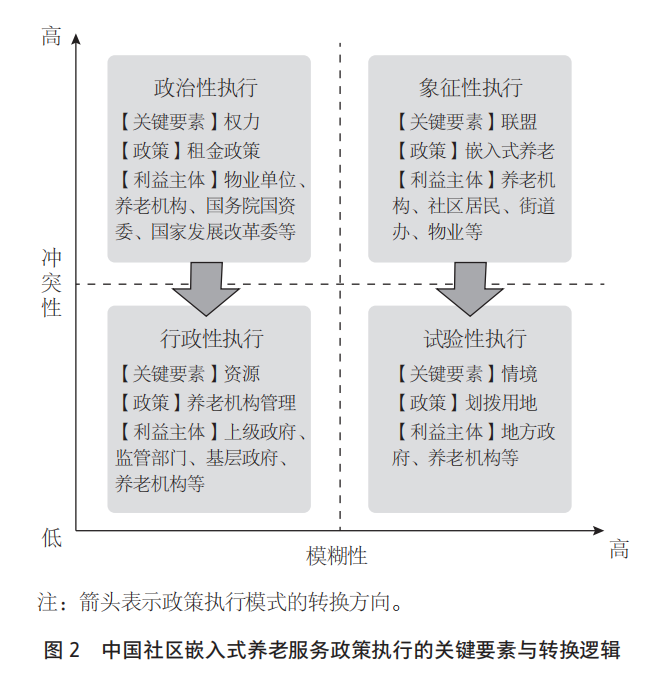
Based on the analysis of the operational dilemmas faced by the Sunshine institution, including cumbersome assessments, difficulties in government land allocation, high operating costs, and frequent NIMBY effects, as well as their causes, we can identify key factors affecting policy implementation, including the circulation of information resources, government attention allocation, power supervision, and interest alliances. In this process, the policy implementation model also begins to transform, shifting from political implementation to administrative implementation and from symbolic implementation to experimental implementation. Accordingly, this paper refines and supplements Matland’s (1995) fuzzy-conflict model (see Figure 2), applying it to the field of community embedded elderly care services in China, summarizing four key elements of policy implementation and their corresponding specific implementation models: First, the obstruction of information resource flow between government departments leads to redundant supervision, indicating that “resources” are key elements of administrative implementation; second, uneven allocation of government attention between elderly care and other economic industries leads to difficulties in elderly care institutions applying for government land allocation, thus “context” is a key element of experimental implementation; third, local governments play a mediating role in disputes over rent between property management units and elderly care institutions, indicating that “power” is a key element of political implementation; fourth, the successful resolution of the NIMBY effect faced by elderly care institutions benefits from the reorganization of multiple stakeholders’ interests in the community, indicating that “alliances” are key elements of symbolic implementation. This paper also finds dynamic transformation characteristics between different policy implementation models, breaking through the static research paradigm of this model. On one hand, the flexible coordination of “power” departments reduces the conflict among relevant stakeholders, shifting low fuzziness – high conflict political implementation to low fuzziness – low conflict administrative implementation; on the other hand, multiple stakeholders shape a community of interest “alliance” through effective discussions, also weakening the conflict of policy implementation, promoting the transition from high fuzziness – high conflict symbolic implementation to high fuzziness – low conflict experimental implementation.
(1) Resource Factors and Administrative Implementation
Low fuzziness – low conflict is the ideal scenario for policy implementation. Under these conditions, policy goals are clear, policy tools are defined, and the interests of policy decision-makers and implementers align, maximizing the effectiveness of policy implementation. However, in the execution of regulatory assessment policies for elderly care institutions, the weak and asynchronous flow of information resources between departments leads to overlapping supervision and cumbersome assessments, placing a heavy burden on elderly care institutions and grassroots governments. Therefore, reflecting on the original intention of policy formulation and the execution process reveals that establishing an effective comprehensive regulatory system is key to solving this issue. Although low fuzziness – low conflict administrative implementation is relatively smooth compared to high conflict policy implementation models, it also exposes the risks hidden in low fuzziness policies, such as information asymmetry and departmental self-interest, prompting us to enhance quality and efficiency through resource sharing and to build a comprehensive regulatory system for elderly care institutions that facilitates data linkage and simplifies processes.
(2) Contextual Factors and Experimental Implementation
In scenarios where policy fuzziness is high and execution conflict is low, the effectiveness of policy implementation depends on the extent of government attention allocation. Elderly care institutions face obstacles in applying for government land allocation, a phenomenon stemming from grassroots governments prioritizing economic development, exposing the limitations of high fuzziness policies. The policies regarding land allocation for elderly care institutions issued by the State Council, the Ministry of Natural Resources, and the Nancheng Civil Affairs Bureau are mostly advisory statements such as “improving,” “actively coordinating,” and “fully ensuring,” lacking mandatory provisions and measures, leaving local governments with considerable discretion, resulting in gray areas in policy implementation. Therefore, relevant departments need to enhance the consistency of elderly care institution land policies and the refinement of elderly care land planning while ensuring the supply of inclusive and basic elderly care services, mitigating the negative impact of uneven government attention allocation on community embedded elderly care services.
(3) Power Factors and Political Implementation Model Transformation
When policy fuzziness is low and conflict is high, the effectiveness of policy implementation often relies on the influence of power factors, especially for top-down policies, where the preferences of local governments or departments may not be incorporated into the overall design of the policy, and the effectiveness of policy implementation often depends on the coercive supervision of power. It is noteworthy that power supervision has prompted the transformation of rent policies from political implementation to administrative implementation. In the rent dispute incident, political implementation served as the starting point for the transformation of the policy implementation model, where the elderly care institution and the property management unit had differing views on whether the rent standard should be civil or commercial, resulting in a high-conflict policy implementation. It was only when the local government intervened to mediate that the conflict was resolved. In this incident, although the policy details were not modified, meaning that the fuzziness of the policy did not change, the conflict of the policy was effectively reduced under the authoritative supervision of the government, achieving a transition from low fuzziness – high conflict political implementation to low fuzziness – low conflict administrative implementation.
(4) Alliance Factors and Symbolic Implementation Model Transformation
In scenarios where both policy fuzziness and conflict are high, the effectiveness of policy implementation is more dependent on the influence of interest alliances. The conflict between the two major interest alliances of community residents and elderly care institutions is a direct trigger for the NIMBY effect, while the resolution of this conflict benefits from the alignment of interests and perspectives between the two major entities. In the NIMBY incident, symbolic implementation serves as the turning point for the transformation of the policy implementation model, where the dual fuzziness of policy goals and tools obstructs the embedding of elderly care institutions in the community, and residents hold a rejection attitude towards “outsiders.” As the interest relationships within the community alliance change, residents, elderly care institutions, and street offices form a new community of interests. The attitudes of community residents towards the policy execution underwent multiple changes during the implementation period, from initial indifference to strong opposition, and then to acceptance and recognition, a process that facilitated the transition from high fuzziness – high conflict political implementation to high fuzziness – low conflict experimental implementation.
6. Conclusion and Recommendations
This paper, using the fuzzy-conflict model as a framework, deeply analyzes the establishment, operation, and expansion process of the Sunshine institution. By examining four typical events, including cumbersome assessments, difficulties in government land allocation approvals, heavy rent burdens, and frequent NIMBY effects, it uncovers the roots of the difficulties in implementing community embedded elderly care service policies. The fuzziness of policy goals and means, as well as the conflicts of interest among diverse stakeholders such as different levels of government, enterprises, community autonomous organizations, and residents, significantly affect the effectiveness of community embedded elderly care service policies. Enhancing the coordination of macro and micro policies, promoting inter-departmental information sharing, optimizing government attention allocation, and enhancing social governance effectiveness are the main paths to resolve the implementation dilemmas of community embedded elderly care service policies.
Based on this, this paper proposes the following four optimization recommendations. First, enhance the consistency of community embedded elderly care service policies. The vague expressions of current rent policies and the flexibility of government land allocation policy implementation essentially reflect inconsistencies in horizontal inter-departmental collaboration, vertical coordination between central and local policies, internal logical coherence of clauses, regional execution standards, and temporal continuity, leaving room for negotiation among diverse interest stakeholders. The author suggests that the state should systematically promote clear responsibilities across departments horizontally, vertical coordination between central and local policies, internal logical consistency of clauses, mutual recognition of regional execution standards, and stability of long-term policy expectations, constructing a policy system that is “coherent horizontally and vertically, and consistent internally and externally.” Second, enhance quality and efficiency through resource sharing, breaking down information sharing barriers. Information flow barriers are the core pain points of redundant supervision and resource misallocation. Relevant departments need to leverage digital and information technology to integrate multi-source data from civil affairs, fire protection, and communities, building a cross-departmental and cross-level information sharing platform for elderly care services, enhancing the comprehensive regulatory effectiveness of elderly care services through “smart + regulation” technology empowerment, and achieving real-time monitoring of elderly care institution operational data and intelligent early warning of risks. Third, optimize the government resource allocation with a focus on people’s livelihoods. Promoting the coordinated development of elderly care undertakings and industries is an important practice for safeguarding and improving people’s livelihoods during development. The author suggests that government departments focus on core aspects such as land security, financing support, and professional talent cultivation for community embedded elderly care services, formulating refined policy toolkits, lowering market entry barriers for stakeholders, and strengthening the downward allocation of policy resources to the “last mile,” creating a fair and orderly institutional environment for social forces to participate in community elderly care. Fourth, shape interest communities through alliances, promoting the coordinated development of elderly care services and social governance. The NIMBY effect is essentially a conflict and imbalance of interests among multiple stakeholders. Relevant departments need to establish a collaborative governance mechanism led by the government, operated by enterprises, supported by communities, and participated in by residents, through building multi-party negotiation platforms, exploring the shared value of public spaces, and designing interest compensation mechanisms, seeking the greatest common divisor between elderly care service supply and community public interests, and integrating the construction of embedded elderly care facilities into overall community planning, promoting their upgrade from “spatial embedding” to “governance embedding” and “emotional embedding,” achieving deep integration of elderly care services and social governance.
This paper also finds that the policy implementation of community embedded elderly care services in China cannot be simply categorized into static typologies; the policy implementation model may change with variations in policy fuzziness and interest conflict. The case presented in this paper provides an explanatory framework for observing the changes in policies related to community elderly care services and exploring the deep-seated roots of policy implementation dilemmas. Of course, this paper also has certain limitations: first, the model refinement and research conclusions are derived from a single case analysis, and subsequent research needs to test and adjust with multiple regional cases; second, this paper does not cover various types in policy practice, and the characteristics, influencing factors, implementation paths, and transformation mechanisms of fuzziness and conflict in various policies are bound to be diverse, which requires further exploration in subsequent research.
(Notes and References omitted; Cover image generated by AI)
Typesetting: Zhou Ke
Review: Ding Jie




Submission
Method

Official Submission Website
http://shjs.ruc.edu.cn




Welcome to Like, Share, and Recommend This Article