Against the backdrop of global trade multipolarization and intensified geopolitical competition, the Gulf Cooperation Council (GCC) is frequently appearing at the free trade/FTA negotiation table. With the historic resumption of negotiations with the European Union and active interactions with China and Japan, the GCC is striving to break through through institutional cooperation, forcing all parties to reconstruct their positions.
The FTA negotiations between the EU and the GCC began in 1990 and stalled in 2008. The core obstacles are not just tariffs: the EU requires the GCC to form a customs union similar to the EU to prevent trade imbalances within the region; it also emphasizes “human rights clauses,” environmental and labor standards. In response, the GCC has delayed the establishment of a customs union for many years, only establishing a basic customs union in 2003. Even with the resumption of negotiations, GCC members still maintain a high degree of sovereignty, while the EU operates as a supranational entity, making structural contradictions difficult to resolve. Data shows that the total bilateral goods trade between the EU and GCC is expected to reach €161.7 billion in 2024, with GCC exports to the EU primarily consisting of energy (75%), while EU exports are mainly machinery, electrical equipment, and chemicals. However, the EU’s previously dominant trade position has been surpassed by China and India, which has motivated the EU to accelerate the EU-UAE FTA negotiations (which began in June 2025).
On September 1, Japanese Foreign Minister Yoshimasa Hayashi visited Kuwait to attend the Japan-GCC Foreign Ministers’ Meeting. Both sides agreed to elevate their relationship to a “comprehensive strategic partnership,” strengthening energy security, economic cooperation, and regional coordination. The Japanese side praised Kuwait for its role as the rotating presidency of the GCC and supported its efforts to promote peace in the Middle East and humanitarian assistance in Gaza.
Japan resumed FTA negotiations with the GCC in 2023 and launched the “Japan-GCC Action Plan 2024-2028.” Japan views the GCC as a key partner for energy security and maritime routes, as well as a window for technological cooperation and investment. Japan’s exports to the GCC market are concentrated in the automotive and machinery sectors. In 2021, Japan’s exports to the GCC were approximately $22 billion, while imports were $76.7 billion. The core of Japan’s push for an FTA is to avoid being “squeezed out”: currently, the GCC imposes a unified 5% tariff on non-GCC countries, and if the GCC signs free trade agreements with other countries first, Japan will face a market disadvantage. Negotiation challenges also include non-tariff barriers (such as lengthy inspection processes and special quality standards) and Japanese companies’ expectations for investment protection mechanisms (national treatment, investment arbitration, and free movement of capital).
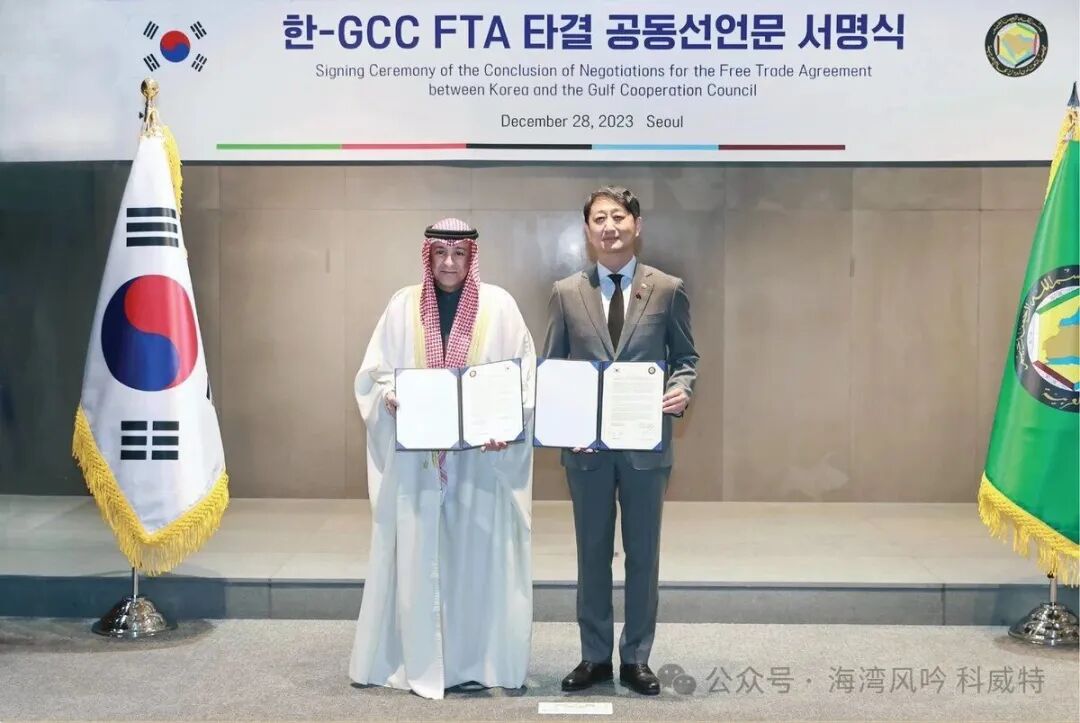
In contrast to the difficult negotiations with Japan, South Korea has taken the lead by signing an FTA with the GCC in December 2023. This agreement, which took five rounds of negotiations, covers 18 chapters, involving goods, services, government procurement, digital trade, intellectual property, and cooperation for small and medium-sized enterprises, and is seen as an important breakthrough for the GCC in promoting external economic integration. The key reason South Korea is “ahead” is its energy security strategy and institutional flexibility: South Korea is already the world’s fifth-largest energy importer, relying on Gulf supplies for over 70% of its crude oil. Kuwait has established oil reserve warehouses in South Korea, allowing Seoul to directly access Middle Eastern oil during supply crises, which is a manifestation of institutionalized energy mutual trust. The completion of the FTA not only helps ensure South Korea’s energy security but also promotes the GCC to export more value-added products to the Asian market, reducing dependence on a single export model.
As for China, its relationship with the GCC has entered a stage of “oil and gas + industry + finance” deep coupling. In 2024, the trade volume between China and the GCC is expected to reach approximately $288.09 billion, with China obtaining 36% of its crude oil supply from the GCC. Cooperation between China and the GCC in new energy, infrastructure (ports, rail transit), and finance (currency swaps, RMB settlement) is also deepening. However, it also faces risks of trade remedy investigations due to the increasing number of Chinese goods: between 2023 and 2025, the GCC initiated multiple anti-dumping investigations against Chinese products, far exceeding the total from 2017 to 2021.
So, what does Japan’s outreach to the GCC mean? First is market lock-in: by signing the FTA in advance, Japan aims to stabilize its market share in automobiles, infrastructure, and technical equipment, avoiding being replaced by Chinese competitors in an open market. Second is strategic balance: through multipolar interactions, Japan strengthens cooperation with the GCC, which is beneficial for constructing energy and political guarantees under a “free and open Indo-Pacific” framework. Finally, Japan’s investment protection and institutional commitments also support the GCC’s economic diversification goals, competing with China’s “engineering delivery” cooperation model.
How should China respond to competition and pressure? First, it must strengthen compliance system construction to address anti-dumping and trade remedy investigations: this includes improving cost and internal pricing records and legalizing documents to avoid the “constructed cost” of overestimating dumping margins becoming the default standard. Second, it should deepen localization strategies: participate in local infrastructure, manufacturing, and green energy projects, using the “Belt and Road” model to establish long-term trust and channels. Third, it should utilize financial tools: promote RMB settlement, currency swaps, and establish ETF connectivity (such as currency cooperation between China and the GCC, and oil transactions using RMB), enhancing transaction efficiency and financial connectivity. Finally, it should demonstrate more “soft power” in strategic cooperation: for example, through cultural, educational, food safety, and disaster assistance pathways, creating an emotional foundation for negotiations.
In summary, the GCC’s free trade negotiations are not only a game of trade terms but also a competition for structural politics and institutional order: the EU needs time and internal coordination, Japan is preemptively occupying the system through FTAs, while China relies on “large infrastructure + financial circulation + localization” to stabilize practical cooperation. In the future, China should strive to maintain its position in the competition within the GCC, and even win the “first-mover advantage” before the rules are clearly defined. (Author: Ethan)