 Click the blue text above to subscribe


(Image from Nano Today official website)
Robotic technology is transforming industry and daily life. As an interdisciplinary field, robotics has garnered significant attention from mechanical engineering, computer science, materials science, chemistry, and other disciplines, facilitating the practical application of robots from micro/nano scales to macro scales. Traditional rigid robots still face challenges in manipulating fragile objects without causing damage, limiting their use in delicate tasks. In contrast to rigid robots, soft robots can deform and adapt to various mechanical forces, giving them advantages in complex terrain applications. Among them, hydrogel robots are typical soft robots (Figure 1a).
Natural organisms provide abundant inspiration for designing and manufacturing hydrogel robots with autonomous and intelligent behaviors, including movement, perception, and responses to environmental changes. It is crucial to study specific body structures and integrate these structures into robots. Miniaturization is another key aspect, expanding the application range of traditional robots, allowing them to access areas that are difficult for traditional robots to reach, such as searching for victims in earthquake rubble or delivering drugs within the human body. Biomimetic miniature soft robots have gradually become a hot research topic in recent years. For example, soft-bodied animals can perform multimodal movements based on complex coordination from biophysical and chemical signals from the environment, including reconfigurable deformation, swimming, inchworm-like movement, and peristalsis. Ants can self-organize through local communication ( referring to self-altering morphology and structure), enabling them to cooperate in completing complex tasks beyond individual capabilities. By studying and mimicking these unique biological structures, movement behaviors, communication mechanisms, and environmental interactions, researchers have designed and manufactured soft hydrogel machines and robots with multimodal deformation and movement for a wide range of applications such as cargo transport, drug delivery, and sensing.
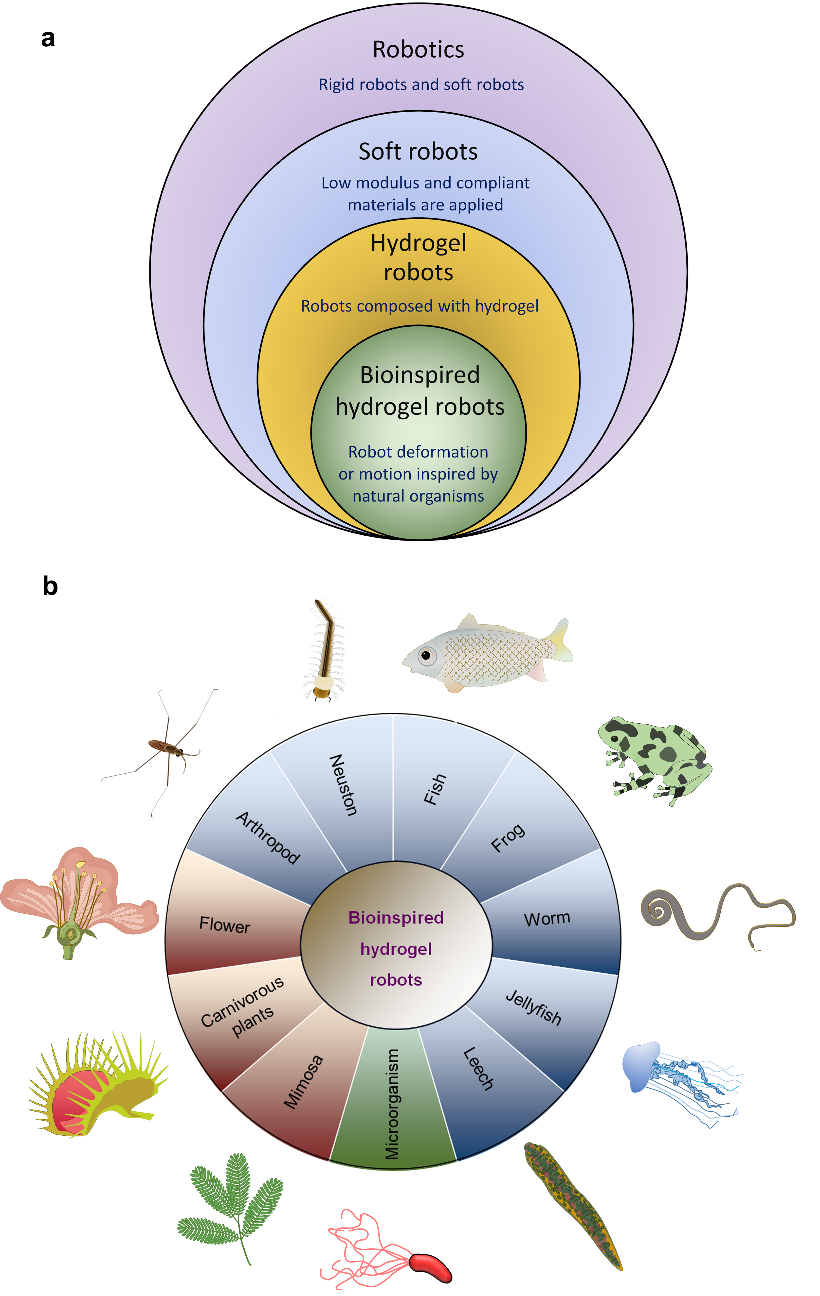
Figure 1. (a) Schematic diagram of the relationship between robots, soft robots, hydrogel robots, and biomimetic hydrogel robots. (b) Several typical nature-inspired miniature hydrogel soft robots. Recently, Professor Wang Ben from Shenzhen University, Professor Niu Shichao from Jilin University, Professor Han Zhiwu from Jilin University, and Professor Guo Zhiguang from Hubei University published a review titled Bioinspired Hydrogel Actuator for Soft Robotics: Opportunities and Challenges in Nano Today. This review systematically introduces hydrogel robots inspired by various biological organisms, including prototypes inspired by water striders, fish, frogs, worms, jellyfish, leeches, flowers, carnivorous plants, Mimosa, and microorganisms (Figure 1b). The review emphasizes various action modalities and their advantages, such as swimming, crawling, swinging, walking, and rolling. It then summarizes the applications of hydrogel robots in drug delivery, sensing, cell transport, cargo transport (Figure 2). Finally, the review discusses the challenges in the current research field and provides a brief outlook, focusing on future research trends and important considerations for future studies.
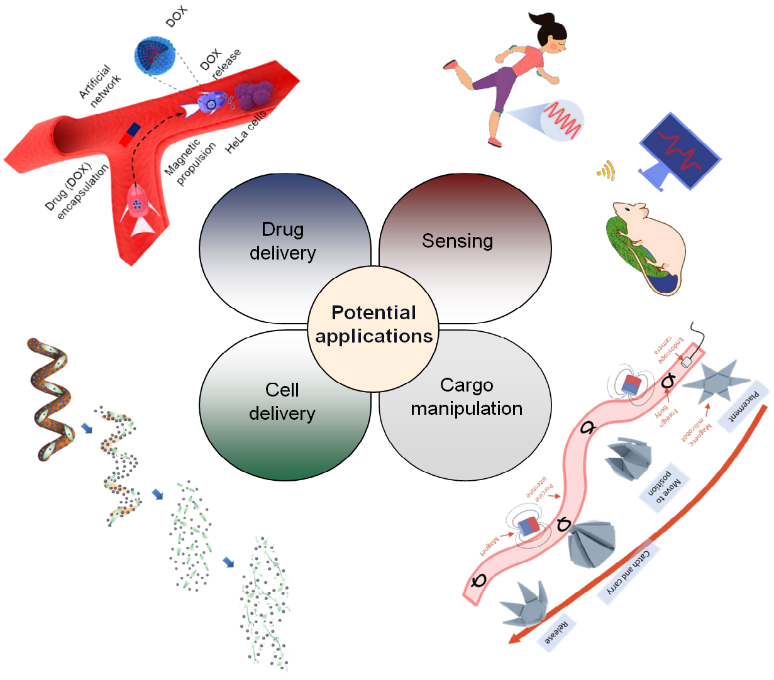 Figure 2. Several typical applications of biomimetic hydrogel miniature soft robots. Biomimetic hydrogel miniature robots have been applied in the biomedical field and have achieved good results both in vitro and in vivo. As an important starting point for hydrogel miniature robots to replicate natural biological processes, the rapid development of materials science helps integrate natural inspirations into artificial materials, thereby increasing the possibilities for clinical applications. Therefore, more in-depth research is needed to combine synthetic methods and assembly techniques to develop biomimetic hydrogel miniature robots with optimal physicochemical properties and biological functions. Additionally, incorporating personalized biological factors can overcome issues related to the cost, short storage life, degradation, and other challenges associated with the clinical application of hydrogels. Furthermore, precision medicine design integrated into biomimetic hydrogel miniature robots can better adapt to patients’ pathological conditions. Nature provides a wealth of biological inspiration, and it is expected that biomimetic hydrogel miniature robots will bring revolutionary changes to precision medicine. Relevant papers were published in Nano Today, with Shenzhen University graduate student Chen Yunrui and Professor Zhang Yabin from Guangxi University as the first authors, and Professor Wang Ben, Professor Niu Shichao, Professor Han Zhiwu, and Professor Guo Zhiguang as corresponding authors.
Paper information:
Bioinspired Hydrogel Actuator for Soft Robotics: Opportunities and Challenges
Corresponding authors: Wang Ben (Shenzhen University); Niu Shichao (Jilin University); Han Zhiwu (Jilin University); Guo Zhiguang (Hubei University)
Other authors: Yunrui Chen, Yabin Zhang, Hongyuan Li, Jie Shen, Fangfei Zhang, Jiajun He, Junzhu Lin
Nano Today 49 (2023) 101764
Publication Date:
https://doi.org/10.1016/j.nantod.2023.101764
Copyright © 2023 Elsevier
Original link:
https://www.sciencedirect.com/science/article/pii/S1748013223000130
Related progress
Dr. Wang Ben from Shenzhen University, Professor Zhou Xuechang from Hubei University, and Professor Guo Zhiguang from Lanzhou Institute of Chemical Physics, Chinese Academy of Sciences published in Nano Today: Research progress on biomimetic water-collecting materials and systems.
The team of Yin Jie from North Carolina State University published in Sci. Adv.: Fast and efficient – soft robots that can swim like butterflies.
Nature cover: Princeton University developed a “fancy balloon” soft robot.
Professor Yu Yanlei’s team at Fudan University published in AFM: Liquid crystal soft actuators and robots for mixed reality.

A polymer technology original article. Personal forwarding and sharing are welcome. For reprints by publications or media, please contact via email: [email protected]


Call for submissions
Experts and scholars are welcome to submit manuscripts (papers, project introductions, new technologies, academic exchanges, news from institutions, conference information, recruitment, admissions, etc.) to [email protected], and please provide detailed contact information. Polymer Technology® will promptly push and also publish on the China Polymer Network.
Welcome to join the WeChat group To meet the needs of various colleagues in the polymer industry, we have successively opened dozens of special discussion groups, including a group for polymer experts and scholars, as well as groups for polymer industry technology, entrepreneurs, PhDs, graduate students, media, journals, exhibitions, and associations, covering the entire polymer industry or field. Currently, we have gathered over ten thousand top experts, scholars, technical personnel, and entrepreneurs from domestic and foreign universities, research institutes, and corporate R&D centers.
To apply for group entry, please first add the review WeChat account PolymerChina (or long-press the QR code below), and please be sure to indicate: Polymer + Name + Institution + Title (or Degree) + Field (or Industry), otherwise, it will not be processed. Qualifications will be reviewed before entering the relevant professional group.

Click here to read the original text for more.