Application Virtualization Supports Real Use in Xinchuang
Written by|Chen Zhiyong
Zhejiang Securities Co., Ltd.
[email protected]
Selected from “Frontiers of Information Technology Application Innovation in Securities and Fund Industry” Issue 1
Abstract: With the advancement of the information technology application innovation industry, changes in the underlying architecture of information technology hardware and software inevitably require a reconstruction of the upper application ecosystem. Traditional information technology has been built and applied for over 20 years, and has accumulated many mature business applications in the industry. These mature applications face challenges and changes brought by innovative information technology applications, making it impossible to adapt to the new application technology system quickly and achieve rapid and effective changes. How to promote the true trial and use of Xinchuang while maintaining the continuity and reliability of application business operations, ensuring that traditional applications can run well on the Xinchuang platform with minimal cost, is a core pain point faced during the Xinchuang work process. This article provides a practical case from the direction of application virtualization technology.
Keywords: Xinchuang, Application Virtualization
In the era of digital economy, the digital transformation of China’s financial industry is in full swing, from general fields to segmented areas, breaking through the situation to comprehensive development, and the value of digitalization for financial institutions is becoming increasingly evident. Digital transformation relies on the support of information technology, and Xinchuang, as an important component of the new digital infrastructure, has become a key force in promoting the digital transformation of China’s economy, with financial Xinchuang entering a stage of comprehensive promotion.
The operating system, as the foundation of the digital world, plays an important role in the entire IT industry, bridging the upper software ecosystem and the underlying hardware resources. The importance is self-evident. Domestic operating systems have developed on the Linux kernel system. Although Linux has its own strong technical ecosystem, there are still significant challenges in building an application ecosystem that adapts to domestic chip instruction sets. There is a huge gap between specialized applications in professional fields and industry users compared to the application ecosystem built over many years with Windows.
The centralized trading counter system used by securities companies operates on a Windows C/S architecture and has been in industry use for over 20 years. The difficulty of adapting it to the Xinchuang desktop operating system in the short term is very high, with a long transformation cycle, conflicting with the goal of completing the Xinchuang terminal replacement in a short time. Such application systems are an essential part of daily business operations for securities companies, making it difficult for daily office operations to seamlessly switch to the Xinchuang desktop and operating system for single-track use. This situation severely affects the real usage rate of Xinchuang terminals. To address the aforementioned difficulties, our company has collaborated with operating system developers to seek feasible solutions during the transition period of Xinchuang from the perspective of application virtualization.
Virtualization Technology Analysis
Various solutions have emerged in the Xinchuang application process, all promoting the real use of Xinchuang terminals in various ways. The following solutions are available in the market:
1. Solution One: Windows Dual-System Solution
The Windows dual-system technology is a type of virtual machine technology that creates an abstract virtualization layer between computer, storage, and network hardware, unifying all hardware into one virtualization layer. The virtual machines created on top of this platform have the same hardware structure. Users can run programs, store data, and other functions on the virtual machine. By using the virtualization layer, hardware-level virtualization is provided, offering a complete set of compatible hardware for the running virtual machines. The virtual machine includes all devices such as motherboard chips, CPUs, SCSI and disk devices, various interfaces, displays, and other input/output devices.
The Windows dual-system solution installs one or more virtual machines on the domestic desktop operating system as needed, and installs various ecological applications under the original Windows operating system in the virtual machine system, using real-time binary code translation and fast memory addressing mapping technology to enable seamless installation and windowed operation of Windows applications across operating systems. The system supports running multiple virtual machines simultaneously under the domestic desktop operating system and allows for one-click seamless switching between the host desktop and the virtual machine desktop.
1) By using virtualization technology, both the domestic desktop system and the Windows system can run simultaneously, preserving the original usage environment.
1) Limited choice of chip architecture, only supporting X86 chip domestic terminals.
2) Running both the domestic desktop system and the Windows system requires significant hardware resources.
3) Running two systems simultaneously affects the real usage rate of the domestic desktop system, which is not conducive to the promotion and application of Xinchuang terminals.
2. Solution Two: Windows Application Virtualization
Windows application virtualization technology achieves logical separation of applications from the underlying operating system, delivering applications as a service to users. Application virtualization separates the computational logic and display logic of applications, abstracting the interface. When users access the virtualized application, the client computer only needs to transmit human-computer interaction data to the server, which opens an independent session for the user to run the computational logic of the application and transmits the processed display logic back to the client, allowing users to experience the application as if it were running locally. Through application virtualization technology, applications can be transformed into services that can be used over the network without requiring the user’s computer to install software, and the user is not associated with the application environment, thus minimizing the cost of application compatibility testing and reducing the workload of system administrators regarding applications.
Advantages of Application Virtualization:
1) Heterogeneous integration, reducing the coupling between application software and operating systems, ensuring that Windows business applications can still be used in a domestic environment, achieving a smooth transition.
2) Lightweight platform, only pushing currently unadapted application software on domestic desktop terminals to users, accurately targeting the corresponding application software based on departmental business application requirements.
1) In business scenarios with UKey, it cannot achieve binding isolation for users and UKey.
2) In scanner scenarios, it does not support TWAN protocol compression, and USB redirection has high bandwidth requirements.
3. Solution Three: Desktop Virtualization
Desktop virtualization is a type of virtualization technology that changes the traditional distributed computing method of PCs by isolating the desktop and client operating systems from the original physical hardware based on back-end server computing combined with thin client application modes. Relying on server virtualization, a large number of independent desktop operating systems (virtual machines or virtual desktops) are generated on the servers in the data center, which are then sent to terminal devices using proprietary virtual desktop protocols, achieving the deployment of Windows operating systems on domestic operating systems. Domestic operating systems and Windows run in parallel.
1) The original usage environment of the customer is preserved through virtual desktop protocols, allowing unmodified business to switch to the Windows system for operation.
1) Initial construction costs are high, requiring infrastructure modifications and high requirements for network conditions and server hardware facilities.
2) The parallel use of domestic desktop systems and Windows affects the real usage rate of the domestic desktop system, which is not conducive to the formation of usage habits for Xinchuang desktop terminals.
4. Solution Four: Application Containers
Application container technology is a cross-platform environment that runs Windows applications on Linux systems, using binary translation tools + Wine (which provides Windows API support) to support Windows applications running in domestic desktop environments. It uses compatibility tools to convert Windows’ underlying function libraries into Linux functions. It can translate Windows API calls into dynamic POSIX calls, allowing modified Windows applications to be used directly on domestic terminal desktops.
1) Windows applications can be used cross-platform on domestic operating systems.
1) Limited software ecosystem, mainly dependent on operating system vendors for adaptation and optimization, with low flexibility.
2) Limited choice of chip architecture, only supporting X86 chip domestic terminals.
5. Solution Five: Mobile Applications
Mobile applications provide a high-performance cross-platform compatibility environment for mobile applications, directly using hardware through a shared kernel to achieve integration between Android and domestic desktop operating systems. This forms an advanced and complete mobile application ecological migration solution.
1) Massive native support for Android applications;
2) Smooth application switching integration;
1) Limited choice of chip architecture, only supporting ARM chip domestic terminals;
2) Limited software ecosystem, only supporting software from the original Android ecosystem;
After researching and comparing the above Xinchuang application solutions, combined with our company’s chosen domestic ARM chip technology route, most client software does not have an Android version. To solve the application software usage problem during the transition period and promote the real single-track use of terminals, our company has chosen the application virtualization solution, collaborating with Kylin Software to implement the application virtualization technology.
Project Implementation Overview
Zhejiang Securities, in collaboration with Kylin Software, formed a joint innovation team to conduct testing and evaluation for the adaptation of internal C/S applications. After analyzing the C/S applications, a route primarily based on Windows application virtualization was developed. Standard Windows applications were generated as virtual applications for cross-platform release. Given that domestic Linux operating systems cannot directly run Windows software, by deploying Windows applications on Windows servers in the AD domain, AD domain users can remotely access numerous applications running on Windows servers, allowing Windows native applications to run directly on KylinOS, ensuring a smooth progression of the domesticization phase for users.
A joint technical team was formed based on needs, problems, and goals to adapt applications and solve various adaptation issues: using a server + client approach, with the server including AD domain control, control center, and application sessions, supporting both single-machine and multi-machine modes, ensuring rapid expansion of subsequent application sessions.
The functions of the three major software modules on the platform were confirmed, and the technical architecture is shown in Figure 3-1.
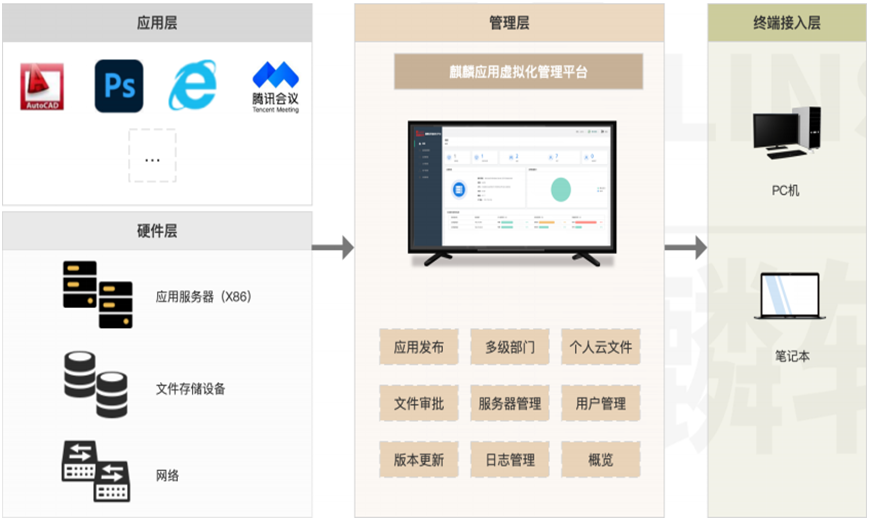
AD domain control: responsible for unified user management.
Application session: The Windows software session host is responsible for carrying user applications.
Control center: connection proxy responsible for redirecting client connections and managing application servers.
1) Centralized management platform
2) Real-time monitoring of the server’s resource consumption.
3) User hierarchical management
4) Pushing virtual Windows applications on domestic desktops.
5) File management, supporting local disk redirection to the server for convenient file import and export.
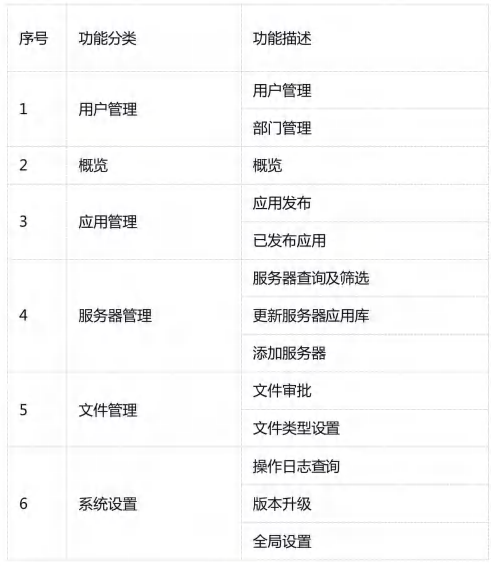
The project lasted 8 months, achieving the project goals, and officially went live in December 2021, running applications in our company’s information technology development, wealth management, and proprietary business scenarios, with stable system operation. The main functions of the system are as follows:
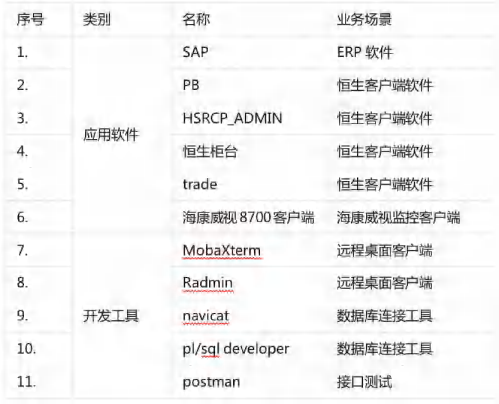
Through application virtualization technology, our company has launched the following Windows application virtualization software:
Main Project Achievements
Promoting Single-Track Use of Domestic Terminals
The construction of the Windows application virtualization Xinchuang project has unified the use of business systems and traditional apps on domestic desktop operating systems, achieving safe and autonomous control. Users do not need to switch operating systems to use traditional C/S applications, effectively cultivating users’ habits of using domestic terminal operating systems.
It ensures the continuity and reliability of business operations, reserving time and space for the transformation and reform of application Xinchuang, demonstrating a certain effect and providing a feasible transitional technical route for industry Xinchuang transformation.
Breaking Industrial Boundaries
The background of promoting the Xinchuang industry lies in the fact that in the past, most of the underlying standards, architectures, products, and ecosystems of China’s IT were set by foreign IT companies, leading to various risks of restrictions on underlying technologies, information security, and data preservation methods. The global IT ecological pattern will evolve from the past “one pole” to the future “two poles”. China must gradually establish its own IT underlying architecture and standards to form an independent open ecosystem. The IT industry ecosystem established based on its own IT underlying architecture and standards is the main connotation of the financial Xinchuang industry.
From the perspective of the domesticization level of information infrastructure, most core information technology products and key services used in important domestic information systems and critical infrastructure still rely on foreign sources. Without information and network security, there can be no national security, making the construction and transformation of financial Xinchuang urgent. During the implementation of the Kylin Windows application virtualization Xinchuang project, our company actively promoted the replacement of domestic desktop operating systems, accumulating a wealth of transitional experience throughout the entire process of project implementation, facilitating the rapid deployment of regulatory requirements, and assisting in completing the long-term strategy for national security and the Xinchuang industry. At the same time, drawing on its experience in Xinchuang transformation, it has helped other securities companies and manufacturers avoid risks and pitfalls, having strong demonstrative significance. For the entire industry, through the successful implementation of this project, effective exploration of the boundaries for replacing domestic desktop systems can be conducted, laying the groundwork for future normative transformation tasks.
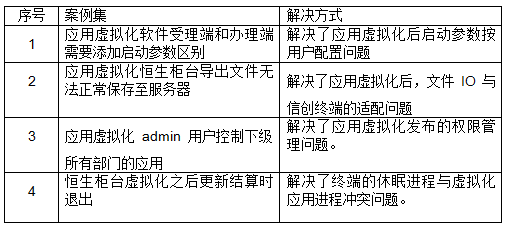
The application of application virtualization technology effectively solves the requirement for users to configure a Xinchuang terminal to complete daily business operations in certain business scenarios, truly cultivating users’ habits of using domestic desktop terminals and minimizing the impact on business caused by the continuous construction of the Xinchuang terminal application ecosystem. However, it is undeniable that application virtualization technology has some unsuitable application scenarios, such as business applications that rely on local UKey and scenarios that require connecting scanner peripherals for business authentication. There are issues with achieving this through virtualization. Application virtualization requires higher processing performance from the server, making it less suitable for large-scale users using applications through virtual applications. However, application virtualization can help make Xinchuang desktop terminals truly usable in the short term, promoting the development of the Xinchuang industry. Ultimately, a complete Xinchuang solution requires the cooperation of upstream and downstream suppliers across the entire industry to build an application ecosystem that meets Xinchuang requirements.
The content of this public account is for reference only. The public account does not bear any legal responsibility for any losses caused directly or indirectly by the use of the content of this public account, including but not limited to losses caused by inaccuracies or incompleteness of relevant content. If there are any issues, please provide feedback to [email protected].
————————–Shanghai Stock Exchange provides trading technology support and services to market participants such as securities companies and fund management companies, including daily trading technical support, technical exchanges and discussions, market surveys and feedback, securities information technology knowledge base, testing, and other services.