
By | Travis
Produced by | OSC Open Source Community (ID: oschina2013)
Google released the first developer preview of Android 13 last week (click to see our report), and many users who have seen the update content expressed their disappointment in the comments, feeling that the updates are too minor and unsatisfactory.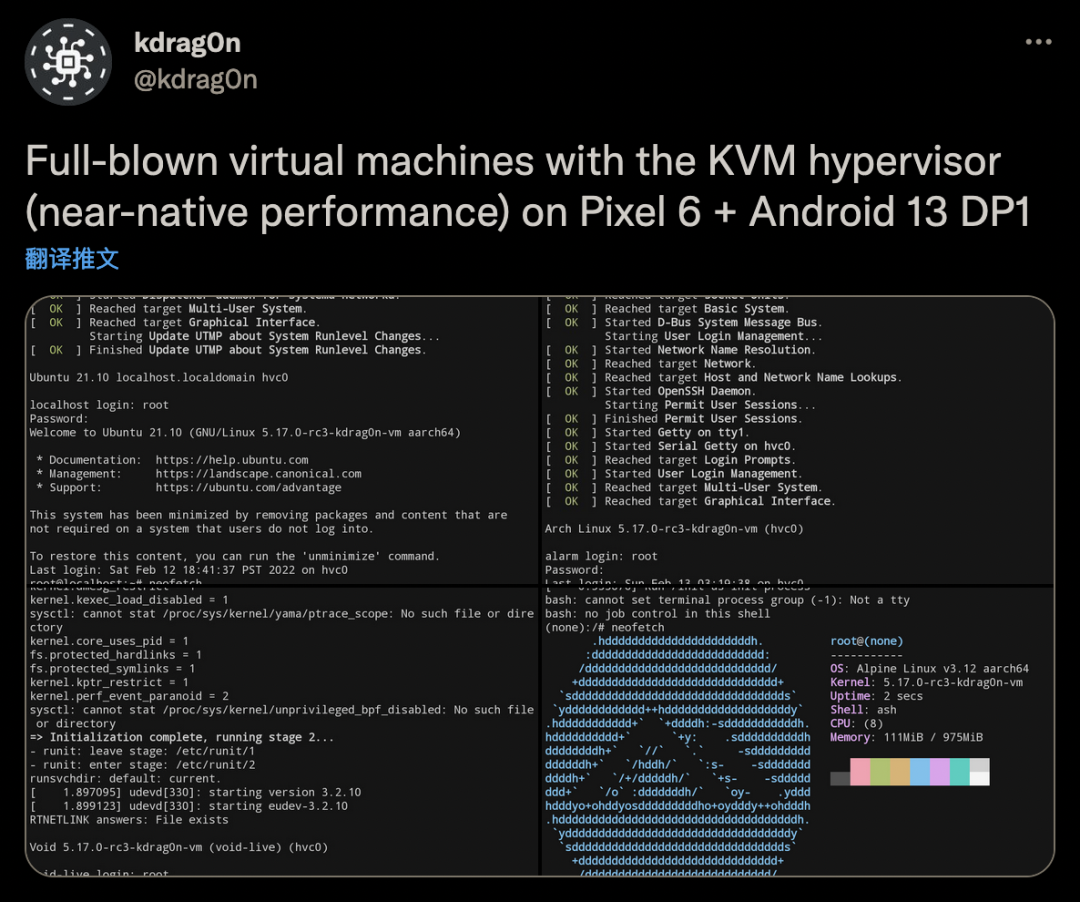 However, developer kdrag0n recently discovered an easter egg hidden in Android 13 that allows developers to achieve full virtualization after installing Android 13 on Google Pixel 6 devices. This means that it is now possible to run almost any operating system on Pixel 6 (or other devices powered by the Tensor processor).Video source: TwitterDeveloper kdrag0n tested several Linux distributions compiled for Aarch64 using the KVM hypervisor on Pixel 6 + Android 13 DP1, including Ubuntu 21.10, Arch Linux Arm, Void Linux, and Alpine Linux. In addition to testing various Linux distributions, kdrag0n also successfully ran Windows 11 on Pixel 6 using the same Android 13 virtualization technology.Developers even mentioned on Twitter that systems running through virtualization technology can operate at near-native speeds.But why would Google enable virtualization features in the Android system? Logically, they are unlikely to just want users to install Linux or Windows on their phones.
 kdrag0n explained that the original intention of Google embedding virtualization features in the Android operating system is not to allow users to run other operating systems in a virtual machine; instead, this technology is mainly used to enhance kernel security and run other code outside the Android system (such as for DRM and other closed-source binaries).Developers who have Pixel 6 series devices and are willing to experiment might want to give it a try. BTW: Is anyone planning to run Android applications on Pixel 6 using Windows 11’s WSL?
END
How is the domestic open-source ecosystem in 2021?
 If you think it’s good, please give it a thumbs up!